On this page · 12 sections
- What OpenAI shipped on 7 August
- The price gap, and what it is a gap between
- The long-context surcharge that cannot fire
- The regional processing gap
- A Batch queue limit on a model with no Batch endpoint
- What is identical, and why that is the awkward part
- Blue's price has a date on it
- India-specific considerations
- What to do this week
- FAQ
- How eCorpIT can help
- References
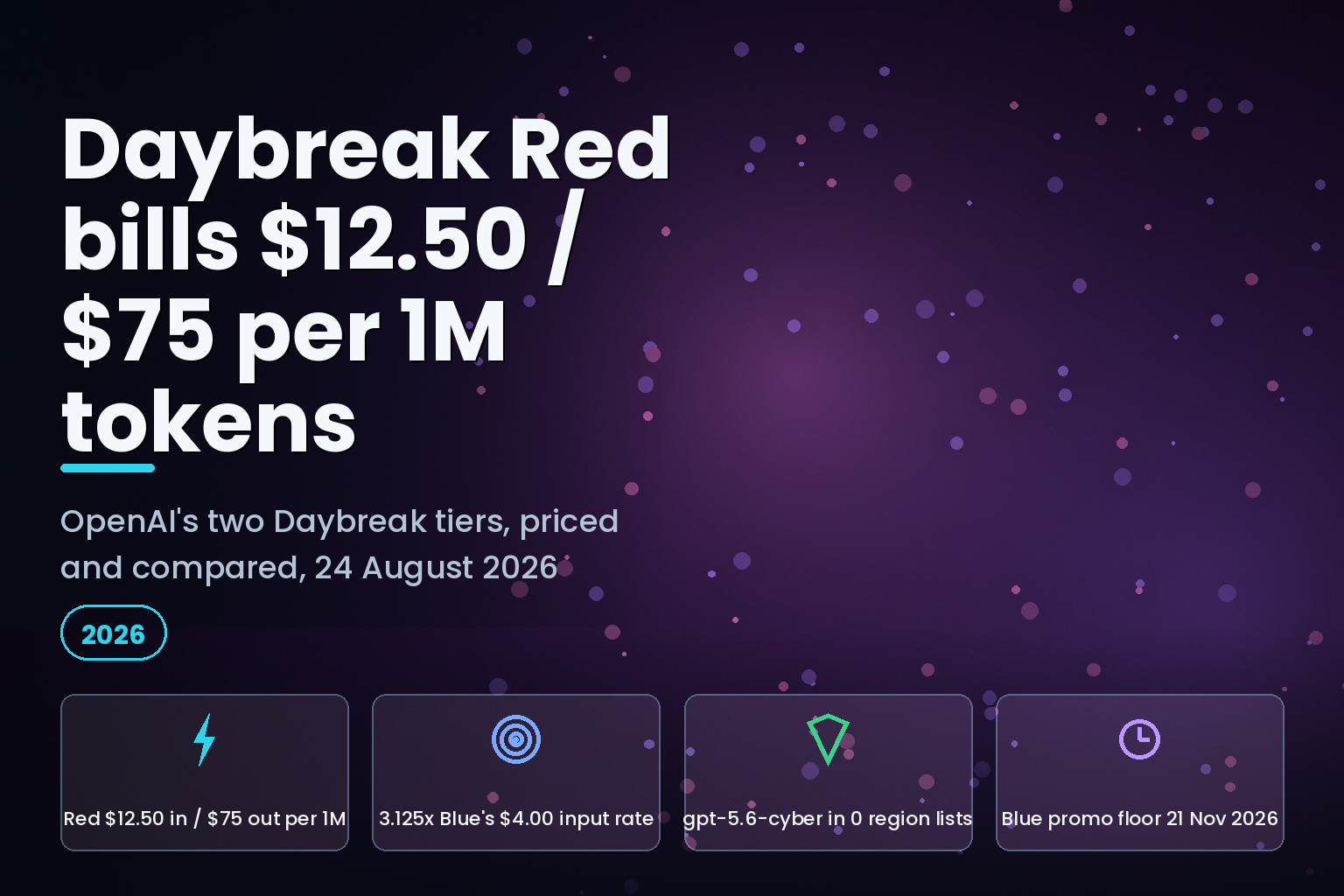
Summary. OpenAI split its Daybreak security programme into two access tiers on 7 August 2026. Daybreak Blue is an alias for gpt-5.6-sol at $4.00 input and $20.00 output per 1M tokens. Daybreak Red is an alias for gpt-5.6-cyber at $12.50 input and $75.00 output, which is 3.1x Blue's input rate and 3.75x its output rate. The two aliases are documented as capability-identical: same 7 features, same 11 Responses tools, same 128,000 maximum output tokens, same 16 February 2026 training cutoff, same rate limits at every tier. What separates them is price, a context window of 400,000 against 1,050,000, and one line nobody has written down: gpt-5.6-cyber appears in none of OpenAI's regional processing tables, so an EU or UAE team that moves a workload from Blue to Red loses in-region inference on the same day it starts paying triple.
Two further defects sit in the published documentation. The gpt-5.6-cyber model card carries a long-context surcharge that can never be triggered, and both Daybreak cards advertise a Batch queue limit of up to 15,000,000,000 tokens on a model whose own endpoint table marks v1/batch as not supported. Blue's price is promotional and dated: OpenAI's pricing page commits to $4.00/$20.00 only "at least through November 21, 2026".
What OpenAI shipped on 7 August
The OpenAI API changelog entry for 7 August 2026 names three model IDs at once: gpt-5.6-cyber, daybreak-red-latest and daybreak-blue-latest, all on v1/responses. The entry describes Blue as the starting point "for most defensive security work", covering vulnerability discovery, secure code review, detection engineering, incident response, malware analysis and patch validation. Red is described as "separately approved access to purpose-trained models" for authorized vulnerability reproduction, exploit validation, penetration testing, red teaming and complex system analysis.
Both tiers require separate approval and provisioning. Neither alias model card publishes a price. Both link out to the pricing page instead, and the pricing page prices the underlying snapshots rather than the aliases you actually call. That is the first practical problem: if your finance team greps the price table for the string you put in your model field, they will find nothing.
The price gap, and what it is a gap between
The grouped pricing table lists the Cyber models under a heading that reads "Our latest Daybreak models", prices per 1M tokens.
| Metric per 1M tokens | Daybreak Blue (gpt-5.6-sol) |
Daybreak Red (gpt-5.6-cyber) |
|---|---|---|
| Short context input | $4.00 | $12.50 |
| Short context cached input | $0.40 | $1.25 |
| Short context cache writes | $5.00 | $15.625 |
| Short context output | $20.00 | $75.00 |
| Long context input | $8.00 | not priced |
| Long context output | $30.00 | not priced |
Input, cached input and cache writes all scale by exactly 3.125x. Output scales by 3.75x, so the multiple you pay depends on how verbose the model is, and a red-team run that emits long reproduction steps costs proportionally more than the input ratio suggests. The gpt-5.6-cyber card also runs a "Quick comparison" against GPT-5.5 at $5.00/$30.00 and GPT-5.4 at $2.50/$15.00. It does not compare Red against Blue, which is the comparison an approved defender is actually making.
One row below Red in the same table sits gpt-5.4-cyber with all eight cells empty. gpt-5.5-cyber is priced at $12.50/$1.25/$75.00 but its cache-writes cell is blank where the 5.6 row reads $15.625. Neither older Cyber model appears anywhere in the deprecations page, which returns 0 occurrences of "cyber" and 0 of "daybreak". A model family with three generations, one priced, one half-priced, one unpriced, and no published end-of-life date for any of them.
The long-context surcharge that cannot fire
Both the gpt-5.6-sol and gpt-5.6-cyber model cards carry the same bullet, verbatim: "Prompts with >272K input tokens are priced at 2x input and 1.5x output for the full request."
On Sol that rule is live. Sol has a 1,050,000 context window and a documented maximum input of 922,000 tokens, so a prompt can cross 272,000 easily, and the pricing table gives it real long-context numbers of $8.00 in and $30.00 out.
On Cyber the same sentence is dead text. Cyber's documented maximum input is 272,000 tokens exactly. You cannot send more than 272,000 input tokens, so a rule that triggers above 272,000 can never apply. The pricing table agrees by omission: every long-context cell on the gpt-5.6-cyber row is a dash. The bullet was copied from the Sol card along with the threshold, and the threshold happens to equal Cyber's ceiling.
This matters less as a billing risk than as a signal. If you are building a cost model for a security engagement, do not budget a long-context multiplier on Red, and do check whether your prompt assembly silently truncates at 272,000 rather than erroring.
The regional processing gap
This is the finding that should change a rollout plan.
OpenAI's data controls guide publishes a table of endpoints against supported models and snapshots for regional processing. The /v1/responses row lists gpt-5.5-pro-2026-04-23, gpt-5.4-pro-2026-03-05, gpt-5.2-pro-2025-12-11, gpt-5-pro-2025-10-06, gpt-5.6-sol, gpt-5.6-terra, gpt-5.6-luna and roughly two dozen older snapshots. It does not list gpt-5.6-cyber. Grep the entire guide and "cyber" returns 0 occurrences and "daybreak" returns 0. The API documentation index at developers.openai.com/api/llms.txt also returns 0 occurrences of "daybreak".
Read that against the 21 August 2026 changelog entry, which added per-request regional processing through a prefixed domain for projects with Global geography, and states that "the selected endpoint and model must also support regional processing". Blue's snapshot is on the list. Red's is not.
The practical consequence, for a bank or a healthcare platform that bought EU or UAE in-region inference:
| Requirement | Daybreak Blue | Daybreak Red |
|---|---|---|
| Underlying snapshot | gpt-5.6-sol |
gpt-5.6-cyber |
Listed for regional processing on /v1/responses |
Yes | Not listed |
| Chat Completions route | Not supported | Not supported |
| Batch route | Not supported | Not supported |
| Context window | 1,050,000 | 400,000 |
| Documented maximum input | 922,000 | 272,000 |
Exploit validation and penetration-test transcripts are among the most sensitive artefacts a regulated organisation produces. The tier built specifically to handle them is the one with no documented in-region processing. Teams that route defensive work through per-request regional processing on the OpenAI API should assume Red runs outside their selected region until OpenAI adds the snapshot to that table.
A Batch queue limit on a model with no Batch endpoint
Both Daybreak cards publish the same Standard rate-limit table: Tier 1 at 500 RPM and 500,000 TPM, rising to Tier 5 at 15,000 RPM and 40,000,000 TPM. Those are identical to the plain gpt-5.6-sol card, so separate approval and provisioning buys no extra throughput.
The third column of that table is "Batch queue limit", running from 1,500,000 tokens at Tier 1 to 15,000,000,000 at Tier 5. Four lines above it, the endpoint table on the same page marks v1/batch as not supported on both aliases. The Batch API carries a 50% cost discount against synchronous calls and a 24-hour turnaround, so the column is not a harmless template artefact. It reads as an available 50% saving on a $75.00 output rate, and it is not one.
What is identical, and why that is the awkward part
Blue and Red publish the same 7 supported features (streaming, structured outputs, function calling, file search, image input, web search, prompt caching) and the same 11 Responses tools, including code_interpreter, hosted_shell, apply_patch, computer_use and mcp. Same 128,000 maximum output tokens. Same 16 February 2026 training cutoff. Same rate limits.
Blue is described as carrying "safeguards calibrated for defensive cybersecurity work". Nothing in the published capability surface shows what those safeguards are or where they bind. A buyer choosing between the tiers has price, context window and an approval process to go on, and no documented behavioural difference to test against. The real cost here is usually the approval cycle, not the tokens.
Blue's price has a date on it
The 21 August 2026 changelog entry cut Sol to $4.00 and $20.00, described as 20% lower input and 33% lower output pricing, and states that the promotional pricing runs "at least through November 21, 2026". The Sol model card repeats it.
The pricing page then adds a second variable: daybreak-blue-latest and daybreak-red-latest "are aliases that currently point to gpt-5.6-sol and gpt-5.6-cyber, respectively. As new frontier models are released through the Daybreak program, these aliases will be updated to point to the latest models, with pricing adjusted to match each underlying model."
So a Daybreak Blue cost line can move twice without anyone changing a line of code: once if the promotion ends after 21 November 2026, and again whenever OpenAI re-points the alias. Pin the snapshot if you need a stable cost model, the same discipline covered in the GPT-5.6 Sol, Terra and Luna tier selection guide.
India-specific considerations
Indian teams have no regional processing option on either tier today. OpenAI's regional processing list covers the United States, Europe (EEA and Switzerland) and the United Arab Emirates for /v1/responses, with India appearing on the storage side only. For work covered by the Digital Personal Data Protection Act 2023, the material question is not where the transcript is stored but where the prompt is processed, and Red is not documented for in-region processing anywhere.
For a security team in Gurugram or Bengaluru running an authorized engagement, that argues for keeping raw artefacts out of the prompt: redact identifiers before the call, keep customer data in your own boundary, and treat the model as a reasoning engine over sanitised evidence. The same architecture pattern applies to any zero data retention and India residency limit decision on the OpenAI API.
What to do this week
Check three things before Red enters a production runbook. First, confirm your prompt assembly hard-stops at 272,000 input tokens rather than relying on a surcharge that cannot fire. Second, if you hold an EU, UAE or India residency commitment, either keep the engagement on Blue or get written confirmation from OpenAI on where Cyber inference runs. Third, delete any cost model that assumes a Batch discount on either alias, because neither supports v1/batch.
What is still unknown: OpenAI has published no end-of-life date for gpt-5.5-cyber, no price at all for gpt-5.4-cyber, and no description of what Blue's calibrated safeguards actually refuse. Until the data controls table names gpt-5.6-cyber, the residency answer is absent rather than negative, which is a different and worse thing to put in a compliance file. For the wider tier comparison, see our Gemini 3.5 Pro vs GPT-5.6 vs Claude Fable 5 analysis.
FAQ
How eCorpIT can help
eCorpIT builds and reviews AI systems for regulated teams, including the prompt-boundary and redaction work that keeps sensitive security artefacts out of a provider's processing region. Our senior engineering teams hold CMMI Level 5 and ISO 27001:2022 certification, and we design applications aligned with DPDP Act 2023 requirements. If you are pricing a Daybreak engagement or auditing which model IDs your code actually calls, book a model residency and cost review with our AI engineering team.
References
- OpenAI API changelog - 7 August 2026 Daybreak tiers entry, 21 August 2026 Sol pricing and per-request regional processing entries.
- Daybreak Blue model card - snapshot, context window, endpoints, tools and rate limits.
- Daybreak Red model card - snapshot, 400,000 context window, 272,000 maximum input.
- GPT-5.6 Cyber model card - $12.50/$1.25/$75.00 text token pricing and the long-context bullet.
- GPT-5.6 Sol model card - $4.00/$0.40/$20.00 pricing and the 21 November 2026 promotional floor.
- OpenAI API pricing - grouped Cyber model table and the Daybreak alias re-pointing note.
- OpenAI data controls guide - regional processing endpoint and supported snapshot tables.
- OpenAI Batch API guide - 50% cost discount and 24-hour turnaround.
- OpenAI deprecations page - checked 24 August 2026 for Cyber and Daybreak entries.
- OpenAI API documentation index - checked for Daybreak model page listings.
- Cloudflare Regional Services - the sub-processor OpenAI names for in-region TLS termination.
- Ministry of Electronics and IT, Digital Personal Data Protection Act 2023 - India processing and consent obligations.
Last updated: 24 August 2026.