On this page · 11 sections
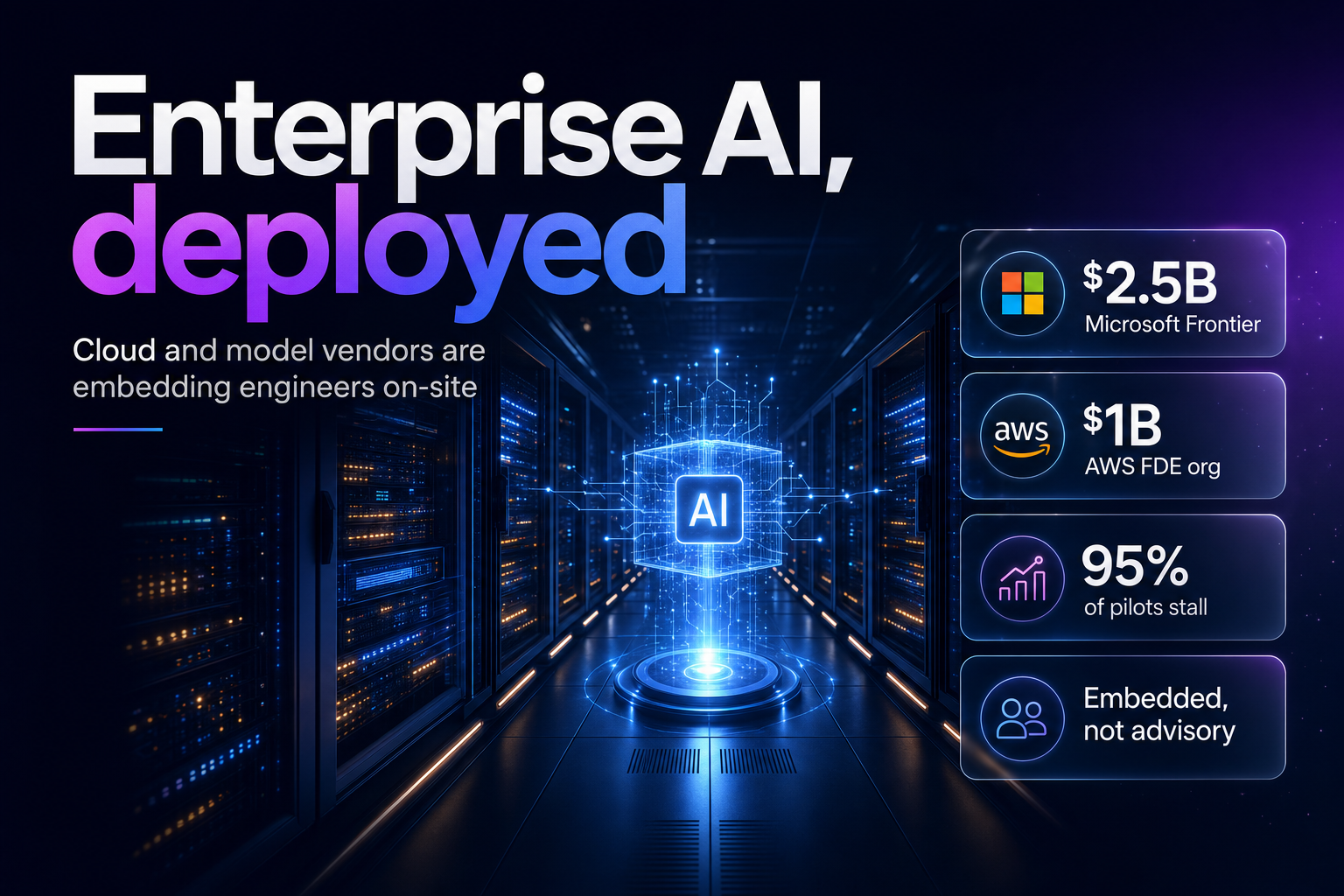
Summary. On July 2, 2026, Microsoft committed $2.5 billion and 6,000 engineers to a new unit, Microsoft Frontier Company, built to get enterprise AI projects into production. Two days earlier, on June 30, AWS put $1 billion into its own forward-deployed engineering organization. Both follow the joint ventures OpenAI and Anthropic launched on May 4, 2026, valued near $4 billion and $1.5 billion. The trigger is one hard number: MIT's NANDA initiative found that 95% of enterprise generative AI pilots return nothing measurable. The contest has moved from whose model is smartest to whose engineers can make it work inside your business.
Four of the largest names in AI have now placed the same bet inside ten weeks. The bet is that the hard part of enterprise AI is no longer the model. It is the deployment: the data plumbing, the workflow integration, the security review, and the change management that turns a promising demo into a system people actually use. This article walks through what each vendor announced, why they all moved at once, what a forward-deployed engagement really is, and how to judge one if you are the buyer.
What Microsoft put on the table
Microsoft announced Microsoft Frontier Company on July 2, 2026, as a standalone operating business backed by $2.5 billion and 6,000 industry and engineering specialists. The mandate is narrow and blunt: embed experts with customers to co-design, deploy, and keep improving AI systems on Microsoft's existing stack, from Copilot to Foundry on Azure. Initial clients named at launch were Unilever and Novo Nordisk.
Judson Althoff, CEO of Microsoft's Commercial Business, framed the scale plainly: "This goes beyond what has been labeled as Forward-Deployed Engineering, and will be the largest, most capable, outcome-driven engineering organization in the industry." The language matters. Microsoft is not selling more licenses here. It is selling the labor to make licenses pay off, and it is staffing that effort with 6,000 people.
The read for buyers is direct. Microsoft has decided that the reason Copilot and Azure AI seats do not always convert into results is a delivery gap, and it is spending $2.5 billion to close that gap with its own staff rather than leaving it to the partner channel alone.
AWS answered two days earlier
AWS moved first in this round. On June 30, 2026, it created a $1 billion Forward Deployed Engineering organization, funded entirely from internal Amazon resources with no outside partners. The structure is deliberately different from a consulting retainer. Teams of five to six engineers embed inside a customer's environment for roughly 45-day engagements, build production agentic systems next to the client's own staff, and are meant to leave the customer self-sufficient when the engagement ends, according to AWS.
AWS describes the model as agentic-first and time-compressed, measured in days rather than the months a classic system-integration project runs. Named early customers include the Allen Institute, Cox Automotive, the NBA, the NFL, Ricoh, and Southwest Airlines, per reporting on the launch. The 45-day clock is the tell: AWS is betting that a small senior squad, working against real data and real constraints, ships more value in six weeks than a large advisory team does in two quarters.
OpenAI and Anthropic started the run
The model vendors set this off. On May 4, 2026, OpenAI and Anthropic each launched an enterprise deployment venture on the same day, splitting the market into two camps with combined valuations near $11.5 billion.
OpenAI formed The Deployment Company, a joint venture it majority-owns and controls, which raised over $4 billion from 19 investors anchored by TPG, with Advent International, Bain Capital, and Brookfield Asset Management as co-lead founding partners. OpenAI also acquired Tomoro, an applied-AI consultancy of roughly 150 engineers with prior deployment work at Tesco, Virgin Atlantic, and Supercell, to seed the delivery team. Anthropic's venture took the opposite funding path: valued at $1.5 billion, with Blackstone, Hellman and Friedman, and Goldman Sachs as founding partners, and a $300 million commitment each from Anthropic, Blackstone, and Hellman and Friedman, per TechCrunch. We covered the OpenAI structure in detail in our breakdown of OpenAI's Deployment Company.
Both borrowed the same playbook, and both are honest about where it comes from: the forward-deployed engineer model that Palantir spent a decade refining. The difference in 2026 is the target. Instead of pointing embedded engineers at data integration, the vendors point them at getting AI agents into production.
| Vendor play | Structure and size | Delivery model | Announced |
|---|---|---|---|
| Microsoft Frontier Company | $2.5B, 6,000 experts, wholly Microsoft | Embed on Microsoft stack, co-design and improve | July 2, 2026 |
| AWS Forward Deployed Engineering | $1B, internal, squads of 5 to 6 | Agentic-first, ~45-day embeds, exit self-sufficient | June 30, 2026 |
| OpenAI The Deployment Company | ~$4B raised, JV, OpenAI-controlled | Embedded delivery, seeded by Tomoro (~150 engineers) | May 4, 2026 |
| Anthropic venture | $1.5B, JV with PE and bank partners | Embedded delivery on Claude | May 4, 2026 |
| Palantir (the origin) | Established FDE practice | Senior engineers inside customer systems | Model since the 2010s |
Why four vendors moved in ten weeks
The common cause is a study that has haunted boardrooms since it landed. MIT's NANDA initiative published "The GenAI Divide: State of AI in Business 2025" and found that 95% of organizations were seeing zero measurable return from generative AI spending, while only 5% captured real value. The research rested on 150 leader interviews, a survey of 350 employees, and analysis of 300 public deployments, as Fortune reported.
The finding that reshaped strategy was the cause of failure. It was almost never the model. It was data readiness, workflow integration, and the absence of a defined outcome before the build started. MIT called it a learning gap: companies could buy capability but could not fold it into how they actually work. If the model is not the constraint, then spending more on model access does not help. Spending on the people who wire the model into a business does.
Demand is pulling in the same direction. Enterprises are moving from isolated pilots to agents embedded across core applications, so the volume of deployments that need wiring is climbing fast. A vendor that only sells tokens captures a shrinking slice of that value. A vendor that sells the deployment captures the part the customer is willing to pay a premium for. That is the logic behind all four announcements, and it is why the sales motion is shifting from software to embedded engineering. For the broader strategic picture, see our guide to generative AI enterprise strategy.
What forward-deployed actually means
A forward-deployed engineer is a senior engineer who sits inside the customer's environment, learns its data and its politics, and ships production code against the mess that legacy systems present, as The New Stack describes the role. The output is a working system, not a recommendation deck. That single difference separates this model from the consulting engagements most enterprises already know.
The contrast is worth making concrete, because the pricing and the risk profile are different too.
| Dimension | Traditional consulting | Forward-deployed engineering |
|---|---|---|
| Primary output | Strategy, slides, recommendations | Production code and running systems |
| Who does the work | Large blended team, junior-heavy | Small senior squad inside your systems |
| Engagement length | Two to four quarters | Weeks (AWS uses ~45-day cycles) |
| End state | A plan you must still execute | A system your team can run |
| Value test | Report accepted | Agent in production, measured |
The engineering judgement worth stating: the real cost of enterprise AI is usually the integration, not the model access. A capable model wired into the wrong workflow returns nothing, which is exactly what the 95% figure measures.
What it means if you are buying
The vendor land-grab is useful to you only if you buy the engagement well. Five questions separate a deployment that ships from one that becomes an expensive pilot.
| Question to ask | Why it matters | A good answer looks like |
|---|---|---|
| Is the business outcome defined first? | MIT tied failure to no defined outcome | A named metric and baseline agreed before build |
| Is our data ready? | Data readiness, not the model, stalls pilots | An honest data audit in week one, not month three |
| What is the exit plan? | AWS designs for self-sufficiency | Your staff can run and change the system after |
| Who owns the code and prompts? | Lock-in risk sits in the integration layer | You own the artifacts and can port them |
| How is governance handled? | Agents in production expand the attack surface | Guardrails, logging, and access controls from day one |
On that last point, embedding engineers does not remove your governance duty; it concentrates it. Production agents touch real data and take real actions, so the security and oversight layer has to be built alongside them, not after. Our note on enterprise AI agent governance layers covers the controls that belong in any embedded build, and our review of enterprise AI agents in production shows what a shipped deployment looks like.
India-specific considerations
The 95% pilot-failure pattern is not a Western problem. Indian enterprises run the same stalled pilots, and they carry an extra constraint: the Digital Personal Data Protection Act, 2023 (DPDP), whose compliance deadline for organizations falls in 2027. When personal data cannot leave the country or must stay inside a defined boundary, embedded delivery matters more, because the engineers wiring an agent into your systems also decide where data flows and how consent is honored.
There is a cost angle too. A global vendor's forward-deployed squad is a premium engagement priced in dollars. For many Indian mid-market buyers, the same embedded model is available from senior-led local teams at rates set in rupees, without the global brand premium, and with people who already understand DPDP obligations and Indian cloud-region choices. The decision is less about whether to embed engineers and more about which embedded team fits the budget and the data-residency rules. Teams weighing cloud economics alongside this should read our guide to cutting cloud spend for Indian teams.
The bottom line
Four vendors that compete on almost everything now agree on one thing: enterprise AI is won or lost at deployment, and they are each spending billions to own that step. For a buyer, the signal is not which logo to pick. It is to stop funding pilots without a defined outcome, a data audit, and an exit plan, and to insist any embedded engagement leaves your own team able to run what was built. The model was never the hard part. Getting it into production is, and now the vendors are charging for the fix.
FAQ
How eCorpIT can help
eCorpIT is a Gurugram-based technology consultancy, founded in 2021, that builds and deploys enterprise AI the embedded way: senior-led squads working inside your systems, not slide decks. Our CMMI Level 5, MSME-certified teams design agent deployments aligned with DPDP requirements, wire them into real workflows, and hand your staff a system they can run. If a pilot has stalled or you want an AI agent shipped to production with a defined outcome and an exit plan, talk to us.
References
_Last updated: July 11, 2026._