On this page · 8 sections
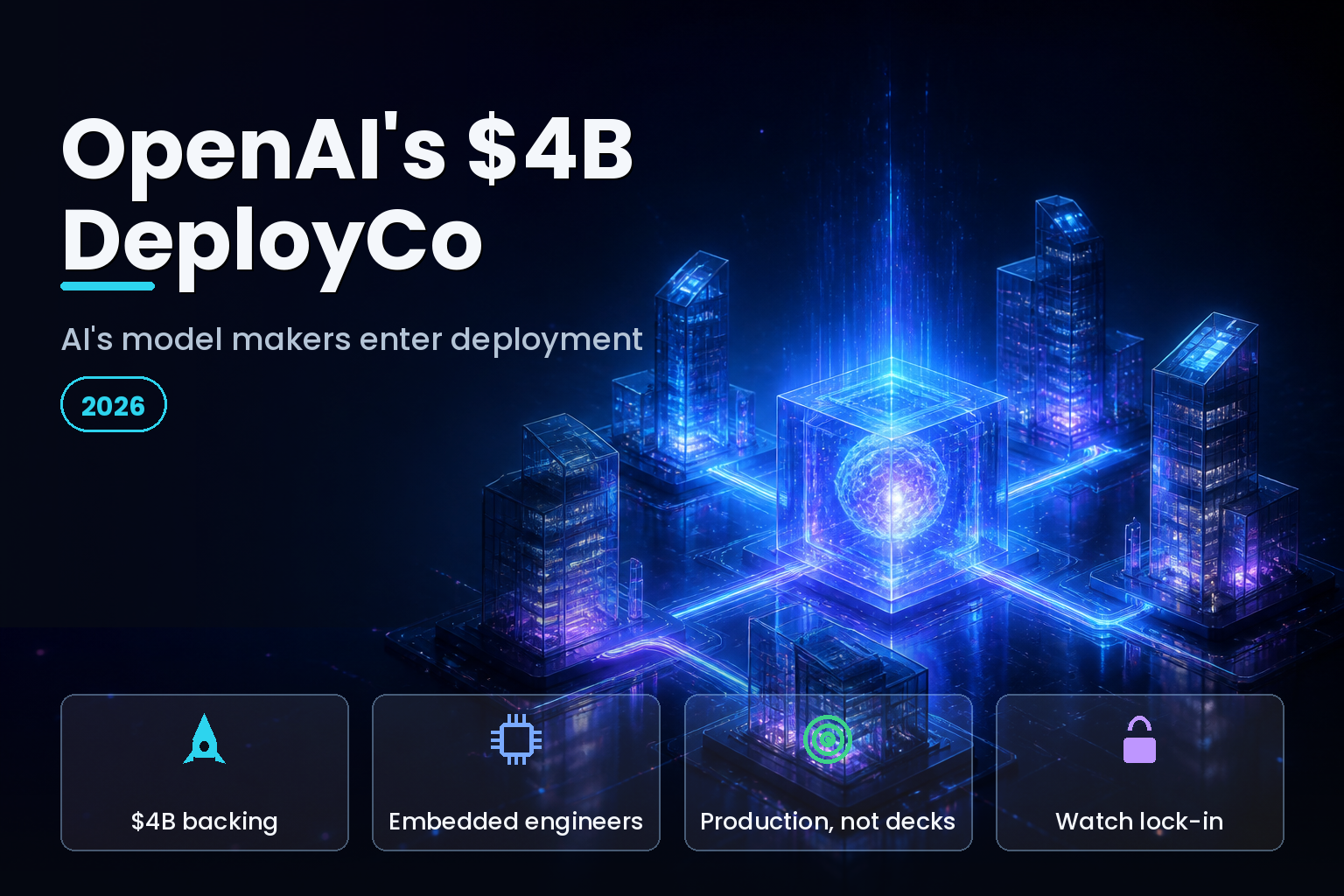
Summary. On 11 May 2026, OpenAI launched the OpenAI Deployment Company, known as DeployCo, a majority-owned subsidiary seeded with $4 billion at a $10 billion pre-money valuation, which Axios reported as roughly $14 billion including the raise. TPG led the round, with Advent International, Bain Capital, and Brookfield as co-lead founding partners and 19 investors in total, and reporting notes a guaranteed minimum 17.5% investor return with capped profits. DeployCo embeds specialists called Forward Deployed Engineers directly inside enterprises to write production code, not slide decks. To staff it, OpenAI is acquiring Tomoro, a UK applied-AI firm, adding roughly 150 engineers. The move puts a frontier model maker into the systems-integration business, and it changes the buying decision for any enterprise planning serious AI work. Here is what it is, and what it means for you.
When the company that builds the model also sells you the team to deploy it, the vendor map shifts. This analysis covers what DeployCo actually is, how its delivery model differs from classic consulting, and the practical trade-offs for AI buyers, especially in India.
What OpenAI actually launched
DeployCo is a standalone, majority-owned OpenAI company built to help organisations deploy AI across their core workflows, per the OpenAI announcement. Denise Dresser, OpenAI's Chief Revenue Officer, framed the purpose directly: "The challenge now is helping companies integrate these systems into the infrastructure and workflows that power their businesses. DeployCo is designed to help organizations bridge that gap and turn AI capability into real operational impact."
The financing is unusual for a lab. The venture was seeded with $4 billion from OpenAI and 19 additional investors, led by TPG with Advent International, Bain Capital, and Brookfield as co-lead founding partners, as CIO Dive and eWeek reported. Axios put the valuation at about $14 billion and noted investor terms including a guaranteed minimum 17.5% return with capped profits. Notably, the consultancies Bain & Company, Capgemini, and McKinsey are among the investors, a hedge by incumbents against a new competitor.
| DeployCo at a glance | Detail | Note |
|---|---|---|
| Launch date | 11 May 2026 | Standalone, majority-owned by OpenAI |
| Initial investment | $4 billion | From OpenAI and 19 investors |
| Valuation | ~$10 billion pre-money (~$14 billion with raise) | Per Axios |
| Lead investors | TPG, Advent, Bain Capital, Brookfield | Bain & Co., Capgemini, McKinsey also invested |
| Delivery model | Forward Deployed Engineers (FDEs) | Engineers embedded in the client |
| Staffing move | Acquiring Tomoro (UK) | Adds roughly 150 engineers |
Sources: OpenAI, eWeek, and Axios.
Forward Deployed Engineers: not the usual consulting
The core idea is the Forward Deployed Engineer. Unlike an advisory consultant who recommends and departs, an FDE embeds in the client organisation, works alongside its domain experts, and writes real code that runs in the client's production systems, per The New Stack. The FDE owns implementation and production delivery, which is a different contract from a strategy engagement.
| Aspect | Forward Deployed Engineers | Traditional advisory consulting |
|---|---|---|
| Main output | Production code and running systems | Recommendations and roadmaps |
| Location | Embedded in the client's workflows | Client site or remote, project-scoped |
| Model expertise | Deep, frontier-model native | Broad, vendor-agnostic |
| Ownership | Owns implementation and delivery | Hands off to the client or an integrator |
| Best fit | Complex, high-stakes deployments | Strategy, process, and change programmes |
Sources: The New Stack and MarkTechPost.
The model has a track record. Tomoro, the firm OpenAI is acquiring, built an in-game support agent for Supercell that served 110 million users within 12 weeks, and has deployments at Tesco and Virgin Atlantic, according to eWeek. That is the kind of production outcome DeployCo is selling, and it is why the FDE role is now being hired across OpenAI, Anthropic, and Google, per MarkTechPost.
Why OpenAI is doing this now
Models alone do not move revenue. Most enterprises stall between a working demo and a production system, and the gap is integration, not intelligence. By standing up a deployment arm, OpenAI captures the services layer that would otherwise go to integrators, and it shortens the path from model access to measurable outcome. Our guide to enterprise AI agents in production covers why that last mile is where most value and most failure live.
OpenAI is not alone. Anthropic launched a parallel enterprise deployment initiative with Wall Street partners around the same time, as AI Business reported. When two leading labs build the same company in the same month, the signal is clear: frontier providers now treat services and operational integration as core growth, not an afterthought.
What it means for AI buyers
For enterprises weighing a serious AI programme, DeployCo is an option with real upside and real caveats.
The upside is depth and speed. An FDE team knows the model at a level most integrators cannot match, owns production delivery, and can compress a multi-quarter build. For a high-stakes, model-heavy project, that expertise is hard to buy elsewhere.
The caveats are lock-in and scope. A team supplied by the model vendor has every reason to design around that vendor's models, which raises switching costs later. DeployCo is also aimed at complex, high-stakes work, so most mid-market projects will not be a fit, and capacity will be scarce and priced accordingly. A vendor-neutral partner still matters when you want the freedom to route work across GPT-5.6, Claude Sonnet 5, and others as prices and capabilities change.
| Consideration | Upside with DeployCo | Watch-out |
|---|---|---|
| Model expertise | Frontier-native engineers | Designs bias toward one vendor |
| Delivery speed | Owns production, compresses timelines | Capacity limited to high-stakes work |
| Cost | Outcome-focused delivery | Premium pricing, scarce supply |
| Lock-in | Deep integration with OpenAI stack | Higher switching cost later |
| Governance | Vendor knows its own guardrails | You still own risk and compliance |
The sensible posture is to treat DeployCo as one supplier in a portfolio, not a default. Keep an independent view of architecture, cost, and model choice so the deployment partner does not also own every downstream decision. For the strategic frame, see our generative AI enterprise strategy guide.
India-specific considerations
For Indian enterprises and the country's large IT-services sector, DeployCo cuts two ways. It validates the forward-deployed model that Indian integrators can also run, often at lower cost and with deep domain benches. At the same time, it puts a well-funded, model-native competitor into the same high-end deals. The pragmatic response for Indian buyers is to insist on vendor-neutral architecture and clear exit terms, so a model provider's delivery team does not lock the estate to one stack.
Data governance sharpens the point. Under the Digital Personal Data Protection Act, 2023 (DPDP), embedding any external engineers inside production systems that touch personal data requires clear contracts on data access, residency, and retention. Whoever writes the code, the enterprise remains the data fiduciary, so the DPDP obligations do not transfer to the vendor. Fold those terms into the engagement from day one.
How eCorpIT can help
eCorpIT is a Gurugram-based, senior-led technology consultancy that delivers production AI the way DeployCo describes, engineers embedded in your workflows shipping real systems, but vendor-neutral by design. We help you weigh a model-vendor deployment arm against an independent partner, keep your architecture portable across model providers, and build the governance and exit terms that protect you under the DPDP Act. If you are scoping a high-stakes AI programme, talk to our team.
FAQ
References
_Last updated: 10 July 2026._