On this page · 10 sections
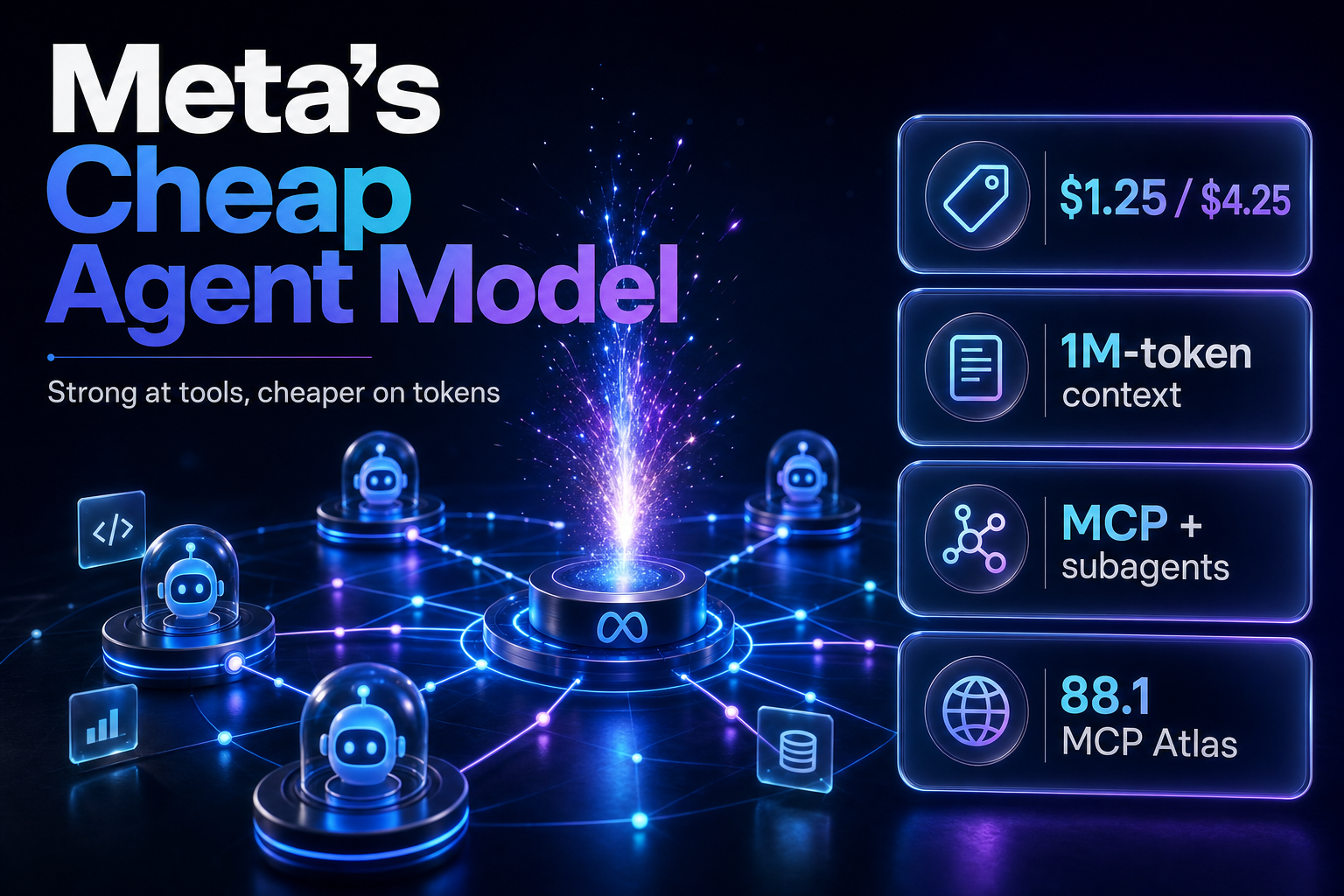
Summary. Meta Superintelligence Labs shipped Muse Spark 1.1 on July 9, 2026, a multimodal reasoning model built for agents and coding, with a self-managed 1 million-token context window, native support for the Model Context Protocol, and the ability to run as both a primary agent and a subagent. The pricing is the headline: $1.25 per million input tokens and $4.25 per million output, roughly a quarter of comparable Anthropic and OpenAI rates, with $20 in free credits for new accounts. On tool use it is genuinely strong, scoring 88.1 on the MCP Atlas benchmark, ahead of Claude Opus 4.8 and GPT-5.5. On raw coding it trails, sitting about seven points under Opus 4.8 on SWE-Bench Pro. Alexandr Wang, Meta's AI chief, called it "our strongest model yet for agentic and coding work." For dev teams the read is specific: a cheap, capable orchestrator, not the best single coder. This guide explains where to use it.
What Meta shipped
Muse Spark 1.1 arrived through the new Meta Model API, which opened in public preview for US developers on July 9, 2026, and it is also available in the Meta AI app and on meta.ai in Thinking mode. It accepts text, image, video, PDF, and audio input and returns text. This is Meta's first paid model API, a notable strategic shift for a company that built its reputation on open-weight Llama releases.
The design centres on long-horizon agent work. Muse Spark 1.1 actively manages its million-token context: it remembers earlier actions, retrieves information from much earlier in a task, and compacts what it keeps so the window does not fill with noise. As a primary agent it plans and delegates work across parallel subagents; as a subagent it stays within its assigned job, uses the tools it is given, and escalates back when it hits a limit. It supports MCP servers and custom skills and can control a computer directly. Wang framed the release as Meta chasing the agent frontier, and the model, per Meta, "rivals gpt-5.5 and opus-4.8" across many agentic evals.
The pricing story
The number that will move adoption is cost. At $1.25 input and $4.25 output per million tokens, Muse Spark 1.1 undercuts the models it is measured against, which is the point of a challenger entering a crowded market.
| Model | Input / output per 1M tokens | Position |
|---|---|---|
| Muse Spark 1.1 | $1.25 / $4.25 | Challenger, aggressive pricing |
| GPT-5.6 Luna | $1.00 / $6.00 | Cheapest OpenAI tier |
| Claude Sonnet 5 | $2.00 / $10.00 (intro to Aug 31) | Mid-tier |
| GPT-5.6 Sol | $5.00 / $30.00 | OpenAI flagship |
The GPT-5.6 and Claude Sonnet 5 rates in the table are OpenAI and Anthropic list prices as of July 2026. Meta is buying its way into the developer market on price, and for high-volume agent workloads that run millions of tokens, the difference compounds fast. Our guide to choosing GPT-5.6 tiers by workload shows how much tier and provider choice can swing a bill.
Where it is strong, and where it is weak
The honest picture is mixed, and pretending otherwise would misdirect a build decision. Muse Spark 1.1 is built for orchestration and tool use, and the benchmarks reflect that shape.
| Benchmark | Muse Spark 1.1 | Comparison |
|---|---|---|
| MCP Atlas (scaled tool use) | 88.1 | Ahead of Opus 4.8 and GPT-5.5 (high 70s to low 80s) |
| SWE-Bench Pro (coding) | Trails | About 7 points under Opus 4.8 |
| DeepSWE 1.1 (coding) | Third | Behind GPT-5.5 and Opus 4.8 |
Read together, the message is clear. Muse Spark 1.1 leads on scaled tool use, the skill that matters most when a model has to coordinate many tools and subagents across a long task. On the pure code-writing tests that dev teams watch closely, it is a step behind the leaders. That is not a failure; it is a different design target. A cheap model that orchestrates well and delegates the hardest coding to a stronger model can be the most cost-effective node in a multi-model system.
What it means for dev teams
The practical pattern is multi-model routing, not single-vendor loyalty. Use Muse Spark 1.1 where its strengths pay off and route around its weakness.
Put it in charge of orchestration: planning a task, calling tools and MCP servers, spawning subagents, and holding a long context across a multi-step job. Let it run the high-volume, tool-heavy legs where its price and MCP Atlas strength win. Then, for the hardest code generation and debugging, delegate to whichever model tops your own coding evals, which today is often Claude Opus 4.8 or a GPT-5.6 tier. Our Grok 4.5 enterprise coding evaluation and GPT-5.6 versus Claude Sonnet 5 for agents cover how to benchmark that choice on your workload rather than on a leaderboard.
The MCP support matters here. Because Muse Spark 1.1 speaks the Model Context Protocol natively, it slots into an existing tool ecosystem without custom glue, and custom skills let you package repeatable procedures. For teams already building on MCP, that lowers the switching cost of adding it as the orchestration layer.
The honest caveats
Four cautions belong in any adoption decision. First, availability: the Meta Model API is a US-developer public preview at launch, so non-US teams should confirm access and terms before planning around it. Second, the coding gap is real, so do not route your hardest code generation to it on price alone; validate on your own tasks. Third, the benchmark that flatters it, MCP Atlas at 88.1, is one tool-use test, and vendor-highlighted numbers always need independent confirmation on representative work. Fourth, this is Meta's first paid API and a new agent model, so treat early production use with the usual caution around rate limits, reliability, and data handling. Any autonomous agent with computer control also needs guardrails; our note on prompt-injection and agent security covers the risks.
India-specific considerations
For cost-sensitive Indian dev teams, the aggressive pricing is attractive, especially for high-volume agent and tool-use workloads where a quarter of the token cost is decisive. Two constraints temper that. The US-developer preview means Indian teams should verify access and data-transfer terms before committing. And any personal data sent to Muse Spark 1.1 through the API should be handled under the Digital Personal Data Protection Act, 2023, with a documented purpose and, for regulated data, a data protection officer's review. Keep an abstraction layer so you can route sensitive or India-resident workloads to a compliant model without rewriting your agent code.
What to do now
Run a scoped evaluation rather than a switch. Pick one agent workload that is heavy on tool use and orchestration, wire Muse Spark 1.1 in as the primary agent through its MCP support, and measure task success, latency, and cost against your current setup. Keep your strongest coding model in the loop for the hard code-generation steps and compare a Muse-orchestrated multi-model pipeline against a single-model baseline. If the cost and tool-use gains hold on your own tasks, expand its role as the orchestration layer while leaving specialised coding where it performs best.
How eCorpIT can help
eCorpIT is a Gurugram technology consultancy, founded in 2021, that helps engineering teams adopt AI models on evidence, not hype. Our senior-led engineers design multi-model routing and agent architectures that put each model where it is strongest, build MCP-based tool integrations and evaluation harnesses, and set up data handling aligned with Digital Personal Data Protection Act, 2023 requirements. We benchmark Meta, Anthropic, OpenAI, and Google models on your own tasks and costs. To design a cost-efficient agent stack, contact us.
FAQ
References
- Meta Superintelligence Labs releases Muse Spark 1.1 — MarkTechPost
- Muse Spark 1.1: Meta's agentic model and API — DataCamp
- GPT-5.6 API pricing: Sol, Terra and Luna rates — AI Pricing Guru
_Last updated: July 14, 2026._