On this page · 10 sections
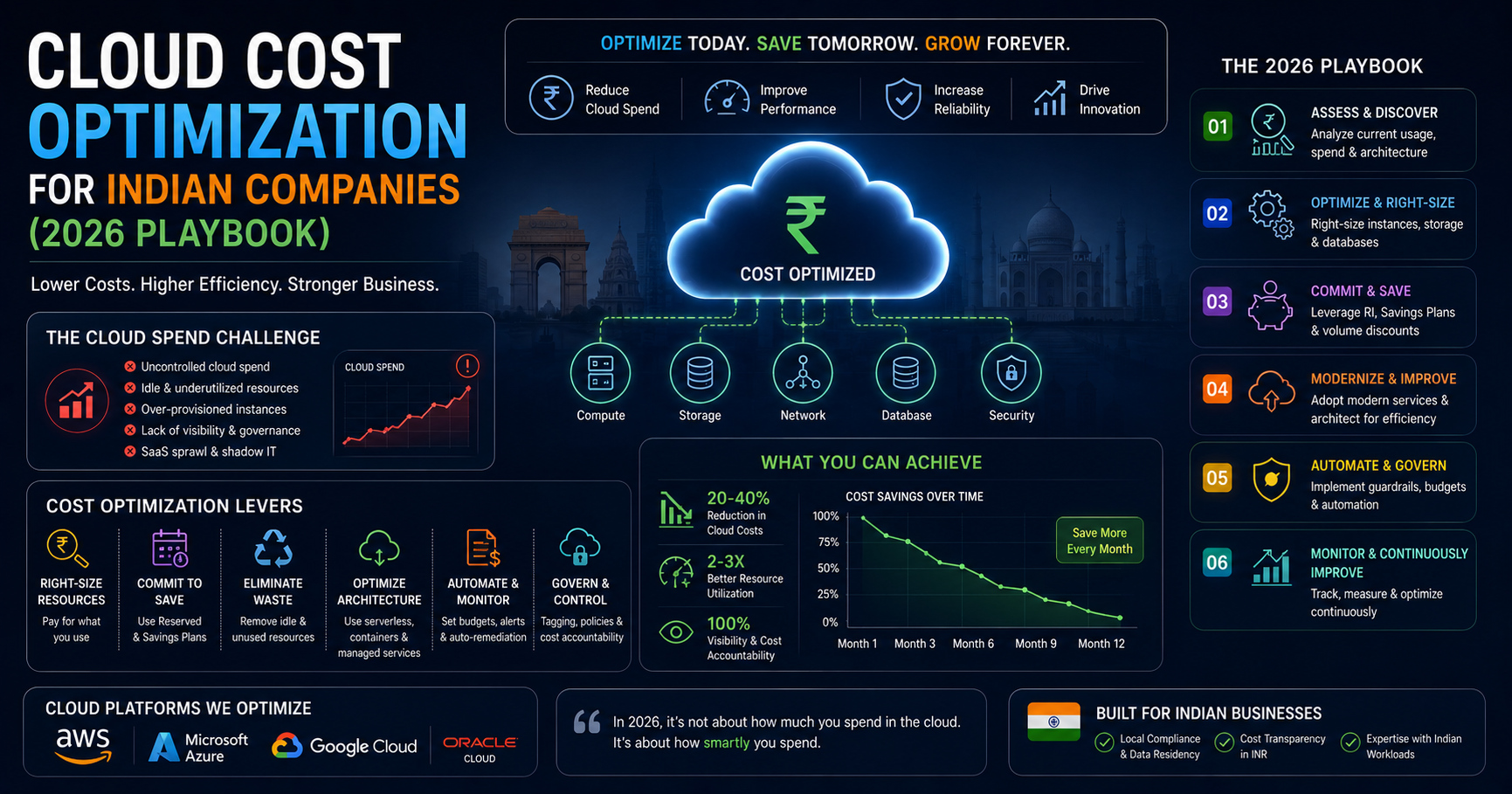
Summary. Industry research finds that 30-35% of cloud spend is wasted on average, and 94% of enterprises overspend versus budget. Indian companies face the same waste profile plus three local pressures — rupee-dollar volatility on USD-denominated cloud bills, DPDP data residency requirements that constrain region choice, and a maturing FinOps discipline that lags global benchmarks by 18-24 months. The good news: companies that implement disciplined FinOps practice typically capture 20-30% of cloud spend within 12 months without sacrificing performance or compliance. This playbook covers what good cloud cost optimization looks like for Indian companies in 2026 — waste patterns, DPDP-aware architecture, the rupee economics of multi-region choice, the FinOps practices that actually move the bill, and a 90-day cost reduction sprint.
The framing that consistently works for Indian companies is that cloud cost is not an infrastructure problem; it is an engineering practice problem. Most overspend comes from engineering decisions made years ago and never revisited — oversized RDS instances, idle dev environments, unattached storage volumes, over-provisioned Kubernetes clusters, unoptimised data egress, default storage classes on infrequently accessed objects. Fixing them is rarely difficult; the difficulty is in instituting the practice that finds them and fixes them every month.
This guide is built for CTOs, CFOs, FinOps practitioners and engineering directors at Indian companies — growth-stage startups, mid-market enterprises and Indian arms of global firms. The numbers come from FinOps Foundation research, the major cloud providers' India regional pricing, and patterns observed across cloud cost reduction engagements in the past 24 months.
The aggregate picture
Five numbers ground the rest of the article.
Waste. Industry research summarised at Cloudchipr and Cloudaware finds that 30-35% of cloud spend across the industry is wasted on resources that are idle, oversized, redundant or simply forgotten.
Overspend. Approximately 94% of enterprises overspend their cloud budget — the structural pattern is that cloud spend grows faster than the financial team's forecast assumed.
Multi-cloud is standard. Roughly 89% of enterprises now use two or more cloud providers, up from 87% in 2025. AWS holds approximately 31% global market share, Azure 24% and GCP 12%.
FinOps maturity captures 20-30%. Companies implementing disciplined FinOps practice typically achieve 20-30% cost savings through rightsizing resources, eliminating idle workloads, and optimising commitment purchases.
2026 pricing shifts. AWS launched Trainium3 instances in Q1 2026 with significantly improved price-performance for AI training workloads. GCP cut compute pricing by 8% across all regions in Q1 2026. Azure's value proposition continues to depend heavily on existing Microsoft licensing agreements.
The question for Indian engineering leaders is not whether cost optimization works — the evidence is clear — but how to implement it as practice rather than a one-time project.
The India-specific factors
Three pressures shape cloud cost decisions for Indian companies that do not apply equally elsewhere.
Rupee-dollar volatility. Cloud bills are USD-denominated. INR-USD volatility translates directly into cloud spend variability that the Indian CFO sees in INR P&L. A 5% rupee depreciation produces a 5% cloud cost increase on a stable-volume workload. Indian companies should hedge cloud spend explicitly or build cost optimization headroom into the operating budget.
DPDP data residency. The Digital Personal Data Protection Act (2023) requires that personal data of Indian individuals be processed under DPDP-aligned conditions, with sectoral regulators adding tighter requirements for specific categories (banking, healthcare, payments). This constrains region choice — Indian companies cannot freely shift personal-data workloads to the cheapest global region. The practical implication is that AWS Mumbai (ap-south-1), AWS Hyderabad (ap-south-2), Azure Central India, Azure South India, Azure West India, GCP Mumbai (asia-south1) and GCP Delhi (asia-south2) are the relevant regions for personal data, with all the pricing implications that brings.
Domestic cloud alternatives. Indian-headquartered providers — Yotta Data Services, Tata Communications, E2E Networks, Sify, NxtGen — increasingly compete on price for India-resident workloads. For non-elastic workloads with predictable volume, these providers can be meaningfully cheaper than equivalent capacity on AWS Mumbai or Azure Central India.
The eight waste patterns Indian companies should hunt first
Cost optimization usually begins by finding the eight common waste patterns that contribute disproportionately to overspend.
1. Idle compute
Compute instances and VM scale sets that run 24/7 but produce no useful work. Common offenders: dev environments running outside business hours, abandoned proof-of-concept clusters, instances behind decommissioned load balancers, scheduled tasks that finished years ago but kept the host running.
Fix. Automated start/stop schedules on dev and staging. Quarterly hibernation of unused instances. Alarms for instances with 0% CPU utilisation for 30 days.
2. Oversized compute
Production instances that are 4x or 8x what the workload needs. Most engineering teams provision for safety, then never revisit. Workload patterns shift, traffic flattens, the original sizing becomes wrong.
Fix. Monthly rightsizing recommendations from the cloud provider (AWS Cost Explorer, Azure Advisor, GCP Recommender). Set a target of 65-75% sustained utilisation. Move workloads to Graviton (AWS), Ampere (Azure) or Arm-based compute where compatible — typically 20-40% cheaper at equal performance.
3. Unattached storage
EBS volumes, persistent disks and managed disks that became orphaned when their compute instance was terminated but the volume was never deleted. These sit on storage bills indefinitely.
Fix. Weekly automated scan for unattached storage older than 14 days, with tagged retention policy or deletion.
4. Snapshot accumulation
EBS snapshots, RDS snapshots, blob snapshots that accumulate over time. A snapshot-per-day policy applied to 500 volumes for 3 years produces over half a million snapshots, all paid for monthly.
Fix. Lifecycle policy that retains the last 7 daily, 4 weekly and 12 monthly snapshots, with deletion of everything else. Saves materially on long-running deployments.
5. Suboptimal storage classes
Data sitting in standard / hot storage that is rarely accessed. AWS S3 Glacier, Azure Cool / Archive tiers and GCP Coldline / Archive are dramatically cheaper for infrequent-access data.
Fix. S3 Intelligent-Tiering on object stores. Lifecycle policies that transition objects to cooler tiers after a defined period. Audit large buckets for access patterns and reclassify accordingly.
6. Data egress costs
Outbound data transfer is the most expensive category on most cloud bills. Common offenders: cross-region replication that is no longer needed, services calling data from US regions that could be served from India regions, third-party SaaS pulling data egress charges, public IP bandwidth on databases.
Fix. Audit egress charges by service. Use CloudFront, Azure CDN or GCP CDN for outbound web traffic. Move services calling data from US into India regions. Use Direct Connect / ExpressRoute / Dedicated Interconnect for high-volume on-prem traffic.
7. Over-provisioned Kubernetes
Kubernetes clusters with node pools sized for peak load but running 24/7. Pods over-requesting resources because the original developer guessed.
Fix. Vertical Pod Autoscaler, Cluster Autoscaler, Karpenter (AWS) and similar autoscaling. Workload right-sizing with goldilocks or similar tools. Use spot / preemptible / Azure spot for fault-tolerant workloads — typically 60-80% cheaper.
8. Forgotten managed services
Managed databases, managed search clusters, managed Kafka, managed Redis that were provisioned for a project that finished. They keep running and keep billing.
Fix. Tag every managed service with owner, project and end date. Run a monthly review of services past their end date.
The FinOps practices that move the bill
Fixing the eight waste patterns reduces the bill once. FinOps practices keep it down.
Showback and chargeback. Engineering teams see what their workloads cost. Most teams have no idea. Showback reports surface this monthly. Chargeback assigns the cost to the team's budget. Both produce behavioural changes that no other intervention matches.
Commitment optimisation. Reserved instances, savings plans and committed-use discounts trade flexibility for discount. AWS Compute Savings Plans and EC2 Instance Savings Plans, Azure Reservations and Reserved Capacity, GCP Committed Use Discounts can reduce compute costs 30-72% depending on commitment term and coverage. The discipline is in choosing the right commitment level for each workload type — over-commitment is wasteful, under-commitment leaves money on the table.
Spot / preemptible adoption for fault-tolerant workloads. Batch processing, data engineering, CI/CD, training jobs and non-critical services can run on spot capacity at 60-80% discount. The trade-off is interruption risk, which is acceptable for workloads that can be restarted.
Automated tagging discipline. Every resource has owner, project, environment, cost-centre and end-date tags. Untagged resources are visible on monthly reports and flagged for remediation. Without tagging, no FinOps practice works.
Anomaly detection. Cost anomaly detection (AWS Cost Anomaly Detection, Azure Cost Management, GCP Cost Anomaly Detection) catches sudden spikes early — before the monthly bill makes them painful. Combined with budget alerts, this prevents the worst overspend incidents.
Architecture review. The biggest cost savings rarely come from rightsizing — they come from architectural choices. Serverless instead of always-on compute. Managed instead of self-hosted. Single-region instead of multi-region for non-disaster-recovery workloads. Architecture reviews quarterly, with cost as one of the explicit criteria.
The 2026 FinOps tool landscape
A few FinOps platforms have emerged as the practical choices for Indian companies.
[Amnic](https://amnic.com/). Indian-headquartered FinOps platform covering AWS, Azure, GCP, Alibaba, Oracle, Kubernetes and multiple SaaS services. Built for CFO, CTO and SRE personas. Pricing is competitive for the Indian market.
[Vantage](https://www.vantage.sh/). Multi-cloud FinOps platform covering AWS, Azure, GCP, Snowflake, Databricks, Datadog, MongoDB, OpenAI and Kubernetes. Strong for companies with SaaS spend integrated alongside cloud spend.
[Cloudchipr](https://cloudchipr.com/). Cost optimisation and idle resource detection with automated actions. Strong for engineering-led FinOps practices.
[Hyperglance](https://www.hyperglance.com/). Multi-cloud cost and architecture visualisation. Strong for companies with complex cloud footprints needing topology-aware analysis.
[PointFive](https://www.pointfive.co/). Engineering-focused cost optimization with deep code and infrastructure context.
For most Indian companies, the right starting point is either Amnic (if the priority is Indian-based support and pricing) or Vantage (if SaaS spend is meaningful alongside cloud).
A 90-day cloud cost reduction sprint
For Indian engineering and finance leaders ready to capture the 20-30% savings benchmark, a 90-day sprint pattern that has worked across Indian companies.
Weeks 1-3 — Inventory and baseline. Catalogue every cloud account, every workload owner, every monthly spend line. Map workloads to teams and to product lines. Establish the baseline against which savings will be measured. Set up tagging discipline if it does not exist.
Weeks 4-6 — Quick wins. Hunt the eight waste patterns above. Idle compute, oversized compute, unattached storage, snapshot accumulation, suboptimal storage classes, data egress, over-provisioned Kubernetes, forgotten managed services. Typical capture in this phase: 10-15% of baseline spend.
Weeks 7-10 — Commitments and architecture. Optimise commitment coverage (Savings Plans, Reservations, CUDs). Identify the highest-spend workloads and review architecture for serverless and managed alternatives. Adopt spot / preemptible for fault-tolerant workloads. Typical capture in this phase: another 10-15%.
Weeks 11-13 — Productionise. Set up showback / chargeback reports, anomaly detection, monthly review cadence, FinOps tooling. Make the savings durable rather than a one-time hit. Report cumulative savings to the CFO. Decide on phase-two scope.
The output of a successful 90-day sprint is 20-30% reduction in monthly cloud spend, a FinOps practice that prevents the bill creeping back up, and clear engineering-team accountability for cloud cost.
DPDP-aware architecture choices for Indian companies
Three design patterns reconcile DPDP residency with cost optimization.
Pattern 1 — Personal data in India regions, processing flexibility globally. Indian personal data stays in AWS Mumbai, Azure Central India or GCP Mumbai. Anonymised or aggregated derivatives can flow to global regions for analytics or AI. The pattern keeps DPDP compliance simple at the architectural boundary.
Pattern 2 — Multi-region active-active for resilience without personal data egress. Indian personal data is replicated across India regions (Mumbai + Hyderabad on AWS, Central + South + West on Azure, Mumbai + Delhi on GCP) for high availability without leaving Indian jurisdiction.
Pattern 3 — Hybrid with Indian sovereign cloud. For workloads with the strictest residency requirements (banking, healthcare, government), Indian sovereign cloud providers (Yotta, Tata, E2E) handle the personal data tier, with non-personal-data compute on global hyperscalers.
Each pattern has cost implications — India regions are typically 5-15% more expensive than US East regions, but the compliance simplification usually outweighs the premium.
FAQ
How eCorpIT can help
eCorpIT helps Indian companies build cloud architecture and FinOps practice that captures the 20-30% cost optimization benchmark sustainably. Our work covers FinOps tooling setup, waste-pattern remediation, commitment optimisation, architecture review and DPDP-aware multi-region design.
If your engineering and finance leaders are planning a cloud cost initiative in 2026, our team can help. Reach us at ecorpit.com/contact-us/ or contact@ecorpit.com.
References
- Cloudchipr — "Best Cloud Cost Optimization Tools [2026]": cloudchipr.com
- Cloudaware — "10 Cloud Cost Optimization Tools That Actually Reduce the Bill in 2026": cloudaware.com
- PointFive — "Best Cloud Cost Optimization Tools (2026)": pointfive.co
- Ramp — "Best FinOps Tools for Cloud Cost Management in 2026": ramp.com
- Hyperglance — "10 Best Cloud FinOps Tools for 2026": hyperglance.com
- Amnic — Indian FinOps platform: amnic.com
- Vantage — Multi-cloud FinOps: vantage.sh
- AWS Cost Optimization: aws.amazon.com
- Azure Cost Management: azure.microsoft.com
- GCP Cost Management: cloud.google.com
- FinOps Foundation: finops.org
- eCorpIT — "Generative AI Enterprise Strategy 2026": ecorpit.com
Last updated 8 June 2026 by the eCorpIT Editorial team.