On this page · 16 sections
- What was announced — five things to understand
- Comparison table 1 — Fable 5 versus Mythos 5
- Comparison table 2 — Fable 5 vs Opus 4.8 vs GPT-5.5 (benchmarks)
- Comparison table 3 — Pricing across the 2026 frontier
- Comparison table 4 — When to use Fable 5 vs Mythos 5 vs Opus 4.8 vs Sonnet 4.5
- What Fable 5 is actually good at — five categories Anthropic and customers documented
- The safety architecture — three classifier categories, fallback to Opus 4.8
- The data retention change
- Customer feedback — what early-access partners reported
- Availability and rollout
- What this means for engineering teams
- What this means for businesses
- India-specific considerations
- FAQ
- How eCorpIT can help
- References
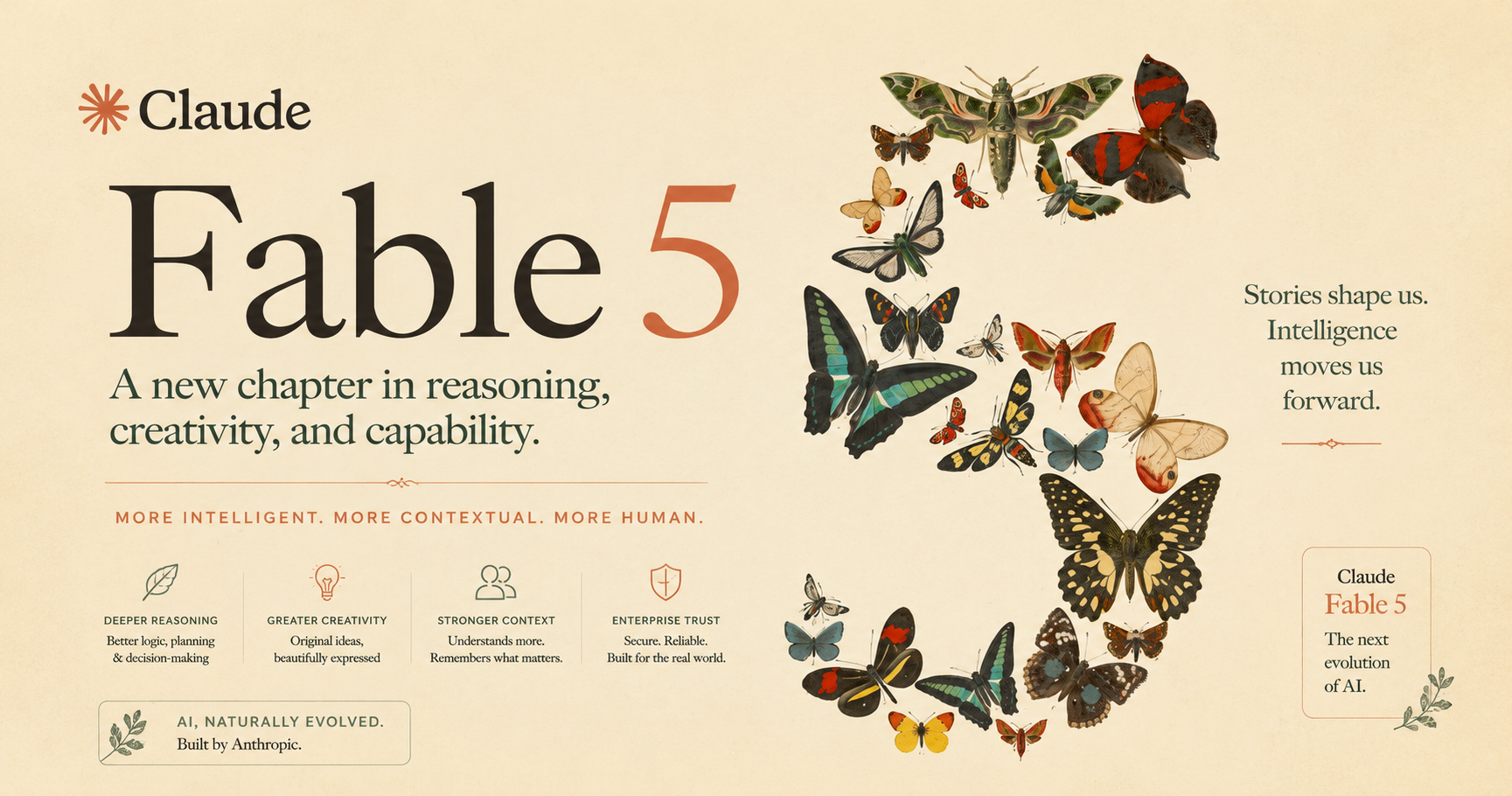
Summary. Anthropic launched two models on Tuesday, June 9, 2026 — Claude Fable 5 for general availability and Claude Mythos 5 for a restricted access program in cybersecurity and biology research. Both are the same underlying model. Fable 5 is "a Mythos-class model made safe for general use" per Anthropic's wording — Mythos 5 is the same weights with safeguards removed in specific categories. Fable 5 hits 80.3% on SWE-Bench Pro (versus GPT-5.5 at 58.6%), 29.3% on Cognition's FrontierCode Diamond (versus 13.4% for Claude Opus 4.8 and 5.7% for GPT-5.5), 66.0% on HealthBench Professional (versus 56.9% for Opus 4.8 and 51.8% for GPT-5.5), and is described by Anthropic as state-of-the-art on nearly every public benchmark. Both models are priced at $10 per million input tokens and $50 per million output tokens — less than half the price of Claude Mythos Preview. The pricing puts Fable 5 above GPT-5.5's $5/$30 but the benchmark gap is wide. Stripe's early test compressed a 50-million-line Ruby codebase migration that would have taken a team two months into a single day. This article covers what Anthropic actually announced, four comparison tables (Fable vs Mythos, benchmarks against frontier alternatives, pricing, when-to-use), the new safety architecture with classifier fallback to Opus 4.8, the customer feedback Anthropic published, and what engineering teams and businesses should plan around.
The honest framing of today's launch: this is the first time a "Mythos-class" model — Anthropic's new tier above Opus — has been generally available. The first Mythos-class model, Claude Mythos Preview, shipped in April 2026 only to a small group of cybersecurity partners through Project Glasswing. Fable 5 brings that capability profile to every Anthropic API customer. It is the largest single capability jump in a publicly-available Claude model since the Opus class itself was introduced.
This guide is built for AI engineering leaders, CTOs, product teams evaluating LLMs for production workloads, and business buyers comparing the 2026 frontier model landscape. The research draws from Anthropic's official launch announcement, the AWS Bedrock launch coverage, GitHub Copilot day-one availability, Vellum, DataCamp, Tom's Hardware, TechCrunch, CNBC, and the Anthropic system card.
What was announced — five things to understand
1. Fable 5 and Mythos 5 are the same model. Same weights, same training, same capability profile. The difference is the safeguard layer. Fable 5 ships with classifier safeguards that catch certain categories of request and route them to Claude Opus 4.8 instead. Mythos 5 has those safeguards lifted in specific categories — currently cybersecurity for Project Glasswing partners.
2. "Mythos-class" is a new capability tier. Above Opus, above Sonnet, above Haiku. Anthropic introduced the tier with Mythos Preview in April 2026, restricted to cybersecurity defenders. Fable 5 is the first general-availability member of the tier.
3. The benchmarks are state-of-the-art. Anthropic describes Fable 5 as state-of-the-art on nearly all tested benchmarks. The gap over GPT-5.5 is wide on coding, computer use, knowledge work, legal reasoning and vision. Token efficiency is also materially better than prior Claude models.
4. The safety architecture is unusual. Rather than refuse on flagged queries, Fable 5 falls back to Opus 4.8. This is meant to be a better user experience than outright refusal — Opus 4.8 remains a highly capable model. The fallback triggers in fewer than 5% of sessions per Anthropic's early data, and in 95%+ of sessions Fable 5 behaves identically to Mythos 5.
5. Pricing is unchanged from Mythos Preview's tier but materially cheaper. $10 per million input tokens and $50 per million output tokens — less than half the price of Claude Mythos Preview. Batch pricing is $5 input and $25 output.
Comparison table 1 — Fable 5 versus Mythos 5
The same underlying model, three operational differences.
| Dimension | Claude Fable 5 | Claude Mythos 5 |
|---|---|---|
| Underlying model | Same weights | Same weights |
| Availability | All Anthropic API customers, Bedrock, Vertex AI, Microsoft Foundry, Cowork, Claude Code | Project Glasswing partners (cyber); soon select biology researchers |
| Cybersecurity safeguards | Active — falls back to Opus 4.8 on cyber queries | Lifted (for Glasswing partners) |
| Biology / chemistry safeguards | Active — falls back to Opus 4.8 | Lifted (for the upcoming biology trusted-access program) |
| Distillation safeguards | Active | Active |
| Fallback frequency | <5% of sessions trigger fallback | Not applicable in lifted categories |
| Pricing | $10 / $50 per million input/output tokens | Same |
| Best for | General development, agentic coding, knowledge work, vision, legal, finance | Authorised cybersecurity, biomedical research |
The strategic point: Fable 5 is what almost every reader of this article will use. Mythos 5 requires application to a trusted access program. The capability ceiling is the same; the lifted safeguards are what gates Mythos 5.
Comparison table 2 — Fable 5 vs Opus 4.8 vs GPT-5.5 (benchmarks)
Benchmark numbers below are drawn from the official Anthropic announcement, Vellum's reporting, and DigitalApplied's comparison. Where Anthropic and third-party reporting agree, the figure is reproduced; where they diverge, Anthropic's published figure is used.
| Benchmark | Claude Fable 5 | Claude Opus 4.8 | GPT-5.5 |
|---|---|---|---|
| SWE-Bench Verified (coding) | 95.0% | n/a | n/a |
| SWE-Bench Pro (coding) | 80.3% | n/a | 58.6% |
| FrontierCode Diamond (Cognition agentic coding) | 29.3% | 13.4% | 5.7% |
| GDPval-AA (knowledge work) | 1932 | n/a | 1769 |
| Computer use | 85.0% | n/a | 78.7% |
| Legal Agent Benchmark | 13.3% | 10.4% | 2.1% |
| HealthBench Professional (medical reasoning) | 66.0% | 56.9% | 51.8% |
| Hebbia Finance Benchmark | Highest tested | n/a | Behind Fable |
| Vision / multidisciplinary reasoning | State-of-the-art | n/a | Behind Fable |
Two observations worth keeping in mind. First, the gaps in agentic coding are unusually wide — 22 points on SWE-Bench Pro and 24 points on FrontierCode Diamond over GPT-5.5. Second, the gaps over Opus 4.8 in legal and medical reasoning are also substantial. Anthropic's positioning of Fable 5 as a step beyond Opus is not marketing inflation — the gap is measurable on independent benchmarks.
Comparison table 3 — Pricing across the 2026 frontier
| Model | Input ($/M tokens) | Output ($/M tokens) | Batch input | Batch output |
|---|---|---|---|---|
| Claude Fable 5 / Mythos 5 | $10.00 | $50.00 | $5.00 | $25.00 |
| Claude Opus 4.8 | $15.00 | $75.00 | n/a | n/a |
| Claude Sonnet 4.5 | $3.00 | $15.00 | n/a | n/a |
| Claude Haiku 4.5 | $0.80 | $4.00 | n/a | n/a |
| GPT-5.5 | $5.00 | $30.00 | n/a | n/a |
| Claude Mythos Preview (April 2026 — predecessor) | ~$20.00 | ~$100.00 | n/a | n/a |
A few practical implications. Fable 5 is materially cheaper than Mythos Preview was — Anthropic specifically positions it as "less than half the price." GPT-5.5 is cheaper per token but the benchmark gap on agentic coding suggests Fable 5 will often deliver the same result in fewer tokens, narrowing the total-cost gap meaningfully. For routine production work where Mythos-class capability is not required, Sonnet 4.5 at $3/$15 remains the cost-effective default. Haiku 4.5 at $0.80/$4 is the right pick for high-volume, lower-complexity tasks. The pricing structure invites tiered architectures — see the model-choice table below.
Comparison table 4 — When to use Fable 5 vs Mythos 5 vs Opus 4.8 vs Sonnet 4.5
| Use case | Recommended model | Why |
|---|---|---|
| Long-horizon agentic coding | Fable 5 | 22-point lead over GPT-5.5 on SWE-Bench Pro; +16 points over Opus 4.8 on FrontierCode Diamond |
| Production agent that runs autonomously for hours | Fable 5 | Long-context memory, three-times improvement with persistent file memory over Opus 4.8 |
| Complex codebase migrations | Fable 5 | Stripe migration of 50M-line Ruby codebase done in 1 day vs 2 months by hand |
| Legal redlining and contract review | Fable 5 | Harvey reported blind reviews where Fable 5 matched or beat their current model |
| Senior finance and trading analysis | Fable 5 | Hebbia Finance Benchmark highest score; IMC reported near-perfect across categories |
| Frontier physics, life sciences, novel research | Mythos 5 (if accessible) or Fable 5 | Lab-grade autonomous research; 80% preference in blinded molecular biology |
| Authorised cybersecurity research and defence | Mythos 5 | Cyber safeguards lifted; required for offensive-research workflows |
| Authorised biomedical / drug design research | Mythos 5 (upcoming biology program) | Biology safeguards lifted for trusted researchers |
| Day-to-day production workloads at scale | Sonnet 4.5 | One-fifth the cost; sufficient capability for most non-frontier workloads |
| High-volume classification / extraction | Haiku 4.5 | Cheapest token economics; latency optimised |
| Anything requiring stable behaviour under regulatory audit | Opus 4.8 | Mature track record, broad enterprise deployment, predictable safety behaviour |
The recommended pattern for most enterprise architectures: route most production traffic to Sonnet 4.5; route hard-task agent calls to Fable 5; reserve Opus 4.8 for workflows requiring its specific safety profile; reserve Mythos 5 for authorised research only.
What Fable 5 is actually good at — five categories Anthropic and customers documented
1. Agentic software engineering. Stripe reported that Fable 5 compressed a 50-million-line Ruby codebase migration into a single day that would otherwise have taken a team over two months. GitHub, Cursor, Replit, Cognition and Notion all reported significant performance improvements over Opus 4.8 in early testing. Cursor's Michael Truell described Fable 5 as the state-of-the-art model on CursorBench, opening a class of long-horizon problems that earlier models could not handle. GitHub's Mario Rodriguez framed it as "a future where developers can hand increasingly ambitious work to agents and trust the results across the software lifecycle."
2. Knowledge work and analysis. Hebbia's Finance Benchmark for senior-level reasoning records Fable 5 as the highest-scoring model tested, with substantial gains in document-based reasoning, chart and table interpretation, and problem solving. IMC reported that Fable 5 aced their trading-analysis evaluations across factual lookup, conceptual reasoning, root-cause analysis and expected-value analysis. Hex's Izzy Miller described Fable 5 as the first model to break 90% on Hex's core analytics benchmark — a 10-point jump over Opus 4.8.
3. Vision. Fable 5 extracted precise numbers from detailed scientific figures and rebuilt working web-app source code from screenshots alone. The headline demonstration: prior Claude models needed scaffolding to play Pokémon FireRed; Fable 5 beat the game with vision-only access to raw screenshots, no maps, no navigation aids, no game-state information.
4. Memory and long-context work. Across millions of tokens of long-running tasks, Fable 5 stays focused and improves its outputs using its own notes. In the deck-building game Slay the Spire, giving Fable 5 access to persistent file-based memory improved its performance three times more than the same intervention did for Opus 4.8 — and Fable reached the game's final act three times more often. The mechanism matters operationally: agents that can write to and read from their own scratchpad outperform stateless agents by a wider margin on Fable 5 than on prior generations.
5. Life sciences and frontier research. Using Mythos 5, Anthropic's internal protein design experts accelerated drug design by approximately ten times. In one study, Mythos 5 — with protein design and bioinformatics tools but no human assistance — matched or beat skilled human operators. Nine of fourteen protein targets yielded strong drug-design candidates. In genomics, Mythos 5 trained a custom machine learning model that outperformed a model published in Science despite being 100 times smaller. In blinded head-to-head comparisons, Anthropic scientists preferred Mythos 5's molecular biology hypotheses ~80% of the time over Opus-class models.
The safety architecture — three classifier categories, fallback to Opus 4.8
The Fable 5 safety design is unusual and worth understanding before deploying the model.
The mechanism. Separate AI systems — classifiers — analyse incoming requests. If a classifier detects a request in one of three categories (cybersecurity, biology/chemistry, distillation), Fable 5 does not respond. The query is automatically handled by Claude Opus 4.8 instead, and the user is informed.
Why fallback rather than refusal. Anthropic's stated rationale: "a response that falls back to Opus is a far better experience than an outright refusal from Fable." Opus 4.8 is a strong model in its own right; the fallback yields a useful answer for many benign requests in flagged categories.
The cybersecurity classifier. Mythos-class models excel at discovering and exploiting software vulnerabilities. The classifier covers both vulnerability exploitation and broader agentic hacking tasks (reconnaissance, lateral movement, etc.). Anthropic engaged external red-team partners. One partner found Fable 5's safeguards against harmful cyber queries the strongest of any model tested. An external bug bounty produced no universal jailbreaks over 1,000+ hours of testing, though the UK AISI made progress toward one in a brief initial testing window.
The biology and chemistry classifier. Anthropic widened biology/chemistry safeguards beyond previous narrow bioweapons categories because Mythos-class models now have a greater ability to accomplish real-world scientific tasks. In one test, Mythos-class models outperformed dedicated protein language models on predicting how genetic modifications would impact adeno-associated virus assembly using biological reasoning alone — important for legitimate gene therapy research but dual-use enough to require guardrails. The biology classifier is currently broad; Anthropic states an intention to narrow it as the trusted access program for biology launches.
The distillation classifier. Anthropic has previously identified large-scale attempts to extract Claude's capabilities to train competing models in authoritarian countries. Requests flagged as part of distillation attempts also fall back to Opus 4.8.
False positive expectations. Anthropic states the classifiers are conservatively tuned and will sometimes catch harmless requests. The trigger rate is described as under 5% of sessions on average. Anthropic plans to refine the safeguards to reduce false positives after launch.
The data retention change
Worth flagging for enterprise buyers: Anthropic is introducing 30-day retention for all traffic on Mythos-class models (Fable 5, Mythos 5, and future similar-or-higher capability models), on both first- and third-party surfaces.
The constraints around the retention:
- Data will not be used to train new Claude models
- Data will not be used for any non-safety-related purpose
- All human access to the data is logged
- Data is deleted after 30 days in almost all cases
- The retention is intended to defend against complex jailbreaks and identify false positives
For enterprises with strict data residency or short-retention requirements, this is a change worth verifying against the Anthropic Trust Center and the new retention policy details before deploying Fable 5 at scale.
Customer feedback — what early-access partners reported
Anthropic published feedback from fourteen named customers. The pattern is consistent across very different use cases:
- Cursor (Michael Truell, CEO and Co-founder): State-of-the-art on CursorBench; opens a class of long-horizon problems out of reach for earlier models.
- GitHub (Mario Rodriguez, CPO): Real step forward; level of autonomy and reliability that exceeded previous benchmarks on long-horizon coding.
- Cloudflare (Matt Colyer, Director of Product, Developers): Strongest results of any Claude model tested.
- iGent AI (Sean Ward, CEO and Co-founder): Reasoning a clear step beyond Opus 4.8; works at senior research scientist grade.
- Lovable (Fabian Hedin, CTO and Co-founder): Apps that took a hundred prompts a year ago now one-shot.
- Harvey (Aveek Duttagupta, Member of Technical Staff): In blind review, Fable 5's legal redlines matched or beat their current model every time.
- Rakuten (Yusuke Kaji, GM AI for Business): At highest effort, Fable 5 reflects on and validates its own work — enabling highly autonomous operations.
- Notion (Luke Anderson, CTO): More capable engineering in fewer turns than prior models — handling complex multi-agent workflows.
- Cognition (Scott Wu, CEO): Highest-scoring model on Cognition's FrontierBench coding evaluation.
- Applied AI at investment firm (Damian Miraglia): Strongest finance-first model tested.
- Hex (Izzy Miller, AI Research Lead): First model to break 90% on Hex's core analytics benchmark — a 10-point jump over Opus.
- Bedrock physics research lab (Matthew Pines, CEO): Strongest model tested on frontier physics; got nearly to where GPT-5.5 landed after four days, in 36 hours, using a third of the reasoning tokens.
- Replit (Michele Catasta, President & Head of AI): Highest-performing model on ViBench end-to-end vibe-coding benchmark — nearly saturating base use cases.
- Anaconda (Peter Wang, Chief Science Officer): Beats Opus 4.8 on everyday spreadsheet suite at every effort level; finishes runs 25-30% faster.
The pattern across these reports: Fable 5 is materially better than Opus 4.8 on tasks that involve long-horizon reasoning, agentic execution, and complex domain work. The 14 testimonials cover coding, legal, finance, analytics, physics and creative engineering — meaningful breadth for a launch-day report.
Availability and rollout
Fable 5. Available from June 9, 2026 on the Claude API, in Claude.ai, in Claude Code, in Cowork, in Amazon Bedrock, in GitHub Copilot, Google Cloud Vertex AI, and Microsoft Foundry.
Mythos 5. Restricted to Project Glasswing partners (cybersecurity) and soon a small set of biology researchers. Wider access through a forthcoming trusted access program.
Subscription rollout. On Pro, Max, Team and seat-based Enterprise plans, Fable 5 is included at no extra cost from June 9 through June 22, 2026. After June 23, using Fable 5 on those plans requires usage credits until Anthropic restores it as a standard inclusion when capacity allows.
Consumption-based plans. Claude API and consumption-based Enterprise are fully available with no rollout gating.
What this means for engineering teams
Five takeaways for AI engineering leaders planning around Fable 5.
Long-horizon agents become commercially deployable. Tasks that previously required dozens of orchestrated calls to Opus 4.8 may now run end-to-end on Fable 5. The Stripe migration example is a real engineering load that compressed from team-months to a day. Expect similar compression on agentic workloads that fit Fable 5's strengths.
Token efficiency materially changes the cost model. Multiple early-access partners reported that Fable 5 produces equivalent or better results in fewer tokens. The GPT-5.5 price advantage on per-token economics shrinks meaningfully when total tokens spent fall by 25-40%.
Memory-aware agent design is more valuable. The 3x lift in Slay the Spire performance from persistent file memory (versus the same intervention on Opus 4.8) suggests agent architectures that include scratchpad memory will see disproportionate benefit on Fable 5.
The safety fallback model needs design consideration. If your application surfaces classifier-flagged categories (cybersecurity, biology, anything that resembles distillation), expect Opus 4.8 to handle those requests transparently. UX should account for the model behaviour shift. The under-5% fallback rate sounds small but matters for analytics and product expectations.
Tiered architectures still win. Route most production traffic to Sonnet 4.5 ($3/$15) or Haiku 4.5 ($0.80/$4); reserve Fable 5 ($10/$50) for the agentic and frontier-capability calls; reserve Opus 4.8 ($15/$75) for stable-behaviour workflows. Total cost across the stack drops materially when routing is intent-aware.
For deeper enterprise AI strategy context, see eCorpIT's generative AI enterprise strategy guide.
What this means for businesses
Three implications for product and engineering leaders evaluating their AI roadmap.
Agentic AI just became more commercially deployable. Fable 5 closes much of the gap between "agent prototype that works in demos" and "agent that runs production for hours." Categories that depend on long-horizon execution — code modernisation, document processing pipelines, research workflows, multi-step customer support flows — now have a credible underlying model.
Frontier benchmarks now influence procurement. The 22-point SWE-Bench Pro lead and the 24-point FrontierCode Diamond lead over GPT-5.5 will shift LLM procurement decisions at engineering-heavy organisations. Expect this to be discussed in CTO-level vendor reviews through Q3 2026.
Regulatory and compliance reviews become more important. The new data retention policy, the safeguards on cybersecurity and biology, and the strict access model for Mythos 5 all create new procurement and compliance questions. Indian, US and UK enterprises in regulated sectors (banking, healthcare, government, defence) should expect their procurement teams to ask additional questions about the safeguard fallback behaviour and the 30-day retention.
India-specific considerations
Three notes for Indian businesses evaluating Fable 5 in 2026.
Indian engineering teams will absorb the pricing. A Fable 5 production deployment at $10/$50 per million tokens carries meaningful but absorbable cost economics for Indian B2B SaaS, fintech and product companies. Combined with the token-efficiency improvements, total cost-per-task often lands close to or below GPT-5.5 for agentic workloads.
DPDP and regional compliance need review. The 30-day retention policy and the cross-cloud availability (Bedrock, Vertex AI, Foundry) interact with India's Digital Personal Data Protection Act differently per deployment surface. Indian enterprises handling personal data should review the retention and routing behaviour with the Anthropic Trust Center documentation before scaling production deployments.
Agentic coding talent in India can take immediate advantage. Indian engineering teams have deep AI agent experience from the last 18 months of building on Opus, Sonnet, GPT and Gemini. Fable 5's capability profile maps cleanly to workloads Indian dev shops already deliver — code modernisation, app migrations, RAG-augmented analytics, agentic operations. Expect rapid adoption across Indian product and services firms in Q3 2026.
For India-aware AI strategy, see eCorpIT's AI business operations transformation guide.
FAQ
How eCorpIT can help
eCorpIT builds AI-aware applications, RAG systems, agentic workflows and enterprise AI integrations for clients across India, the United States and the United Kingdom. Our work covers model selection across the Claude family, evaluation, fine-tuning, agent design, observability, cost engineering and production deployment.
If your team is evaluating Claude Fable 5 for production workloads, planning a tiered LLM architecture, or moving from Opus 4.8 to the new Mythos-class tier, our engineering team can help. Reach us at ecorpit.com/contact-us/ or contact@ecorpit.com.
References
- Anthropic Newsroom — "Claude Fable 5 and Claude Mythos 5" (June 9, 2026): anthropic.com
- Anthropic — Claude Fable 5 / Mythos 5 system card: anthropic.com
- Anthropic — Project Glasswing: anthropic.com
- AWS — "Anthropic Claude Fable 5 on AWS": aws.amazon.com
- GitHub — "Claude Fable 5 is generally available for GitHub Copilot": github.blog
- Vellum — "Claude Fable 5 & Mythos 5 Benchmarks Explained": vellum.ai
- DigitalApplied — "Claude Fable 5 vs GPT-5.5: Benchmarks & Cost Compared": digitalapplied.com
- TrueFoundry — "Claude Fable 5: API, Benchmarks, Pricing & How to Use It": truefoundry.com
- DataCamp — "Claude Mythos 5: Features, Benchmarks & Capabilities": datacamp.com
- Tom's Hardware — "Claude Fable 5 brings Mythos to the masses": tomshardware.com
- TechCrunch — "Anthropic released Claude Fable 5": techcrunch.com
- VentureBeat — "Anthropic brings Mythos to the masses": venturebeat.com
- The Decoder — "Anthropic releases Claude Fable 5 and Mythos 5": the-decoder.com
- eCorpIT — "Generative AI Enterprise Strategy 2026": ecorpit.com
- eCorpIT — "How AI Is Transforming Business Operations in 2026": ecorpit.com
- eCorpIT — "AI Overview Content Strategy 2026": ecorpit.com
Last updated 9 June 2026 by the eCorpIT Editorial team within hours of the Anthropic launch. We will refresh this article as further benchmarks, customer case studies and the trusted access program details become available.