On this page · 8 sections
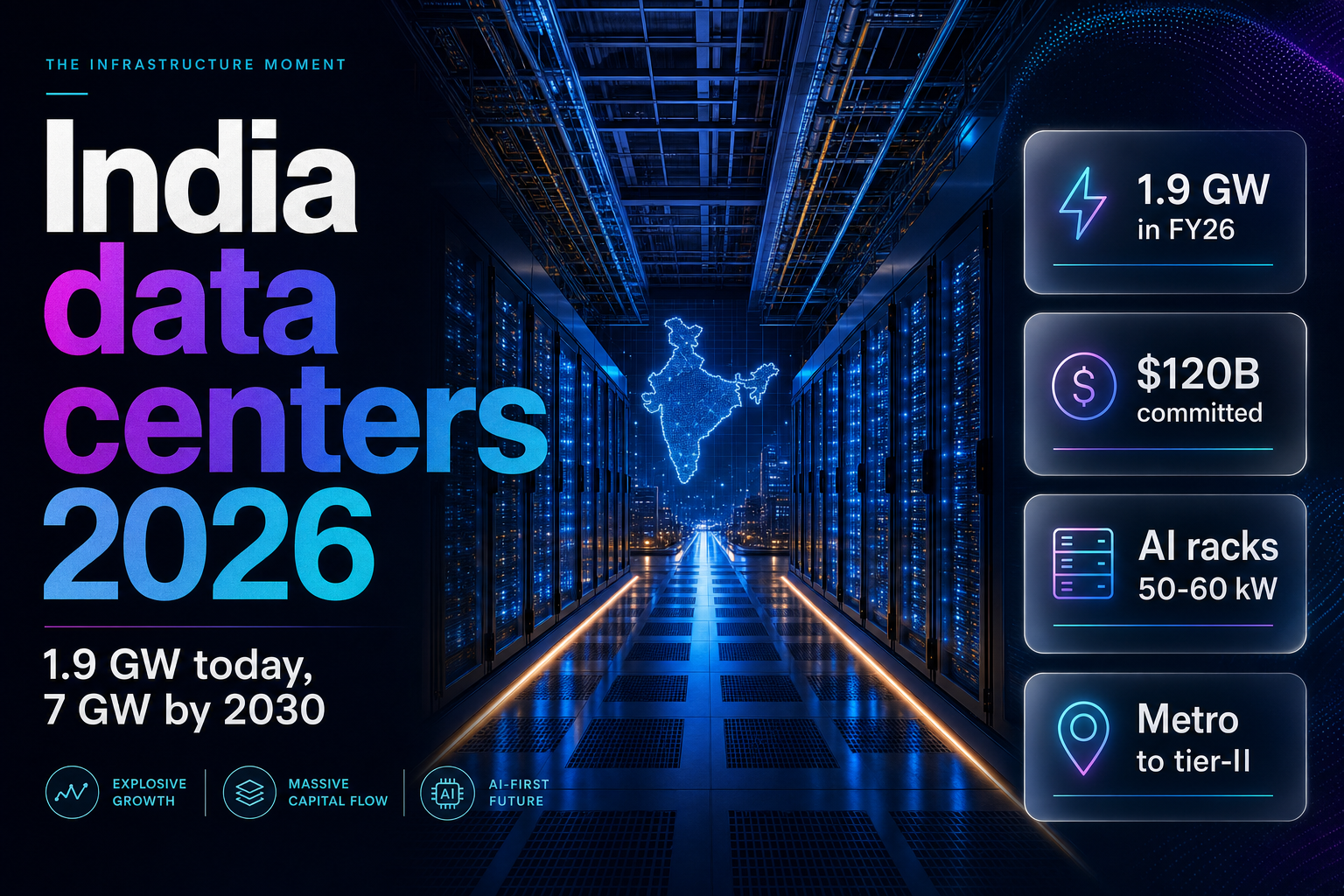
Summary. India's installed data centre capacity reached about 1.9 GW in FY26, up from roughly 778 MW in FY23, and a pipeline of about 4.5 GW is expected over the next five years, taking capacity to 7.0-7.5 GW by 2030, per KPMG's July 2026 report. Investment commitments are a separate number: more than $120 billion has been committed by hyperscalers and operators as of 31 March 2026, which CBRE projects rising about 45% to exceed $180 billion across 2026. The annual market itself is smaller and different again: about $1.7 billion in FY26 rising to about $6.8 billion by FY30. Microsoft has pledged $17.5 billion through 2029, Google $15 billion in Andhra Pradesh, and Amazon a cumulative $48 billion in India by 2030. These figures get quoted as if they mean the same thing. They do not. For a team deciding where to run AI training and inference, the number that matters is power and rack density, not the headline capex. This article separates the three measures, then gives a hosting decision framework.
Three numbers that measure three different things
The single most common mistake in India data centre coverage is treating installed capacity, committed investment, and market revenue as one story. They move on different clocks and mean different things to a buyer. A CTO sizing a workload cares about gigawatts and kilowatts per rack. A finance director cares about the annual rental market. A journalist quotes the multi-year capex pledge because it is the biggest number. The table below keeps them apart.
| Measure | What it actually counts | India figure | Source |
|---|---|---|---|
| Installed capacity | Physical IT load available now (GW) | ~1.9 GW in FY26 | KPMG, Jul 2026 |
| Pipeline capacity | Future load under development (GW) | +~4.5 GW over 5 years; 7.0-7.5 GW by 2030 | KPMG, Jul 2026 |
| Committed investment | Multi-year capex pledges ($) | >$120B as of 31 Mar 2026 | KPMG / CBRE |
| Market size | Annual colocation rental revenue ($) | ~$1.7B FY26 to ~$6.8B by FY30 | KPMG, Jul 2026 |
| Construction opportunity | One-time build-out spend ($) | ~$30B by FY30, ~$90B by FY35 | KPMG, Jul 2026 |
Read across that table and the confusion dissolves. The "$180 billion" you see in headlines is a commitment forecast for 2026, not capacity and not revenue. The market that operators actually bill for is under $2 billion a year today. And the physical thing you rent, gigawatts of IT load, is still under 2 GW.
How much capacity India actually has
Two credible sources give two different capacity numbers, and both are right. KPMG puts installed capacity at about 1.9 GW in FY26. CBRE reports operational IT load closer to 1.3-1.53 GW in early 2026 and projects roughly 30% growth in 2026 on about 500 MW of new supply. The gap is basis and timing: KPMG counts installed capacity through the Indian financial year ending March 2026, while CBRE tracks live operational IT load earlier in the calendar year. Neither is wrong; they answer slightly different questions.
The trajectory is the part both agree on. India's capacity has more than tripled since FY19, with annual additions rising about 2.4 times from roughly 778 MW in FY23 to about 1,900 MW in FY26. KPMG projects 7.0-7.5 GW by 2030 and 16-18 GW by FY35. The demand mix is what should catch an engineering leader's eye: AI workloads are expected to reach about 55% of total data centre capacity by FY30 and about 65% by FY35, and AI workloads alone need an estimated 400-600 MW of incremental capacity by 2027. This is the same capacity-crunch dynamic we track in our AI compute capacity planning analysis, now playing out on Indian soil.
Where the committed capital is really going
The $120 billion figure is real, but it is a stack of multi-year pledges, not money spent this year. KPMG's breakdown, current to 31 March 2026, shows where it sits.
| Investor type | Committed | Notes |
|---|---|---|
| Hyperscalers | $50-55B | Concentrated in metros; Vizag emerging hub |
| Large Indian conglomerates | $40-50B | Expansion of existing clusters |
| Global DC operators | $19-20B | Scaling India platforms |
| Indian DC operators | $10-11B | Pipeline for existing clusters |
| Total | >$120B | As of 31 March 2026 |
The named hyperscaler pledges are the visible edge of that stack. Microsoft has committed $17.5 billion through 2029, its largest in Asia, and will open a Hyderabad data centre region with three availability zones by mid-2026. Google has pledged $15 billion for AI data centres in Andhra Pradesh. Amazon's additional $13 billion lifts its cumulative India commitment to $48 billion between 2026 and 2030, expanding AWS capacity in Mumbai and Hyderabad. CBRE's Anshuman Magazine, its Chairman and CEO for India, South-East Asia, Middle East and Africa, framed the pull plainly:
The combination of a low-bottleneck development environment, a rapidly expanding digital economy, and aggressive hyperscaler commitments positions India as one of the most compelling DC markets globally.
For teams costing their own GPU capacity against this backdrop, our India GPU cloud rental pricing note tracks the rupee rates, and the India FinOps cloud cost moves piece covers how to keep the bill down.
What AI workloads change: power, rack density, cooling
Here is the operational reality most investment headlines skip. AI does not just need more data centres; it needs a different kind. Traditional cloud racks in India ran at 8-12 kW. AI and high-performance computing racks run at 50-60 kW typically, and specialised configurations reach 120-150 kW. AI workloads are 5-10 times more power-intensive than traditional cloud use cases, which changes cooling, power trains, and floor loading all at once.
| Factor | Traditional cloud rack | AI / HPC rack |
|---|---|---|
| Rack density | 8-12 kW | 50-60 kW typical, up to 120-150 kW |
| Cooling | Air | Direct-to-chip liquid above ~50 kW; immersion above ~150 kW |
| PUE target | ~1.5 or higher | Below 1.3 |
| Power intensity | Baseline | 5-10x |
| Existing stock that can be upgraded | High | Only ~25-30% meets AI standards |
That last row is the one to underline. KPMG estimates only about 25-30% of existing Indian data centre capacity can be upgraded to meet AI workload standards. So the headline capacity number overstates how much is actually usable for frontier AI today. Most AI capacity has to be built new, which is why the pipeline matters more than the installed base for anyone planning a 2026-2027 deployment.
Where to host: metro, tier-II, or cloud
India's capacity is concentrated, and that concentration drives the hosting decision. About 90% of capacity sits in Bengaluru, Chennai, Delhi NCR, and Mumbai, with Hyderabad and Pune gaining, and new projects increasingly moving to tier-II locations such as Visakhapatnam for land and power. Maharashtra and Tamil Nadu offer 25-50% land and stamp-duty subsidies, and Mumbai ranks as one of the world's most cost-effective locations to build a data centre, at roughly $6.6 per watt of construction cost.
Two India-specific constraints shape the call. First, the Digital Personal Data Protection Act 2023 (DPDP) pushes onshore storage of personal data, which KPMG estimates could add 1,800-2,000 MW of demand by 2027; if your workload touches Indian personal data, the region choice is a compliance decision, not only a latency one. Second, the government-backed IndiaAI Mission offers subsidised GPU access at about $0.76 per hour against international rates of $3-5 per hour, a real option for research and non-latency-critical training, which we cover in our IndiaAI Mission and sovereign AI analysis.
| Workload | Where to host | Why |
|---|---|---|
| Latency-sensitive inference for Indian users | Metro region near users (Mumbai, Chennai, Delhi NCR, Hyderabad) | Round-trip latency; DPDP onshore for personal data |
| Large training or batch jobs | Tier-II AI parks (e.g. Vizag) or hyperscale regions | Power availability, land, state subsidies |
| Bursty experimentation | Hyperscale cloud regions in India | Elastic capacity, no capital outlay |
| Subsidised research compute | IndiaAI Mission GPU grid | ~$0.76/hr versus $3-5/hr commercial |
| DPDP-bound personal data | Indian regions only | Data localisation requirement |
The pragmatic pattern for most Indian enterprises is a split: keep latency-sensitive inference in a metro region close to users, place large training where power and subsidies are best, and burst experimentation into the hyperscale clouds. Our cloud FinOps for Indian teams guide and the Karnataka data centre policy breakdown go deeper on the state-incentive and cost angles.
FAQ
How eCorpIT can help
eCorpIT is a Gurugram-based, CMMI Level 5 and ISO 27001:2022 certified engineering organisation that helps Indian and India-serving teams place AI workloads where the power, latency, cost, and DPDP constraints actually line up. Our senior engineering teams map your training and inference profiles against metro, tier-II, and hyperscale options, and design a hosting and FinOps plan that survives the 2026-2027 capacity crunch. To pressure-test where your AI workloads should live, talk to us.
References
_Last updated: 27 July 2026._