On this page · 8 sections
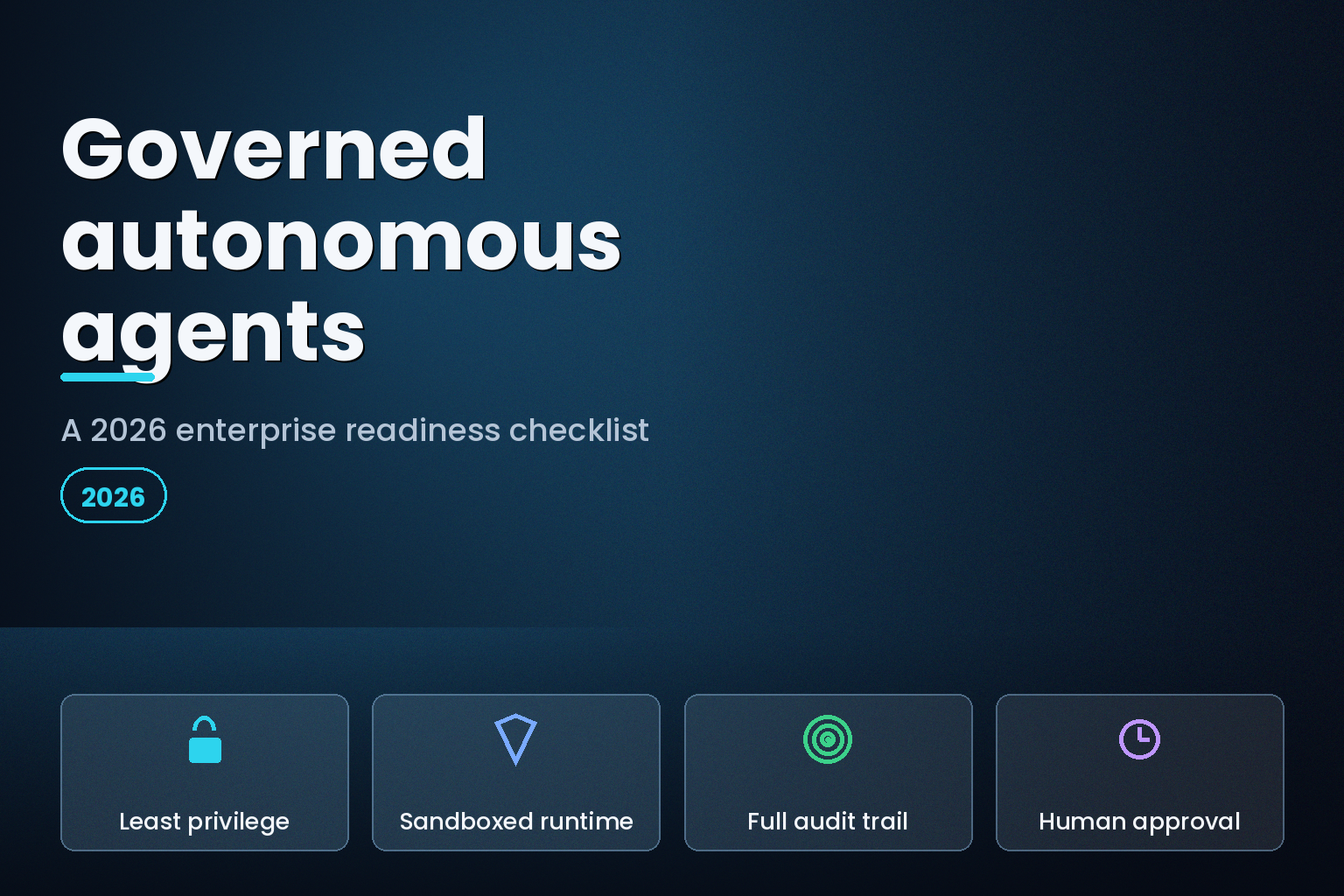
Summary. ServiceNow Project Arc, introduced with NVIDIA at Knowledge 2026 on 5 May 2026, is an autonomous desktop agent that reads local files, runs terminal commands, and calls enterprise APIs to finish multi-step work with no pre-built workflow. It shipped as an early preview, so the controls around it decide whether it is safe to run. Gartner expects task-specific AI agents inside 40% of enterprise applications during 2026, up from under 5% in 2025, and warns that more than 40% of agentic AI projects could be cancelled by 2027 on weak governance and unclear return. The prize is large: Gartner's best case puts agentic AI at about 30% of enterprise application software revenue by 2035, above $450 billion. This guide gives 10 governance controls to put in place before an autonomous desktop agent touches production, each mapped to the ServiceNow AI Control Tower and NVIDIA OpenShell stack so the checklist stays concrete.
An autonomous desktop agent is not a chatbot and not a scripted macro. It is a long-running process that thinks, writes code, executes it, and adapts when a step fails, working across the same tools a person uses: the file system, the terminal, a browser, email, and internal APIs. That is exactly why it needs a different control model. A read-only assistant that drafts text can be wrong and cost you an edit. An agent with a shell and standing credentials can be wrong and cost you a deleted table, an exfiltrated customer list, or a bad change pushed to production while nobody watched.
The good news for 2026 is that the reference architecture now exists in the open. You do not have to invent the control plane from scratch. The ServiceNow and NVIDIA design splits the job cleanly: NVIDIA OpenShell contains what the agent can do, and ServiceNow AI Control Tower governs and records what it did. The 10 controls below are written so you can apply them whether you buy that stack, assemble an equivalent from your cloud provider, or build your own on top of an open runtime.
What actually changed: from scripted automation to autonomous execution
Traditional robotic process automation follows a recorded path. It breaks the moment a button moves. An autonomous desktop agent decides its own path at run time, which is powerful and, without controls, dangerous. The table below sets the two side by side so the risk shift is obvious.
| Dimension | Traditional RPA / scripted automation | Governed autonomous desktop agent |
|---|---|---|
| Task definition | Pre-recorded, step-by-step script | Goal stated in natural language; the agent plans the steps |
| When a step fails | Halts or errors out | Re-plans and tries another route on its own |
| Scope of access | Narrow, fixed to the recorded flow | Broad by default: files, terminal, apps, APIs |
| Governance model | Change-controlled code review | Run-time policy on every action |
| Audit trail | Execution logs of a known script | Every file read, command run, and API call, unknown in advance |
| Failure blast radius | Small and predictable | Large unless contained by design |
The last row is the whole argument. With scripted automation you review the blast radius once, at code review. With an autonomous agent the blast radius is decided at run time, so the review has to move to run time too. ServiceNow describes Project Arc as running every action inside a sandboxed runtime that keeps autonomous activity contained, auditable, and enterprise safe, with the AI Control Tower setting policy, monitoring behaviour, and logging files read, commands executed, and APIs called. That is the shape every deployment needs, regardless of vendor.
"Long-running, autonomous agents are rapidly changing the game for enterprise AI, and delivering them securely at scale requires governance that spans models, software and AI infrastructure," said Kari Briski, vice president of generative AI for enterprise at NVIDIA, in the Knowledge 2026 announcement. The engineering translation: governance cannot be a policy PDF bolted on after the pilot. It has to be three technical layers, containment, control, and record, present before the first real task.
The 10 governance controls
Each control names what it enforces and how the Project Arc and OpenShell reference stack implements it. Treat the table as the checklist and the notes below as the reasoning a senior reviewer should expect.
| # | Control | What it enforces | Reference implementation |
|---|---|---|---|
| 1 | Sandboxed runtime | Every action runs inside an isolated, policy-governed environment | NVIDIA OpenShell secure runtime |
| 2 | Default-deny access | The agent starts with no tools or data until each is granted | OpenShell defines what an agent can see and use |
| 3 | Least-privilege scoping | Access is limited to the current task, not standing and broad | Per-task tool and resource grants |
| 4 | Short-lived credentials | No long-lived secrets the agent can hoard or leak | Scoped, expiring tokens per session |
| 5 | Human approval gates | Irreversible or high-impact actions pause for a person | Policy checkpoints in AI Control Tower |
| 6 | Full action audit log | Files read, commands run, and APIs called are all recorded | AI Control Tower logging |
| 7 | Real-time observability | Behaviour is monitored live, with anomaly and drift alerts | AI Control Tower agent observability |
| 8 | Injection and tool-abuse guardrails | Untrusted content cannot escalate the agent's authority | Runtime policy plus input controls |
| 9 | Pre- and post-deploy evaluation | The agent is benchmarked on multi-step enterprise tasks | NOWAI-Bench and EnterpriseOps-Gym |
| 10 | Kill switch and cost governance | You can stop a runaway agent and track its spend | Lifecycle controls and runtime cost tracking |
1. Put every action inside a sandboxed runtime
Containment is control one because it makes the other nine enforceable. If the agent's file writes, shell commands, and network calls all pass through a runtime you own, you have a single choke point for policy. OpenShell is an open-source secure runtime built for exactly this: developing and deploying autonomous agents in sandboxed, policy-governed environments. If you assemble your own, the equivalent is a per-session container or micro-VM with no host access unless granted.
2. Start from default-deny, not default-allow
An agent that inherits a developer's full laptop or a broad service account is a breach waiting for a bad prompt. Begin with zero tools and zero data scopes, then grant each capability explicitly. With OpenShell, enterprises define what an agent can see, which tools it can use, and how each action is contained. The engineering rule is simple: if a capability was not granted for this task, it does not exist for this agent.
3. Scope every grant to the task, not the role
Least privilege for agents means task-scoped, not role-scoped. A person in finance holds broad access all day; an agent should hold only what the current job needs and lose it when the job ends. This limits how far a hijacked or confused agent can reach. It also makes the audit log readable, because each grant maps to a task rather than to a permanent identity.
4. Issue short-lived, scoped credentials
Standing secrets are the asset attackers want most. An always-on agent that caches a long-lived API key becomes a high-value target. Issue expiring, narrowly scoped tokens per session and rotate them. Our own delivery teams treat any long-lived secret reachable by an agent as a finding, not a convenience. For deeper patterns, see our guide to keeping AI agent credentials with zero standing exposure.
5. Gate irreversible actions behind a human
Autonomy does not mean unattended for everything. High-impact actions, moving money, deleting or exporting data, deploying code, changing production configuration, should pause for human approval regardless of what instruction the agent followed to get there. This is the single highest-use control for regulated work, because it caps the damage a single wrong decision can cause while leaving routine steps fast.
6. Log every action at the level of files, commands, and APIs
An audit trail for an autonomous agent has to record what a person could not predict in advance. ServiceNow AI Control Tower logs files read, commands executed, and APIs called, which is the right granularity: it lets a security lead reconstruct exactly what happened after the fact and approve the agent with confidence. If you cannot answer "which files did the agent touch last Tuesday," you are not ready to deploy.
7. Watch behaviour in real time
Logs tell you what happened; observability tells you what is happening. Live monitoring with anomaly and drift alerts catches an agent that starts calling an unusual API, looping, or drifting from its task before the damage compounds. Pair this with silent-failure detection in your pipelines, an agent that quietly produces wrong output is worse than one that crashes loudly. Our notes on catching silent agent failures in CI/CD go deeper on the test side.
8. Harden against prompt injection and tool abuse
An autonomous agent reads web pages, emails, and documents, any of which can carry instructions designed to hijack it. The defence is layered: treat all retrieved content as untrusted, keep the agent's authority separate from the content it reads, and enforce tool policy at the runtime so a malicious instruction cannot grant itself new powers. This is where containment and default-deny pay off. For the attack patterns and specific guardrails, see prompt-injection guardrails for AI agents.
9. Evaluate on real multi-step work, before and after deploy
An agent that demos well can still fail on the messy, multi-step tasks that make up real operations. ServiceNow and NVIDIA released NOWAI-Bench for this, an open benchmarking suite whose EnterpriseOps-Gym framework scores agents across IT service management, customer service, and HR workflows. Borrow the idea even if you do not use the tool: build a fixed set of representative tasks, score every model and prompt change against it, and run those evals in CI so a regression is caught before users are.
10. Keep a kill switch and track the cost
Two failure modes remain after the first nine controls: the agent that will not stop, and the agent that quietly burns money. You need a hard stop that halts a running agent and revokes its access immediately, and you need per-agent cost tracking. Token economics are central here. NVIDIA states its Blackwell platform delivers more than 50 times the token output per watt of the prior Hopper generation and nearly 35 times lower cost per million tokens, but at millions of always-on workflows even a low per-token cost adds up, so tie runtime spend to a value metric from day one.
Map the controls to owners before the pilot
Controls without owners rot. Before a pilot, assign each of the 10 to a named team so nothing sits in the gap between security, platform, and the application team.
| Control area | Primary owner | First artefact to produce |
|---|---|---|
| Containment (1-3) | Platform engineering | A sandbox profile with default-deny defaults |
| Identity and secrets (4) | Security / IAM | Short-lived credential policy for agents |
| Approval and audit (5-6) | Risk and security | Approved list of gated actions and a log schema |
| Observability (7) | SRE / platform | Live dashboards with anomaly alerts |
| Injection defence (8) | AppSec | Threat model for untrusted content |
| Evaluation (9) | The application team | A task suite and CI eval gate |
| Kill switch and cost (10) | Platform + FinOps | A tested stop procedure and a cost dashboard |
This division matters because agent governance fails at the seams. The application team assumes security owns the audit log; security assumes the platform team scoped the credentials; nobody owns the kill switch until an agent runs away. A one-page ownership map, produced before the pilot, is cheap insurance. For the layered view of how these responsibilities stack, our breakdown of enterprise AI agent governance layers pairs well with this checklist, and both sit under our enterprise AI agents in production pillar.
Compliance: name the rules, then design to them
Regulators moved in 2026, and not always in the direction teams expected. Design to the current text, not last year's slide.
| Regulatory anchor | What it asks of autonomous agents | Timing as of July 2026 |
|---|---|---|
| EU AI Act, Article 50 transparency | Disclose AI interaction; label synthetic content | Applies from 2 August 2026 |
| EU AI Act, high-risk (Annex III) | Conformity assessment, human oversight, logging | Postponed to 2 December 2027 by the AI Omnibus |
| EU AI Act, high-risk embedded products (Annex I) | Same duties for regulated-product AI | Extended to 2 August 2028 |
| India DPDP Act 2023 | Consent, purpose limitation, data minimisation | In force; penalties up to Rs 250 crore per breach |
| Internal audit retention | Reconstruct agent actions after the fact | Set a retention window and enforce it |
The headline correction for planners: the EU AI Act's high-risk obligations did not land on 2 August 2026. After the AI Omnibus political agreement in May 2026, the Annex III high-risk use-case duties were extended to 2 December 2027, and embedded high-risk products to 2 August 2028. What still applies from 2 August 2026 are the Article 50 transparency obligations. That extra runway is a chance to build controls properly, not a reason to skip them, and our deeper read on the EU AI Act enterprise changes for August 2026 tracks the moving dates.
India-specific considerations
For teams in India, or handling Indian users' data, the Digital Personal Data Protection Act 2023 is the binding frame. An autonomous desktop agent that reads local files and internal systems will touch personal data, so purpose limitation and data minimisation apply to the agent exactly as they apply to a human process. Keep the agent's data grants (control 3) mapped to a lawful purpose, retain the audit log (control 6) to evidence handling, and treat cross-system access as in-scope for DPDP. The penalty ceiling of Rs 250 crore per breach makes least privilege a financial control, not only a security one.
A practical order of operations
Do not try to land all 10 controls in one sprint. A workable sequence: stand up the sandboxed runtime and default-deny access first (controls 1-3), because they make everything else enforceable. Add short-lived credentials and human approval gates next (4-5), the two controls that cap worst-case damage. Turn on full logging and live observability (6-7) before any real data flows. Build injection defences and an evaluation suite (8-9) during the pilot, using real tasks. Wire the kill switch and cost tracking (10) before you widen access beyond the pilot team. Only then expand scope.
Project Arc itself is an early preview, and the AI Control Tower integration with the NVIDIA Enterprise AI Factory validated design is generally available, so most enterprises will pilot the pattern before they run it at scale. That gap between preview and production is precisely the window in which the 10 controls should be built and tested.
"Project Arc represents the next step in our ongoing collaboration with NVIDIA, bringing autonomous execution to the desktop," said Jon Sigler, executive vice president and general manager of AI Platform at ServiceNow. "By combining OpenShell's runtime layer with ServiceNow AI Control Tower, and powered by ServiceNow Action Fabric, we're delivering the governance and security that enterprise AI requires." The pattern is the point: containment, control, and record, in that order.
FAQ
How eCorpIT can help
eCorpIT builds and governs enterprise AI agents for teams that need autonomy without losing control. As an ISO 27001:2022 certified and CMMI Level 5 organisation, our senior engineering teams design agent deployments aligned with DPDP Act 2023 and EU AI Act requirements: sandboxed runtimes, least-privilege access, human approval gates, full audit logging, and evaluation suites wired into CI. Whether you are piloting a Project Arc-class agent or assembling an equivalent on your own cloud, we can stand up the control plane and the ownership map before anything touches production. Start the conversation at /contact-us/.
References
- NVIDIA Blog, NVIDIA and ServiceNow partner on new autonomous AI agents for enterprises, 5 May 2026.
- ServiceNow Newsroom, ServiceNow extends agentic AI governance from desktops to data centers with NVIDIA, 5 May 2026.
- NVIDIA, OpenShell secure agent runtime.
- Gartner, 40% of enterprise applications will feature task-specific AI agents by 2026, 26 August 2025.
- Gartner, Over 40% of agentic AI projects will be canceled by end of 2027, 25 June 2025.
- Cloud Security Alliance, EU AI Act high-risk compliance deadline and enterprise readiness.
- European Commission, Regulatory framework for AI (AI Act).
- King Stubb & Kasiva, Penalties and adjudication under India's DPDP Act 2023.
- Gartner, USD 234 billion in enterprise application software spend is at risk from agentic AI, 1 July 2026.
_Last updated: 31 July 2026._