On this page · 10 sections
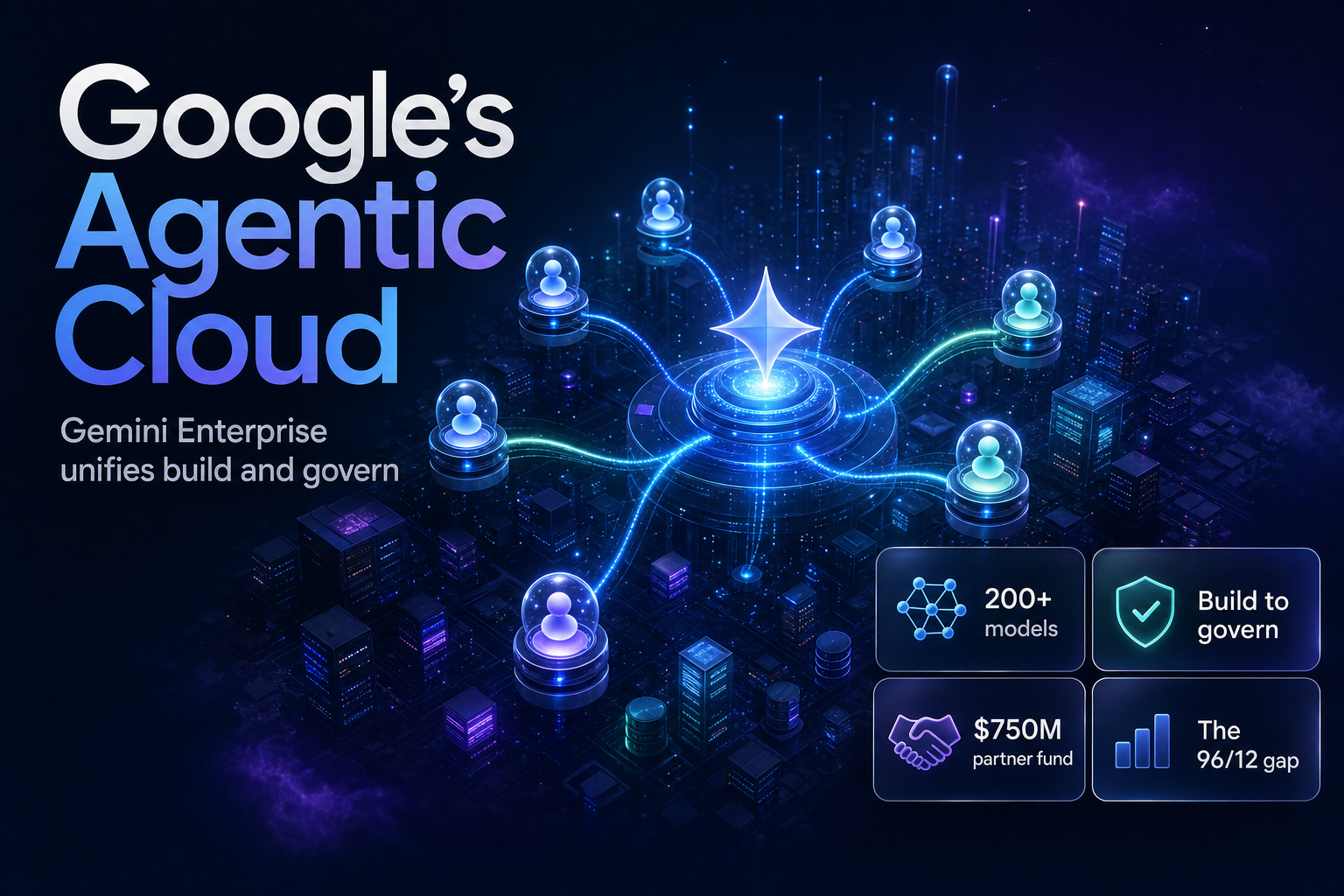
Summary. At Google Cloud Next '26, on April 22, 2026, Google rebranded and consolidated Vertex AI into the Gemini Enterprise Agent Platform, organised around four pillars: build, scale, govern, and optimise. Thomas Kurian, Google Cloud's chief executive, called it "the end-to-end system for the agentic era, the connective tissue between your data, your people and your goals." The platform bundles low-code Agent Studio, a code-first Agent Development Kit, agent-to-agent orchestration, and governance primitives such as Agent Identity and Agent Gateway, with first-class access to more than 200 models through Model Garden and a $750 million partner innovation fund behind it. The reason this matters is not the feature list. It is a gap: an OutSystems 2026 survey of 1,900 IT leaders found 96% of enterprises already run AI agents in production, yet only 12% say they can govern them. Whoever closes that 96-to-12 gap wins the enterprise. This piece explains the platform and how it stacks up against Microsoft and AWS.
What Google announced
Google positioned Gemini Enterprise as an evolution of Vertex AI, not a fresh product, adding what TechTarget called connective tissue between model building, agent building, and the operational layer around them. Kurian framed the moment bluntly: "The experimental phase is behind us, and now the real challenge begins."
The platform gives builders a choice of surface. Agent Studio is a low-code visual interface, the upgraded Agent Development Kit is the code-first path, and a no-code Agent Designer lets non-engineers build trigger-based workflows. A graph-based framework organises agents into networks of sub-agents with defined logic for how they cooperate, and multimodal streaming supports live audio and video. For long jobs, new long-running agents work autonomously in secure cloud sandboxes. Underneath sits Google's AI Hypercomputer and its eighth-generation TPUs.
The four pillars
The clearest way to read the platform is by its four organising pillars and the components under each.
| Pillar | What it covers | Key components |
|---|---|---|
| Build | Author agents at any skill level | Agent Studio, Agent Development Kit, Agent Designer |
| Scale | Run agents reliably | Agent Runtime, agent-to-agent orchestration, Memory Bank |
| Govern | Control the agent estate | Agent Identity, Agent Gateway, Agent Registry, Agent Observability |
| Optimise | Test and improve | Agent Simulation, Agent Evaluation |
Model Garden gives the platform first-class access to more than 200 models, including Gemini 3.1 Pro, Gemini 3.1 Flash Image, and Lyria 3, alongside open models like Gemma 4. Memory Bank, which holds persistent context across sessions, targets the agent-amnesia problem that has blocked multi-turn enterprise use in support, analytics, and marketing.
The real problem: governing agents
The feature that should shape buying decisions is governance, because that is where enterprises are failing. When 96% of firms have agents in production and only 12% can govern them, the risk is not that agents fail to launch. It is that they launch without identity, policy, or observability, and no one can see what they did or why. Our guide to prompt-injection and agent security covers why unmanaged agents are a security liability.
Gemini Enterprise answers with Agent Identity, Agent Gateway, Agent Registry, and Agent Observability, so agents get identities, controlled tool access, a catalogue, and audit trails. That is a real governance stack. The open question, flagged by comparison write-ups, is whether it enforces unified policy as tightly as a control plane built on an existing identity system, a point where Microsoft has a structural claim, covered next.
How it compares to Microsoft and AWS
Three full-stack bets are now on the table, and the right one depends on where your data and identity already live.
| Platform | Build layer | Governance | Pricing model |
|---|---|---|---|
| Gemini Enterprise | Agent Studio, ADK, Agent Designer | Agent Identity, Gateway, Registry, Observability | Usage-based |
| Microsoft Azure AI Foundry + Agent 365 | Foundry, Copilot Studio, Agents Toolkit | Agent 365 control plane, inherits Entra ID | Per seat (~$30 plus $15 with Agent 365) |
| AWS Bedrock + Amazon Q | Bedrock multi-model API | IAM-based, per-service | Usage-based; Q Business ~$20/user |
Microsoft split its story into Azure AI Foundry as the build-and-run layer, with Agent Service generally available since May 2025, and Agent 365, launched November 2025, as a control plane that governs agents across Salesforce, ServiceNow, Google, and open-source frameworks. Its structural advantage is identity: if you already run Microsoft 365 and Entra ID, agents inherit existing identity, compliance, and data-loss-prevention policy on day one. AWS Bedrock competes on model breadth, routing between Claude, Llama, Mistral, Cohere, and Amazon Nova through one API, which suits AWS-native and multi-framework teams. Our comparison of Microsoft's sales and service agents covers that side in depth.
The pricing split is strategic. Microsoft's per-seat model is predictable and built for broad rollout across every Microsoft 365 user; Google's and AWS's usage-based models fit variable-intensity agent workloads but make budgeting harder. Choose on your existing stack and workload shape, not on the demo.
The honest caveats
Two cautions belong in any decision. First, governance maturity: naming Agent Identity and Agent Gateway is not the same as proving unified, enforceable policy across every tool an agent touches, so validate the governance story against your actual compliance requirements rather than the keynote. Second, usage-based cost: variable agent workloads can produce variable bills, so model your expected token and tool-call volume before committing, and instrument spend from day one. As with any vendor platform, treat headline numbers like the 200-model count and the $750 million fund as reasons to evaluate, not reasons to sign.
India-specific considerations
For Indian enterprises, three factors matter beyond features. Data residency: confirm which Gemini Enterprise services run in India-region infrastructure before routing regulated data through agents, and design under the Digital Personal Data Protection Act, 2023 with a documented compliance basis. Cost predictability: usage-based pricing needs disciplined FinOps, especially where the rupee cost of variable agent runs can surprise a budget. Existing stack: many Indian enterprises already run Microsoft 365, which tilts the identity-and-governance argument toward Foundry and Agent 365, while AWS-heavy shops lean to Bedrock. Match the platform to what you already operate, then close the governance gap deliberately.
What to do now
Start with governance, not build. Inventory the agents already running in your organisation, because if you match the survey you have more than you think and can govern fewer than you assume. Decide where identity and policy will live, then pick the platform that fits that decision and your existing cloud. Run a scoped pilot on one business process, measure it on task success, cost per completed task, and auditability, and require an agent identity, access policy, and observability trail before anything reaches production. Our enterprise AI agent development guide walks through that sequencing.
How eCorpIT can help
eCorpIT is a Gurugram technology consultancy, founded in 2021, that helps enterprises build and govern AI agents. Our senior-led teams evaluate Gemini Enterprise, Microsoft Azure AI Foundry with Agent 365, and AWS Bedrock against your existing stack, design the identity, policy, and observability layer so agents are governable from day one, and align deployments with Digital Personal Data Protection Act, 2023 requirements. We run scoped pilots measured on cost per completed task, not demos. To plan an agent platform decision, contact us.
FAQ
References
- Introducing the Gemini Enterprise Agent Platform — Google Cloud
- Google announces the Gemini Enterprise Agent Platform — THE Journal
- Claude vs ChatGPT vs Copilot vs Gemini: 2026 enterprise guide — IntuitionLabs
- Bedrock vs Foundry vs Gemini Enterprise — Triotech Systems
- Compare Copilot vs Gemini Enterprise — Microsoft
_Last updated: July 14, 2026._