On this page · 10 sections
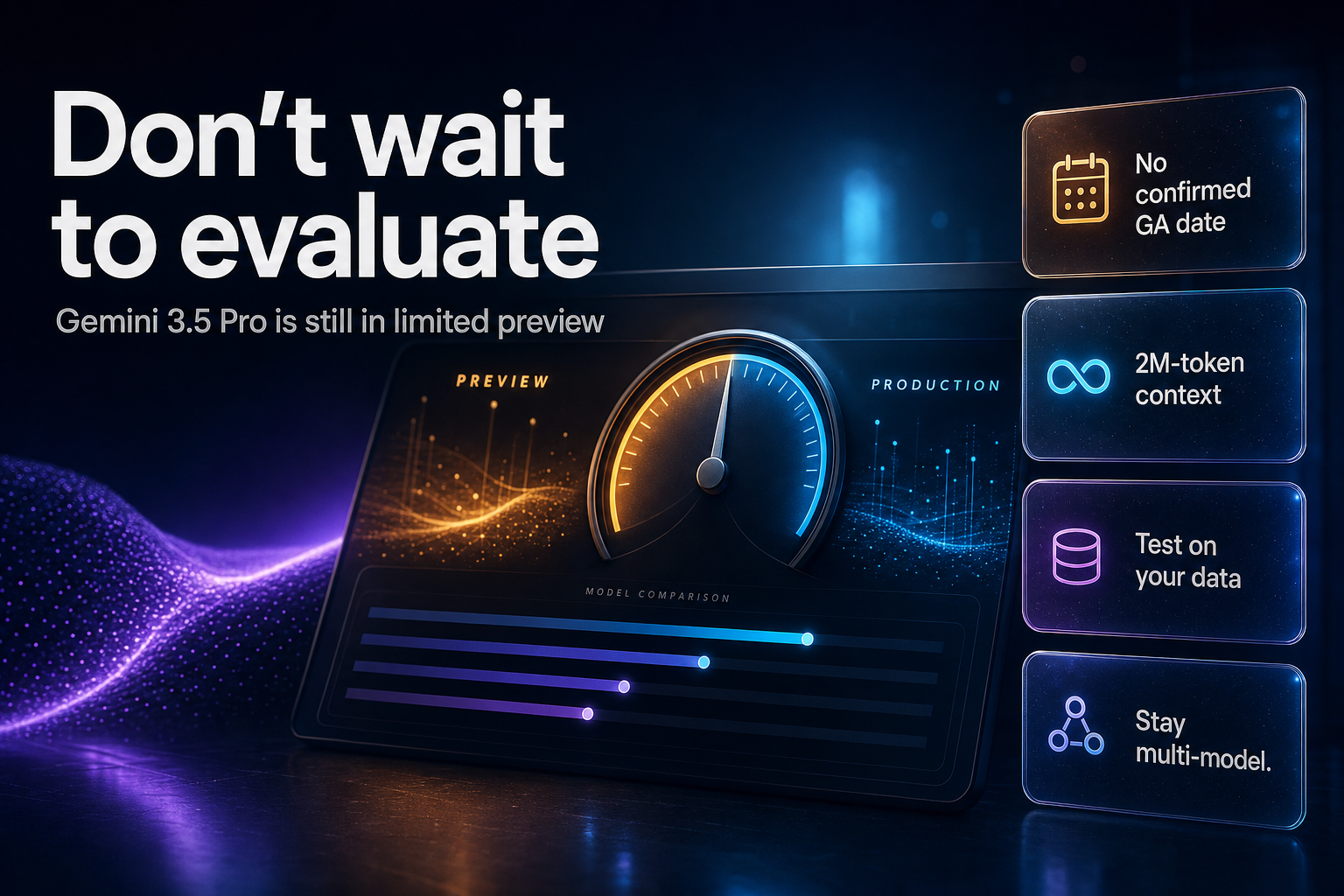
Summary. Gemini 3.5 Pro entered the second week of July 2026 still in limited preview, with no confirmed general-availability date, no published benchmarks, and no final pricing. Google unveiled it at I/O on May 19, 2026, where Sundar Pichai said it would arrive "next month," but June passed and the model stayed in a small Vertex AI enterprise preview. Reporting ties the slip to three issues: token efficiency, coding below flagship standard, and long-horizon reasoning short of the I/O bar. Reported specs point to a 2 million-token context window and pricing near $15 per million input tokens and $60 per million output, though none is official. One delay headline put Google's market-cap drop at about $225 billion. If you are evaluating it, the wait is not idle time.
A model in preview is a planning problem, not a product decision. You cannot ship on it, the numbers can change, and the timeline has already moved once. But teams that treat the preview window as a pause fall behind teams that use it to build the evaluation they will need whichever model wins. This article covers exactly where Gemini 3.5 Pro stands, why it slipped, what is reported versus confirmed, and the concrete work an enterprise team should do now.
Where Gemini 3.5 Pro actually stands
As of the second week of July 2026, Gemini 3.5 Pro is in limited preview without a confirmed GA date, published benchmarks, or final pricing, per MarketScale. Google is staging access in waves rather than a single launch, as reporting describes: an AI Studio whitelist preview, then Vertex AI enterprise channels, then general availability for Gemini Advanced subscribers.
| Stage | Audience | Reported timing |
|---|---|---|
| I/O reveal | Public announcement | May 19, 2026 |
| AI Studio preview | Whitelisted developers | July 8 to 12, 2026 |
| Vertex AI channels | Enterprise preview customers | Around July 15, 2026 |
| GA for subscribers | Gemini Advanced users | July 22 to 28, 2026 |
| Confirmed GA date | Everyone | Not yet set |
Why it slipped
The delay was not a single miss. Early testers flagged three linked reasons: token-efficiency concerns, coding performance that was not yet at flagship standard, and long-horizon, multi-step reasoning that fell short of the bar Google set at I/O, per Bind AI. Those are the three capabilities enterprise agent workloads lean on hardest, which is why Google held the model rather than shipping to the I/O date. The market noticed: one account put the associated market-cap drop at roughly $225 billion, per tech-insider. A held launch is usually better news for buyers than a rushed one, because the failure modes surface in Google's testing rather than your production.
What is reported but not confirmed
Treat the specs as provisional. Reporting points to a 2 million-token context window, double the 1 million offered by Claude Opus 4.8 and most rivals, and pricing near $15 per million input tokens and $60 per million output, per coverage of the rollout. None of this is official until Google publishes it, so build your plan around ranges, not the exact numbers.
| Detail | Status | Note |
|---|---|---|
| Limited preview | Confirmed | Vertex AI, whitelisted access |
| GA date | Not confirmed | Reported waves through late July |
| 2M-token context | Reported | Double Claude Opus 4.8's 1M |
| Input and output pricing | Reported | Near $15 and $60 per million tokens |
| Published benchmarks | Not available | None at preview |
What enterprise teams should do now
The preview window is the time to prepare, not to wait. Five steps put you ahead of the GA date.
Build your own evaluation harness on your data. Benchmarks tell you whether a model is improving under controlled conditions, but not whether it works on your data, in your product, with your users, under your cost and latency limits, as model-selection analysis argues. A reusable harness with your tasks and your acceptance thresholds outlasts any one model.
Do not build production on a preview endpoint, because the API, pricing and behaviour can still change. Keep the model behind an abstraction so you can swap it. Plan for staged access, since AI Studio, Vertex AI and consumer GA arrive at different times. And keep a multi-model posture: the average enterprise now runs four or more distinct large models in production, choosing per workload rather than betting on one, per enterprise comparison guidance.
| Do this now | Why it matters |
|---|---|
| Write an eval harness on your tasks | Benchmarks do not predict fit on your data |
| Set acceptance thresholds for cost and latency | A model must clear your limits, not a leaderboard |
| Keep the model behind an abstraction | Preview APIs and pricing can still change |
| Map the staged rollout to your access | AI Studio, Vertex and GA land at different times |
| Maintain a multi-model shortlist | Enterprises run four or more models in production |
The bigger point: stop picking by benchmark
Gemini 3.5 Pro's delay is a useful reminder that a leaderboard score is not a deployment decision. The question that matters is whether a model performs on your workflows under your constraints, and the only way to answer it is your own evaluation. Current guidance already splits by fit: Claude Opus 4.8 for complex coding and high-stakes agent work, GPT-5.5 for general professional workflows, and Gemini for long-context, multimodal or Google Cloud-connected workloads, per model comparison analysis. We lay out a full framework in our GPT-5.6 versus Claude Sonnet 5 comparison and the strategy in our generative AI enterprise strategy guide.
India-specific considerations
For Indian enterprises, three points apply. First, data residency: if you evaluate through Vertex AI, confirm the region and whether data stays in a boundary the Digital Personal Data Protection Act, 2023, requires, before you send real data into a preview. Second, cost: reported pricing is in dollars, so a 2 million-token context is powerful but expensive at scale, and long-context calls priced near $15 per million input tokens add up fast in rupee terms. Third, the multi-model habit fits Indian teams well, since Google Cloud, Azure and independent APIs each suit different workloads. For cost-sensitive options, see our note on Chinese open models and enterprise AI cost.
The bottom line
Gemini 3.5 Pro is not late so much as held, and a held frontier model is usually safer to adopt than a rushed one. Until Google confirms the GA date, benchmarks and pricing, treat the 2 million-token context and the dollar figures as provisional. Spend the preview window building an evaluation harness on your own data, keep the model behind an abstraction, and keep three or four models on your shortlist. The team that has its eval ready on GA day moves in a week; the team still arguing over benchmarks takes a quarter.
FAQ
How eCorpIT can help
eCorpIT is a Gurugram-based technology consultancy, founded in 2021 and CMMI Level 5 certified, with senior-led AI engineering teams. We build model-evaluation harnesses on your own data, set cost and latency thresholds, keep model calls behind a swappable abstraction, and design deployments aligned with DPDP data-residency requirements. If you want to be ready to judge Gemini 3.5 Pro on the day it ships, rather than argue over benchmarks, talk to us.
References
_Last updated: July 11, 2026._