On this page · 11 sections
- What the 2026 seed bar actually looks like
- Why 12 weeks, and what fits inside it
- The stack, and what it actually costs
- The five things diligence checks that a demo never shows
- Billing is the part founders underestimate
- India-specific considerations
- What we cut from every v1
- How the 12 weeks are staffed
- FAQ
- How eCorpIT can help
- References
Summary. Indian startups raised $5.2 Bn across 501 deals in H1 2026, down 9% year on year from $5.7 Bn, according to Inc42's Indian Tech Startup Funding Report. The money did not leave the early stage. Seed-stage startups raised $478 Mn, an 18% increase over the previous year, with the median seed ticket steady at $1 Mn. Late-stage funding fell 27% to $2.2 Bn over the same six months, and the median Series A and Series B ticket dropped 25% to $6 Mn. The pattern matters for anyone planning a first build: capital at seed is available, capital after seed is harder, and the gap between them is closed by what your v1 can prove. A 12-week SaaS MVP is enough time to build something that answers a diligence question. It is not enough time to build a platform. This is the plan we use, the stack costs as published in July 2026 by Stripe, Vercel and Supabase, and the five things investors check that a demo never shows.
What the 2026 seed bar actually looks like
The headline number is a decline, and the headline number is misleading for founders at the start of a build.
Inc42's H1 2026 funding report puts total Indian startup funding at more than $5.2 Bn across 501 deals for the January to June period. That is 9% below the $5.7 Bn raised in H1 2025. Deal count went the other way, rising 7% year on year to 501. The median ticket across all stages held at $3 Mn, unchanged from the previous year.
Break it apart by stage and the shape changes. Seed-stage startups raised $478 Mn, up 18%, even though seed deal volume fell marginally. The median seed ticket stayed at $1 Mn. Growth-stage funding rose 15% to $2.3 Bn. Late-stage funding fell 27% to $2.2 Bn. Series A and Series B median tickets fell 25% to $6 Mn, while deal activity rose, which suggests investors spread the same capital across more companies rather than concentrating it.
Kannan Sitaram, cofounder and partner at Fireside Ventures, put the early-stage view plainly: "From where we stand as early-stage investors, we haven't seen a slowdown. We're continuing to see strong entrepreneurship, new founding teams and plenty of capital flowing into early-stage consumer companies."
Vikram Gupta, managing partner at IvyCap Ventures, described the shift in what investors are underwriting: "First, the global AI infrastructure buildout has created real enterprise demand... Second, investors are moving away from businesses where the moat is distribution towards companies where the moat is technology."
That second sentence is the one to build against. If the moat investors want is technology rather than distribution, your MVP is the artifact that has to carry the claim. AI startups raised $676 Mn across 57 deals in H1 2026, a 317% jump year on year with deal volume up 90%. The capital is going to teams who can show the thing works.
So the practical bar for a 2026 seed conversation is not "we have a landing page and a waitlist". It is a running product with real users, instrumented, with a billing path that works and a data model that will not need to be thrown away at 1,000 customers. Twelve weeks is enough for exactly that, and nothing more.
Why 12 weeks, and what fits inside it
Twelve weeks is not a marketing number. It is the point where three constraints meet.
The first is capital. At a $1 Mn median seed ticket, a founder pre-seed is typically funding the build from savings, an angel cheque, or revenue. Every additional month of build is burn against a round that has not closed.
The second is decay. Product assumptions have a shelf life. A spec written in January and shipped in October was answered by the market somewhere around May, and nobody was watching.
The third is engineering reality. Twelve weeks of a senior team is roughly 1,000 to 1,400 engineering hours across two to three people. That buys one workflow done properly. It does not buy three workflows done adequately. The single most common failure we see in a v1 is a team that spent 12 weeks building four half-features instead of one complete one, and then could not demo any of them end to end.
The discipline is subtraction. Pick the one workflow where your product is different, build it to production quality, and stub or buy everything around it.
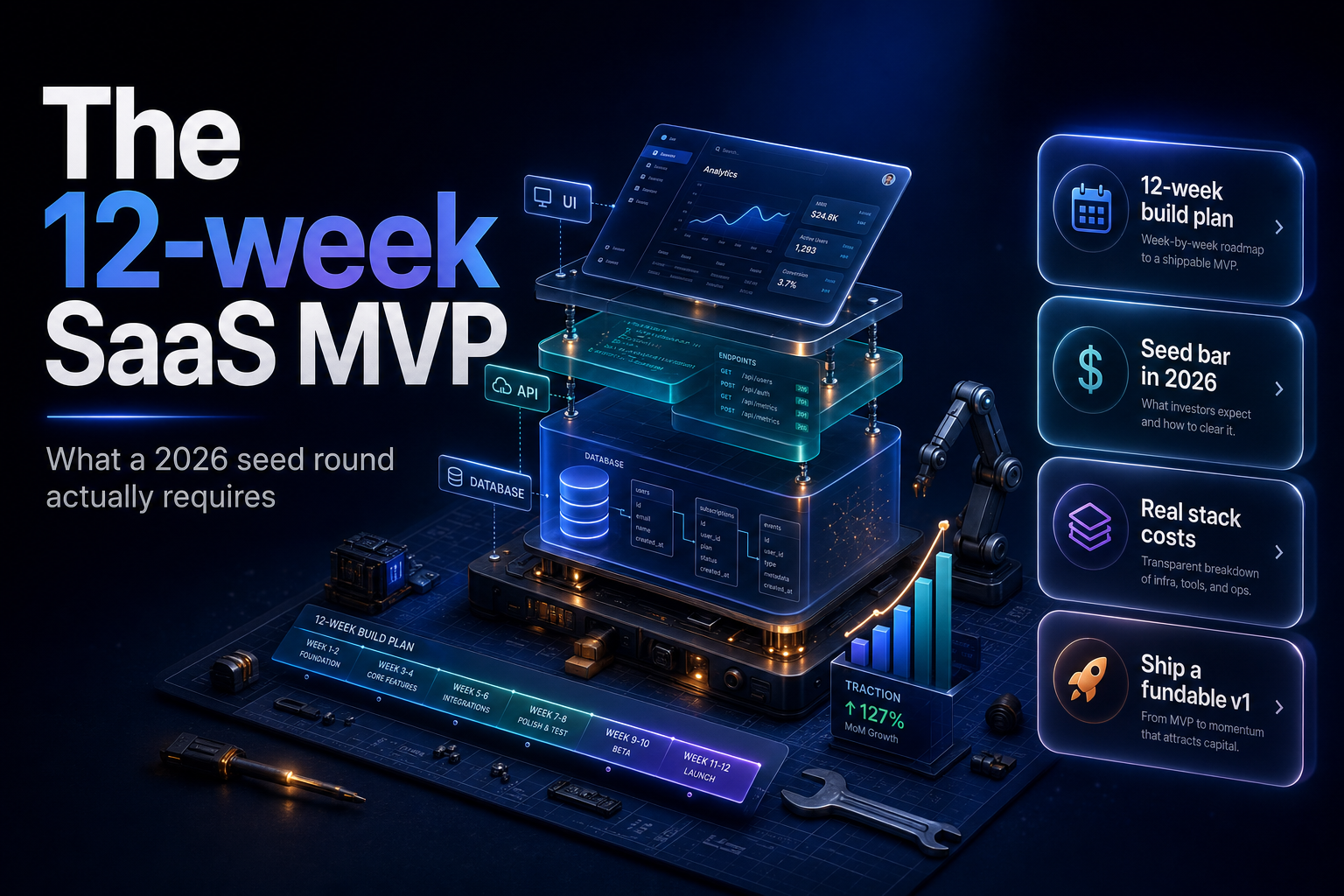
| Phase | Weeks | What ships |
|---|---|---|
| Definition and architecture | Weeks 1 to 2 | One workflow chosen and written down, data model, auth model, deploy pipeline running to a live URL |
| Core build | Weeks 3 to 7 | The differentiating workflow end to end, real data, no mocks in the primary path |
| Billing and accounts | Weeks 8 to 9 | Subscription, plan limits, invoices, the upgrade and downgrade paths |
| Instrumentation and hardening | Weeks 10 to 11 | Event tracking, error reporting, rate limits, idempotency on writes, backups tested |
| Pilot and handover | Week 12 | First external users on production, runbook, metrics dashboard, diligence pack |
The order is deliberate. Billing lands before instrumentation because a product that cannot take money is not a business, and because billing exposes data model mistakes that are cheap to fix in week 8 and expensive in month 8.
The stack, and what it actually costs
Founders consistently overestimate infrastructure cost at launch and underestimate it at scale. Here are published July 2026 prices from the vendors most first builds land on.
Supabase uses organization-based billing. The Pro plan starts at $25 per month and includes $10 per month in compute credits, which covers one Micro instance. Compute is billed per project, hourly. A Micro instance is $10 per month for a 2-core ARM machine with 1 GB RAM, 60 direct connections and 200 pooler connections. A Pro organisation running two projects on Micro compute costs $25 for the plan, $10 for each project, less the $10 credit, so $35 per month. Pro includes 100,000 monthly active users, then $0.00325 per MAU; 8 GB disk per project, then $0.125 per GB; and 250 GB egress, then $0.09 per GB. Spend caps are on by default on the Pro plan, which is a setting worth leaving alone until you understand your usage.
Vercel charges a $20 per month Pro platform fee that includes one deploying seat and $20 per month in usage credit. Additional deploying seats are $20 per month each; viewer seats are free and unlimited. The plan includes 1 TB Fast Data Transfer and 10,000,000 Edge Requests per month before usage bills against the credit. Vercel enables spend management notifications for new customers at $200 per billing cycle by default. The add-ons are where the number moves: SAML Single Sign-On is $300 per month, a HIPAA BAA is $350 per month, Advanced Deployment Protection is $150 per month, and Static IPs are $100 per month per project.
Stripe charges 2.9% plus 30 cents per successful domestic card transaction, with 1.5% added for international cards, 1% if currency conversion is required, and 0.5% for manually entered cards. Stripe Billing on pay-as-you-go is 0.7% of billing volume, covering billing transactions processed on and off Stripe and excluding one-off invoices.
| Layer | Typical v1 choice | Published cost, July 2026 |
|---|---|---|
| Application hosting | Vercel Pro | $20/month platform fee, includes 1 seat and $20 usage credit |
| Database and auth | Supabase Pro, Micro compute | $25/month plan + $10/month compute, less $10 credit |
| Payments | Stripe cards | 2.9% + 30c domestic, +1.5% international |
| Subscriptions | Stripe Billing, pay-as-you-go | 0.7% of billing volume |
| Extra deploying engineers | Vercel additional seats | $20/month per seat |
Run the arithmetic for a two-engineer team with one production project and one staging project: $20 Vercel platform fee, $20 for the second deploying seat, $25 Supabase Pro, $20 compute across two projects less the $10 credit. That is $75 per month before traffic. The infrastructure is not what makes a v1 expensive. Engineering time is.
Where the cost does bite is compliance add-ons bought early. A HIPAA BAA at $350 per month and SAML at $300 per month on Vercel is $650 per month, or $7,800 a year, for controls that a pre-revenue product frequently does not yet need. Supabase puts SOC 2 and ISO 27001 on the Team plan at $599 per month, with HIPAA as a paid add-on above that. Buy those when a signed contract requires them, not because a template security questionnaire asked.
The five things diligence checks that a demo never shows
A demo shows the happy path. Technical diligence, when it happens, goes looking for the things a founder-built or agency-built v1 usually skips. Five come up repeatedly.
The data model survives the pivot
The question is not whether the schema is elegant. It is whether the schema encodes an assumption that the business is about to break. Multi-tenancy is the classic case. If tenant identity is implicit, and every table assumes one organisation per user, then the first enterprise customer who wants two teams under one contract forces a migration through every query in the codebase. Model the tenant as a first-class entity in week 1, even if you launch with one user per tenant. The cost is a column. The alternative is a rewrite.
Writes are idempotent
Any endpoint that takes money or creates a record needs to be safe to retry. Networks fail mid-request, users double-click, and payment webhooks are delivered more than once by design. Without an idempotency key on those paths, a retry becomes a duplicate charge, and a duplicate charge becomes a support conversation that costs more than the subscription. We wrote up the mechanics separately in idempotency keys and safe retries for REST APIs. In a 12-week build this is a week-10 task, and it takes about a day.
The billing state machine is real
Subscriptions are a state machine: trialing, active, past due, cancelled, and the transitions between them. Most v1s implement "active" and discover the rest in production. Stripe Billing at 0.7% of billing volume handles the invoicing, but it does not decide what your product does when a card fails on day 34. That decision is yours, and it belongs in the code before the first paying customer, not after.
Someone can tell you what happened
Event tracking and error reporting are not week-12 extras. Without them you cannot answer the first question a seed investor asks about traction, which is what users actually do in the product. You also cannot debug production. Instrumentation is the difference between "retention looks soft" and "72% of signups never complete step three, and here is the drop-off".
The backups have been restored at least once
An untested backup is a belief, not a backup. Supabase Pro includes daily backups stored for 7 days; Team extends that to 14 days, and point-in-time recovery is a $100 per month add-on per 7 days of retention. The configuration is trivial. The test is the part teams skip. Restore into a scratch project once, in week 11, and write down how long it took.
Billing is the part founders underestimate
Payments look like a solved problem from the outside. Integrate Stripe, take money. In practice, billing is where product decisions and engineering decisions collide, and it is the most common reason a 12-week build slips to 16.
Three things drive the slip.
Plan limits have to be enforced somewhere. If your pricing says 5 projects on Starter and 50 on Growth, something in the code counts projects and blocks the sixth. That counter has to be correct under concurrency, it has to be visible to the user before they hit it, and it has to change when the plan changes mid-cycle. This is real work, and it is invisible on a pricing page.
Proration is arithmetic that users will check. When a customer upgrades on day 12 of a 30-day cycle, the invoice has to make sense to them. Stripe computes it; your product has to explain it.
Failed payments are a workflow, not an error. Cards expire. At 2.9% plus 30 cents per domestic transaction and an extra 1.5% on international cards, the economics of a failed retry are small, but the churn from a silent failure is not. Dunning, retries, and a clear in-product state for past due accounts belong in v1.
For an India-facing product, add currency. Stripe charges 1% when currency conversion is required and 1.5% on international cards. A product priced in dollars but sold to Indian customers pays both on a meaningful share of transactions, which is a real margin question at seed scale, not a rounding error.
India-specific considerations
Building from India for a global market is now the default rather than the exception, and it changes three things about a v1.
Cost structure is the obvious one, and it is frequently overstated in both directions. Senior engineering capacity in India is materially cheaper than equivalent capacity in the United States or Western Europe, but a 12-week MVP is priced by seniority and scope, not geography alone. A team that quotes a fraction of the market rate is quoting a different scope, and the difference usually surfaces in weeks 10 to 12 when the hardening work that was never in the estimate turns out to be necessary.
Data protection is the second. The Digital Personal Data Protection Act, 2023 is India's data protection statute, passed by Parliament in August 2023, and it puts obligations on the data fiduciary, the entity that determines the purpose and means of processing personal data. As Anirudh Burman's analysis for the Carnegie Endowment sets out, those duties include data erasure on consent withdrawal or on expiry of the specified purpose, notifying a breach to the Data Protection Board of India in a prescribed manner, appointing a data protection officer, and setting up grievance redress. For a SaaS product handling Indian users' personal data, the design decisions that follow are the boring ones: knowing what personal data you hold and why, being able to delete it on request, being able to show consent was given for the purpose you are using it for, and being able to detect and report a breach. Each of those is cheap to design in during week 1 and expensive to retrofit. We covered the build-side detail in our note on DPDP-ready application development. We design applications aligned with DPDP requirements; the compliance determination itself is the operator's, made with their counsel.
Payment rails are the third. A product selling to Indian customers and a product selling from India to the world have different billing architectures, and choosing one in week 8 without deciding which you are is how teams end up with two payment integrations and neither working properly.
What we cut from every v1
The plan above works because of what is not in it. These are the items we argue out of scope on nearly every 12-week build, and the reasoning we use.
| Commonly requested | Verdict for a 12-week v1 | Why |
|---|---|---|
| Admin dashboard | Cut | Query the database directly for the first 100 customers. Build it when support volume justifies it |
| Mobile app | Cut | A responsive web app answers the same diligence question at a fraction of the build cost |
| SSO and SAML | Defer | $300/month on Vercel plus build time. Add it when an enterprise contract requires it |
| Multi-region deploy | Defer | Latency is not your problem at 50 users. It is a week of work whenever you actually need it |
| Custom design system | Cut | Use a component library. Nobody has ever declined a seed round over a button radius |
| Microservices | Cut | A modular monolith is faster to build, easier to debug, and splits cleanly later |
That last row is the one founders push back on hardest. The instinct is that a service-oriented architecture is the professional choice, and that a monolith is a shortcut that will need undoing. In our experience the opposite is true at this stage: a well-structured monolith with clear module boundaries is the fastest path to a working product and the cheapest thing to decompose later, once the boundaries are known rather than guessed. We have written about the decomposition itself in application modernization from monolith to microservices. The mistake is doing it in week 3 of a product that has no users.
The real cost of a v1 is rarely the code. It is the decisions the code makes on your behalf before you have the evidence to make them.
How the 12 weeks are staffed
A 12-week SaaS MVP is not a one-person job and it does not need ten people. The shape that works is small and senior.
Two engineers who can each take a feature from schema to deployed UI. One product-minded lead who owns scope and says no. Part-time design, front-loaded into weeks 1 and 2 so the build is not waiting on screens. Part-time QA from week 8, when there is enough product to test.
What breaks this shape is junior-heavy staffing on a fixed deadline. Twelve weeks has no slack for rework. The value of a senior engineer here is not speed of typing, it is the number of decisions they get right on the first attempt, in weeks 1 and 2, that nobody has to revisit in week 11.
Related reading on how we scope custom builds: custom web application development, and on keeping cloud spend honest once you are live: cloud FinOps as a managed service.
FAQ
How eCorpIT can help
eCorpIT is a Gurugram-based technology organisation, founded in 2021, CMMI Level 5 appraised and MSME certified, with senior-led engineering teams and partnerships including AWS, Microsoft and Google. We scope and build SaaS MVPs on the 12-week shape described above: one differentiating workflow to production quality, billing that works, instrumentation that answers the traction question, and a data model that will not force a rewrite at your first enterprise contract. We are direct about what belongs in a v1 and what does not, and we hand over a running product with a runbook rather than a demo. If you are planning a first build and want the scope argued properly before the estimate, talk to our team.
References
- Stripe, Pricing and fees
- Stripe, Billing pricing
- Stripe, Local payment methods pricing
- Vercel, Vercel Pro plan
- Vercel, Pricing on Vercel
- Vercel, Spend management
- Supabase, Pricing and fees
- Supabase, Compute and disk
- Supabase, Organization-based billing
- Anirudh Burman, Carnegie Endowment for International Peace, Understanding India's New Data Protection Law
Last updated: 16 July 2026.