On this page · 11 sections
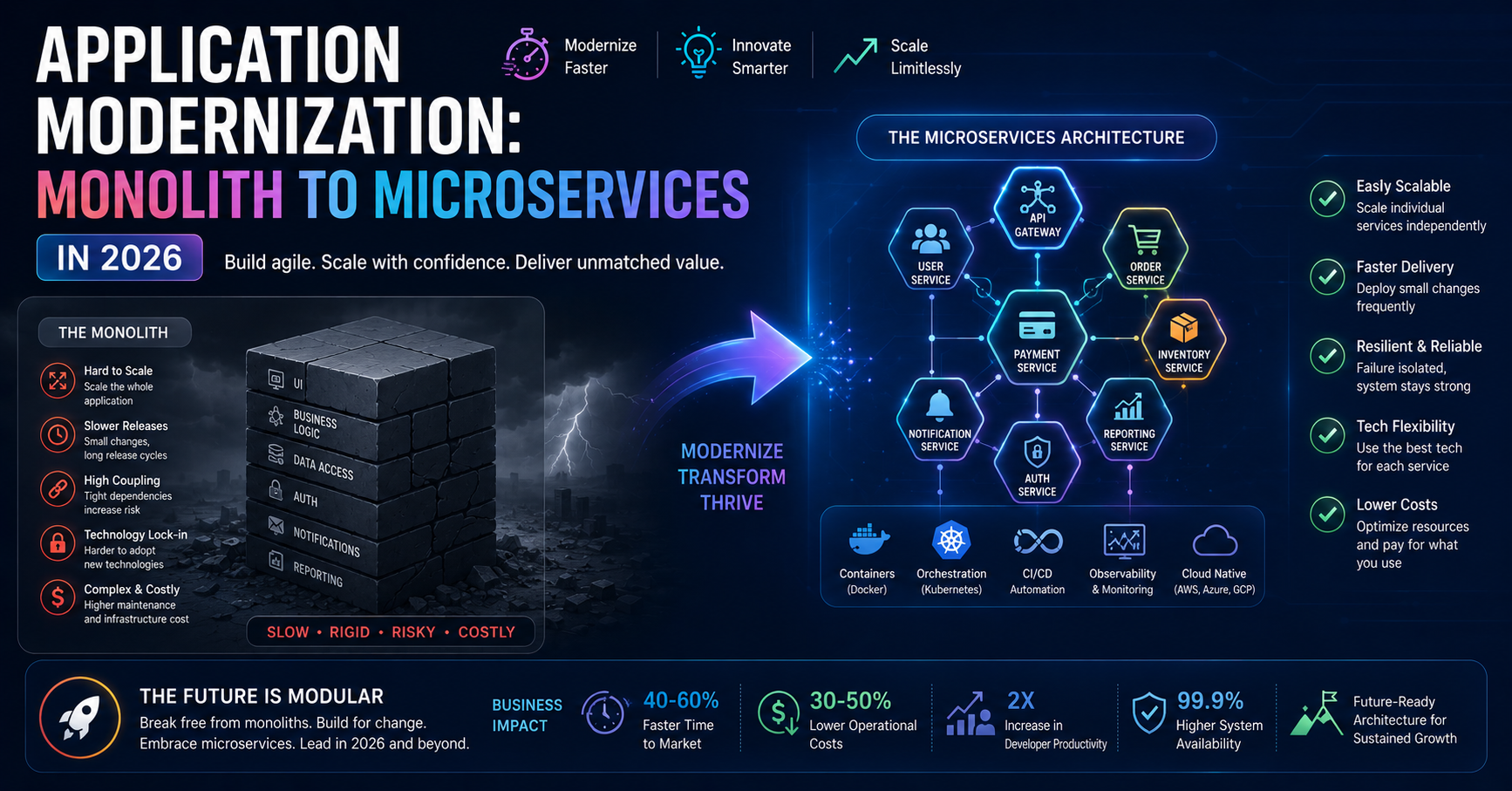
Summary. Application modernization remains one of the most consequential and most expensive engineering decisions enterprises take. In 2026, the median modernization project costs $450,000 to $2.3 million depending on codebase size and technical debt. Only 42% of modernization projects meet their original budget. 68% end up costing more in cloud spend than the legacy systems they replaced. Amazon Prime Video famously consolidated a distributed microservices video monitoring system into a single process and cut infrastructure costs by over 90% — a public reminder that microservices are not always the right answer. This guide covers when monolith-to-microservices makes sense, the Strangler Fig pattern that consistently works, the cost benchmarks, the failure modes that derail projects, and the practical 18-month migration plan.
The strategic point about application modernization in 2026 is that the question "monolith or microservices" is the wrong frame. The right frame is: which parts of this system benefit from independent scaling, independent deployment and independent data management — and which parts will pay an architecture-tax forever if we decompose them. Get that question right and the modernization compounds. Get it wrong and you build a distributed monolith that costs three times what the original system did.
This guide is built for CTOs, VPs of Engineering and software architects running modernization decisions at growth-stage companies, mid-market enterprises and global firms. The research draws on AWS Prescriptive Guidance, Confluent and Microservices.io reference materials, public engineering postmortems including Amazon Prime Video's, and patterns observed across modernization engagements in 2024-26.
The 2026 numbers
Five facts that shape modernization decisions today.
Median cost is $450K to $2.3M. Across modernization types, the median project sits in this range. Small monolithic apps modernised through lift-and-shift cost $15,000-$30,000 in 2-4 weeks. Mid-market core systems refactored to containers cost $50,000-$150,000 over 3-6 months. Enterprise-scale legacy applications rebuilt to microservices frequently exceed $500,000 and span 12-18 months.
42% hit the original budget. Industry research summarised by LegacyLeap and others finds only 42% of modernization projects meet their original budget. The primary cause is incomplete discovery before kickoff, not poor execution during build.
68% see post-migration cloud bills higher than legacy spend. The first post-migration cloud bill arrives at 2-5x what was projected. This is the most expensive surprise in the modernization industry and is usually traceable to over-decomposition and inefficient data flow patterns.
ROI in 18-24 months for cloud migrations. Cloud migrations typically break even in 18-24 months through infrastructure savings and licensing cost reductions. Mainframe modernizations have 3-5 year payback because of upfront cost, but mainframe operations typically cost 3-5x equivalent cloud infrastructure per workload, so the long-term savings are larger.
The strangler fig pattern is the working migration approach. Almost every successful monolith-to-microservices migration in 2024-26 uses the Strangler Fig pattern — incremental replacement that keeps the business running while the architecture changes underneath. Big-bang rewrites continue to fail at the same rate they did fifteen years ago.
Should you modernize? A decision framework
Before discussing how, the harder question: should you. Five questions that distinguish modernization candidates from systems that should be left alone.
1. Is the existing system slowing down the business? Concretely — feature ship rate, incident frequency, scaling cost, security exposure, talent retention. If the answer is "yes" across multiple dimensions, modernization is justified. If it is "no" or "only in one area," reconsider whether the problem can be solved with targeted refactoring rather than full modernization.
2. Is the system's domain stable enough to decompose? Microservices work when bounded contexts (Domain-Driven Design terminology) are stable. If the business is still discovering what the domain actually is, decomposing prematurely produces churn that consumes the modernization budget.
3. Do you have the operational capability? Microservices require mature observability, CI/CD, incident response, on-call rotation, distributed tracing, deployment automation. If the existing team cannot run a single production service well, running 30 is going to be worse.
4. Is there a business case beyond engineering preference? "We want microservices because the team likes them" is not a business case. "We need independent scaling of the order pipeline because it consumes 70% of the AWS bill at peak" is. "Tight coupling between billing and product catalogue is blocking pricing experiments" is.
5. Can the business afford the dual-run period? The Strangler Fig pattern creates a 12-24 month period where both the legacy and modern environments run simultaneously. That cost has to be budgeted explicitly. Companies that underestimate this end up with a half-finished migration and an architecture that is worse than what they started with.
If the answers point clearly toward modernization, proceed. If they are mixed or unclear, run a smaller pilot — extract one bounded context, learn what it actually costs, then decide.
When microservices are the wrong answer
Two cautionary cases worth understanding.
Amazon Prime Video's case study, published in early 2023 and still widely cited, describes how a distributed microservices architecture had become a cost and scaling bottleneck for their video monitoring service. The team consolidated into a single process and reduced infrastructure costs by over 90%. The lesson: for workloads that have very high inter-service communication, the network and serialisation overhead of microservices can dominate the actual work being done.
The 68% statistic on post-migration cloud overspend reflects this pattern at scale. Over-decomposed architectures pay for inter-service messaging, observability infrastructure, dual-write data layers, deployment overhead and operational tooling that the monolith did not need.
Microservices are right for some workloads. They are wrong for many others. The 2026 architectural maturity is in choosing — modular monolith for some systems, microservices for others, function-as-a-service for specific workloads — rather than treating decomposition as the only correct direction.
The Strangler Fig pattern in 2026
Martin Fowler named the pattern in 2004 after the strangler fig tree, which grows around an existing tree and gradually replaces it. The pattern remains the right framework for monolith-to-microservices migration two decades later because the alternative — a big-bang rewrite — has the same failure rate it had then.
The pattern. You build new features as microservices. You incrementally route traffic from the monolith to the new services. The monolith shrinks. Eventually it disappears.
The infrastructure prerequisites. A routing layer that supports traffic splitting (Envoy, Istio, API gateway with route rules, or a custom proxy). Observability that lets you compare behaviour between old and new implementations (Datadog, New Relic, Honeycomb, Grafana stack, OpenTelemetry). CI/CD that supports independent deployment of multiple services. Authentication and authorisation that work consistently across the legacy and new services.
The phasing. Start with low-risk, low-coupling seams. Read-only operations are usually first — a microservice that serves a query the monolith currently handles, with traffic gradually shifted. Write operations come next. Core transactional flows (payments, order placement, account creation) come last because they involve consistency requirements and rollback complexity.
The data problem. The monolith has one database. The new microservices may want different databases. During the transition, data has to flow between them. Common patterns: dual writes during transition with eventual sunset of the monolith write path; change data capture (Debezium, AWS DMS) feeding the microservice database; or a shared database during transition with logical separation enforced by service contract.
The decommissioning discipline. The pattern only works if you actively decommission monolith code after each extraction. If both old and new code paths remain, you have a distributed monolith — more complex than what you started with, no clearer ownership, more places for the same bug to live.
The boundary rule. A table should be written to by exactly one service. If the monolith and a new service are both writing to the same table, you have not created a real boundary. This is the single most common Strangler Fig anti-pattern.
Domain-Driven Design and bounded contexts
The hardest engineering decision in a microservices migration is where to draw the boundaries. Domain-Driven Design (DDD) is the discipline that answers this.
Bounded contexts. A bounded context is a section of the domain with its own consistent language, models and rules. "Order" might mean very different things in inventory, shipping, accounting and customer-support contexts. Each bounded context becomes a candidate for a separate service.
Aggregates. Within a bounded context, an aggregate is the consistency boundary — the set of entities that must be updated atomically. Aggregates do not span service boundaries.
Context maps. The relationships between bounded contexts. Some are customer-supplier (one provides data the other consumes). Some are anti-corruption layers (translation between models). Some are shared kernels (carefully managed shared code). Mapping these relationships before extraction prevents tight coupling between the new services.
For most enterprise systems, the right pattern is to identify 5-15 bounded contexts at the architectural level, then extract them one at a time using the Strangler Fig pattern, with the extraction order driven by business value and technical risk.
The 18-month modernization plan
A pattern that consistently works across mid-market and enterprise modernization engagements.
Months 1-3: Discovery and architecture. Map the current system. Identify bounded contexts using DDD. Catalogue the integration surface (external dependencies, internal callers, data flows). Identify the first 3-5 extraction candidates by business value and technical risk. Set the success metrics — ship rate, incident frequency, infrastructure cost, security exposure.
Months 4-6: Operational foundation. Build observability, CI/CD, deployment automation, authentication, authorisation and the routing layer. The first extraction needs the platform to be ready before code is moved. Most modernization projects that fail skip this phase and pay for it across the entire migration.
Months 7-9: First extraction. Pick the lowest-risk bounded context. Build the new service. Route traffic incrementally — 1%, 10%, 50%, 100%. Monitor behaviour comparison. Decommission the corresponding monolith code. Document the playbook for subsequent extractions.
Months 10-15: Second and third extractions. Each subsequent extraction takes roughly 60% of the time of the first because the platform and playbook exist. Bounded contexts come out one at a time. The team learns operational discipline.
Months 16-18: Core transactional extraction or stabilisation. The hardest extractions (payments, order placement) happen last. Or, if the project value has been captured through the first three extractions, stabilise the architecture and move into business-as-usual mode without further decomposition.
For larger enterprise systems the plan extends to 24-36 months. The phases stay the same; the pace is determined by the system complexity and the team's operational maturity.
Common failure modes
Six patterns that derail modernization projects.
Incomplete discovery. The single largest cause of budget overrun. Teams underestimate what they do not know about the legacy system — undocumented integrations, hidden state, batch jobs nobody owns, customer-specific code paths.
Big-bang rewrite. A team commits to rebuilding the entire system at once, with no incremental migration. By month 18, the rewrite is 60% complete and the legacy system has continued evolving. The rewrite never catches up.
Over-decomposition. Splitting into 50 microservices when 15 would have been right. The cost is inter-service communication, deployment overhead, observability complexity and operational drag. This is the failure mode behind the 68% cloud-overspend statistic.
Distributed monolith. Services that look like microservices but share databases, deploy together, and propagate failures. The team gets the cost of microservices and the constraints of a monolith.
No platform investment. Skipping the observability, CI/CD, deployment automation and authentication work. The first extraction succeeds; the second drags; the third reveals the platform is not ready; the project stalls.
No decommissioning discipline. Old code paths stay alongside new ones. The monolith never shrinks. The team has two systems to maintain forever.
Indian and global cost economics
Two practical notes for Indian engineering leaders.
Indian engineering cost advantage. Modernization engagements delivered from Indian engineering bases (in-house or partner) typically run 40-60% lower cost than US or UK equivalents. The architectural decisions are the same; the labour and operations cost is different. For Indian enterprises modernising their own systems, internal engineering teams can deliver outcomes that would require costly external consultancy in higher-cost geographies.
Global enterprise economics. For US and UK companies, the practical pattern is increasingly hybrid — architecture and platform work led by senior internal teams, extraction work delivered by mature offshore partners with the operational discipline to follow the Strangler Fig pattern. Done well, total project cost reduces 30-50% versus fully internal delivery.
FAQ
How eCorpIT can help
eCorpIT designs and delivers application modernization for clients across India, the US and the UK — discovery and architecture, Domain-Driven Design, platform engineering, Strangler Fig extraction, cloud migration and operational readiness. Our work covers SaaS, fintech, healthtech, retail, manufacturing and enterprise B2B.
If you are running a modernization decision or a live migration in 2026, our engineering team can help. Reach us at ecorpit.com/contact-us/ or contact@ecorpit.com.
References
- AWS Prescriptive Guidance — "Strangler fig pattern": docs.aws.amazon.com
- Microservices.io — "Pattern: Strangler application": microservices.io
- Confluent — "Strangler Fig Pattern": developer.confluent.io
- LegacyLeap — "How Much Does Application Modernization Cost in 2026?": legacyleap.ai
- Modernization Intel — "Application Modernization Consulting Rates: 2026 Benchmark Guide": softwaremodernizationservices.com
- LeanOps Tech — "Cost-Optimized Application Modernization 2026 Guide": leanopstech.com
- Amazon Prime Video Tech — "Scaling up the Prime Video audio/video monitoring service and reducing costs by 90%": primevideotech.com
- Ideas2IT — "Application Modernization Metrics & ROI Tips": ideas2it.com
- TxMinds — "App Modernization ROI: Cost-Benefit Analysis Guide": txminds.com
- eCorpIT — "Generative AI Enterprise Strategy 2026": ecorpit.com
Last updated 8 June 2026 by the eCorpIT Editorial team.