On this page · 10 sections
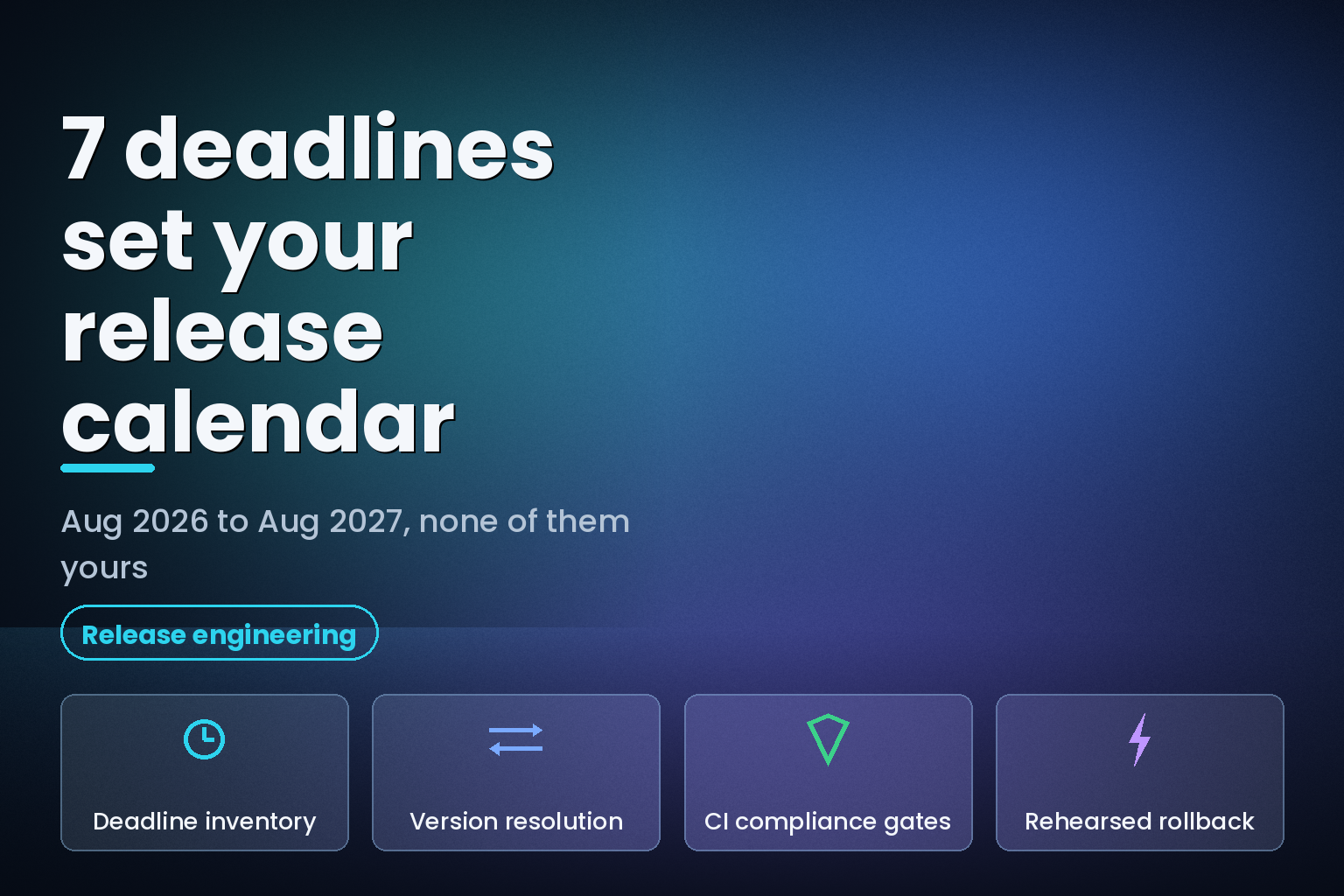
Summary. Between 31 August 2026 and 17 August 2027, seven upstream deadlines land on the same engineering team: Google Play requires target API level 36 for new apps and updates from 31 August 2026, Chrome moves to a 14-day release cadence with Chrome 153 on 8 September 2026, the Play extension window closes on 1 November 2026, Chrome 158 removes XSLT on 17 November 2026, the CocoaPods trunk becomes read-only on 2 December 2026, full compliance with India's Digital Personal Data Protection Act 2023 is due on 13 May 2027 with penalties reaching Rs 250 crore, and Chrome's XSLT enterprise policy expires at Chrome 176 on 17 August 2027. Only 61% of the top 100 iOS Flutter plugins had moved to Swift Package Manager when Flutter announced the switch on 30 April 2026. None of these dates was set by your product roadmap. All of them will be met by the same three or four people, and whether that is a bad fortnight or a bad quarter is decided by your build pipeline.
This is what a release platform that absorbs upstream deadlines looks like, why most teams discover the gap two weeks before a deadline, and how eCorpIT builds it.
The 2026 to 2027 deadline calendar
Each of these is published by the vendor with a date attached. None of them is negotiable, and four of them carry a hard consequence for missing them.
| Date | What lands | Consequence of missing it |
|---|---|---|
| 31 Aug 2026 | Google Play requires target API level 36 for new apps and updates | You cannot publish an update at all |
| 8 Sep 2026 | Chrome 153 starts a 14-day release cadence | Compatibility checkpoints double in frequency |
| 1 Nov 2026 | Play target API extension window closes | The escape hatch for API 36 is gone |
| 17 Nov 2026 | Chrome 158 removes XSLT on Stable | Client-side XML transformation stops rendering |
| 2 Dec 2026 | CocoaPods trunk becomes read-only | No new pod versions; existing builds keep working |
| 13 May 2027 | DPDP Act 2023 full compliance due | Penalties reaching Rs 250 crore for safeguard failures |
| 17 Aug 2027 | Chrome 176 ends the XSLT origin trial and enterprise policy | The last XSLT workaround expires |
Two of these deserve unpacking, because they are the ones teams underestimate.
Google Play target API level 36
From 31 August 2026, new apps and updates to existing apps must target Android 16, API level 36, to be published on Google Play. Existing published apps must target Android 15, API level 35 or higher, to stay available to new users on devices running a newer Android version than the app targets. Apps targeting Android 14, API level 34 or lower, are only available on devices running the same or lower Android version. Wear OS and Android Automotive OS apps need API level 35 or higher; Android TV and Android XR apps need API level 34 or higher. Developers can apply for an extension to 1 November 2026 through a form in the Google Play Console.
The trap is that this deadline blocks updates, not just feature work. A team that cannot ship an API 36 build on 31 August also cannot ship a hotfix. That turns a compatibility task into an availability risk, which is a different conversation with the business.
CocoaPods going read-only
Starting with Flutter 3.44, Swift Package Manager replaces CocoaPods as the default dependency manager for iOS and macOS apps, and the Flutter CLI migrates the Xcode project automatically on the next build or run. CocoaPods is in maintenance mode and its registry becomes permanently read-only on 2 December 2026, after which no new versions or pods are added to the trunk. Existing builds continue to work.
The number that decides your exposure is plugin coverage. Jenn Magder of the Flutter team wrote on 30 April 2026 that 61% of the top 100 iOS plugins had migrated, with Flutter falling back to CocoaPods for the rest and printing a warning listing exactly which dependencies are unsupported. Packages without Swift Package Manager support now receive lower pub.dev scores. If a migration breaks the build, enable-swift-package-manager: false under the flutter: config: block in pubspec.yaml is a temporary opt-out, not a plan. Our CocoaPods sunset and SPM migration guide covers the per-plugin path.
Why upstream cadence broke the quarterly release model
The old model worked because upstream moved slowly enough to batch. Chrome shipped every four weeks. Play announced target API changes about a year out. Framework majors landed annually. A quarterly release train absorbed all of it with room to spare.
Two things changed at once.
Upstream release intervals halved. Chrome moves to a new major every 14 days from 8 September 2026, and its Extended Stable channel, which keeps an eight-week cycle, runs on managed Windows and Mac only. Mobile Chrome has no Extended Stable at all. The driver is documented: Google's Chrome Security Team reported on 30 July 2026 that Chrome 149 and 150 together fixed 1,072 security bugs, more than the previous 23 milestones combined, and that the team is piloting two security releases per week. When upstream ships fortnightly, a quarterly train is six milestones behind by the time it leaves the station. We covered the testing implications in the Chrome two-week release cadence playbook.
At the same time, the cost of a release rose. Store submissions carry policy review. Billing library migrations carry revenue risk. Data protection obligations carry an audit trail. A release is no longer a deploy; it is a deploy plus evidence.
The 2025 DORA State of AI-assisted Software Development report, published by Google Cloud, frames what happens next: "AI's primary role is as an amplifier, magnifying an organization's existing strengths and weaknesses. The greatest returns on AI investment come not from the tools themselves, but from a strategic focus on the underlying organizational system." Teams generating more code per week against a pipeline that ships quarterly do not ship faster. They accumulate a larger, less-tested batch.
The plain version: if your release process needs a human to remember something, it will fail on the fortnight when that human is on leave.
What a release platform has to do now
Six capabilities, in the order we build them. None is exotic. The value is that they exist before the deadline, not after.
Dependency and deadline inventory as code
A machine-readable list of every upstream deadline that applies to your artefacts, with the milestone or version that triggers it, checked in alongside the build. When a date moves, one file changes and every downstream reminder follows.
Version resolution instead of version pinning
Browser, SDK and toolchain versions resolved at build time from a single source, with an alert when the resolved version drifts more than one milestone from what production traffic actually uses. Hand-edited version strings in a Dockerfile were viable when they changed monthly.
A pre-release lane that runs unattended
Chrome Beta ships about three weeks before each stable release; Play and Apple both offer pre-release tracks. A nightly critical-path run against the next version is the only reliable place to catch an upstream regression before users do.
Store submission as a pipeline stage
Target API level, SDK version, privacy declarations and billing library version checked in CI, failing the build rather than the submission. A build that cannot be published should not reach the publish step.
Evidence generated by the build
Signed artefacts, an SBOM, dependency versions and test results emitted per release, so a compliance question is answered from the pipeline rather than reconstructed from memory. This is what turns the DPDP deadline from a project into a property of the build.
Rollback that has been rehearsed this quarter
Fortnightly upstream cadence means more small surprises. Recovery speed matters more than change avoidance, and a rollback that has not been exercised is a hypothesis.
| Capability | Quarterly-train reality | Platform-backed reality |
|---|---|---|
| Upstream deadline tracking | A spreadsheet one person maintains | Inventory in the repo, alerts from the build |
| Browser and SDK versions | Pinned by hand, bumped when something breaks | Resolved at build time with drift alerts |
| Pre-release testing | Ad hoc before big launches | Nightly run against beta and pre-release tracks |
| Store compliance | Discovered at submission | Enforced as a CI gate before merge |
| Release evidence | Assembled during an audit | Emitted per build, retained on a schedule |
| Rollback | Documented, rarely tested | Rehearsed on a schedule, timed |
What to measure, and what not to
Release engineering attracts vanity metrics. Deployment count per week tells you very little on its own, because a team shipping twice as often into an unrehearsed rollback path is carrying more risk, not less. Three measures are worth putting on a wall.
Time from an upstream announcement to a green build on the new version. This is the number the 2026 calendar actually taxes. If Chrome 154 branches on 31 August and your pipeline first sees it in October, that gap is your exposure, and it repeats every fortnight rather than every month.
Percentage of releases where a compliance gate failed in CI rather than at submission. A store rejection is the same defect caught two weeks later and one review cycle more expensively. Moving that number toward CI is the clearest evidence the platform work paid for itself.
Rehearsed rollback time, measured this quarter rather than remembered from last year. Under a fortnightly upstream cadence, the strategy that survives is fast recovery, not change avoidance.
What not to measure: how many upstream deadlines you met. Every team meets them eventually, because the consequence of not meeting them is that you stop shipping. The question is what the meeting cost, and whether it landed on a weekend.
The failure mode we see most often
A team knows about a deadline eleven months out. It goes into a planning document. The document is not the pipeline, so nothing changes. Two weeks before the date, someone tries the upgrade, hits a transitive dependency that has not migrated, and now has fourteen days to fix something that needed a maintainer's cooperation.
The Flutter plugin situation is the concrete version. Flutter falls back to CocoaPods for unmigrated plugins and prints a warning naming each one, which means the information you need has been in your build log since you moved to 3.44. The build already knows. The failure is that nobody reads build warnings until something breaks, and by then the maintainer you need to hear from is a stranger on GitHub with no obligation to you.
Turning that warning into a build failure on a schedule you control, rather than on the vendor's, is roughly a day of work and it is the difference between a planned migration and an emergency.
How eCorpIT builds it
eCorpIT is a Gurugram-based technology consulting organisation founded in 2021, with senior-led, multi-disciplinary engineering teams. We are CMMI Level 5, MSME certified and ISO 27001:2022 certified, and we work with AWS, Microsoft, Google, Shopify and Kaspersky as technology partners. Release engineering work runs as a defined engagement rather than an open-ended retainer.
The sequence we use.
First, an inventory pass. We map your artefacts to the upstream deadlines that actually apply to them, which usually removes half the list. A backend-only team does not care about the Play target API date; a Flutter team shipping on iOS cares about 2 December 2026 more than it currently thinks.
Second, a pipeline audit against the six capabilities above, producing a gap list ordered by which deadline it threatens first.
Third, implementation. Version resolution, the pre-release lane, CI gates for store compliance, and evidence generation, built into the pipeline you already run rather than a parallel one nobody adopts. We work in your repositories and hand over runbooks written for your on-call engineers.
Fourth, a handover with the deadline inventory as a living file, so the next upstream date is a build alert rather than a discovery.
Engagement model: a short assessment engagement to produce the gap list, then a fixed-scope implementation phase per capability, then optional support through the first two or three upstream deadlines while your team runs it. We scope from your repositories, not from a template, and we say no to work that a two-week fix inside your existing pipeline would solve.
Who this is for: product companies in India shipping web and mobile against app-store and browser deadlines, teams that have outgrown a single release engineer, and organisations where a missed store deadline blocks revenue. Teams that ship one internal web application a quarter do not need this, and we will tell you so.
Where mobile release compliance is the whole problem rather than part of it, the Google Play Billing Library 8 migration guide and our QA and test automation service cover the narrower engagements. The broader platform context sits in the 2026 web platform developer guide.
India-specific considerations
Change advisory boards need restructuring, not stretching. Regulated Indian environments in BFSI and healthcare typically approve browser and dependency updates monthly. Chrome's fortnightly cadence plus weekly security updates does not fit that rhythm, and stretching the board's schedule just means running behind. The workable pattern is standing pre-approval for security updates with a documented exception path, and per-release approval reserved for functional changes.
DPDP obligations belong in the pipeline. Full compliance with the Digital Personal Data Protection Act 2023 is due on 13 May 2027, and failure to keep reasonable security safeguards that results in a personal data breach carries penalties reaching Rs 250 crore. Consent records, retention behaviour and data deletion paths are code, so they should be tested by CI and evidenced by the build. eCorpIT designs applications aligned with DPDP Act 2023 requirements; we do not certify anyone against it, and neither does anyone else selling you a dashboard.
Team structure matters more here than tooling. Indian product teams frequently run one release engineer across web, Android and iOS. Under a fortnightly upstream cadence that is a single point of failure with a leave calendar attached. Automating the store-compliance gates is cheaper than hiring a second release engineer, and it is the change that survives attrition.
FAQ
How eCorpIT can help
eCorpIT builds release engineering and internal developer platforms for Indian product teams: deadline inventories checked into the repo, build-time version resolution, pre-release test lanes, store-compliance gates in CI, and release evidence generated by the build rather than assembled during an audit. We are CMMI Level 5, MSME certified and ISO 27001:2022 certified, with senior-led teams working inside your repositories rather than alongside them. If the 31 August or 8 September dates are already uncomfortable, talk to our engineering team and we will start with the inventory pass.
References
- Target API level requirements for Google Play apps - Play Console Help.
- Get features faster with Chrome's two-week release cycle - Chrome for Developers, 3 March 2026.
- Stronger with every update: how we're making Chrome and the web safer in the AI era - Chrome Security Team, Google, 30 July 2026.
- Removing XSLT for a more secure browser - Chrome for Developers, 29 October 2025.
- Extended Stable channel - Chrome Enterprise and Education Help.
- Saying goodbye to CocoaPods: Swift Package Manager is soon the default in Flutter - Jenn Magder, The Flutter Blog, 30 April 2026.
- CocoaPods Specs repo going read-only - CocoaPods Blog.
- Swift Package Manager migration for app developers - Flutter documentation.
- Swift Package Manager migration for plugin authors - Flutter documentation.
- State of AI-assisted Software Development 2025 - DORA, Google Cloud.
- Chromium Dashboard release schedule - authoritative Chrome milestone dates.
- Penalties and adjudication under India's DPDP Act 2023 - King Stubb and Kasiva.
Last updated: 4 August 2026.