On this page · 11 sections
- Why Interop 2025 is the proof, not the promise
- What Interop 2026 targets
- Two of these features, in code
- How the Interop score is decided
- The investigation areas
- What this means for your 2026 front-end
- India-specific considerations
- What to still watch before you rely on a feature
- FAQ
- How eCorpIT can help
- References
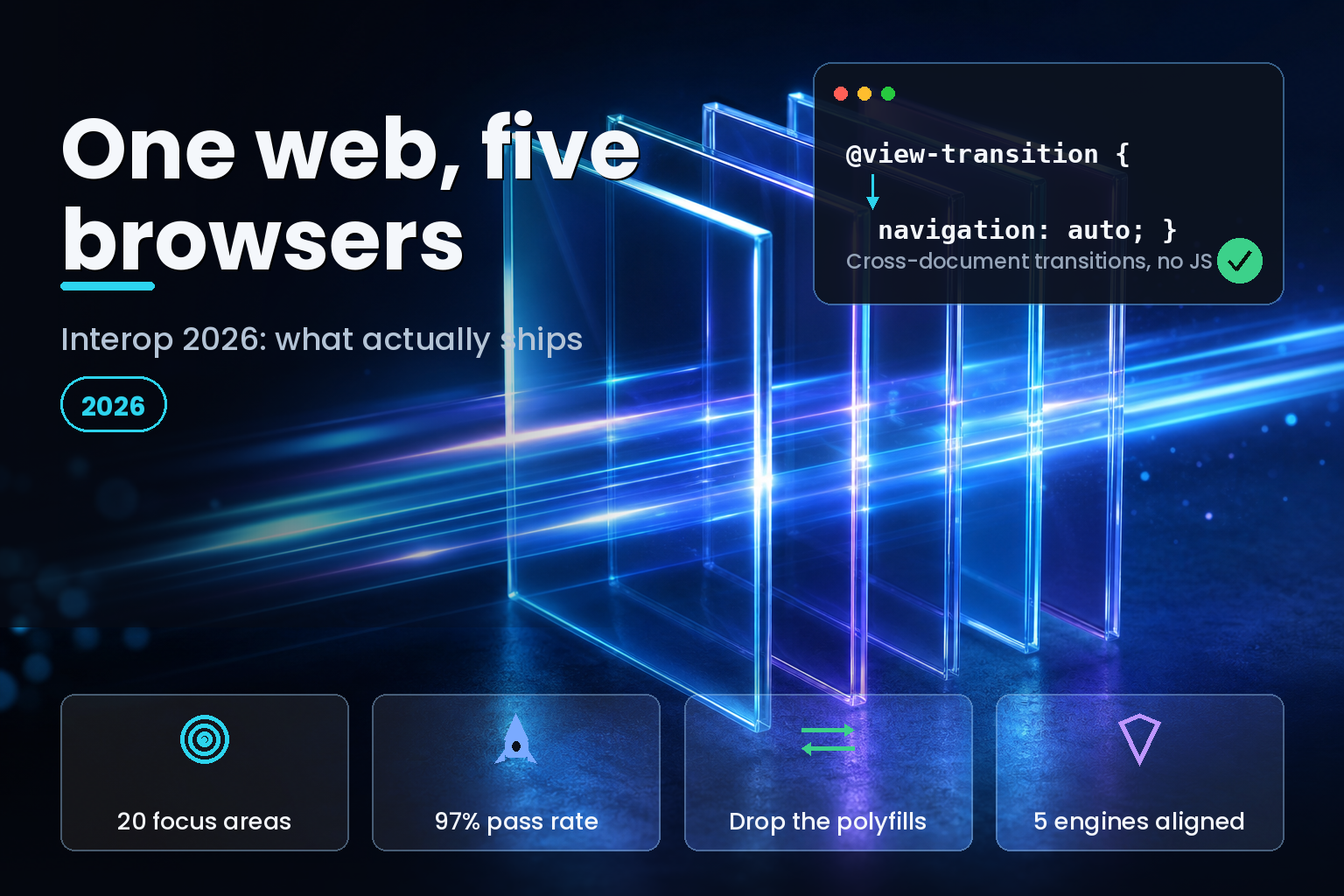
Summary. Interop 2026 is the sixth cross-browser convergence cycle, and the five engine makers behind it, Apple, Google, Igalia, Microsoft, and Mozilla, have agreed on 20 focus areas built from 33 proposals, plus 4 investigation areas. The reason to care is the 2025 result: the shared Interop score climbed from 29% of selected tests passing at the start of the year to 97% by the close, with all four experimental browsers reaching 99%. Safari alone jumped from 43 to 99, and Firefox from 46 to 99. That convergence is why CSS anchor positioning reached Baseline in 2026 with support in Chrome 125, Firefox 132, and Safari 18.2, covering about 91% of global browser traffic. For front-end leads, this is a planning document as much as a standards note: a front-end developer in India bills roughly $15 to $55 an hour (about 196 to 577 rupees), and the features below decide how much of that time goes to shipping versus polyfilling. This guide covers what Interop 2026 targets, what 2025 already delivered, and which JavaScript workarounds you can now delete.
Interop is a yearly effort by the major browser makers to raise the interoperability of specific web platform features, so the same code behaves the same way in every engine. Each cycle picks a set of focus areas, writes shared tests in the web-platform-tests project, and tracks a public pass-rate score on the wpt.fyi dashboard. The point is not new features for their own sake. It is removing the per-browser bugs and gaps that force teams to write conditional code, ship polyfills, or avoid a standard feature entirely.
Why Interop 2025 is the proof, not the promise
The case for reading a standards roadmap is that last year's roadmap delivered. Interop 2025 started with only 29% of its selected tests passing across all browsers. By the end of the cycle the score reached 97%, and the experimental channels, Chrome Canary, Edge Dev, Firefox Nightly, and Safari Technology Preview, all reached 99%. Safari made the largest jump of any browser, from 43 to 99, and Firefox went from 46 to 99.
The concrete result is a set of features that moved to Baseline, the web.dev status that marks a feature as usable across the current versions of every major browser. Same-document view transitions, CSS anchor positioning, the Navigation API, CSS @scope, and the URLPattern API all became cross-browser reliable through the 2025 work. View transitions had shipped in Safari 18.0 and 18.2 in late 2024, and the Interop cycle closed the remaining gaps so they behave the same everywhere.
| Interop 2025 focus | Status after 2025 | What it replaces |
|---|---|---|
| Same-document view transitions | Baseline | Manual JavaScript animation between UI states |
| CSS anchor positioning | Baseline 2026 | JavaScript tooltip and popover libraries |
| Navigation API | Baseline | Fragile history and routing hacks |
| CSS @scope | Baseline | Deep selector specificity workarounds |
| URLPattern API | Baseline | Hand-rolled URL matching in routers |
If you shipped any of those with a library in 2024, the 2025 cycle is your signal to remove it. Anchor positioning is the clearest example: it tethers a tooltip, menu, or popover to any element in pure CSS, and it now works in Chrome 125, Firefox 132, and Safari 18.2 and later, with the @position-try flip fallback needing Safari 18.4. That covers about 91% of global traffic, so for most products the JavaScript positioning library is now dead weight.
What Interop 2026 targets
The 2026 cycle agreed on 20 focus areas from 33 proposals. Rather than list all of them, here are the groups that change day-to-day front-end work, each drawn from the published focus-area set.
Cross-document view transitions
The 2025 work made same-document view transitions reliable. The 2026 focus extends this to cross-document view transitions, which animate the moment between two separate pages as a user navigates, with no JavaScript required. For multi-page sites and server-rendered apps, this is the feature that finally gives plain HTML navigation the smooth motion that used to require a single-page framework. The cycle also covers the blocking="render" attribute for link, script, and style elements, the link rel="expect" attribute, and the :active-view-transition-type() pseudo-class for styling a transition by type.
Anchor positioning and container style queries
Anchor positioning continues into 2026 so the remaining engine differences close, including the anchored container query case, where a component reacts to which fallback position an anchored element landed in. Alongside it, Interop 2026 targets container style queries, the @container at-rule used with one or more style() functions, so an element can style itself based on the custom-property values of its container. Size-based container queries have been Baseline since 2023; the 2026 work is on the style-query variant.
Dialog, popover, and the interaction primitives
The native dialog element and the Popover API get focused work on three additions: the dialog closedby attribute, which declares which user actions dismiss a dialog, the :open CSS pseudo-class, which matches elements in an open state, and the popover="hint" value, which creates a hint popover subordinate to auto popovers. Together these push more modal and popover behaviour into the platform and out of component libraries.
CSS layout and color
Four smaller CSS items carry weight. The shape() function builds shapes with line, move, and curve commands for clip-path and shape-outside, replacing brittle polygon math. CSS scroll snap gets interoperability fixes for panning and scrolling inside a scroll container. The contrast-color() function returns a color with guaranteed contrast against a given background, which helps accessible theming. Custom highlights let you style arbitrary text ranges without inserting extra DOM nodes, and the attr() function can now return a typed value, not just a string.
Networking and real-time APIs
On the platform side, Interop 2026 continues WebRTC interoperability by fixing the tests still failing from 2025, and adds the WebTransport API, which moves data between client and server over HTTP/3. For real-time and streaming products, WebTransport behaving the same across engines removes a class of connection-handling special cases.
| Interop 2026 focus area | Primary benefit | Front-end code you can drop |
|---|---|---|
| Cross-document view transitions | Animated page-to-page navigation, no JS | SPA-only routing chosen for transitions |
| Container style queries | Style by container custom properties | JavaScript that reads and reacts to state |
| Dialog closedby and popover=hint | Native modal and hint behaviour | Custom modal and tooltip logic |
| shape() function | Curved shapes for clip-path | Hand-computed polygon coordinates |
| contrast-color() | Guaranteed accessible contrast | Manual contrast calculation in JS |
| WebTransport over HTTP/3 | Consistent low-latency transport | Engine-specific connection fallbacks |
Two of these features, in code
The two focus areas most teams reach for first, cross-document view transitions and anchor positioning, are short to adopt because the platform does the work. Cross-document view transitions are opt-in from CSS on both the outgoing and incoming page:
            /* Enable animated transitions between full page loads */
@view-transition {
  navigation: auto;
}
With that rule on two same-origin pages, the browser cross-fades between them on navigation, and you refine the motion with view-transition-name and the :active-view-transition-type() pseudo-class rather than orchestrating it in JavaScript. The result is animated navigation on ordinary multi-page HTML, which is exactly the experience that used to justify reaching for a single-page framework.
Anchor positioning replaces a positioning library with three declarations. You name an anchor, point an element at it, and place the element relative to it:
            .menu-button {
  anchor-name: --menu;
}

.menu {
  position: absolute;
  position-anchor: --menu;
  position-area: bottom span-right;
}
The menu now tracks its button without a scroll-and-resize listener in JavaScript. Add @position-try fallbacks so the menu flips when it would overflow the viewport, and the browser handles the repositioning. This is the pattern that retires most tooltip and dropdown libraries in a 2026 codebase.
Container style queries follow the same shape. You expose a custom property on a container, then style descendants based on its value:
            .card-host {
  container-name: card;
}

@container card style(--tone: urgent) {
  .card {
    border-color: crimson;
  }
}
The card restyles itself from its container's state, with no JavaScript reading that state and toggling a class. Each of these is a few lines of CSS standing in for a dependency you previously shipped, tested, and kept updated.
How the Interop score is decided
Each cycle, browser vendors and the wider community propose focus areas, and the group selects a final set through a public process recorded in the web-platform-tests repository. Every focus area maps to a suite of shared tests. The Interop score is the share of those tests that pass, calculated per browser and as a group number, and published live on the wpt.fyi dashboard for both stable and experimental channels. Because the experimental channels, Chrome Canary, Edge Dev, Firefox Nightly, and Safari Technology Preview, carry fixes months before stable, their score is the leading indicator: when they approach 100 on a focus area, that feature is close to reliable everywhere. This is why the 2025 group number moving from 29 to 97 is a measured outcome rather than a marketing figure, and why the same dashboard is the right place to judge 2026 progress through the year.
The investigation areas
Beyond the 20 focus areas, Interop 2026 runs 4 investigation areas, which are problems the group wants to make testable before committing them as focus areas. They are accessibility testing, aimed at generating consistent accessibility trees across browsers and improving the test infrastructure; JPEG XL, to make that image format testable; mobile testing, to improve web-platform-tests infrastructure for mobile-specific behaviour such as dynamic viewport changes; and WebVTT, to fix tests and update documentation. The accessibility-tree investigation matters most for teams with compliance obligations, because consistent accessibility trees are what assistive technology depends on.
What this means for your 2026 front-end
Read Interop 2026 as a deletion list. Every focus area that reaches Baseline is a library, polyfill, or conditional branch you can remove, which shrinks bundle size and cuts the test matrix. Three moves pay off now.
First, audit for JavaScript that a platform feature now covers: tooltip and popover positioning, modal dialogs, URL matching, and state-based styling. Anchor positioning, the Popover API, URLPattern, and container queries replace common libraries. Second, plan cross-document view transitions for multi-page and server-rendered sites, because the smooth navigation that pushed teams toward a single-page framework is arriving in plain HTML. Our guide to the HTTP QUERY method covers a related platform shift on the request side. Third, keep testing against the experimental browser channels, since that is where Interop scores land first and where you catch the last engine differences before they reach your users.
If your product also runs a canvas-rendered framework surface, the browser-support math overlaps with what we covered in the Flutter web with WebAssembly production guide. And because view transitions and faster, standards-based pages improve page experience, they feed directly into the work in our ultimate guide to SEO in 2026.
India-specific considerations
For teams building from India, cross-browser convergence changes the cost equation directly. Web developers in the Indian market bill roughly $15 to $55 an hour, with an average near 298 to 317 rupees an hour and a spread from about 196 to 577 rupees depending on seniority and city. A large share of that time historically went to reconciling browser differences and maintaining polyfills. As Interop pushes features to Baseline, that reconciliation work shrinks, so the same budget buys more product.
The practical caution is audience data. Baseline means current versions of every major browser, but Indian traffic includes a long tail of older Android devices and delayed browser updates. Check your own analytics before you rely on a 2026 feature without a fallback, and lean on the automatic fallbacks the platform provides, such as anchor positioning degrading gracefully where @position-try is unsupported. Accessibility also stays a first-class requirement under Indian procurement and the Rights of Persons with Disabilities Act, which is why the Interop accessibility-tree investigation is worth tracking.
What to still watch before you rely on a feature
Baseline is a strong signal, not a guarantee for every visitor. It describes the current versions of each browser, so any audience with a long tail of older or unupdated browsers still needs a fallback path. Three habits keep you safe. Treat each 2026 focus area as progressive enhancement: ship the standards feature, and make sure the page still works where it is missing, the way anchor positioning degrades when @position-try is unavailable. Watch the gap between stable and experimental scores, because a feature can sit near 99 on experimental channels months before it reaches the stable release your users run. And remember the 4 investigation areas, including JPEG XL and the accessibility-tree work, are explicitly not commitments to ship this year; they are efforts to make those areas testable first. Verify against your own analytics and the live wpt.fyi score before you remove a fallback, not against the headline number alone.
FAQ
How eCorpIT can help
eCorpIT is a CMMI Level 5, Gurugram-based engineering organisation that builds standards-first web front ends with senior-led teams. We audit your codebase for polyfills and JavaScript that Baseline features now replace, plan cross-document view transitions and anchor-positioned interfaces with graceful fallbacks for your real audience, and set up cross-browser testing against the channels where Interop convergence lands first. If you are modernising a web front end for 2026, talk to our team and we will map the features worth adopting now.
References
_Last updated: 7 July 2026._