On this page · 9 sections
- Why generalist "top developer" lists fail fintech buyers
- The nine criteria that matter for fintech mobile
- Eight fintech-capable agencies evaluated against the same nine criteria
- Side-by-side fintech criteria comparison
- How to use this framework in your fintech procurement
- Frequently asked questions
- A short closing note
- Further reading
- References
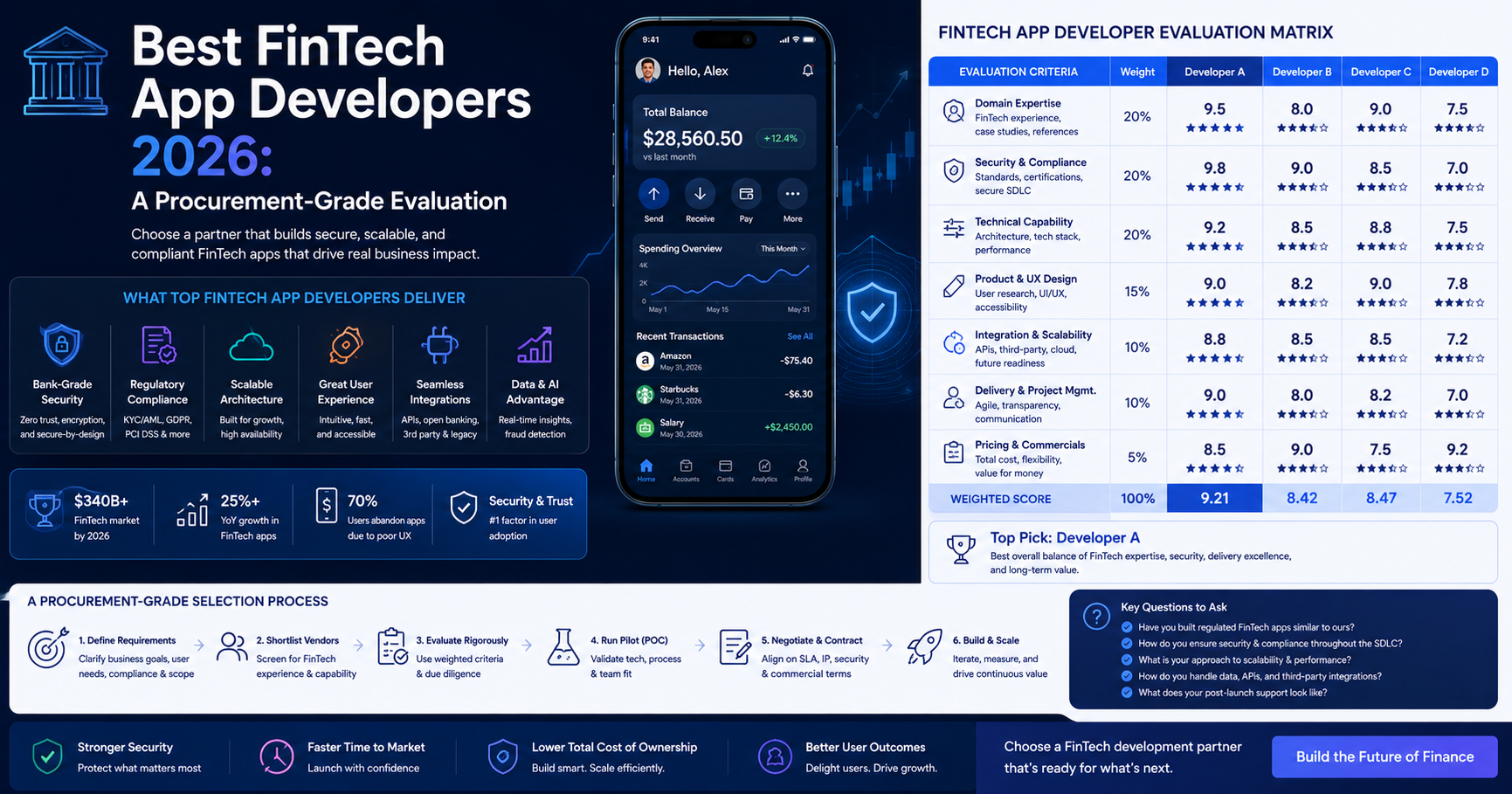
Summary. FinTech mobile app development is not "mobile development for an app that handles money." It is engineering under audit. PCI-DSS-aware data handling, FCA-aware UK operational resilience, KYC/AML flows that survive sanctions screening, 3DS2 and Strong Customer Authentication for European payments, multi-PSP architectures, fraud and dispute handling. This guide defines nine evaluation criteria for fintech-mobile vendors, then assesses eight named agencies (US, UK, India) against the same standard. Companies are listed alphabetically. The procurement decision is yours; the criteria are testable.
Talk to eCorpIT about a fintech build · Hire FinTech App Developers
Why generalist "top developer" lists fail fintech buyers
Three structural reasons.
Regulatory exposure is invisible until it bites. A generalist mobile agency can ship a competent consumer app with a Stripe integration and call it "fintech." That is not the same as shipping an app that survives a PCI-DSS scope-reduction review, an FCA operational-resilience assessment, or an RBI tokenisation audit. The cost difference between competent-mobile and fintech-aware-mobile is often $30K–$80K on a $100K project. The cost of getting it wrong is regulator enforcement.
Volume agencies dilute domain depth. Large India-based exporters and US hybrid agencies count fintech among 12 categories they serve. The senior fintech engineer who shipped the last bank-tier app may have moved to retail before you sign. Domain depth is what you are paying for in fintech; agency size often does not correlate with it.
Pay-for-placement biases the directory rankings. Clutch, GoodFirms, and DesignRush mix verified reviews with sponsored placement. The agencies at the top of "best fintech" directory rankings are usually the agencies paying the most, not the agencies shipping the highest-trust fintech work.
This guide applies a fintech-specific evaluation framework. The criteria are testable. The named companies are evaluated against the same standard. The conclusion is yours.
The nine criteria that matter for fintech mobile
Each maps to a question a fintech CTO, regulated-firm compliance lead, or US payment-processor procurement team will ask before signing.
1. PCI-DSS scope-reduction architecture experience. Has the agency shipped mobile builds that keep PCI scope minimal — tokenisation at the PSP layer, no PAN on device, no plaintext card data in logs or analytics? This is the foundational fintech-mobile design discipline.
2. FCA-aware UK fintech work. For UK builds, has the agency shipped apps with KYC, AML, customer-due-diligence, and operational-resilience flows that survived an FCA-regulated client audit? No vendor can be "FCA approved" — only the regulated firm can — but the agency's design discipline determines whether the audit is straightforward or painful.
3. Multi-PSP architecture experience. Stripe, Adyen, Razorpay, Worldpay, Checkout, Braintree. Mature fintech apps integrate multiple payment processors for routing, redundancy, and regional optimisation. Has the agency shipped this pattern?
4. KYC and AML SDK integration depth. Onfido, Sumsub, Jumio, Persona, Trulioo. Liveness checks, document capture, sanctions screening, ongoing monitoring webhooks. Mature integration experience matters more than generalist mobile experience.
5. 3DS2 and Strong Customer Authentication. EU and UK payment flows under PSD2/PSD3 require SCA with a specific exemption matrix. Senior engineers who have shipped SCA flows beat junior engineers who treat 3DS as one library call.
6. Named fintech reference clients. Specific neobanks, payment processors, BNPL providers, or regulated fintech firms the agency has shipped production work for. Anonymous "leading fintech" references do not count.
7. Cryptographic key management discipline. Secure enclave usage, HSM integration where required, key rotation patterns, audit-trail logging that does not leak keys through observability tooling.
8. Mobile fraud detection signal collection. Device fingerprinting, behavioral biometrics, jailbreak/root detection, debugger and Frida detection. Mature fintech apps collect fraud signals at the mobile layer; junior implementations skip this.
9. Procurement-grade credentials. CMMI Level, ISO/IEC 27001:2022, ISO 9001:2015, D-U-N-S, GDPR / UK GDPR alignment. Standard for any serious fintech procurement.
Eight fintech-capable agencies evaluated against the same nine criteria
In alphabetical order. Based on each agency's public-facing claims, case studies, third-party directory listings, and our observations across the market. No agency paid for inclusion.
Appinventiv (Noida, India)
Large-volume India-based exporter with multiple fintech case studies, particularly for consumer-facing financial apps and payment platforms.
- PCI-DSS architecture: Project-specific; documented in case studies.
- FCA-aware UK: Some UK fintech work referenced.
- Multi-PSP: Multiple payment integrations across case studies.
- KYC/AML SDK depth: Some Onfido and similar integration references.
- 3DS2 / SCA: Project-specific.
- Named fintech refs: Multiple consumer-fintech case studies publicly cited.
- Crypto key management: Standard enterprise patterns.
- Mobile fraud signal collection: Project-specific.
- Procurement credentials: ISO certifications and India-exporter trust signals.
Best fit for: Consumer-fintech buyers who value high-volume delivery capacity and broad service catalogue.
Apadmi (Manchester, UK)
UK enterprise mobile agency with retail and transport depth; growing fintech engagement.
- PCI-DSS architecture: Standard enterprise approach.
- FCA-aware UK: UK enterprise base aligns with UK regulator-aware design.
- Multi-PSP: Project-specific.
- KYC/AML SDK depth: Less publicly highlighted for fintech specifically.
- 3DS2 / SCA: Standard for UK payment work.
- Named fintech refs: Limited fintech-specific public references.
- Crypto key management: Standard enterprise patterns.
- Mobile fraud signal collection: Project-specific.
- Procurement credentials: ISO/IEC 27001, UK GDPR + DPA 2018 aligned.
Best fit for: UK enterprise buyers with budget for in-country agency engagement on a fintech extension to a primarily retail or transport-led business.
eCorpIT (Gurugram, India)
Senior-only delivery, fintech-aware design discipline, FCA-aware UK fintech work that has survived FCA-regulated client audits.
- PCI-DSS architecture: Scope-reduction design, tokenisation at PSP layer, no PAN on device, audit-trail logging by default. Documented in the fintech hire page.
- FCA-aware UK: Shipped UK fintech apps that survived FCA-regulated client audits. Not "FCA approved" — no vendor can be — but the design discipline makes the audit straightforward.
- Multi-PSP: Multi-PSP architecture is standard. Stripe, Adyen, Razorpay, Braintree, Worldpay integration experience.
- KYC/AML SDK depth: Onfido, Sumsub, Jumio integration experience. Liveness checks, document capture, sanctions screening webhooks.
- 3DS2 / SCA: Shipped SCA-compliant flows for FCA-regulated UK fintech clients. PSD2/PSD3 exemption matrix is standard senior knowledge, not a research exercise.
- Named fintech refs: Global Banking & Finance Review — banking-and-finance media platform; reference call with editorial leadership under NDA. Additional UK fintech and US payment-processor references on request under NDA.
- Crypto key management: Secure enclave usage, key rotation patterns, ISO 27001-aligned source-code handling.
- Mobile fraud signal collection: Device fingerprinting, jailbreak/root detection, Frida detection patterns in production builds.
- Procurement credentials: CMMI Level 5, ISO/IEC 27001:2022, ISO 9001:2015, ISO/IEC 20000-1:2018, ISO 45001:2018, GDPR and UK GDPR + DPA 2018 aligned, DPDP Act, DPIIT recognised, D-U-N-S #854367803. Fuller set than most India-based or US-boutique fintech-capable vendors.
Best fit for: UK and US fintech buyers who need senior-only delivery, FCA-aware design discipline, multi-PSP architecture experience, and the 60–70% cost arbitrage against US fintech-specialist agencies without sacrificing seniority.
Fueled (New York, USA)
US boutique with strong NYC fintech-startup engagement record. Premium design ethos.
- PCI-DSS architecture: Standard premium US-boutique approach.
- FCA-aware UK: Less focus given US-East primary base.
- Multi-PSP: Project-specific.
- KYC/AML SDK depth: Multiple consumer-fintech case studies.
- 3DS2 / SCA: Project-specific.
- Named fintech refs: US fintech startup references publicly cited.
- Crypto key management: Standard premium-boutique patterns.
- Mobile fraud signal collection: Project-specific.
- Procurement credentials: Standard US-boutique posture.
Best fit for: US fintech startups in the NYC ecosystem with design-led product strategy and premium-tier budget.
Hedgehog Lab (UK + US)
UK-headquartered with US offices. Fintech engagement across UK consumer fintech and US neobank-adjacent work.
- PCI-DSS architecture: Enterprise-fintech approach across multiple engagements.
- FCA-aware UK: UK base supports FCA-aware design familiarity.
- Multi-PSP: Project-specific.
- KYC/AML SDK depth: Multiple fintech case studies.
- 3DS2 / SCA: Standard for UK fintech work.
- Named fintech refs: Named UK and US fintech references publicly cited.
- Crypto key management: Standard enterprise patterns.
- Mobile fraud signal collection: Project-specific.
- Procurement credentials: UK-aligned posture.
Best fit for: UK consumer fintech firms with research-led product strategy and premium-tier engagement budget.
Hyperlink InfoSystem (Ahmedabad, India)
High-volume India-based exporter with broad fintech catalogue across multiple verticals.
- PCI-DSS architecture: Project-specific.
- FCA-aware UK: Less publicly highlighted.
- Multi-PSP: Multiple payment integrations.
- KYC/AML SDK depth: Project-specific.
- 3DS2 / SCA: Project-specific.
- Named fintech refs: Multiple case studies publicly cited.
- Crypto key management: Standard patterns.
- Mobile fraud signal collection: Project-specific.
- Procurement credentials: ISO 9001 and similar India-exporter signals.
Best fit for: Buyers seeking a high-volume India-exporter for standard fintech mobile builds.
Nordstone (London, UK)
London-based mobile boutique with UK fintech engagements.
- PCI-DSS architecture: UK-boutique standard.
- FCA-aware UK: UK base supports FCA-aware design familiarity.
- Multi-PSP: Project-specific.
- KYC/AML SDK depth: UK fintech case studies.
- 3DS2 / SCA: Standard for UK fintech work.
- Named fintech refs: UK fintech references publicly cited.
- Crypto key management: Standard boutique patterns.
- Mobile fraud signal collection: Project-specific.
- Procurement credentials: UK-aligned posture.
Best fit for: UK fintech founders wanting London-based boutique engagement.
TechAhead (Los Angeles, USA + Noida, India)
US-India hybrid with fintech engagement across multiple geographies. Publishes extensive cost guides.
- PCI-DSS architecture: Standard hybrid-vendor enterprise approach.
- FCA-aware UK: Less focus given US-Pacific primary base.
- Multi-PSP: Multiple payment integrations across engagements.
- KYC/AML SDK depth: Multiple fintech case studies.
- 3DS2 / SCA: Project-specific.
- Named fintech refs: Multiple fintech case studies publicly cited.
- Crypto key management: Standard enterprise patterns.
- Mobile fraud signal collection: Project-specific.
- Procurement credentials: ISO certifications and hybrid-vendor trust signals.
Best fit for: Fintech buyers who value the US-India hybrid model with US sales presence and India delivery capacity.
Side-by-side fintech criteria comparison
A summary view across the eight agencies. "✓" indicates a strong publicly-visible signal; "—" indicates not highlighted.
| Agency | PCI-DSS depth | FCA-aware UK | Multi-PSP | KYC/AML SDK | Named fintech refs | CMMI 5 + ISO 27001 |
|---|---|---|---|---|---|---|
| Apadmi | partial | ✓ | partial | partial | partial | partial + ✓ |
| Appinventiv | ✓ | partial | ✓ | partial | ✓ | — + ✓ |
| eCorpIT | ✓ | ✓ | ✓ | ✓ | ✓ | ✓ + ✓ |
| Fueled | partial | — | partial | partial | ✓ | — |
| Hedgehog Lab | ✓ | ✓ | partial | ✓ | ✓ | — + partial |
| Hyperlink InfoSystem | partial | — | ✓ | partial | partial | — + ✓ |
| Nordstone | ✓ | ✓ | partial | ✓ | ✓ | — + partial |
| TechAhead | ✓ | partial | ✓ | ✓ | ✓ | — + ✓ |
This table reflects publicly visible posture as of May 2026. Agencies may hold certifications or capabilities not publicly highlighted. The right move when evaluating any agency is to ask for the certification documents under NDA and request a reference call with two recent fintech clients.
How to use this framework in your fintech procurement
Six practical steps.
Step 1: Pick the top three criteria for your specific build. UK fintech with FCA exposure: FCA-aware design + named UK refs + PCI-DSS depth. US payment processor work: multi-PSP + crypto key management + procurement credentials. Indian neobank: UPI 2.0 depth + RBI tokenisation + multi-PSP.
Step 2: Shortlist 4–5 agencies that meet the top three criteria. Use the table above as a starting point. Add agencies we did not cover that have specific fintech depth in your category.
Step 3: Request a 30-minute fintech-specific discovery call with each. Same regulatory perimeter, same payment-acceptance scope, same KYC/AML requirements. Ask the same questions. Note who joins (sales? account manager? senior engineer? founder?).
Step 4: Request the actual certification documents. ISO 27001 certificate with issuing body and expiry. CMMI Level appraisal with appraiser firm. Ask for evidence of FCA-regulated client audit cooperation if that is a requirement.
Step 5: Request two fintech reference calls. Named fintech clients only. Ask: who actually wrote the code, did the PCI-DSS audit go cleanly, did the FCA audit go cleanly, would they hire the agency again for a regulated build.
Step 6: Run the prototype test. Ask each shortlisted agency for a 1–2 week paid prototype that exercises the highest-risk regulatory or technical requirement (multi-PSP routing, SCA exemption matrix, KYC document capture with liveness). Compare the outputs.
The agencies worth hiring will encourage steps 4–6. The agencies not worth hiring will resist.
Frequently asked questions
A short closing note
Fintech mobile is a domain where the agency's design discipline determines whether the regulator's audit is straightforward or painful. The procurement-grade credentials, named regulated-client references, and shipped-PCI-DSS-design experience matter more than agency size or marketing spend. The nine criteria above give you the framework to evaluate any fintech-capable vendor honestly.
If you want a senior, honest read on whether eCorpIT fits your fintech build — including a recommendation of an alternative agency if we are not the right fit — that is what we do on the discovery call.
Further reading
- Hire FinTech App Developers — the deep dive on eCorpIT's fintech capability.
References
Page last reviewed by Manu Shukla, Founder, eCorpIT, on 30 May 2026. Next review: August 2026. Evaluation reflects publicly available agency posture as of May 2026.