On this page · 10 sections
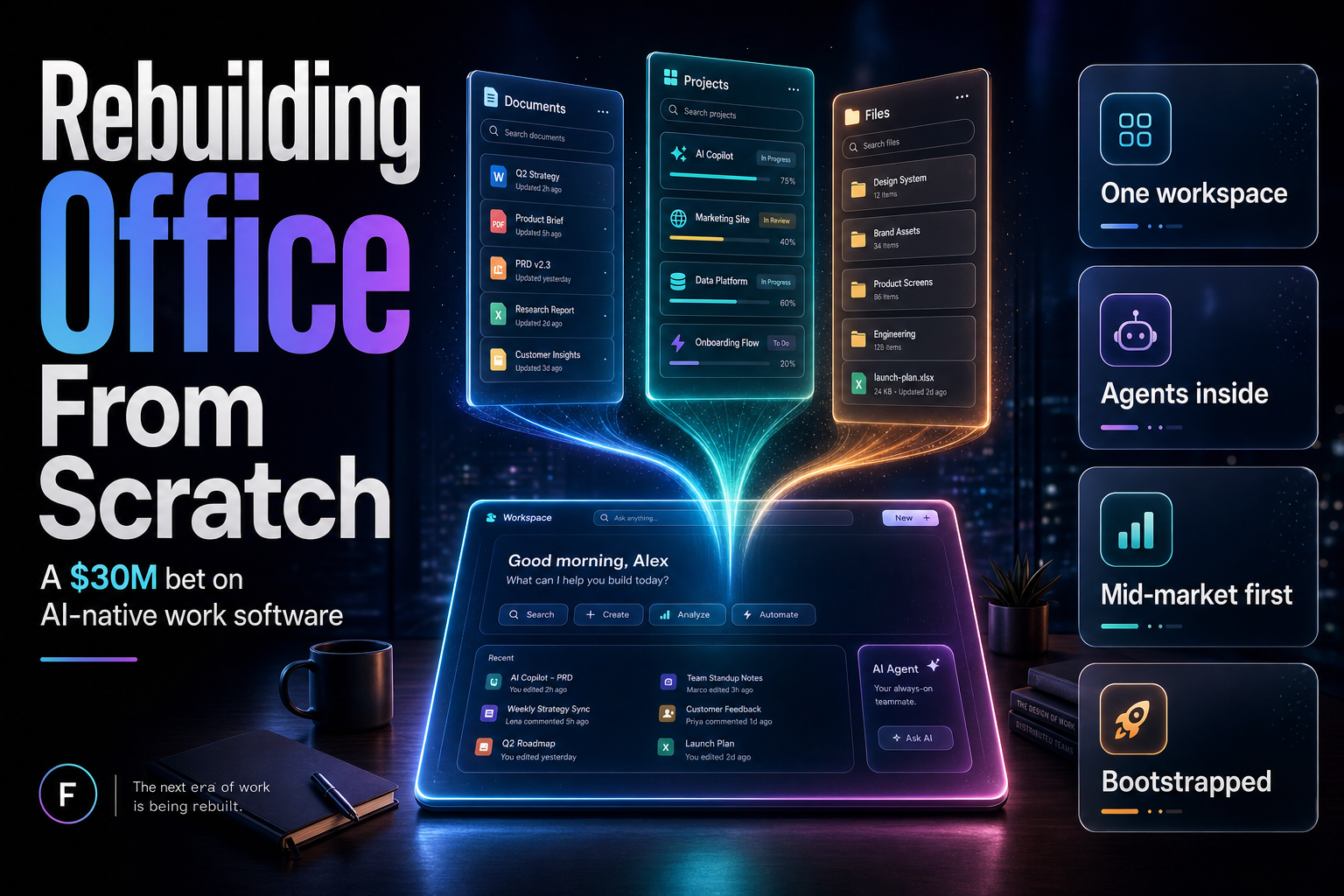
Summary. Bhavin Turakhia launched Neo on July 2, 2026, committing $30 million of his own capital to an enterprise work platform that combines project management, documents, file storage and AI in one product. The Bengaluru company employs about 45 people, including 18 engineers, and ran the product internally from April 2026 before launch. Neo is Turakhia's fifth venture: he co-founded Directi in 1998 at age 18 with an initial investment of ₹25,000, sold Directi's web businesses for $160 million in 2014, built Titan to a $300 million valuation after an Automattic investment, and co-founded Zeta, now valued at roughly $2 billion with SoftBank backing. The argument behind the $30 million is narrow and testable: software designed before AI cannot be upgraded into AI-native software by adding a chatbot. Whether that is true decides whether Neo is a real category or an expensive rebuild of things you already pay for.
What Turakhia actually launched
Neo is a single product with four named parts, not a suite of apps sharing a login.
| Component | What it does | The incumbent it targets |
|---|---|---|
| Friday | AI assistant, co-work and agent layer connected to more than 1,000 external applications | Copilot, Gemini in Workspace |
| Tasket | Project management | Asana, ClickUp, Jira |
| Studio | Knowledge management for documents, spreadsheets and diagrams | Word, Excel, Google Docs, Notion |
| Drive | File sharing workspace where people and AI agents work on files together | OneDrive, Google Drive, Dropbox |
| The platform itself | Model-agnostic core, so enterprises can switch AI models | Single-vendor AI lock-in |
The model-agnostic point is the one buyers should press hardest on, and it is the clearest structural difference from Microsoft and Google. Copilot is Microsoft's route to selling you Microsoft's model layer. Gemini in Workspace is Google's route to selling you Google's. Neo's pitch is that the model is a swappable component rather than the reason the product exists.
Neo launched internally in April 2026 and goes to mid-sized businesses over the coming months, targeting knowledge workers at technology, consulting and professional services firms first. That sequencing is deliberate. Mid-market buyers have less Microsoft enterprise agreement gravity than a 40,000-seat bank does.
The argument: rebuild, not retrofit
Turakhia's case rests on a single claim about software architecture. His phrasing, reported by TechCrunch: "If you want to build an iPhone, you can't take the parts of a Nokia and somehow convert it into an iPhone."
Stripped of the analogy, the claim is that AI-native products need a different data model, a different permission model and a different execution model than document-centric products designed in the 1990s and 2000s. An agent that has to act across your projects, files and documents needs those three things in one schema. If they live in three products stitched together by an API, the agent inherits the seams.
The counter-argument is equally simple and has more evidence behind it right now. Microsoft and Google have the distribution, the data and the enterprise agreements. Incumbents rarely lose because their architecture is old. They lose when the new thing is enough better that switching cost stops mattering, and workplace software has unusually high switching cost because it holds every file you have.
There is a third data point worth holding next to both. On July 2, 2026, the same day Neo launched, Mark Zuckerberg told Meta staff that AI agent progress had not accelerated the way executives expected, despite Meta betting its company structure and as much as $145 billion of infrastructure spending this year on the technology. If the agent layer is the reason to rebuild, and the agent layer is moving slower than its biggest backers hoped, the rebuild case gets harder rather than easier. Our analysis of what Meta's slower agent progress means for CTOs covers that thread.
Two credible people looked at the same technology in the same week and drew opposite conclusions about its readiness. That is the actual state of the evidence.
What staying put costs
The honest reason to look at a product like Neo is not that AI-native architecture sounds better. It is that the current stack has a measurable cost, and most organisations have never counted it.
| Metric | Figure | Source |
|---|---|---|
| SaaS applications per enterprise | 275 on average | Coommit consolidation playbook |
| Licences unused or underutilised | 57% | Coommit consolidation playbook |
| Wasted licence spend per organisation | Up to $21 million | Coommit consolidation playbook |
| Productivity lost per employee per year | $4,800 | Coommit consolidation playbook |
| AI tools per enterprise in 2026 | 14 or more, most adopted without IT review | worqlo AI tool sprawl analysis |
| Fragmented AI licensing per user per year | $1,800–$2,800 | worqlo AI tool sprawl analysis |
| Consolidated AI platform per user per year | $800–$1,400 | worqlo AI tool sprawl analysis |
The AI-specific line is the interesting one. Fragmented AI licensing running $1,800 to $2,800 per user per year against $800 to $1,400 for a consolidated platform is roughly a 2x spread, and it exists because AI tools entered most companies through expense reports rather than procurement. Fourteen tools per enterprise, most adopted without IT review, is a governance problem before it is a cost problem.
Consolidation claims have to be read with care, because the people publishing the numbers sell consolidation. Coommit reports that consolidated stacks can cut total costs by up to 36%, finish implementations 20% faster and raise on-time delivery rates 66%. Treat "up to 36%" as a ceiling somebody achieved, not a forecast for you.
What the incumbents charge
Neo has not published pricing. What the alternatives cost is public, and it frames the decision.
| Option | Published price per user per month | AI included in the base price? |
|---|---|---|
| Microsoft 365 Copilot (enterprise) | $30 add-on, annual term, on top of an eligible plan | No, it is an add-on |
| Microsoft 365 E3 or E5 plus Copilot | $66–$87 combined | No, $36–$57 base plus $30 |
| Microsoft 365 Copilot Business | $18 promotional, standard $21, up to 300 seats, promo through December 31, 2026 | No, it is an add-on |
| Google Workspace Business Standard | $14 | Yes, Gemini bundled |
| Google Workspace Business Plus | $22 | Yes, Gemini bundled |
| Gemini Enterprise plus Google Workspace | $48–$60 | Yes |
The structural split matters more than any single number. Google folded Gemini into Workspace in January 2025 with a plan-price increase instead of an add-on fee. Microsoft kept Copilot as a paid per-seat add-on. As of mid-2026 that produces a total-cost divide that reaches about $40 per user per month at enterprise scale.
For a 500-person company, the gap between Workspace Business Standard at $14 and E5 plus Copilot at $87 is roughly $438,000 a year. That is the budget Neo is arguing about. Any new entrant has to be cheaper than $87, better than $14, or solve something neither does.
How to judge Neo without a pilot
Five questions, in the order they will actually decide the outcome.
Does model-agnostic survive contact with procurement?
Model-agnostic is the strongest claim Neo makes and the easiest to erode. Ask which models are supported today, what switching costs in practice, and whether prompts, evaluations and agent definitions port across models or get rewritten. If switching means rewriting the agent layer, it is portable in the brochure only.
Is the agent layer doing work or summarising work?
Friday connects to more than 1,000 external applications. Connection count is a marketing metric. The question is what the agent completes end to end without a human finishing it. Zuckerberg's July 2 comment is the useful benchmark here: the company spending $145 billion this year says agents are behind schedule. Ask Neo for a task an agent finishes unattended.
What happens to your files?
Drive is a file workspace. Migration is where consolidation projects die. Ask what a rollback looks like eighteen months in, when Neo holds your documents. The real cost is usually the migration, not the licence.
Does 45 people scale to your support expectations?
Neo has about 45 employees including 18 engineers. That is the right size for a focused first release and the wrong size for a 24-hour enterprise support SLA. For mid-market buyers in technology and consulting, that trade may be fine. Match the vendor's stage to your tolerance.
Is Turakhia's track record the right kind of evidence?
Directi's web businesses sold for $160 million in 2014. Titan reached a $300 million valuation after Automattic invested. Zeta is worth roughly $2 billion with SoftBank behind it. That record says he builds durable companies and can fund this one without a term sheet. It does not say workplace software is winnable. Founder quality and category difficulty are separate variables, and the second one has killed better-funded attempts.
India-specific considerations
Neo is built in Bengaluru and that changes the calculation for Indian buyers in three ways.
Support hours align. A Bengaluru company selling to Indian mid-market firms answers the phone during your working day, which is a real difference from routing an enterprise ticket through a US support tier.
Data residency becomes a design conversation rather than a contract negotiation. Under the Digital Personal Data Protection Act 2023, teams handling personal data need clear answers about where it is processed. A vendor headquartered in India can answer that directly. Ask anyway, and get it written into the agreement, because being headquartered in India does not by itself mean data stays there.
Pricing pressure runs the other way. Indian mid-market buyers already compare Google Workspace Business Starter at about $7 per user per month against alternatives. A new platform entering that market has less room above Workspace pricing than it would in the US.
The Indian AI ecosystem gives the venture context: more than 170 Indian AI startups have raised over $2.6 billion to date, and India's AI market is projected as a $126 billion opportunity by 2030. Neo is not an isolated bet. It is one of the better-funded entries in a crowded domestic field. For the wider picture, see our generative AI enterprise strategy guide and our note on Sarvam AI and India's sovereign AI push.
What we would do
If your AI spend is fragmented across 14 tools at $1,800 to $2,800 per user per year, the consolidation problem is real and worth solving this quarter. Neo is one candidate answer. Microsoft and Google consolidating your existing stack is another, and it does not require a migration.
Run the count first. Most teams that audit AI tool spend find the number is larger than anyone believed and that three or four tools do the same job. That audit costs nothing and pays back regardless of which platform you pick.
Then wait for pricing. Neo has not published rates. A platform pitching consolidation economics without a public price cannot be compared to $14 Workspace or $30 Copilot yet. Put it on the evaluation list for the next budget cycle and ask for the number.
FAQ
How eCorpIT can help
eCorpIT is a CMMI Level 5 certified technology organisation in Gurugram, and our senior engineering teams work across Microsoft, Google and AWS platforms. We help teams count what their AI and SaaS stack actually costs, test whether an agent layer completes work or just summarises it, and plan migrations where the file estate is the hard part. If you are weighing a consolidation move against staying on your current suite, contact us for a review of your stack and its real annual cost.
References
- Indian tech tycoon bets $30M of his own money to build AI alternative to Microsoft Office — TechCrunch
- Serial entrepreneur Turakhia launches AI work platform Neo with $30 mn — Business Standard
- Copilot vs Gemini 2026: 5x Context Gap and $40 Cost Divide — Tech Insider
- Google Workspace vs Microsoft 365 2026, Pricing and AI — Unico Connect
- ClickUp 4.0 Review and Pricing (2026) — LinkStart AI
- Bhavin Turakhia launches Neo, commits $30 million to build the AI-native work platform — Business News This Week
_Last updated: July 15, 2026._