On this page · 9 sections
Summary. CVE-2025-3248 is a critical, unauthenticated remote-code-execution flaw in Langflow, a popular open-source tool for building AI agents. Its /api/v1/validate/code endpoint let anyone on the network run arbitrary Python by abusing decorators and default arguments. It scored 9.8 on the CVSS scale, was patched in Langflow 1.3.0, and CISA added it to its Known Exploited Vulnerabilities catalog on 5 May 2025. Since then the same flaw has been used to deliver botnets and, in July 2026, to drive an autonomous ransomware campaign. It has not been Langflow's only exploited bug either. The pattern matters more than any single CVE: teams stood up AI frameworks with default settings on public IPs, skipping the hardening a normal production app would get. The stakes are real money, since IBM put the average Indian data breach at a record ₹220 million in 2025, with vulnerability exploitation behind 13% of cases. This is a developer's guide to closing that gap, using patching, network isolation, gateway authentication, secrets hygiene, and sandboxing.
The core mental model: an AI framework that runs model-generated or user-supplied code is a code-execution service exposed to the internet. Treat it with the same suspicion you would give any such service.
What CVE-2025-3248 actually is
The bug is a missing authentication check. Langflow's code-validation endpoint accepted crafted input and executed it, with no login required. As Horizon3.ai documented, an unauthenticated attacker could send a single HTTP request and run Python on the host by abusing decorators and default arguments. The NVD rates it 9.8, and the fix in Langflow 1.3.0 adds an authentication dependency, a _current_user parameter, so the endpoint verifies identity before it runs anything.
This was exploited quickly and repeatedly. Trend Micro observed the flaw used to deliver the Flodrix botnet, Zscaler's ThreatLabz tracked in-the-wild abuse, and the same vulnerability was the entry point for the JADEPUFFER agentic ransomware campaign. Our breakdown of that autonomous attack covers how an AI agent chained this single flaw into full database extortion.
It is a category problem, not a Langflow problem
Fixing one CVE misses the point. Langflow has seen repeated active exploitation, and researchers reported further Langflow flaws under attack in 2026. Related tools have their own issues: agent builders and automation platforms like Flowise and n8n process user-defined code and connect to external tools, which is exactly the surface attackers want. Through 2025 and 2026, many of these were deployed to prototype quickly and never hardened, running with authentication disabled by default while sitting on public IPs. With tens of thousands of instances reachable over the internet, the exposure is systemic.
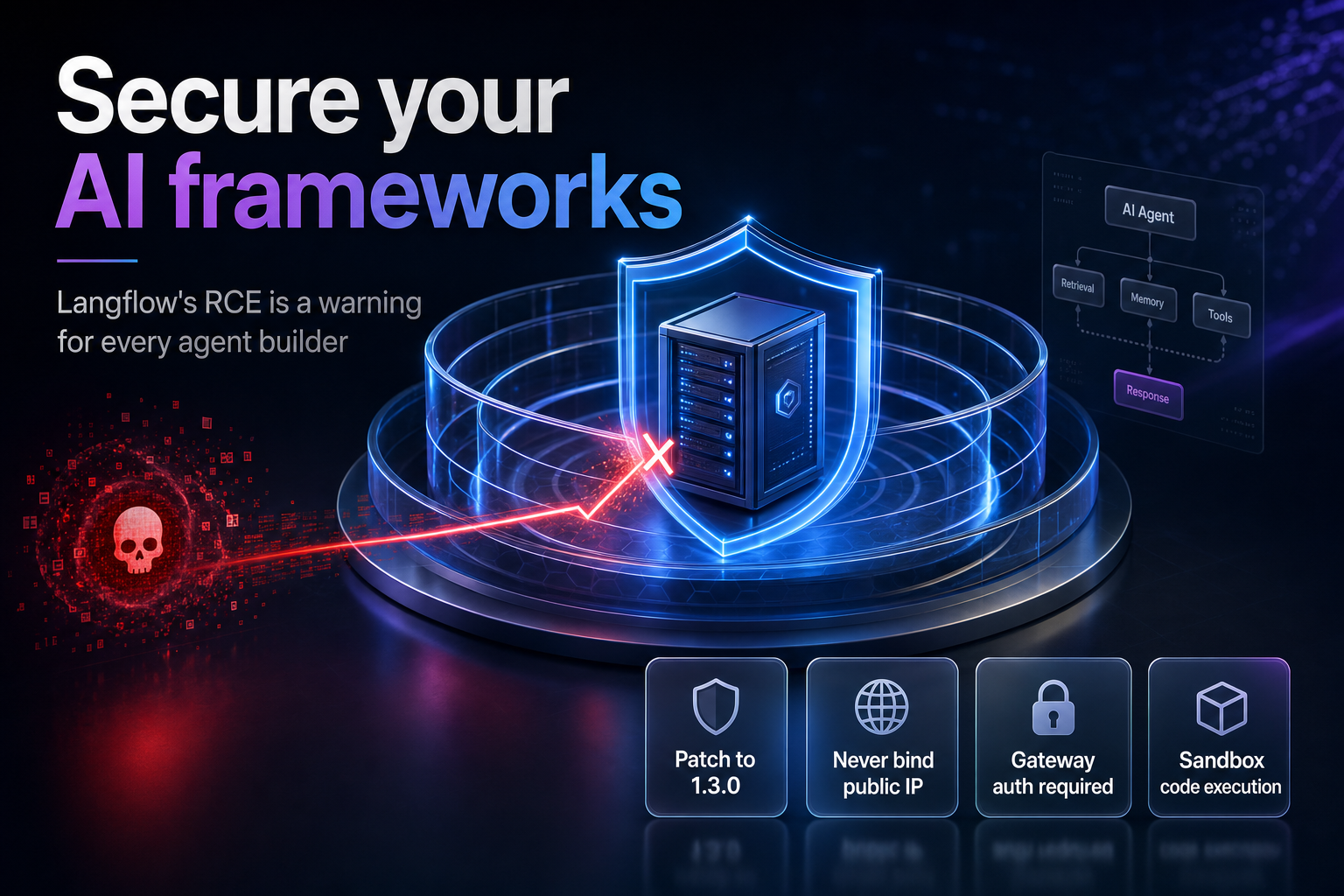
So the goal is not to patch one bug but to treat every AI framework as a production code-execution service. The checklist below is ordered by impact.
| Control | What it stops | Priority |
|---|---|---|
| Patch to the fixed version | The known exploit path | Do now |
| Never bind to a public IP | Internet-wide scanning and hits | Do now |
| Gateway auth: OAuth2, mTLS, API keys | Unauthenticated access | High |
| Network egress allowlist | Data theft and second-hop pivots | High |
| Sandbox code execution | Host takeover after a compromise | High |
| Per-task, short-lived secrets | Credential theft and reuse | Medium |
| Continuous attack-surface scanning | Shadow and forgotten instances | Medium |
Network and authentication: the two fastest wins
The single most effective change is to get these tools off the public internet. The guidance for securing Langflow and similar frameworks is blunt: never bind the app directly to a public IP. Bind it to localhost and put a reverse proxy such as Nginx or HAProxy in front, then enforce real authentication at that gateway, using OAuth2, mutual TLS, or managed API keys rather than the framework's built-in basic auth. Keep the instance behind a VPN or firewall so only trusted users can reach it at all.
Pair that with visibility. Continuously fingerprint your external surface for Langflow, Flowise, n8n, and similar tools, and flag anything new within hours, because the biggest risk is the shadow instance a team spun up for a demo and forgot. An inventory that catches a new deployment the day it appears, then forces it behind authentication and a firewall, closes most of the exposure that made CVE-2025-3248 so damaging. These controls sit alongside the prompt-injection and agent-permission defenses in our AI agent security and guardrails guide.
Sandboxing: assume the code will be hostile
Network controls stop outsiders reaching the app. Sandboxing limits the damage when something does run malicious code, which is the whole job of a tool that executes model-generated logic. The key fact many teams miss: a standard container is not enough, because it shares the host kernel. Enterprise sandboxing guidance for 2026 points to stronger isolation.
| Technology | Isolation level | Best for |
|---|---|---|
| Standard containers | Shared host kernel, weak | Not sufficient for untrusted code |
| Firecracker micro-VMs | Strongest, VM-level | Regulated or sensitive data |
| gVisor | Syscall-level interception | Compute-heavy multi-tenant workloads |
| V8 Isolates | JavaScript-only, lightweight | Latency-critical small tasks |
| WebAssembly (Wasm) | Capability-based, portable | Untrusted plugin and tool code |
The rule of thumb from OWASP is to treat all model output as hostile and run it inside a micro-VM or Wasm sandbox, never directly on the host. That one habit would have blunted the impact of Langflow's RCE even before the patch existed.
Map your controls to OWASP's agentic risks
For teams that want a framework rather than a checklist, OWASP now publishes an agentic-application top-ten, and its LLM risk list maps cleanly onto the controls above. OWASP, NVIDIA, and Microsoft have converged on the same core set: kernel-level process isolation, network egress allowlists, write protection on configuration files, and per-task secrets provisioning.
| OWASP risk | What it is | Mitigation |
|---|---|---|
| LLM05 Improper output handling | Blindly running model output | Treat output as hostile; sandbox execution |
| LLM06 Excessive agency | Too many permissions for an agent | Least privilege; just-in-time tokens; human approval |
| LLM02 Sensitive information disclosure | Model leaks PII or secrets | Mask inputs; filter outputs; use DLP |
| LLM07 System prompt leakage | Secrets embedded in prompts | Keep secrets in a vault, not the prompt |
| ASI10 Rogue agents | An agent deviates from its goal | Scoped permissions; monitoring; kill switches |
The theme across all of these is least privilege and containment: give an agent the smallest set of permissions and secrets it needs, for the shortest time, inside the strongest sandbox you can run. Our enterprise AI agent governance guide puts these controls into an organizational structure.
India-specific considerations
For Indian teams shipping AI features fast, the exposure is concrete and the cost is quantified. IBM's 2025 report put the average Indian breach at ₹220 million, with vulnerability exploitation behind 13% of them, and unmanaged "shadow AI" adding to the bill. Two practical steps. First, inventory every self-hosted AI framework across your cloud accounts and data centers, because the risky instance is usually the undocumented one. Second, design deployments so that an incident triggers the DPDP and CERT-In reporting duties cleanly: encrypted-at-rest data, logged access, and a clear owner for each service. Building security in from the first prototype is cheaper than retrofitting it after a breach notification.
FAQ
How eCorpIT can help
eCorpIT is a Gurugram-based technology organization, founded in 2021 and assessed at CMMI Level 5, with senior-led engineering and security teams. We help enterprises inventory and harden self-hosted AI frameworks, put gateway authentication and sandboxing around code-executing tools, and design deployments aligned with DPDP and CERT-In requirements. If you run Langflow, Flowise, n8n, or similar tools in production, talk to our team for an AI framework security review.
References
_Last updated: 12 July 2026._