On this page · 14 sections
- The case in one paragraph
- What the court actually held
- The headline most people are getting wrong
- The precedent chain: DRS Logistics → MakeMyTrip → Hindware
- What this means for brand owners (the playbook)
- What this means for Google Ads buyers (the advertiser playbook)
- What this means for Google (and other ad platforms)
- The founder amplification, in context
- What this ruling does and does NOT do (dedicated fact-check)
- What to expect next
- A 30-60-90 day brand-protection playbook
- Frequently asked questions
- A short closing note
- References
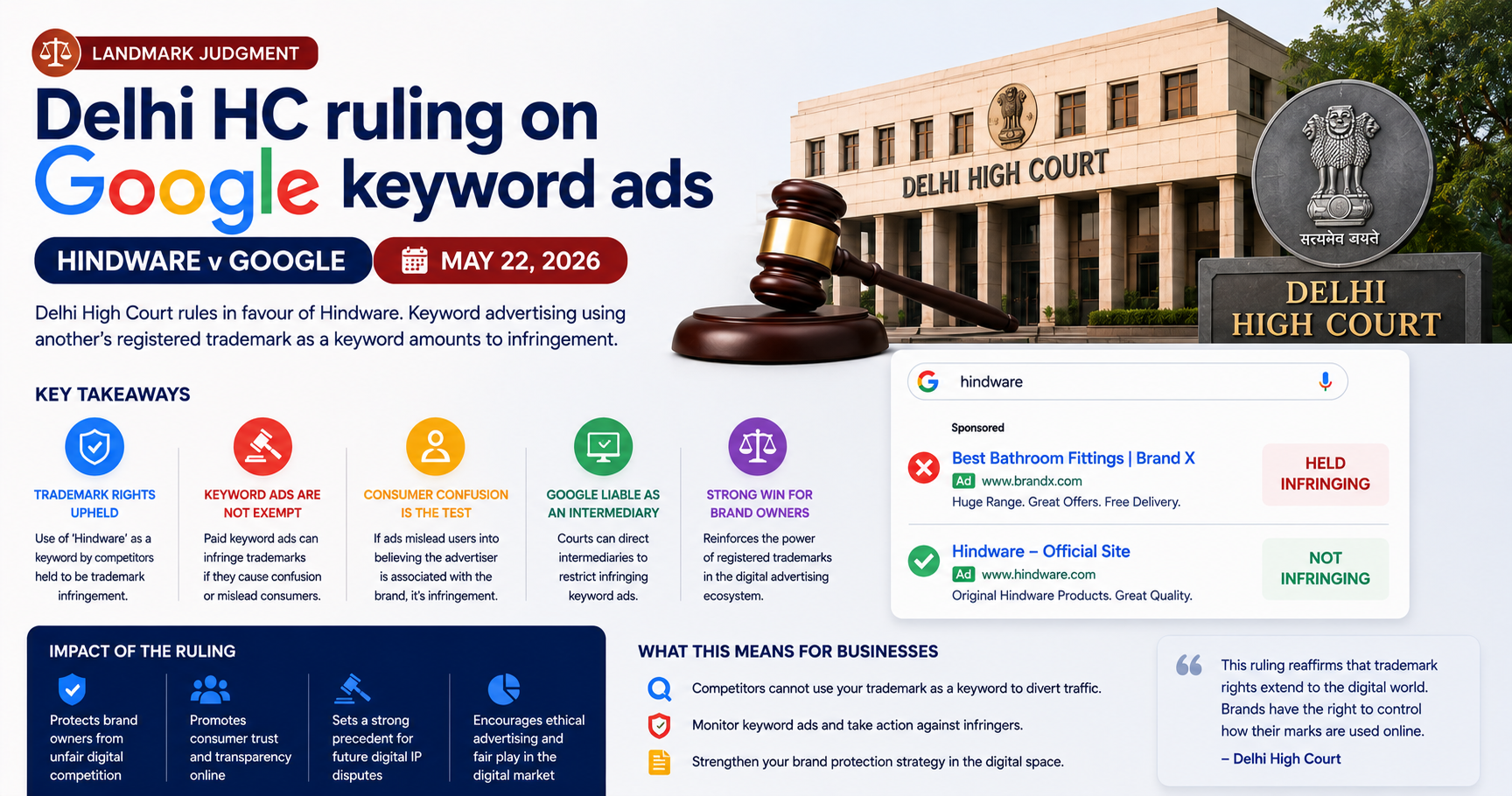
Summary : On 22 May 2026, Justice Mini Pushkarna of the Delhi High Court held Google liable for trademark infringement for allowing competitors to bid on "HINDWARE" as a Google Ads keyword, awarded ₹30 lakh in nominal damages (about $31,600), and permanently restrained Google from auctioning the HINDWARE marks. The headline reading — "India has banned Google Ads keyword bidding on trademarks" — is wrong. The narrower and more useful reading is that the court extended the 2023 DRS Logistics framework, denied Google the Section 79 IT Act safe-harbour because it actively runs the auction and suggests trademarked terms, and signalled that brand owners in India now have a real legal route to stop rivals from buying their marks as keywords. The injunction itself is specific to HINDWARE. The doctrine reaches further. Google is expected to appeal.
By Manu Shukla, Founder, eCorpIT. Last updated 30 May 2026.
Talk to eCorpIT about a brand-protection audit · Book a 30-minute discovery call
The case in one paragraph
Bar and Bench's reporting and ThePrint's case file line up on the chronology. In 2013, Hindware (the sanitaryware brand, suing through its predecessor HSIL and later Brilloca Ltd) discovered that rival Cera Sanitaryware and a website developer called Omkara Infoweb were buying HINDWARE as a Google AdWords keyword. When buyers searched for Hindware, Cera's sponsored result appeared on top. In October 2014, Hindware found that plumbing fixtures maker Grohe had also bought the keyword. Hindware filed two commercial suits in the Delhi High Court — one against Cera/Omkara, one against Grohe — joining Google India and Google LLC as defendants. Over the next twelve years, Grohe, Cera and Omkara settled and decrees were passed against them. Google contested all the way to judgment. Justice Pushkarna's 163-page ruling on 22 May 2026, as TechCrunch confirms via the judgment PDF on the Delhi HC website, found Google liable, awarded ₹15 lakh in each suit (₹30 lakh total, payable in 8 weeks), and permanently restrained Google from using HINDWARE or listed variations as advertising keywords.
That is the case. Everything else is interpretation.
What the court actually held
The doctrine matters more than the damages.
Section 29(6)(d) of the Trade Marks Act 1999 covers invisible advertising use. ThePrint's analysis captures the central holding cleanly. The statute makes a person who uses a registered mark "in advertising" without consent liable for infringement. Google's defence was that an invisible keyword cannot be "use" because the consumer never sees the trademark on screen. The court rejected this directly. In Justice Pushkarna's words: "it is not necessary that the registered trademark physically appears in an advertisement for the same to be used 'in advertising'." Once you accept that a backend keyword trigger counts as "use in advertising," the infringement question follows.
Google's commercial activity makes it a primary user, not just a conduit. The judgment is quoted in Bar and Bench: "Google suggests, offers and sells words, including, trademark terms, as keywords to advertisers. This active offering and selling of trademark terms to advertisers is not mere internal use of the trademark term, and is clearly a commercial use. Thus, use of trademark as keywords also amounts to use by Google, wherein, Google derives a distinct advantage by use of trademarks as keywords." The court's reasoning bound four things into a single picture: Google operates the keyword auction, the Keyword Planner tool actively suggests trademarked terms, the Quality Score ranks ads, and Google takes pay-per-click revenue on every sponsored click. That bundle is what the judgment calls active participation.
Section 79 of the IT Act does not protect an active participant. Google had pleaded intermediary safe-harbour, the same defence that has done a lot of work for platforms across India over the last decade. The court refused it. The Print's read on the reasoning is sharp: Google is "not a 'passive' host but an active participant that determines the recipients of the infringing links and, in the end, monetises the data," and "by having a policy in India that explicitly refuses to investigate the use of trademarks as keywords, Google failed to observe 'due diligence' required of an intermediary." The India policy gap, when compared with Google's investigative policy in the EU, was a material adverse fact the court called out.
The injunction is narrow. The doctrine is wide. The Delhi HC permanently restrained Google from auctioning HINDWARE, HINDWARE SANITARYWARE, HINDWARE SANITARY, HINDWARE SANITARYWARE INDIA or any combination of those marks. ₹30 lakh in damages got described by the court itself as nominal. The injunction does not, by its own terms, cover any other brand. The doctrine, however, is now available to every other trademark owner in India who can prove similar facts.
The headline most people are getting wrong
The Reuters framing — that the ruling "could reshape online advertising" — is fair, with the right emphasis on could. The social media version, especially in the first 72 hours after the TechCrunch follow-up, has been louder than the judgment supports.
A few things this ruling does not do.
It does not ban competitor keyword bidding in India. The injunction is specific to HINDWARE. Other brands have to bring their own suits. The doctrine helps, but it is not automatic relief.
It is not Supreme Court precedent. This is a Single Judge bench of the Delhi High Court. Other High Courts can disagree. The Division Bench can disagree. The Supreme Court has not ruled on this fact pattern. As Aprajita Rana, partner at AZB & Partners, told TechCrunch, the decision does not have a "far-reaching impact" on online-platform liability law that was not already there, because the active-participation framework had already been built.
Google has not exited keyword advertising. Google's response to TechCrunch was operational, not capitulatory: "We look forward to continuing to align our operations with local legal frameworks while maintaining strict standards to protect our users' long-term interests." The expected next move is an appeal to the Division Bench.
₹30 lakh is not punishment. The court explicitly framed it as nominal damages. For Google's India ad revenue, it is not a meaningful penalty. The injunction matters more than the cheque.
This is a real precedent. It is not the end of Google Ads in India.
The precedent chain: DRS Logistics → MakeMyTrip → Hindware
The Hindware ruling did not come from nowhere. It sits at the end of a Delhi HC precedent chain that has been building for three years.
Google LLC v DRS Logistics (P) Ltd & Ors is the cornerstone. In August 2023, a Division Bench of the Delhi High Court upheld a Single Judge's ruling that Google's use of trademarks as keywords amounted to "use" under the Trade Marks Act, and that Section 79 IT Act safe-harbour was not available to Google because it actively promoted and benefitted from keyword auctions. That is the active-participation doctrine the Hindware judgment now extends.
The MakeMyTrip v Booking.com line added the second important nuance. The Division Bench, applying DRS Logistics, held that even when a competitor (Booking.com) bid on a trademarked keyword (MakeMyTrip), there was no infringement because the court did not find consumer confusion. That confusion test is the escape hatch every advertiser who bids on a competitor brand will now lean on. The Hindware judgment did not undo it. It just held that on the HINDWARE facts, confusion was present because HINDWARE is a coined term with no dictionary meaning, the products were identical (sanitaryware) and the searching user clearly intended to find Hindware.
The combined picture for 2026 is this. Platforms remain inside the active-participation framework: if you run the auction and suggest the keyword and take the revenue, you cannot hide behind Section 79. Advertisers remain inside the confusion framework: bidding on a competitor's mark is not automatically infringement, but bidding on a coined, well-known mark for identical goods, with the intent to divert traffic, very likely is. Both branches of the doctrine are now defensible in court.
What this means for brand owners (the playbook)
If you own a trademark in India and competitors are bidding on it through Google Ads, the legal road just got more passable. We are getting more inbound asking about this from brand owners than from advertisers in the days after the ruling.
A practical sequence, in the order we would run it for a client.
Step one: document the infringement. Take dated screenshots of the sponsored result appearing for your branded search. Capture the search query, the ad headline and the destination URL. Run a check from multiple devices and locations. Repeat over a one to two week period to show this is not an isolated occurrence.
Step two: send the cease-and-desist to the advertiser first. The advertiser is almost always the easier and faster target. They are the one bidding. Most established brands will pull the keyword within days when faced with a credible trademark notice. This is consistent with how Hindware first reached settlements with Cera, Grohe and Omkara before continuing against Google.
Step three: escalate to Google through its trademark complaint process. Google does have an ad-text trademark complaint process, even if the keyword complaint route in India has historically been weaker than in the EU. File the complaint with the documentation from Step one. Even if Google does not act on the keyword bid itself, the documentation builds your record.
Step four: if the conduct continues, file in the Delhi High Court. The Hindware ruling now gives a Single Judge bench an active and recent precedent to cite. The ₹30 lakh damages number is modest, but the injunction is the win. An injunction that forces a competitor to permanently stop bidding on your mark is worth far more than the headline damages number.
Step five: register what is not yet registered. If your brand is a coined mark (no dictionary meaning), get it registered. If it is descriptive, work on building well-known status through evidence of use. The strongest claims in this body of case law have always been on coined, well-known marks used for identical goods. The Hindware judgment is a direct example.
The cost of running step four is real. A High Court trademark suit in India runs into the lakhs in legal fees before judgment. For most growing brands, the right initial move is steps one to three. Step four is the lever you hold for repeat offenders or for high-stakes brand erosion.
Need help on the documentation side? eCorpIT runs brand-protection audits for D2C, SaaS and B2B clients in India — competitor keyword bidding tracking, ad-text monitoring, Google Ads complaint preparation and trademark-registry hygiene. Talk to our team about a 30-day audit.
What this means for Google Ads buyers (the advertiser playbook)
If you are an advertiser running Google Ads in India, this ruling is a real risk signal even if it does not change Google's policy tomorrow.
Bidding on competitor trademarks is now legally risky in India. The Hindware judgment puts the advertiser inside the same active-participation logic as Google. If a brand owner can show their mark is well-known and coined, that your bidding diverted clearly-intended traffic, and that the goods are identical, you face a real infringement claim. The MakeMyTrip confusion test gives you an escape hatch only when the brand is descriptive and the products differ enough that a careful consumer would not be misled.
Audit your existing keyword lists today. Pull the report of all bid keywords across your Google Ads account. Flag every keyword that is a registered third-party trademark, especially coined marks in your category. The 80/20 of the risk lives in 20% of your keywords.
Move bid-on competitor keywords to negative lists. This is the operational fix. Add competitor brand terms to a negative-keyword list to actively exclude them. Most agencies offer a "competitor conquesting" service that the Hindware ruling now makes harder to defend in India.
Comparison advertising remains legal, with care. Indian law allows comparative advertising under Sections 30(1) and 30(2) of the Trade Marks Act, subject to honesty and not denigrating the competitor. The Hindware judgment is about keyword bidding for identical goods to divert traffic. It is not about a comparison page on your own site that names a competitor honestly.
Document your own brand-bid spend. Many brands are paying Google Ads on their own brand searches purely to keep competitors out of the top slot. Track that spend separately. After Hindware, if the situation persists and the competitor can be identified, you have grounds for a damages claim that recovers what you spent on defending your own brand.
The rule for advertisers is simple. Bid on category and intent terms. Stop bidding on competitor brand names. Build your own brand strength so customers searching for you find you above any competitor that tries.
What this means for Google (and other ad platforms)
The narrower reading is that the Hindware ruling forces Google to revisit how its India ad policy handles trademark complaints. TechCrunch's quote from Aprajita Rana at AZB & Partners captures this exactly: "The judgment per se will require platforms to relook at their processes to see if their automated tools encourage or offer trademarked terms to advertisers at large."
The broader reading is that the ruling is yet another active-participation case eroding the Section 79 safe-harbour for algorithmically-curated platforms. The doctrine has been moving in this direction for years, including in Delhi HC's social-media takedown jurisprudence and the DRS Logistics line. Any platform whose algorithm suggests, ranks and monetises third-party content will find it harder to argue passive intermediary status in India after Hindware.
The likely operational response from Google, on past form, will be three things in combination. First, an appeal to the Division Bench. Second, a quiet update to the India trademark complaint process that brings it closer to the EU policy. Third, no change to the underlying Keyword Planner suggestion logic globally, because that is a much bigger commercial change.
For competing ad platforms (Meta, Microsoft Ads, programmatic networks), the doctrine is portable. Anyone running a keyword auction or algorithmic ad-recipient determination in India should treat this ruling as an instruction to review their own processes.
The founder amplification, in context
The reason this ruling went from a legal-trade story to a mainstream business one was the founder reaction.
Nithin Kamath of Zerodha posted on X the line that has been quoted by every outlet covering the story: "Whenever someone searches for 'Zerodha,' the traffic should rightfully come to Zerodha. But what often happens is that the first couple of results on Google Search are ads, leading the customer to a competitor's website."
Sridhar Vembu of Zoho, in a longer post, called Google "unethical". Nikhil Kamath weighed in too on Storyboard18's coverage: "The last thing startups need is rivals stealing traffic." The pattern in the reactions is that founders of brands that have spent meaningfully on defending their own brand searches see this as a long-overdue legal lever. The pattern in the legal commentary is that the lever exists but the doctrine is incremental, not revolutionary.
Both reads are true. The ruling matters most to founders who have been paying Google to be the top result on their own name. It matters less to platforms whose lawyers already operate on the assumption that the active-participation framework limits Section 79.
What this ruling does and does NOT do (dedicated fact-check)
A clean separation, because the line has been blurred in a lot of secondary coverage.
What the ruling DOES.
It confirms, with a fresh 163-page judgment, that selling a registered trademark as a Google Ads keyword without authorisation is infringement under Section 29(6)(d) of the Trade Marks Act 1999 when the relevant brand owner can show typical infringement factors (well-known coined mark, identical goods, traffic diversion, lack of authorisation).
It denies Section 79 IT Act safe-harbour to Google on the keyword-auction conduct, on the basis that Google actively runs the auction, suggests trademarked terms via Keyword Planner, ranks ads, and earns pay-per-click revenue.
It permanently injuncts Google from auctioning HINDWARE, HINDWARE SANITARYWARE, HINDWARE SANITARY and HINDWARE SANITARYWARE INDIA as keywords.
It awards Hindware ₹30 lakh in nominal damages, payable within 8 weeks.
It extends the DRS Logistics framework that the Delhi HC Division Bench established in August 2023.
It calls out, explicitly, Google's India policy gap — declining to investigate trademark complaints in India when the EU policy does — as a failure of "due diligence" required of an intermediary.
What the ruling does NOT do.
It does not ban competitor keyword bidding generally in India. The injunction names HINDWARE and its variations. Other brands need their own suits.
It is not Supreme Court precedent. It is a Single Judge bench ruling, appealable to the Division Bench and onward to the Supreme Court. Google is expected to appeal.
It does not bind High Courts outside Delhi. Bombay, Madras, Karnataka and other High Courts can take different views on similar facts.
It does not displace the MakeMyTrip confusion test. An advertiser bidding on a descriptive competitor mark in a category where no reasonable consumer would be confused still has a defence.
It does not impose a punitive fine. ₹30 lakh is what the court itself called nominal. For Google's India ad business, this is operationally trivial.
It does not change Google's published Ads Policy globally. Google's existing policy (as documented in its support pages) already prohibits use of trademarked terms in ad-text. The keyword-bid policy is the part that varies by jurisdiction and is the part this ruling addresses.
It does not give consumers a private right of action. The remedy here is brand-owner enforcement, not consumer suit.
What to expect next
Three things to track over the next 6 to 18 months.
Appeal trajectory. Google's standard playbook is to appeal precedent-setting judgments. Expect an appeal to the Division Bench of the Delhi High Court within the statutory window. If the Division Bench upholds, expect an SLP to the Supreme Court. The Supreme Court has, separately, been considering related cases against Google. The eventual SC ruling, when it comes, is what determines whether Hindware becomes binding national doctrine.
Other brand-owner suits. Expect a wave of suits in the Delhi High Court from other Indian brand owners using the Hindware reasoning. The brands that have spent the most defending their own keyword traffic — fintech (Zerodha-style cases), travel, e-commerce, edtech — are the obvious candidates.
Google's India policy update. The most likely operational response is that Google quietly updates its India trademark complaint policy to bring it closer to the EU process. Whether this happens before or after the appeal is a function of legal strategy rather than principle.
For advertisers running paid search in India in the meantime, the practical guidance is straightforward. Audit your keyword lists. Pull bids on registered third-party trademarks, especially coined marks for identical goods. Treat brand bidding as a permanent line item until the case law settles.
A 30-60-90 day brand-protection playbook
What we recommend to clients who want to act on this ruling without going straight to court.
Days 1-14: instrument. Set up a daily branded-search tracker. Pull screenshots of the top three results for your brand from at least four locations (Delhi, Mumbai, Bangalore, Tier 2). Document who else is bidding. Add competitor brands to your own negative-keyword list if you are running Google Ads.
Days 15-45: communicate. Send measured cease-and-desist letters to the identified competitors with the documentation. Most reputable brands pull the keyword within days when notified properly. File a Google Ads trademark complaint regardless of whether the competitor responds.
Days 46-75: harden. Register any unregistered brand marks. Build evidence of well-known status if applicable. Brief your in-house counsel or external IP firm on the Hindware ruling and the DRS Logistics framework. Decide whether to keep brand-bidding spend (most clients should keep it temporarily) or to redirect to category terms.
Days 76-90: decide and document. For repeat offenders or for high-stakes brand erosion, prepare the litigation package. Even if you do not file, having the package ready shifts the negotiating leverage. Quantify the brand-bid spend you have incurred defending your own name. This is the damages number you can plead for when the time comes.
The cadence repeats every 90 days because Google Ads keyword inventories change continuously.
Frequently asked questions
A short closing note
The Hindware ruling is a meaningful precedent shift for trademark owners in India and a careful warning to advertisers running aggressive competitor bidding. It is not the end of Google Ads in India, and it is not the Supreme Court taking a sweeping view of platform liability. The right reading is somewhere in the middle: a Single Judge ruling that extends an existing Division Bench framework, names a specific brand in its injunction, and gives every other brand owner a usable lever.
The work for most brand operators in 2026 is operational, not litigious. Audit. Document. Cease-and-desist. Stop bidding on competitor brands. Strengthen your own brand so the bidding becomes pointless.
If you want a senior, honest read on what this ruling means for your specific category and your specific brand, that is what we do.
References
This article will be reviewed and refreshed quarterly, and immediately if the Division Bench, Supreme Court, or other High Courts rule on related fact patterns. Next planned refresh: August 2026.