On this page · 12 sections
- What the data actually says
- How ChatGPT compares to the apps it just beat
- What "1 billion mobile MAU" does and does not mean
- The structural shift this confirms
- What this means for brands and marketers in 2026 H2
- The competitive landscape: who else is real at scale
- What is real vs what is positioning
- What to budget for in 2026 H2
- Frequently asked questions
- A short closing note
- Further reading
- References
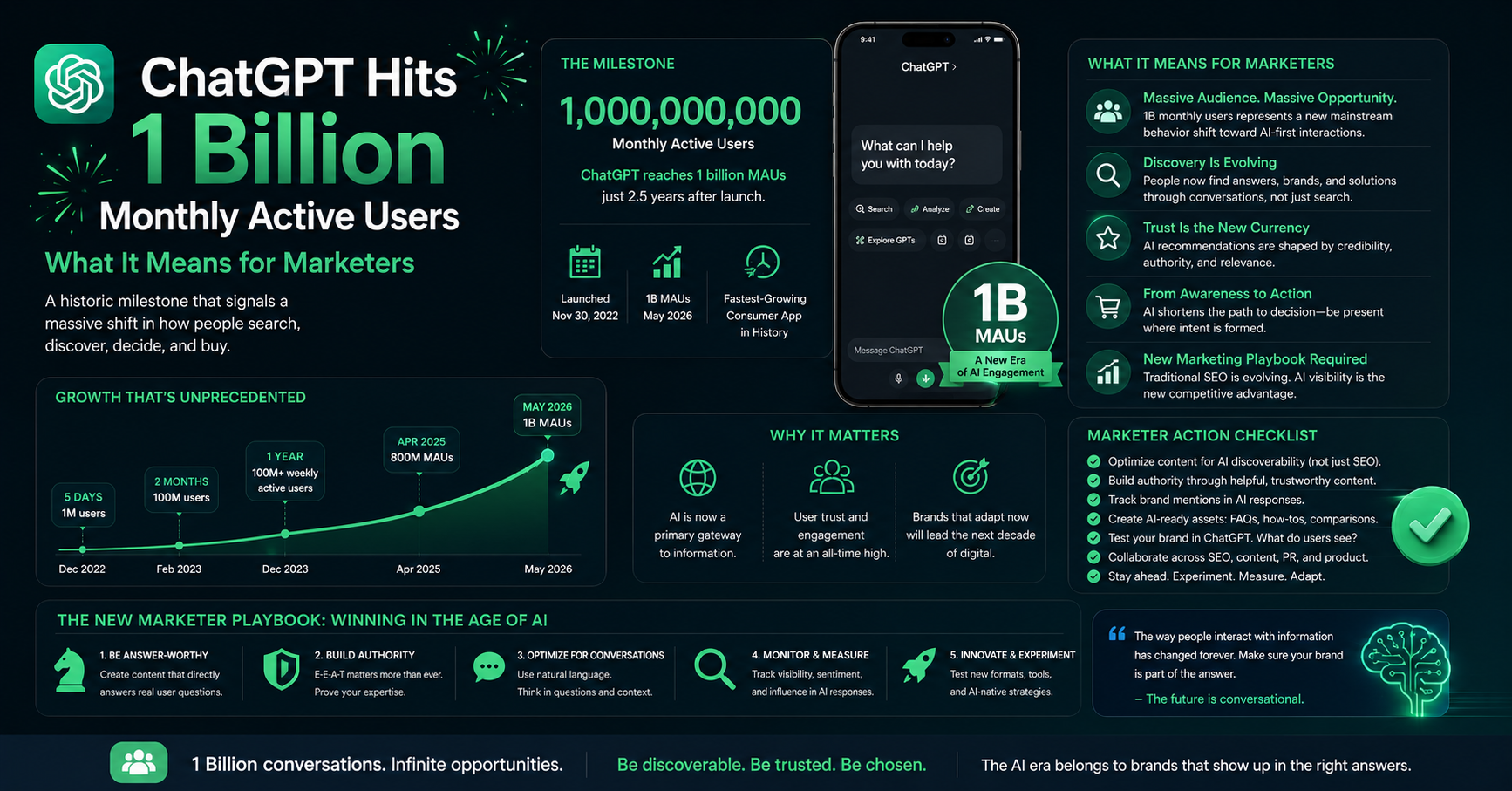
Summary. ChatGPT's mobile app crossed 1 billion monthly active users in May 2026, making it the fastest app in history to reach the milestone per Sensor Tower data. Roughly three years from launch — against five to eight years for Google Maps, Chrome, YouTube, Meta Messenger, and TikTok. The headline matters but the second-order effects matter more. For brands, the milestone changes the AEO/GEO conversation from "should we optimise for AI search" to "we are losing branded queries to ChatGPT's answer surface, every day, at scale." This guide does the actual numbers, separates the headline from the structural shift, and gives marketers a practical lens on what to budget for in 2026 H2.
Talk to eCorpIT about an AEO/GEO sprint · AEO vs GEO vs SEO complete guide
What the data actually says
Three numbers anchor the story. All three matter for different reasons.
1 billion monthly active users, mobile app, May 2026. Sensor Tower's market-intelligence estimate, widely re-syndicated through Reuters on 2 June 2026. The methodology is mobile-app installs and engagement on iOS and Android — not the chatgpt.com web platform, not the API, not enterprise deployments. The mobile-app surface alone hit the billion-MAU threshold.
1.19 billion total MAU, applying Similarweb's MAU-to-WAU ratio. Similarweb's worldwide ChatGPT mobile-app data analysis suggests the actual MAU figure is roughly 1.19 billion when the platform-wide WAU is projected through the typical 1.32 MAU-to-WAU ratio. Different methodology, similar magnitude, separately confirmed.
900 million weekly active users, OpenAI's own February 2026 disclosure. OpenAI publicly reported 900 million WAU in February 2026, up from 800 million in October 2025, 700 million in July 2025, 400 million in February 2025, and 300 million in December 2024. The trajectory is steeper than any consumer product in software history.
Three independent angles, same picture. The mobile-app milestone is the headline; the broader platform is materially bigger.
How ChatGPT compares to the apps it just beat
The "fastest app to 1 billion MAU" framing is not marketing inflation. It is verifiable against the published growth curves of the previous record holders.
| App | Launch | Time to 1 billion MAU |
|---|---|---|
| ChatGPT | November 2022 | ~3 years (to May 2026) |
| TikTok | September 2016 | ~5 years |
| October 2010 | ~6 years | |
| YouTube | February 2005 | ~8 years |
| Google Maps | February 2005 | ~7 years |
| Meta Messenger | August 2011 | ~5 years |
| Google Chrome | September 2008 | ~6 years |
ChatGPT compressed the curve that previously defined "category-defining consumer product" by 40–60%. Per PYMNTS coverage of the Sensor Tower data, no consumer software product in history has reached the threshold this fast.
The reasons matter for marketers. The previous record-setters benefited from smartphone penetration, broadband adoption, and the maturation of mobile UX. ChatGPT benefited from those plus a single-prompt onboarding loop, multi-language native-feeling output, and a category-creation moment that pulled in users who had never used any AI product before.
What "1 billion mobile MAU" does and does not mean
The honest separation, because the social-media interpretation has been louder than the data supports.
What it does mean.
ChatGPT mobile is now a top-tier consumer surface comparable to Instagram, TikTok, and YouTube. Engineering the product to handle 1B+ MAU concurrency requires the infrastructure investment of a hyperscaler — and OpenAI is investing accordingly.
For brand-search traffic specifically: when a user opens ChatGPT and asks "what's a good [your category] product," your competitive position in that answer is now a top-tier-marketing-channel question. Not a research-curiosity question.
OpenAI's $25 billion annualised revenue run-rate at this scale means the platform has the unit economics to keep investing. The conversion from free to paid is working.
What it does not mean.
It does not mean ChatGPT has replaced Google. Google Search still handles roughly 8.5 billion daily queries against ChatGPT's reported 2 billion daily queries. The growth curve is steep; the absolute scale of conventional search is still meaningfully larger.
It does not mean every ChatGPT user is a buyer. Most are still in the curiosity-and-utility usage phase. Commercial-intent queries are a fraction of total volume.
It does not mean Anthropic, Google Gemini, or Perplexity are losing. Each is growing rapidly inside specific use cases. ChatGPT leads the consumer surface; the broader AI-search landscape is genuinely multi-platform.
It does not mean OpenAI is profitable. The $25B revenue run-rate is meaningful, but the underlying compute costs remain enormous. The profit story is still being written.
The structural shift this confirms
Three structural shifts that this milestone confirms more than initiates.
AI search is now a primary discovery surface
In 2024 it was reasonable for marketers to treat ChatGPT search as a "watch and learn" channel. In 2026 it is not. The branded-query traffic that used to go to Google is increasingly going to ChatGPT, Claude, Gemini, and Perplexity. When that traffic arrives in an AI answer, the only competitive positions that matter are: cited, mentioned, or absent.
Our AEO/GEO/SEO complete guide covers the practical mechanics. The headline is that brand presence in AI answers requires a different content discipline than ranking on Google: statistics with sources, named expert quotes, third-party citation patterns, and entity-level brand strengthening across the web.
AI Overviews are the new top result
Google's AI Overviews, ChatGPT's answer surface, Perplexity's citation panel, Claude's sourced responses, Gemini's grounded answers — all are now the first thing a user sees for a meaningful share of informational queries. Per Ahrefs data we cited in the AEO/GEO/SEO pillar, AI Overviews appear on 48% of Google queries as of March 2026 and sites cited in an AI Overview see roughly 35% more organic clicks than they would from a standard #1 result.
For marketers, the implication is clean: being cited in the answer surface is now more valuable than ranking below it.
Token economics drive the agency conversation
When 1 billion users open ChatGPT, the token-cost picture inside enterprise budgets gets harder to ignore. Our analysis of Microsoft and Uber's Claude Code budget blowouts covers the enterprise side; the consumer side has equivalent economic gravity. OpenAI's compute spend at 1B+ MAU scale is in the multi-billion-dollar annual range. The cost discipline that defines the next 24 months of AI applies to every vendor.
What this means for brands and marketers in 2026 H2
Five practical takeaways for 2026 H2 budget planning.
Audit your visibility in AI search
Run a fixed prompt set monthly against ChatGPT, Claude, Perplexity, and Gemini for branded and unbranded queries in your category. Store the answers. Track citation share, brand mentions, and how each AI describes your brand and your competitors. Imperfect, currently the best signal available — and the gap between brands that do this and brands that do not widens monthly.
Treat the AEO/GEO discipline as a 2026 priority, not a 2027 experiment
Three years ago this was research. Two years ago it was a side project. In 2026 it is the practical work of being findable by buyers. The brands that started in 2024 and 2025 already have the entity-level strength, the cited statistics, and the third-party mention network that makes AI engines pick them up. Brands starting in 2026 are 18 months behind; brands starting in 2027 will be 30 months behind.
Stop optimising only for Google
Google still matters. It matters less than it did in 2023. Your content strategy, your link-building, your PR plan, your founder visibility plan all need to be re-evaluated against multi-platform AI search rather than Google-only.
Build the entity-level brand strength that AI engines reward
Per the Princeton GEO research we covered in the AEO/GEO/SEO pillar, AI engines reward statistics, named third-party citations, direct expert quotes, and consistent entity descriptions across the web. The single biggest 12-month investment a brand can make right now is mentions on independent, credible sites that AI engines treat as authoritative. Wikipedia entries. Wikidata entries. Industry-press quotes. Conference talks with published transcripts. Podcast appearances.
Update the marketing budget allocation
If your 2026 marketing budget allocates 40% to paid search and 5% to "AI/SEO research," the ratio is now wrong. The brands navigating 2026 H2 well are reallocating toward content depth, founder visibility, third-party PR, and the operational discipline of measuring AI search visibility as a primary metric.
Need help making AEO/GEO a 2026 H2 priority? eCorpIT runs AEO/GEO sprints for brands in India, the UK and the US — citation tracking, entity-strengthening, expert-quote acquisition, AI Overview inclusion strategy. Talk to our team about a 90-day programme.
The competitive landscape: who else is real at scale
ChatGPT leads the consumer surface. Three other AI assistants matter at scale.
Claude (Anthropic). Different audience composition — heavier in technical, coding, and enterprise workloads. The Microsoft–Anthropic partnership and the $30 billion revenue run-rate at Anthropic make Claude a serious competitor for high-value enterprise users even if the raw MAU figure is smaller than ChatGPT's.
Google Gemini. Distributed across the Google Workspace surface (Gmail, Docs, Sheets) and the Gemini standalone app. Distribution advantage through Workspace; less standalone consumer brand than ChatGPT.
Perplexity. Smaller scale but disproportionate influence in research and category-comparison queries. Perplexity leans heavily on Reddit for sourced content, making it a meaningful citation surface for brands that build Reddit presence.
Brands that build AEO/GEO strategy in 2026 should plan for citation in all four. Each rewards slightly different content patterns; the underlying discipline (statistics, third-party citations, named quotes, entity strength) overlaps significantly.
What is real vs what is positioning
Honest separation, the same shape as our Microsoft Build 2026 enterprise takeaways and the MS-Uber Claude Code analysis.
Real:
- 1 billion mobile MAU, May 2026, Sensor Tower data, widely re-syndicated through Reuters.
- 900 million WAU, OpenAI's own February 2026 disclosure.
- $25 billion annualised revenue run-rate per multiple industry sources.
- 2 billion daily queries processed on ChatGPT.
- Three-year curve to 1B MAU, the fastest in consumer software history.
Positioning:
- "ChatGPT has replaced Google." Overstated. Google still handles ~4× the daily query volume.
- "Every brand is at risk of being absent from AI answers." Closer to true than three years ago, still depends on category.
- "AI search is the new SEO." Closer to true than two years ago, still has implementation discipline that few brands have built.
The right read for marketers is between the over-interpretation and the under-reaction. ChatGPT crossing 1B mobile MAU is a real structural shift. The practical response is AEO/GEO investment, not panic and not dismissal.
What to budget for in 2026 H2
A practical list for marketing teams planning the next 6 months.
AEO/GEO programme budget. Citation tracking, entity-strengthening, expert-quote acquisition, AI Overview inclusion work, quarterly refresh discipline. Roughly $50K–$150K per year for mid-market brands; more for enterprise.
Content depth refresh. Pillar articles refreshed quarterly, FAQ sections built for AEO extraction, statistics-rich content with named sources. The brands that win citation are the brands that publish citation-worthy content.
Founder and senior-leader visibility budget. Podcast appearances, industry-conference talks with published transcripts, named bylines in trade press. The entity-level strength that AI engines reward is built one credible mention at a time.
Branded-search defence audit. Track competitor bids on your trademarked terms (the Hindware v Google ruling made this a real legal lever in India). Monitor competitor citations in AI answers for your branded queries.
Multi-platform measurement infrastructure. Set up monthly prompt sets across ChatGPT, Claude, Perplexity, Gemini. Track citation share by platform. The data is currently messy; the brands building the measurement now will have the 12-month trend line when the procurement conversation gets serious.
Frequently asked questions
A short closing note
ChatGPT hitting 1 billion monthly active users in three years is the kind of milestone that gets over-interpreted in the first week and under-interpreted in the long term. The right read is that AI search is now the primary discovery surface for a meaningful share of branded queries, and the discipline of being cited in AI answers — AEO and GEO — is now a primary marketing channel rather than a research experiment.
If you want a senior, honest read on what this milestone means for your specific brand's AI search visibility, that is what we do.
Further reading
- AEO vs GEO vs SEO: The Complete 2026 Guide to Winning AI Search — the practical AEO/GEO playbook this article references.
- Microsoft and Uber Cut Back on Claude Code in 2026 — the enterprise token-economics context.
- Microsoft Build 2026: Enterprise AI Takeaways — the broader 2026 AI landscape.
- Hindware vs Google: Delhi HC Keyword-Ads Ruling — the branded-search-defence angle for Indian brands.
- B2B Performance Marketing Playbook 2026 — how AI-driven discovery feeds measurable B2B pipeline.
- AI Chatbots for Customer Service: Real Cost Savings in 2026 — the enterprise AI cost-discipline context.
References
This article will be reviewed and refreshed quarterly, and immediately when OpenAI discloses new platform-wide user numbers. Next planned refresh: September 2026.