On this page · 12 sections
- Why the 2026 race is an operations race
- Play 1: Engineer your catalogue for the dark-store model
- Play 2: Use ONDC to cut take rate and acquisition cost
- Play 3: Forecast demand with AI, per dark store
- Play 4: Own first-party data, because the platform owns the order
- Play 5: Run one inventory brain with real-time omni-sync
- The dark-store playbook in numbers
- The unit economics behind the five plays
- What this means for D2C founders
- FAQ
- How eCorpIT can help
- References
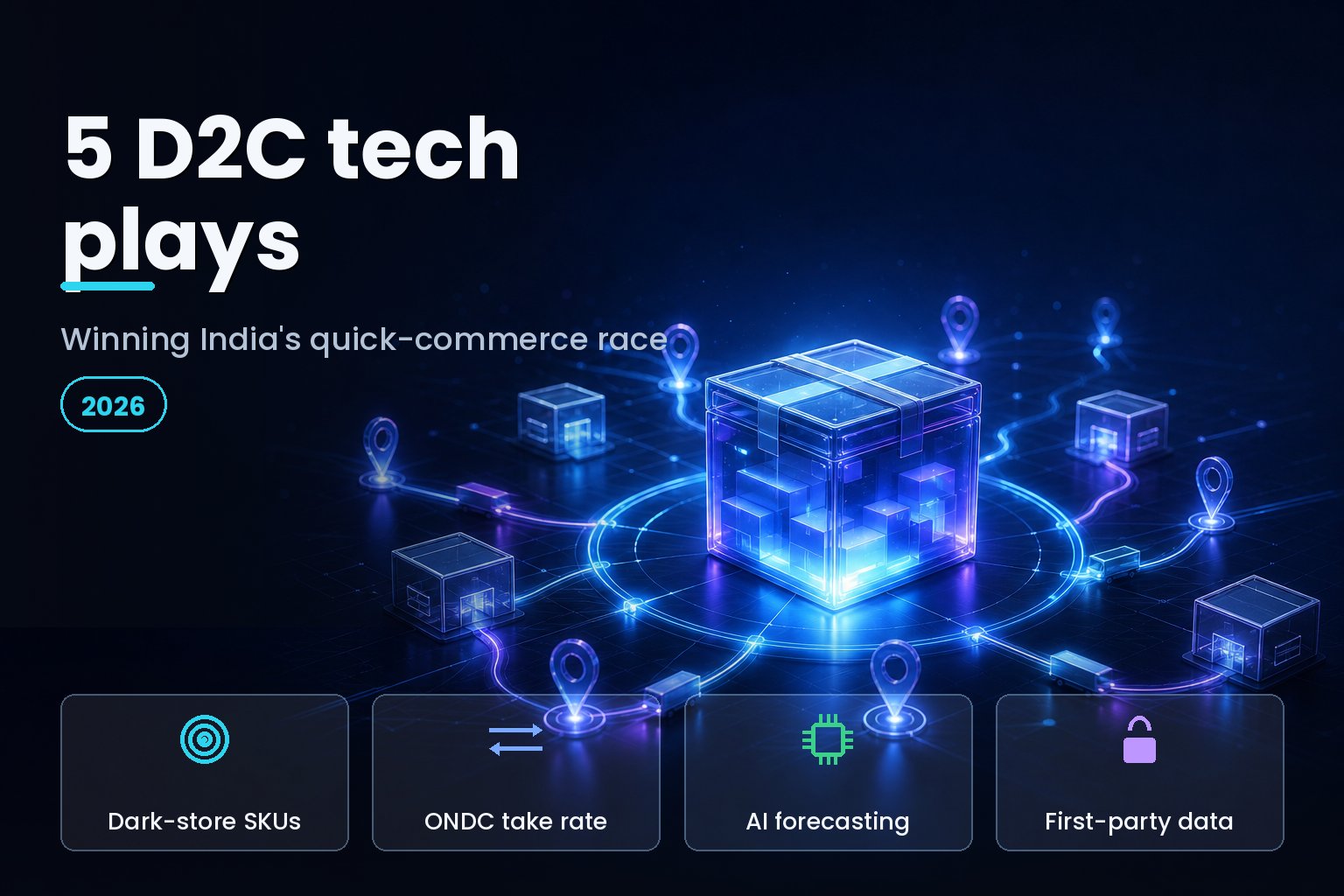
Summary. India's quick-commerce race in 2026 rewards operators, not just brands with a good product. As of January 2026, Blinkit holds about 46% of the market, Swiggy Instamart 24%, and Zepto 22%, per Datum Intelligence data cited by Reuters. Mordor Intelligence values the quick-commerce market at $3.65 billion in 2026, while a separate industry report projects it reaching $12.97 billion by 2029. More than 6,000 dark stores now operate across India. Quick-commerce platform commissions run 18% to 28%, which is exactly why the Open Network for Digital Commerce matters: ONDC caps marketplace take rates near 3% against 15% to 25% on incumbents, and early D2C adopters report 15% to 20% lower customer-acquisition cost. The economics are tight. Blinkit CEO Albinder Dhindsa warned that the sector has leaned on "relentless fundraising" to cover losses, a concern that ran through 2025 reporting on a possible quick-commerce bubble. This article sets out five tech plays D2C founders are using to win on margin, not just growth: dark-store SKU strategy, ONDC, AI demand forecasting, first-party data, and real-time omni-sync.
This is written for retail and D2C founders scaling on ONDC and quick commerce. Each play below ties to a 2026 number, and to a build decision.
Why the 2026 race is an operations race
The headline numbers are large. India's D2C e-commerce market is valued at $108.76 billion in 2026 by Mordor Intelligence, and India has 800-plus D2C brands. Growth is real too: a Unicommerce report found D2C GMV grew 33% in FY2026, with Tier 2 and 3 cities driving 66% of new orders. But quick commerce changed the rules. When a customer expects delivery in ten minutes, the brand that wins is the one with the right stock in the right dark store, not the one with the best landing page.
That shift, with platform pressure on margins, is why Dhindsa's "relentless fundraising" warning matters to founders: the platforms are under their own profit pressure, and they pass discipline downstream through commissions and shelf rules. The five plays below are how D2C brands answer with technology rather than ad spend. For the AI behind several of them, our guide to free AI cost tools helps keep that spend in check.
| Play | What it does | Why it wins in 2026 |
|---|---|---|
| 1. Dark-store SKU strategy | Stock the few SKUs that sell, per location | Quick commerce rewards velocity, not breadth |
| 2. ONDC integration | Sell on an open network at ~3% take | Lower commission and customer-acquisition cost |
| 3. AI demand forecasting | Predict neighbourhood demand per store | Cuts stockouts and dead stock across 6,000+ stores |
| 4. First-party data and retention | Own the customer relationship | Platforms own the order; brands must own the data |
| 5. Real-time omni-sync | One inventory and order brain | Keeps own store, q-commerce and ONDC in step |
Play 1: Engineer your catalogue for the dark-store model
Quick commerce is not a shelf; it is a 2,500 to 5,000 square-foot dark store that stocks only what turns over fast. Brands typically place 5 to 15 high-velocity SKUs per dark store, with smaller pack sizes and strong repeat demand, and quick-commerce baskets average ₹350 to ₹600, as base.com and revq.in document. Trying to list a full catalogue in a dark store is how a brand burns shelf fees on slow movers.
The tech play is SKU-velocity analytics: rank your catalogue by sell-through per location, then push only the winners into each dark store and manage them as a per-store assortment, not a national one. Non-grocery categories are growing about 1.6 times faster than grocery on these platforms, so the velocity map differs by neighbourhood and category. For a founder, the discipline is the same one the platforms use on you: stock what sells, where it sells.
Play 2: Use ONDC to cut take rate and acquisition cost
The single biggest margin lever in 2026 is the take rate. Quick-commerce and marketplace commissions run 15% to 28% depending on platform and category, while ONDC caps marketplace commission near 3%, per Costbo. Early D2C adopters on the network report 15% to 20% lower customer-acquisition cost, according to IssueWire. ONDC has scaled to over 7 lakh sellers across 1,200-plus cities, so the reach is now real, not theoretical.
The tech play is to integrate as a seller node on ONDC and sync your catalogue, pricing, and inventory into the network through a participant app. ONDC removes platform lock-in and forced discounting, which means a brand keeps both more margin and its own customer terms. It is not a replacement for quick commerce; it is the lower-cost channel that balances a portfolio dominated by high-commission platforms.
Play 3: Forecast demand with AI, per dark store
Stock is the whole game in quick commerce, and stock decisions are local. A SKU that sells out in one neighbourhood sits dead in another, and with more than 6,000 dark stores in play, no human plans that by hand. AI that predicts neighbourhood-level demand for data-driven stocking is now standard practice, and Zepto runs AI-powered inventory and routing to cut delivery distance and raise order efficiency, as industry coverage of AI, CLV, and quick commerce describes.
The tech play is a demand-forecasting model fed by per-store sell-through, weather, local events, and promotions, wired into a warehouse management system that adjusts replenishment automatically. The payoff is two-sided: fewer stockouts on your fast movers and less capital trapped in dead stock. For founders building these models, our AI delivery lessons for 2026 cover how to ship forecasting that holds up in production.
Play 4: Own first-party data, because the platform owns the order
Quick commerce has a hidden cost beyond commission: the platform, not the brand, owns the customer relationship. The shopper is Blinkit's or Zepto's, and the brand sees a sale without a name. The answer, the core of what the industry calls D2C 2.0, is to build a first-party data engine: capture consented customer data through your own store, packaging, and post-purchase flows, and use it for retention and customer-lifetime-value growth rather than re-buying the same customer through ads.
The tech play is a customer data platform tied to an owned D2C channel and a loyalty or subscription mechanic that gives shoppers a reason to come direct. This is where India's Digital Personal Data Protection Act, 2023 sets the guardrail: first-party data must be collected with valid consent and clear purpose, with penalties up to ₹250 crore per breach, per EY India. Done right, consented first-party data is both the retention engine and the compliant one.
Play 5: Run one inventory brain with real-time omni-sync
A brand selling on its own store, three quick-commerce platforms, and ONDC has five views of inventory and one real stock position. When those drift, the result is oversells, cancellations, and dead stock, the three failures quick commerce punishes hardest. The play is a single source of truth: an order and inventory management system that syncs stock, orders, and pricing across every channel in real time.
The tech play is composable, headless commerce with an order-management layer underneath, so the storefront, the quick-commerce integrations, and the ONDC node all read and write to one inventory brain. This is the unglamorous plumbing that makes the other four plays safe to run at once. The real cost of multi-channel is rarely the listing; it is keeping one truthful number for stock across all of them.
| Channel | Typical take rate (2026) | Who owns the customer |
|---|---|---|
| Quick commerce (Blinkit, Zepto, Instamart) | 18% to 28% | Platform |
| Marketplace (Amazon, Flipkart) | 15% to 25% | Platform |
| ONDC network | About 3% | Shared with seller |
| Own D2C store | Payment fees only | Brand |
The dark-store playbook in numbers
The operating reality of quick commerce sits in a handful of figures every D2C founder should plan around. They explain why the five plays above are about discipline, not scale.
| Metric | Typical 2026 value | What it means |
|---|---|---|
| Dark stores in India | 6,000+ | Hyperlocal stock decisions, at scale |
| SKUs stocked per dark store | 5 to 15 | Only high-velocity items earn a slot |
| Average quick-commerce basket | ₹350 to ₹600 | Small baskets demand tight unit economics |
| Dark-store size | 2,500 to 5,000 sq ft | Compact, online-only fulfilment |
| Non-grocery vs grocery growth | About 1.6x faster | New category room beyond groceries |
The unit economics behind the five plays
The plays are not abstract; they each defend a specific part of a thin margin. Start from the basket. A quick-commerce order averages ₹350 to ₹600, and the platform takes 18% to 28% of it. On a ₹500 basket at a 23% commission, roughly ₹115 leaves before the brand pays for the goods, the packaging, or the customer it acquired. That is the math that makes quick commerce a volume game with little room for error, and it is why every play above targets a leak rather than chasing more orders.
Play one, dark-store SKU strategy, protects against the worst leak: paying shelf and listing cost on items that do not sell. Stocking only the 5 to 15 SKUs that turn over in a given neighbourhood keeps the slow movers, and their carrying cost, out of the dark store. Play two, ONDC, attacks the take rate directly. Moving even a share of volume to a roughly 3% network instead of a 23% platform changes the contribution margin on those orders, and the reported 15% to 20% lower acquisition cost compounds the effect. The portfolio question for a founder is not quick commerce or ONDC; it is what percentage of volume each channel should carry.
Play three, AI demand forecasting, defends working capital. Dead stock in one dark store and a stockout in another are the same forecasting failure, and at 6,000-plus stores the cost of guessing wrong scales fast. A model that gets per-store replenishment closer to right frees cash and protects the sales the brand already earned. Play four, first-party data, attacks the most expensive line of all: re-acquiring a customer the platform will not hand over. Retention through consented owned-channel data is cheaper than buying the same shopper twice, and under the DPDP Act it has to be done with proper consent regardless.
Play five, real-time omni-sync, is the one that keeps the other four from cancelling each other out. Without a single inventory truth, a brand running its own store, three quick-commerce platforms, and an ONDC node will oversell, refund, and lose the ranking that drives discovery, erasing the margin the other plays earned. The sequencing that works for most founders is to fix the inventory brain first, layer ONDC and dark-store discipline next, then add AI forecasting and the first-party data engine once the operational base is steady. Built in that order, the five plays reinforce each other instead of competing for attention.
What this means for D2C founders
Read together, the five plays say the same thing: in 2026, India's quick-commerce winners compete on operations and data, not just brand. The market is big and growing, with quick commerce projected toward $12.97 billion by 2029 and D2C far larger, but the platform take rates of 18% to 28% mean growth without margin discipline is a trap. ONDC's near-3% economics, AI-led dark-store stocking, and a first-party data engine are how a brand keeps more of every rupee. The plumbing under all of it, one real-time inventory brain, is what lets a founder run every channel without the oversells that quietly drain margin. Build the operations, and the growth is worth having.
FAQ
How eCorpIT can help
eCorpIT is a senior-led, CMMI Level 5 technology organisation in Gurugram that builds commerce and retail systems for global and Indian businesses. We help D2C founders wire the plays in this article together: ONDC seller integration, AI demand forecasting for dark stores, a first-party data platform with DPDP-aligned consent, and a real-time order and inventory layer across quick commerce and owned channels. We work across AWS, Microsoft, Google, and Shopify. To plan your quick-commerce tech stack, contact our team.
References
- Mordor Intelligence, "Quick Commerce Market in India," 2026.
- GlobeNewswire, "India Quick Commerce Report 2026: Market to Reach $12.97 Billion by 2029," April 20, 2026.
- startupfeed, "Quick Commerce War 2026: Blinkit Tops Brutal Six-Way Fight," 2026.
- CNBC, "Zepto files confidential IPO amid warnings of a bubble in the sector," December 29, 2025.
- Business Today, "Zepto vs Blinkit: Aadit Palicha counters Deepinder Goyal's claims on quick commerce," March 4, 2025.
- Costbo, "Top ONDC Platforms in India (2026)," 2026.
- base.com, "What is the Dark Store Model in India," 2026.
- Mordor Intelligence, "India D2C E-commerce Market Analysis," 2026.
- Unicommerce, "India D2C Report 2026," April 2026.
- IMP.news, "AI, CLV, and Quick Commerce: The Three Forces Shaping D2C 2.0," 2026.
- EY India, "Decoding the Digital Personal Data Protection Act, 2023," 2026.
_Last updated: June 24, 2026._