On this page · 13 sections
- What the 2026 evidence says before you start
- Lesson 1: scope to one measurable workflow
- Lesson 2: integrate proven models, do not rebuild the foundation
- Lesson 3: ground outputs with retrieval, not guesswork
- Lesson 4: evaluate continuously, and gate before you ship
- Lesson 5: engineer cost by routing work to the right model
- Lesson 6: govern agents from day one, or join the 40%
- Lesson 7: build DPDP-ready, because the penalty has no cure period
- How the risks map to controls
- What this means for choosing an AI delivery partner
- FAQ
- How eCorpIT can help
- References
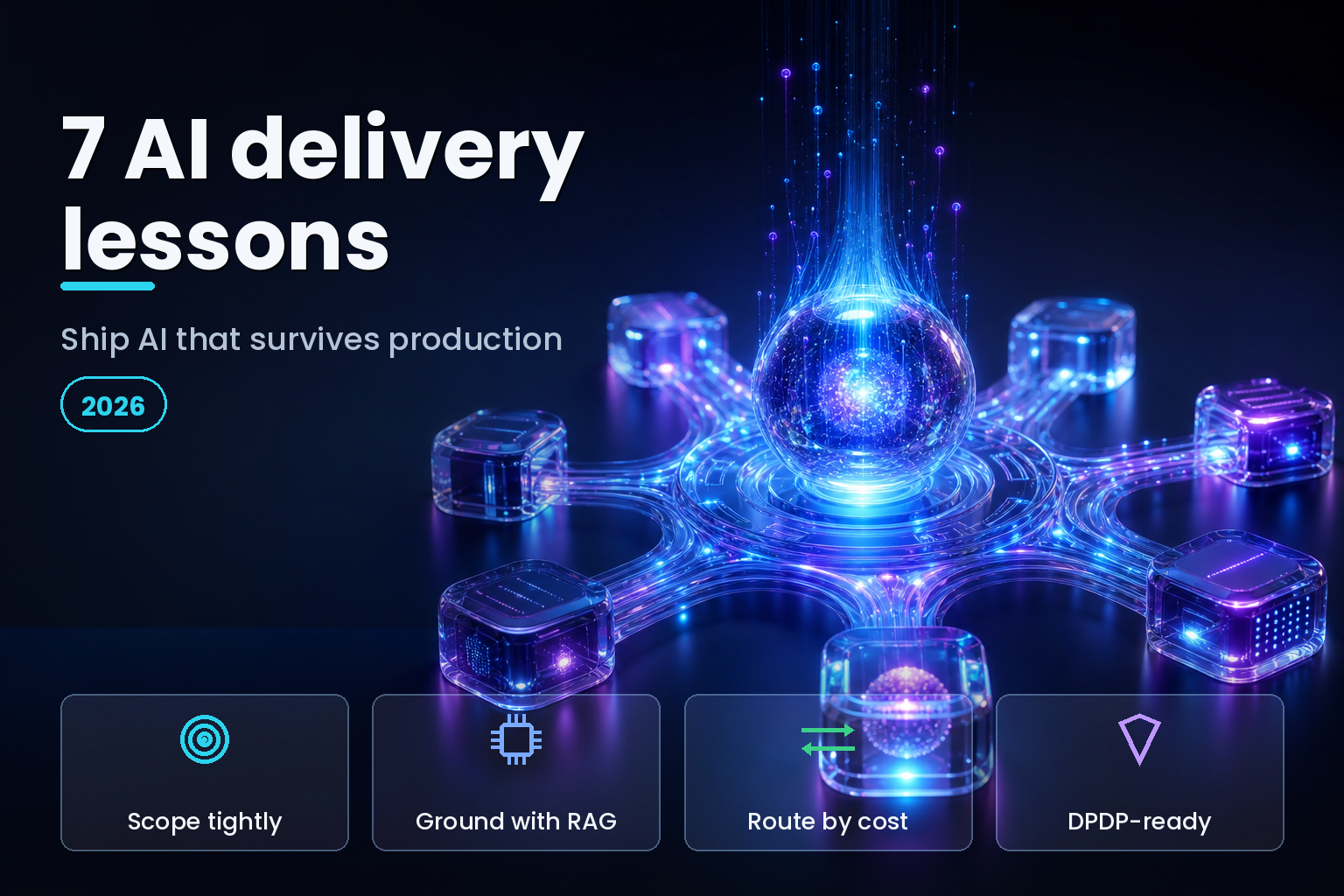
Summary. The hard part of enterprise AI in 2026 is not the model. It is delivery. MIT's NANDA initiative found that about 95% of corporate generative AI pilots produce no measurable profit-and-loss impact, with only 5% reaching rapid revenue, across 150 leader interviews, a 350-employee survey, and 300 public deployments, as Fortune reported in August 2025. Gartner expects over 40% of agentic AI projects to be canceled by the end of 2027 on escalating cost and weak controls, and a January 2025 Gartner poll of 3,412 people found just 19% had made significant agentic investments. eCorpIT is a CMMI Level 5 software organisation founded in 2021, and these seven lessons are how our senior engineering teams ship AI that survives contact with production. None of them is about a bigger model. They are about scope, grounding, evaluation, cost, governance, and privacy under India's DPDP Act, which carries penalties up to ₹250 crore per breach. Each lesson below is tied to a dated, named source a buyer can check, because an AI delivery partner should show its working.
For CTOs and engineering leaders sizing up an AI partner, the questions underneath these lessons double as a vendor checklist. If a partner cannot answer them, that is the signal.
What the 2026 evidence says before you start
Two numbers frame the year. The first is MIT's 95% pilot-stall rate, which is less a comment on models than on how projects are scoped and operated, as Trullion summarised from the same research. The second is Gartner's prediction that over 40% of agentic AI projects will be canceled by 2027, which the firm pins on cost, unclear value, and missing risk controls in its June 2025 press release. Read together, both point at delivery discipline, not raw capability. The table maps the seven lessons to that evidence.
| Lesson | What the 2026 evidence says | What eCorpIT does |
|---|---|---|
| 1. Scope to one workflow | MIT: 95% of pilots show no P&L impact | Tie the build to one metric before code |
| 2. Integrate, do not rebuild | MIT: vendor partnerships beat internal builds | Build on AWS, Microsoft, and Google services |
| 3. Ground with retrieval | RAG is now enterprise infrastructure | Add retrieval plus access control early |
| 4. Evaluate continuously | Evals catch failures before users do | Quality gates and production monitoring |
| 5. Route models by cost | 2026 token rates span 100x | Send easy work to cheaper models |
| 6. Govern agents from day one | Gartner: 40% of agent projects canceled by 2027 | Monitoring, rollback, and human checkpoints |
| 7. Build DPDP-ready | DPDP penalties reach ₹250 crore per breach | Privacy-by-design and consent flows |
Lesson 1: scope to one measurable workflow
The most common reason an AI project fails is that it was never scoped to a number. MIT found more than half of generative AI budgets went to sales and marketing tools, while the larger return sat in back-office automation that removes outside agency and process-outsourcing cost. Generic assistants stall in the enterprise because they do not learn a company's workflow. The fix is unglamorous: pick one workflow, write down its current baseline, such as hours per ticket or error rate, and only then choose a model.
In practice our senior teams refuse to start a build without that baseline. If a stakeholder cannot name the metric the AI is supposed to move, the project is not ready, and starting anyway is how teams join the 95%. For the strategy view above the individual build, our guide to generative AI enterprise strategy for 2026 sets out how to choose use cases worth funding.
Lesson 2: integrate proven models, do not rebuild the foundation
MIT's research carries a buy-versus-build signal that engineering leaders should weigh. Buying from specialised vendors and forming partnerships worked about 67% of the time, while internal-only builds succeeded roughly a third as often. The lesson is not that internal teams are weak. It is that rebuilding undifferentiated foundations wastes the budget that should go to your actual problem.
eCorpIT builds on the model and cloud services of its partners, including AWS, Microsoft, and Google, then puts the engineering effort into the integration, data, and workflow layer where the value sits. The real cost is usually the integration, not the model call. A partner that wants to train a foundation model from scratch for a standard business problem is spending your money on the wrong layer.
Lesson 3: ground outputs with retrieval, not guesswork
A model that invents a policy or cites a document that does not exist is a support ticket, a legal risk, or a lost customer. Retrieval-augmented generation answers this by pulling trusted, current documents into the model's context before it answers. By 2026 RAG has moved from a feature to standard enterprise infrastructure, as Techment describes, and hybrid retrieval that combines vector and keyword search outperforms pure vector search on factual accuracy. Kernshell sets out how grounding cuts hallucination against a standalone model.
The delivery detail that gets skipped is access control. A retrieval pipeline that ignores who is allowed to see which document will happily leak it through an answer. Our teams treat the knowledge base, its permissions, and encryption as part of the AI system, not a later add-on.
Lesson 4: evaluate continuously, and gate before you ship
Evaluation is the cheapest insurance in AI delivery, and the most skipped. In 2026 evals have become foundational infrastructure for any team that needs to measure and monitor AI quality, with continuous evaluation in production rather than a one-time pre-launch check, as Knowlee lays out. Regulatory pressure adds urgency, with EU AI Act enforcement beginning in August 2026.
A practical pattern is a staged pipeline: tests in development, checks on every pull request, a deployment gate that blocks on a quality threshold, and live monitoring after release. The point an engineering leader should press a partner on is simple. What is your eval set, and what score blocks a release? If there is no answer, there is no gate.
Lesson 5: engineer cost by routing work to the right model
Token economics in 2026 reward teams that stop sending every request to the most expensive model. Published API rates as of mid-2026, compiled by CloudZero, span a wide range, and the gap between tiers is the lever. A frontier model can cost tens of times a budget model on output tokens, so routing easy requests to a cheaper tier is the difference between a viable unit economic and a runaway bill.
| Model tier | Example rate, mid-2026 (input / output per 1M tokens) | Best for |
|---|---|---|
| Frontier general | GPT-5.4, $2.50 / $15 | Hard reasoning, broad tasks |
| Balanced production | Claude Sonnet 4.6, $3 / $15 | Most production workloads |
| Premium reasoning | Claude Opus 4.8, $5 / $25 | Complex, high-stakes steps |
| Low-cost capable | Gemini 2.5 Flash, $0.30 / $2.50 | High-volume, simpler tasks |
| Ultra-low-cost | DeepSeek V3.2, $0.14 / $0.28 | Bulk classification, drafts |
The engineering takeaway is to design a router, not a single default model. Classify the request, send routine work to a Flash-class or open model, and reserve the frontier tier for the steps that need it. Cost control belongs in the architecture, not in a quarterly surprise.
Lesson 6: govern agents from day one, or join the 40%
Agentic AI is where 2026 budgets are heading and where they are most likely to die. Gartner predicts over 40% of agentic AI projects will be canceled by the end of 2027, and warns of "agent washing," estimating only about 130 of the thousands of agentic vendors are real. "Most agentic AI projects right now are early stage experiments or proof of concepts that are mostly driven by hype and are often misapplied," said Anushree Verma, Senior Director Analyst at Gartner. The same firm also expects more than 70% of mainframe-exit projects to fail from overestimating generative AI, a June 2026 warning worth heeding.
The cancellations are rarely about agents that fail to build. They are about agents that reach production and cannot be sustained, because monitoring, rollback, and human checkpoints were never designed in. Our approach keeps a human decision point on consequential actions and ships an agent with the same operational controls as any other production service. Verma's own advice is to apply agents only where they deliver clear value: "To get real value from agentic AI, organizations must focus on enterprise productivity, rather than just individual task augmentation."
Lesson 7: build DPDP-ready, because the penalty has no cure period
For any product touching Indian users, India's Digital Personal Data Protection Act, 2023 is now a delivery constraint, not a future one. The Act received assent on August 11, 2023, and the MeitY notified the DPDP Rules on November 13, 2025, with full substantive enforcement beginning May 13, 2027, per EY India. Penalties reach ₹250 crore per breach, and there is no cure period, so there is no grace window to fix a violation after the fact. Compliance responsibility rests with the Data Fiduciary even when a separate processor handles the data, a point DLA Piper also documents.
For AI systems this changes design. Training data, retrieval stores, and logs all hold personal data, and each needs consent, purpose limits, and retention rules. eCorpIT designs applications aligned with DPDP requirements, with consent capture and data-minimisation built in rather than bolted on. The same discipline carries over to platform shifts elsewhere; our breakdown of Apple Intelligence service upgrades in iOS 27 shows how self-expiring data sharing is becoming a default users expect.
How the risks map to controls
The fastest way to read these seven lessons is as a risk register. Each well-known 2026 finding has a delivery control that keeps a project out of the failure statistics.
| Delivery risk | Source signal | Control to ship with |
|---|---|---|
| Pilot shows no return | MIT: 95% of pilots stall | One scoped workflow with a baseline metric |
| Agent gets canceled | Gartner: 40% canceled by 2027 | Monitoring, rollback, human checkpoints |
| Model invents facts | RAG now enterprise infrastructure | Grounded retrieval with access control |
| Cost runs away | 2026 output rates span tens of times | Model routing by task difficulty |
| Privacy penalty | DPDP: up to ₹250 crore, no cure period | Consent and data-minimisation by design |
What this means for choosing an AI delivery partner
The pattern across all seven lessons is that AI delivery is an operations problem wearing a research-problem costume. The teams in MIT's surviving 5% are not the ones with the largest model. They are the ones that scoped tightly, grounded their outputs, evaluated continuously, controlled cost, governed their agents, and respected privacy law. A partner worth hiring should be able to show that working on a whiteboard, not just a demo.
So the buyer's questions write themselves. What single metric will this move? What do you integrate rather than rebuild? How do you ground answers and control who sees what? What blocks a release? How do you route for cost? How do you keep an agent alive in production? And how do you meet DPDP? eCorpIT can walk through each of these against a specific use case; the next section says how to start.
FAQ
How eCorpIT can help
eCorpIT is a senior-led, CMMI Level 5 technology organisation in Gurugram that has built software for global and Indian businesses since 2021. We deliver AI features the way these lessons describe: scoped to a measurable workflow, grounded with retrieval, evaluated continuously, cost-routed across models, governed in production, and designed in line with DPDP requirements. We work on the cloud and model platforms of partners including AWS, Microsoft, and Google. To pressure-test an AI use case against this checklist, contact our team.
References
- Fortune, "MIT report: 95% of generative AI pilots at companies are failing," August 18, 2025.
- Gartner, "Gartner Predicts Over 40% of Agentic AI Projects Will Be Canceled by End of 2027," June 25, 2025.
- Gartner, "Gartner Predicts 40% of Enterprise Apps Will Feature Task-Specific AI Agents by 2026," August 26, 2025.
- Gartner, "Gartner Predicts More Than 70% of Mainframe Exit Projects Will Fail Due to Overestimation of Generative AI's Capabilities," June 18, 2026.
- CloudZero, "LLM API Pricing Comparison In 2026," 2026.
- Kernshell, "How RAG Reduces AI Hallucinations and Improves Accuracy," 2026.
- Knowlee, "LLM Evaluation for Enterprise — Beyond Benchmarks," 2026.
- EY India, "Decoding the Digital Personal Data Protection Act, 2023," 2026.
- DLA Piper, "Data protection laws in India," 2026.
_Last updated: June 24, 2026._