On this page · 10 sections
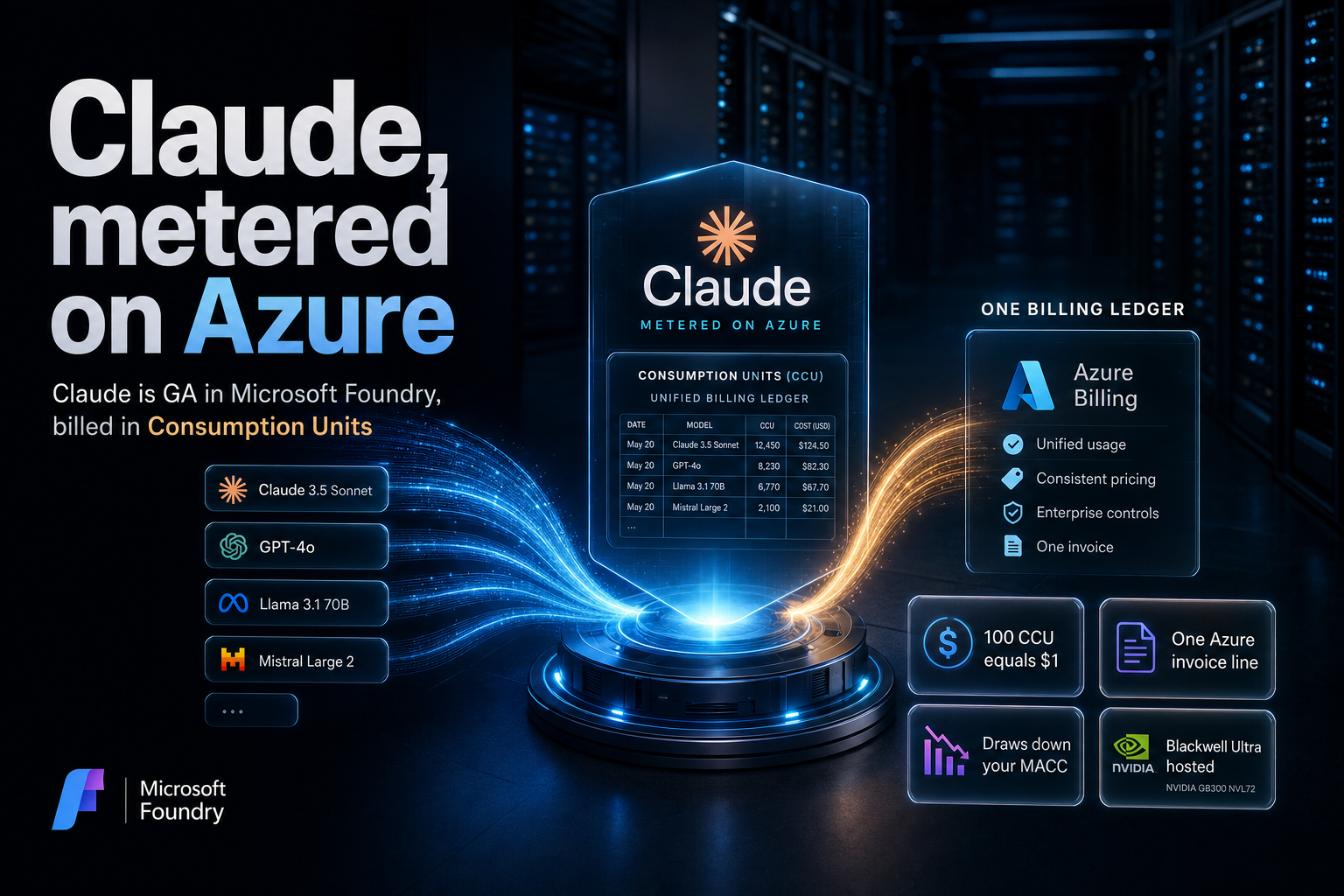
Summary. Anthropic's Claude models reached general availability in Microsoft Foundry on Azure at the end of June 2026. The change that matters for finance is how it bills: Claude usage is metered in Claude Consumption Units (CCU), where 100 CCU equals $1.00 of Claude fees, landing as a single consolidated line on your Azure invoice and drawing down your Microsoft Azure Consumption Commitment. Claude runs on Azure through the Microsoft, NVIDIA and Anthropic partnership announced in November 2025, on NVIDIA Blackwell Ultra systems. Azure is now the only cloud offering both Claude and GPT frontier models on one platform.
For most enterprise buyers the model was never the blocker. Procurement was. A separate contract, a separate invoice, and a separate security review for each AI vendor is what stalls a rollout. Billing Claude through Foundry as an Azure line item removes that friction, and the mechanism is a unit called the CCU. This article explains what a CCU is, how token usage converts into one, why Microsoft bills this way, the infrastructure underneath, and what the shift changes for platform, finance and procurement teams.
What Microsoft announced
Claude is now generally available in Microsoft Foundry on Azure, giving enterprise developers a frontier model they can deploy, manage and govern through Microsoft's cloud AI platform, per the Azure blog. The point of GA, rather than preview, is production use: Azure customers can deploy Claude with their existing authentication, billing, governance and compliance workflows, as Redmond reported.
The strategic line is the multi-model one. Azure is now the only cloud providing access to both Claude and GPT frontier models on a single platform, according to Microsoft. Large customers increasingly want more than one provider so they can compare cost, latency, capability and risk controls per workload. We compared two of those models directly in our GPT-5.6 versus Claude Sonnet 5 breakdown.
What a Claude Consumption Unit is
The billing unit is the new part, so it is worth stating precisely. One hundred CCU represents $1.00 of fees owed for Claude usage, calculated at Anthropic's published per-model token prices after any discounts, per Microsoft's CCU billing documentation. CCU is not a token count and not a flat subscription. It is a dollar-denominated meter with a fixed conversion, wrapped so it can ride on an Azure invoice.
The conversion runs the same way on every call. Anthropic meters the input and output tokens by model, prices them at its published per-model rates, applies any contractual discount, converts the resulting dollar figure to CCU at the fixed CCU price on the Azure Marketplace offer, and meters that hourly to Azure Marketplace so it rolls up onto your Azure invoice.
| Conversion step | What happens | Who controls it |
|---|---|---|
| Token metering | Input and output tokens counted per model | The size of your prompt and response |
| Token pricing | Priced at Anthropic's published per-model rates | Anthropic's rate at the time of the call |
| Discount applied | Any Azure Marketplace private offer is deducted | Your negotiated contract |
| Dollar to CCU | Dollar amount converted at the fixed CCU price | Fixed on the Claude Azure offer |
| Metering to Azure | CCU metered hourly, rolls onto the invoice | Azure Marketplace billing |
One detail deserves attention. The rate in effect at the time of each call applies, so any change to Anthropic's published prices takes effect immediately for later calls, per the billing documentation. There is no fixed price window inside the CCU wrapper; the unit only fixes the dollar-to-CCU ratio, not the underlying token price.
Why bill in CCU at all
The reason is procurement, not math. CCU spend decrements your Microsoft Azure Consumption Commitment (MACC) the same way other Azure Marketplace consumption does. If you have already committed a large Azure spend, Claude usage counts against that commitment instead of a fresh contract. That single fact is what techtimes called clearing "the procurement barrier" for enterprises, because Sonnet 5 on Azure arrives inside an agreement finance and security have already approved, as techtimes reported.
The per-model detail in Foundry stays unchanged, so you still see Claude usage by model. What CCU adds is a consolidated invoice line and MACC drawdown, which is exactly the part a platform team fights to get for any new vendor.
The infrastructure behind it
Claude on Azure is not a re-badged API call to Anthropic. It runs on Azure infrastructure through the strategic partnership Microsoft, NVIDIA and Anthropic announced in November 2025, on NVIDIA Blackwell Ultra systems connected by InfiniBand networking, per Neowin and Dataconomy. Foundry offers an Azure-hosted route that runs processing on Azure with Microsoft authentication, billing, governance and data-zone controls, as Microsoft's deployment guide describes.
| Concern | Azure-hosted Claude in Foundry | A direct third-party API |
|---|---|---|
| Billing | One Azure invoice line, MACC drawdown | Separate vendor invoice |
| Identity | Microsoft authentication | Separate keys and access model |
| Governance | Azure governance and data-zone controls | Vendor-specific controls |
| Procurement | Inside an existing Azure agreement | New contract and review |
| Hosting | Azure infrastructure on Blackwell Ultra | Vendor infrastructure |
Why it matters: multi-model on one control plane
The deeper shift is architectural. Enterprises are moving from one preferred model to a small portfolio, choosing per workload. Running that portfolio through one control plane, with one identity model, one governance layer and one bill, is worth more than a few cents of token savings, because it removes the per-vendor overhead that makes multi-model programs expensive to run. The governance point is not optional: more models and more agents widen the surface you have to control, which we cover in our note on enterprise AI agent governance layers. For the strategy view, see our guide to generative AI enterprise strategy.
| Team | What CCU on Azure changes | What to do |
|---|---|---|
| Finance | Claude spend rides the Azure invoice and MACC | Fold Claude into existing Azure forecasts |
| Platform | One identity and governance plane for Claude and GPT | Standardise access across both model families |
| Procurement | No new vendor contract for Claude | Use the Azure Marketplace private offer for discounts |
| Security | Azure data-zone and compliance workflows apply | Reuse existing Azure controls, verify data zones |
| Engineering | Per-model detail stays visible in Foundry | Route workloads by cost, latency and fit |
India-specific considerations
For Indian enterprises, three points stand out. First, data zones: the Azure-hosted route gives regional controls, which matters under the Digital Personal Data Protection Act, 2023, when personal data must stay in a defined boundary; confirm which Azure data zone serves the deployment. Second, billing is in dollars converted through the Azure agreement, so INR forecasting still carries exchange-rate movement, and CCU drawdown against a MACC is a dollar commitment. Third, procurement is the real unlock: buying Claude through an existing Azure agreement avoids a separate cross-border vendor contract, which shortens the security and legal review most Indian enterprises run. Teams weighing spend across providers should read our FinOps guide across AWS, Azure and GCP.
The bottom line
Claude on Foundry is less a model launch than a billing and procurement change. CCU turns Claude usage into a dollar-denominated Azure line that draws down a commitment you already made, under governance you already run. The token economics are unchanged, and the rate can move mid-stream, so watch the per-model detail Foundry still shows. If you are already an Azure committed-spend customer running multi-model workloads, this removes the main reason a second frontier model used to stall in procurement.
FAQ
How eCorpIT can help
eCorpIT is a Gurugram-based technology consultancy, founded in 2021 and CMMI Level 5 certified, with senior-led teams across Microsoft, AWS and Google Cloud. We help enterprises stand up multi-model AI on Azure Foundry: wiring Claude and GPT into one governance and identity plane, modelling CCU spend against your Azure commitment, and confirming data-zone controls aligned with DPDP requirements. If you are planning a multi-model rollout on Azure, talk to us.
References
_Last updated: July 11, 2026._