On this page · 11 sections
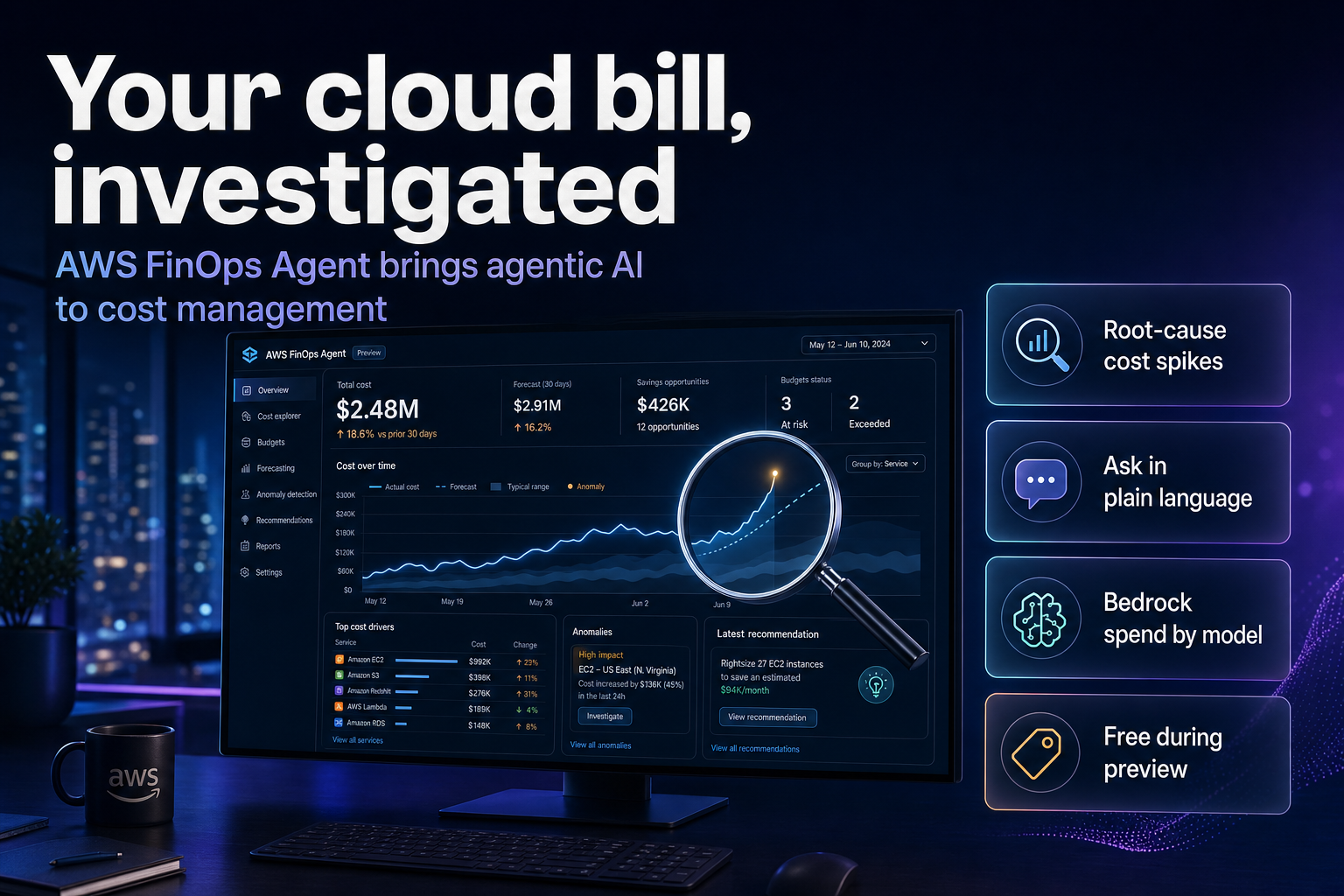
Summary. AWS put its FinOps Agent into public preview at the FinOps X 2026 conference. It is agentic AI that investigates cost spikes to a root cause, answers plain-language cost questions from your real usage data, and attributes Amazon Bedrock AI spend down to the model, application and user. The timing is not an accident: AI workloads reached 19% of total cloud spending in 2026, up from 8% in 2023, and 98% of FinOps teams now manage AI spend, against 31% in 2024. The agent runs in US East (N. Virginia) and is free during preview.
The pitch is simple. Cloud bills grew a new, volatile line item, AI, and the people who own cost can no longer read it by hand. AWS's answer is to point an agent at the cost data so an engineer can ask a question in English and get a sourced answer, and so a cost spike gets traced to the change that caused it without a half-day of detective work. This article covers what the agent actually does, how the Bedrock attribution changes AI cost control, where a human still has to decide, and how to judge the preview for your own team.
What AWS shipped
AWS FinOps Agent is an agentic tool that investigates cost anomalies to their root cause and answers cost questions for engineers inside the tools they already use, per the AWS Cloud Financial Management announcement. It moves cost analysis from a monthly spreadsheet exercise to an on-demand conversation.
Three capabilities define the release. The agent answers natural-language cost questions against actual cost and usage data. It investigates anomalies by correlating a spike with the events that produced it. And it delivers findings into an engineer's workflow rather than a dashboard nobody opens, as InfoQ reported from the launch. AWS introduced it in public preview at FinOps X 2026, according to SiliconAngle.
How the anomaly investigation works
The investigation flow is the part worth understanding, because it replaces the slowest task in cost management. When spend jumps, the agent correlates the cost change with AWS CloudTrail events, identifies the specific change that drove the spike, and produces an investigation summary with the likely root cause and the responsible owner, as TechTarget described.
An engineer can ask, "Why did my AWS cost go up last month?" and get back the cost changes, the contributing services, and the underlying usage drivers. The agent then delivers the finding by opening a Jira ticket or posting to a Slack channel, so the person who owns the resource gets the context and decides what to do. That last step matters more than it looks. Most cost tooling stops at a chart; this routes a specific, attributed finding to a specific owner.
Bedrock cost tracking, now granular
The second half of the announcement is AI-specific. AWS expanded cost visibility for Amazon Bedrock with attribution that tracks AI spend at the application, agent and user level. Within Bedrock, customers can compare cost per token across models and allocate costs by identity and access management roles, which makes it practical to assign a cheaper model to a sandbox and a stronger one to production, again per TechTarget.
This is the feature FinOps teams have been missing. Token spend has been a black box: a single Bedrock bill with no way to see which app, agent or team burned the budget. Per-token, per-model, per-role attribution turns that into an allocatable cost you can charge back and cap.
| Capability | What it does | Where a human still decides |
|---|---|---|
| Natural-language queries | Answers cost questions from real usage data | Judging whether the spend was justified |
| Anomaly investigation | Correlates spikes with CloudTrail events, names root cause and owner | Approving the fix or accepting the cost |
| Workflow delivery | Opens a Jira ticket or posts to Slack | Prioritising the ticket against other work |
| Bedrock attribution | Splits AI spend by model, app, agent and IAM role | Setting the chargeback and budget policy |
| Model allocation | Compares cost per token across models | Choosing sandbox vs production models |
Why this matters now
The agent lands into a cost problem that has changed shape. AI-related workloads reached 19% of total cloud spending in 2026, up from 8% in 2023, and the average enterprise now spends $1.7 million a year on AI cloud services, per FinOps X 2026 takeaways. Inference has overtaken training as the dominant cost, with about 80% of AI GPU spend now going to inference, as GPU FinOps analysis shows.
The discipline moved with the money. AI cost management by FinOps teams went from 31% of practitioners in 2024 to 98% in 2026, according to the FinOps Foundation's sixth annual State of FinOps survey of 1,192 respondents representing more than $83 billion in annual cloud spend, as reported by nOps. At the same time, waste rose: Flexera's 2026 State of the Cloud estimates 29% of IaaS and PaaS spend is wasted, up from 27% in 2025, because AI workloads make forecasting harder, per FinOps statistics for 2026.
| Cost metric | 2023 (or 2024) | 2026 |
|---|---|---|
| AI share of total cloud spend | 8% | 19% |
| GPU share at AI-forward firms | 4% | 18% |
| FinOps teams managing AI spend | 31% (2024) | 98% |
| Wasted IaaS/PaaS spend | 27% (2025) | 29% |
| Inference share of AI GPU spend | training-led | ~80% |
Put together, the numbers explain the product. Cost is more volatile, a larger share of it is AI, and nearly every FinOps team now owns that AI line. Manual investigation does not scale to it. For the wider India context, see our guide to cutting cloud spend for Indian teams and our note on why GPU spend became the top FinOps concern.
What it does not do
The agent is an investigator, not a decision-maker. It names a likely root cause and an owner, but it does not judge whether the spend was worth it, approve a fix, or set your budget and chargeback policy. Those stay with people. It also does not replace FinOps practice: tagging discipline, commitment planning, and rightsizing still decide most of the bill. Idle GPUs are the clearest example, since static deployments often run at only 30 to 40% utilisation, and no query agent reclaims that for you, per GPU FinOps analysis. Treat the agent as a faster path to the question "what changed and who owns it," not as the answer to "should we be spending this."
How to evaluate it for your team
Two caveats shape a trial. The preview runs in US East (N. Virginia) and covers cost and usage data across all AWS regions except GovCloud (US) and China, and it is offered at no additional charge during preview, per the AWS preview notice. Free and read-only makes this low-risk to test.
| Question to ask | Why it matters | A good sign |
|---|---|---|
| Is our tagging clean? | Attribution is only as good as tags | Cost allocation tags already enforced |
| Do we use Bedrock at scale? | Per-model attribution is the headline gain | Multiple models across teams and stages |
| Where do findings land? | Value comes from routing to owners | Jira or Slack already in the workflow |
| Who owns the response? | The agent stops at "who and why" | A named FinOps or platform owner |
| Data-residency limits? | Preview excludes GovCloud and China | Workloads in supported regions |
India-specific considerations
For Indian teams, the agent's value tracks how much of the bill is AI and how disciplined the tagging is. Multi-cloud is the norm, so an AWS-only agent covers one part of the estate; Azure and GCP spend still needs its own tooling, which we compare in our FinOps guide across AWS, Azure and GCP. There is a governance point too. Cost and usage logs can carry identifiers tied to teams and users, so under the Digital Personal Data Protection Act, 2023, treat cost-analysis data with the same access controls as other operational data. Pricing is set in dollars and converted to rupees on the India billing entity, so exchange-rate movement is a real line item when you forecast AI spend in INR.
The bottom line
AWS FinOps Agent is a sensible response to a bill that changed faster than the tooling. The anomaly investigation removes the slowest manual step, and the Bedrock attribution finally makes token spend allocatable. It will not set policy or reclaim idle capacity, so the FinOps fundamentals still matter. If you run Bedrock at any scale and your tags are clean, the free preview is worth a controlled trial this quarter, with a named owner for what the agent surfaces.
FAQ
How eCorpIT can help
eCorpIT is a Gurugram-based technology consultancy, founded in 2021 and CMMI Level 5 certified, with senior-led cloud and FinOps teams across AWS, Microsoft and Google Cloud. We set up cost allocation tagging, wire agents like the AWS FinOps Agent into your Jira and Slack workflows, and build the chargeback and governance policy the tool needs to be useful. If your AI cloud bill has outrun your visibility, talk to us about a FinOps engagement.
References
_Last updated: July 11, 2026._