On this page · 11 sections
- What AWS shipped on 20 July 2026
- The real decision: managed service versus your own stack
- Cost: predictable per-minute versus variable components
- Latency and turn-taking: the engineering you inherit
- When managed wins, and when building wins
- India-specific considerations
- Working out your break-even
- The bottom line
- FAQ
- How eCorpIT can help
- References
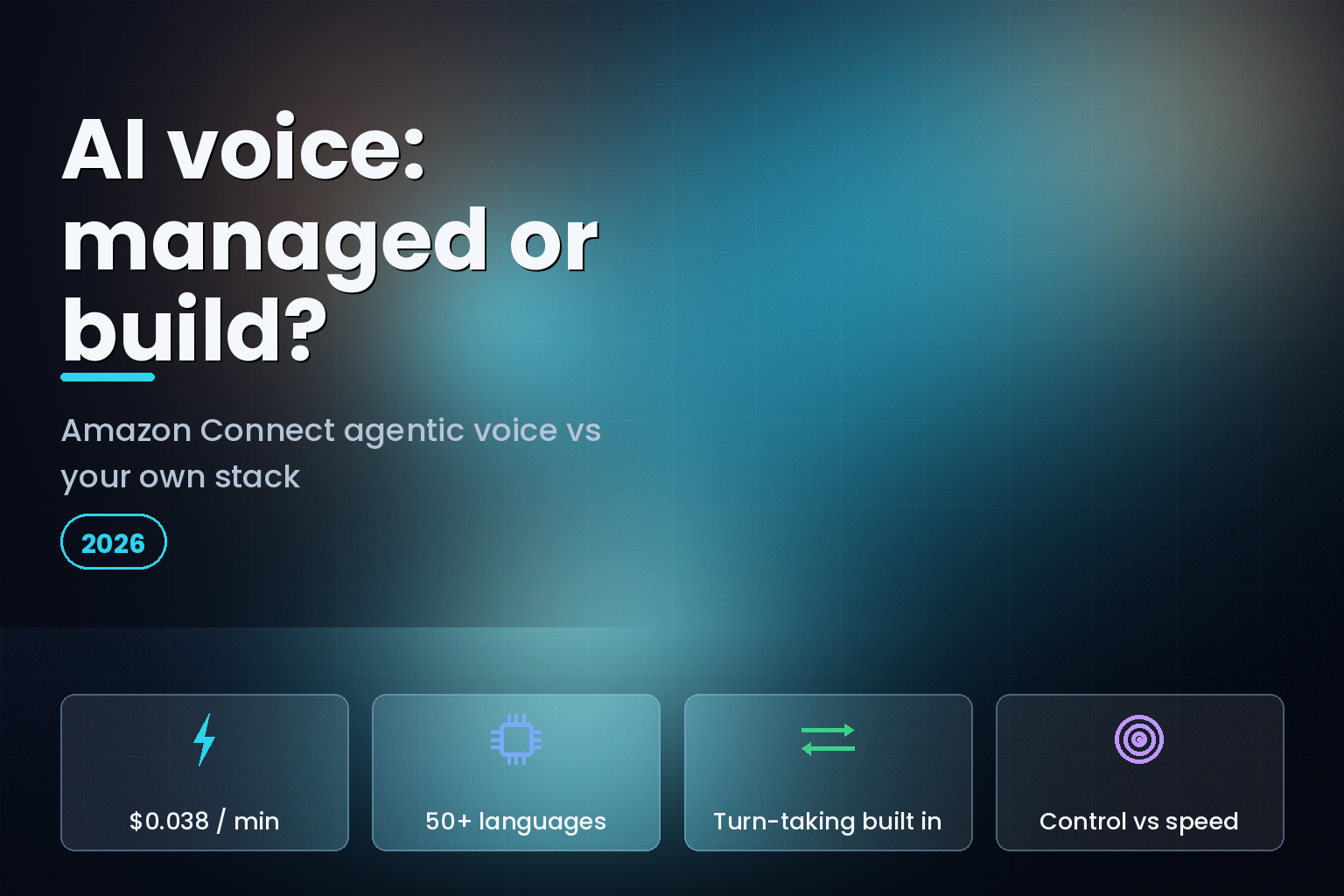
Summary. On 20 July 2026 AWS expanded Amazon Connect's agentic voice to more than 50 languages, over 100 new voice options, and finer speech controls for pace, volume, and emotion. The managed voice service bills $0.038 per minute for the Connect Customer tier, per-second with a 10-second minimum, on a pay-as-you-go model with no upfront licence. That single number reframes a decision every contact-centre team faces in 2026: adopt AWS's managed agentic voice, or assemble your own stack from a streaming speech-to-text engine, a realtime language model, a text-to-speech voice, telephony, and orchestration. Building your own can land lower on raw component cost, one published 2026 model puts a bare speech-to-text, model, and text-to-speech pipeline at roughly $0.007 to $0.091 per minute, but that figure hides the turn-taking, latency, and maintenance engineering you then own. This guide compares the two paths on the vectors that actually decide it: total cost at your call volume, end-to-end latency, conversational quality, control over models and data, and who carries the maintenance. The honest answer is not universal; it is a function of your volume, your language coverage, and how much voice engineering you want to own.
What AWS shipped on 20 July 2026
Amazon Connect's agentic self-service lets AI agents understand a caller, reason over the request, and take action across voice and digital channels, adjusting to the caller's tone and sentiment. The 20 July 2026 update targeted the parts of a phone conversation that make an AI agent sound robotic. It added response pacing that fills natural pauses so replies feel immediate rather than halting, more accurate turn-taking so the agent and the caller stop talking over each other, and speech controls that adjust speed, volume, and emotion to fit a brand's tone. Language coverage now exceeds 50 languages, including Spanish, French, Italian, Japanese, Korean, Portuguese, and Thai, with more than 100 new voices.
Those three additions matter because they are the hardest things to get right when you build voice yourself. Turn-taking and barge-in handling are where do-it-yourself voice agents most often feel broken, and AWS is now shipping them as managed behaviour rather than something your team tunes.
The real decision: managed service versus your own stack
Frame the choice honestly. Amazon Connect agentic voice is a managed contact-centre platform: telephony, routing, the AI agent runtime, analytics, and now natural-sounding voice, billed per minute. Building your own means wiring a streaming speech-to-text engine such as Deepgram, a realtime-capable language model, a low-latency text-to-speech voice such as ElevenLabs, telephony such as Twilio Media Streams, and an orchestration layer such as Pipecat, then owning the latency budget and the turn-taking logic across all of them.
Here is the side-by-side on the vectors that drive the decision.
| Decision vector | Amazon Connect agentic voice (managed) | Build your own voice stack |
|---|---|---|
| Headline price | $0.038 per minute (Connect Customer voice), per-second billing | Components about $0.07 to $0.21 per minute all-in, per one 2026 model |
| Languages and voices | 50+ languages, 100+ voices out of the box | You source and tune a voice per language yourself |
| Turn-taking and pacing | Managed: barge-in, pacing, and speech controls built in | You engineer barge-in and turn-taking; errors waste synthesized audio |
| Latency | Managed by AWS on the Connect network | 600 to 1,700 ms on stitched stacks; under 200 ms only if co-located |
| Model and data control | AWS-managed; extensible through Amazon Bedrock and Lex | Full control of models, prompts, and data path |
| Time to market | Days to a working flow | Weeks to months of integration and tuning |
| Maintenance owner | AWS | Your engineering team, indefinitely |
Two rows carry most of the weight: cost at volume, and the latency-plus-turn-taking engineering. Take them in turn.
Cost: predictable per-minute versus variable components
Amazon Connect's pricing is easy to model because it is metered per minute. The Connect Customer voice service is $0.038 per minute, billed per second with a 10-second minimum. A basic voice tier without the full agentic AI features is $0.018 per minute. On top of the voice service you pay communication charges: in-app and web calling audio at $0.010 per minute, plus telephony (a US direct-inward-dial number is about $0.030 per day with inbound usage around $0.0022 per minute). Amazon Lex speech requests are included at $0.00 when they originate from your Connect instance. Case creation is $0.12 per case, and Customer Profiles are $0.005 per profile used per day. There is no monthly contract or upfront licence.
Worked at volume, using AWS's own example: 100,000 minutes of Connect Customer voice at $0.038 costs $3,800 per month in voice usage, before telephony and any Bedrock AgentCore or Knowledge Base costs your custom AI agents incur.
Now the build-your-own side. A published 2026 cost model from Inworld puts a raw speech-to-text, language-model, and text-to-speech pipeline at roughly $0.007 to $0.091 per minute, and an all-in figure of about $0.07 to $0.21 per minute once you include a 1.8x reality factor for context growth, interruptions, and tool calls. Telephony adds around $0.014 per minute in that model. On raw component cost, a lean self-built stack can undercut $0.038 per minute. The catch is what the per-minute number leaves out: the engineering to build it, the on-call to keep it up, and the wasted spend from poor turn-taking.
| Cost element | Amazon Connect (managed) | Build your own |
|---|---|---|
| Voice / model runtime | $0.038 per min (Customer voice) | ~$0.007 to $0.091 per min raw components |
| Telephony | ~$0.0022 per min inbound + $0.030 per day per number | ~$0.014 per min in one 2026 model |
| Turn-taking waste | Absorbed by the managed service | 10 to 30 percent extra characters on poor barge-in |
| Build and integration | None | Weeks to months of engineering |
| Ongoing maintenance | Included | Your team owns it |
Latency and turn-taking: the engineering you inherit
Latency is where self-built voice agents live or die. Stitched stacks that combine separate speech-to-text, model, and text-to-speech vendors typically respond in 600 to 1,700 ms, per 2026 benchmarks from Telnyx and others. Co-located stacks that run all three layers on the same network as the call can land under 200 ms, but reaching that takes deliberate architecture. A reasonable production target is under 800 ms at the median and under about 1,400 ms at the 95th percentile; one benchmarked fleet reported 680 ms median and 1,180 ms at the 95th percentile.
Turn-taking is the second trap, and it has a direct cost. Every time a caller interrupts, the agent discards synthesized-but-unplayed text-to-speech audio you already paid for, and agents with weak turn-taking regenerate 10 to 30 percent extra characters. That is real money at scale, and it is exactly the behaviour AWS just moved into the managed service. If you build your own, this is your problem to solve and keep solved as models and traffic change.
The general rule from the field: speech-to-speech architectures are fastest, while cascaded speech-to-text to model to text-to-speech stacks are cheaper at scale and easier to control. Choosing between them, and tuning either, is ongoing work.
When managed wins, and when building wins
Amazon Connect agentic voice is the stronger choice when you need broad language coverage quickly, when predictable per-minute billing matters more than squeezing component cost, when you lack a team to own voice latency and turn-taking, and when you already run in AWS and want analytics, routing, and the agent runtime in one place. The 50-plus languages and managed turn-taking remove months of work.
Building your own is the stronger choice when you need full control of the model, prompts, and data path, when a specific voice or domain behaviour is a differentiator you cannot get from a managed service, when your volume is high enough that shaving component cost per minute outweighs the engineering, and when you have the team to hold a sub-800 ms latency budget and turn-taking quality over time. Teams going this route should read our guide to building voice agents on the OpenAI Realtime API and the broader enterprise AI agents in production playbook, because the failure modes are the same ones AWS just absorbed. If you are weighing the wider question of owning versus buying a support agent, our AI customer support agent build-versus-buy cost analysis sets out the framework.
A useful middle path exists. Amazon Connect can integrate external voice systems through a connector at $0.032 per minute plus $100 per connector per day, and its AI agents can call Amazon Bedrock AgentCore Gateway, Bedrock agents, or third-party agents over the Model Context Protocol. So "managed versus build" is not strictly binary; you can run Connect for telephony and turn-taking while bringing your own model and logic behind it.
India-specific considerations
For Indian contact centres, two factors sharpen the decision. First, language. India's customer base spans many languages, and while Connect's 50-plus languages and managed voices cover a wide range, teams needing deep Indian-language coverage should weigh a build path around India-focused voice tooling; our note on multilingual voice agents with Bhashini and the market view in Nurix and Verloop enterprise voice AI in India are the starting points.
Second, data. A voice agent that handles account details, payments, or identity is processing personal data under the Digital Personal Data Protection Act 2023 (DPDP Act). Keeping the voice runtime, transcripts, and any stored profiles in an in-country AWS Region reduces cross-border exposure; confirm current Region availability for Connect agentic voice before you commit. On cost, $0.038 per minute is about ₹3.2 per minute at an assumed ₹85 to the dollar, so a 100,000-minute month is roughly ₹3.2 lakh in voice usage before telephony, a figure worth modelling against the fully loaded cost of a team maintaining a self-built stack.
Working out your break-even
The comparison becomes concrete once you put your own numbers in. Managed voice is a flat $0.038 per minute plus telephony. A self-built stack has two parts: a variable per-minute component cost, and a largely fixed engineering cost you amortise over the minutes you run.
Take a mid-size contact centre running 100,000 voice minutes a month. On Amazon Connect, voice usage is $3,800 a month before telephony. A self-built stack at the low end of the published all-in range, say $0.09 per minute, is $9,000 a month in component and telephony cost, higher than managed, because at this volume you have not spread any engineering over enough minutes to matter. The build only wins once volume is large enough that a lower per-minute component cost outweighs both the managed rate and your amortised build cost.
Now scale to 2 million minutes a month. Managed voice is $76,000 before telephony. A self-built stack at $0.09 per minute is $180,000, still higher unless you drive component cost down toward the $0.007 to $0.02 floor with a co-located, cascaded architecture. If you reach $0.03 per minute all-in through volume pricing and a tuned stack, that is $60,000, below managed, and the gap of roughly $16,000 a month is what has to fund the team maintaining it. Whether that trade is worth it depends on whether that team costs less than the gap, and whether control is itself a business requirement.
The point of the exercise is not the exact figures, which you fill in from your own vendor quotes. It is the shape: managed voice is predictable and front-loaded with value, while a self-built stack only pays off past a volume threshold, and only if you actually reach the low end of component cost.
The bottom line
The managed service now does the hard part, turn-taking, pacing, and 50-plus languages, for a predictable $0.038 per minute. Building your own can beat that on raw component cost but bills you the difference in engineering time and latency risk. Decide on three questions: how many languages you need on day one, whether you have a team to own a sub-800 ms voice budget, and whether predictable per-minute cost or maximum control matters more. Model your real call volume against both, including the maintenance you would carry, before you choose.
FAQ
How eCorpIT can help
eCorpIT designs and ships voice AI for contact centres, both on managed platforms like Amazon Connect and as custom stacks where control or a specific voice is the differentiator. Our senior engineering teams model your real call volume and language mix against both paths, build the turn-taking and latency budget when you go custom, and keep the data path aligned with DPDP Act 2023 requirements. For a scoped build or migration, see our AI voice agent development work and talk to us at /contact-us/.
References
- Amazon Connect delivers more natural agentic voice experiences — AWS What's New, 20 July 2026.
- Agentic voice, Amazon Connect Administrator Guide — AWS documentation.
- Amazon Connect supported languages — AWS documentation.
- Amazon Connect Customer — AWS product page.
- Amazon Lex pricing — AWS.
- Voice agent cost per minute 2026: a worked model — Inworld AI.
- Real-time vs turn-based voice agents in 2026 — Softcery.
- AI voice agent benchmark 2026: latency and cost — DestiLabs.
- AWS Weekly Roundup, 27 July 2026 — AWS News Blog.
_Last updated: 1 August 2026._