On this page · 9 sections
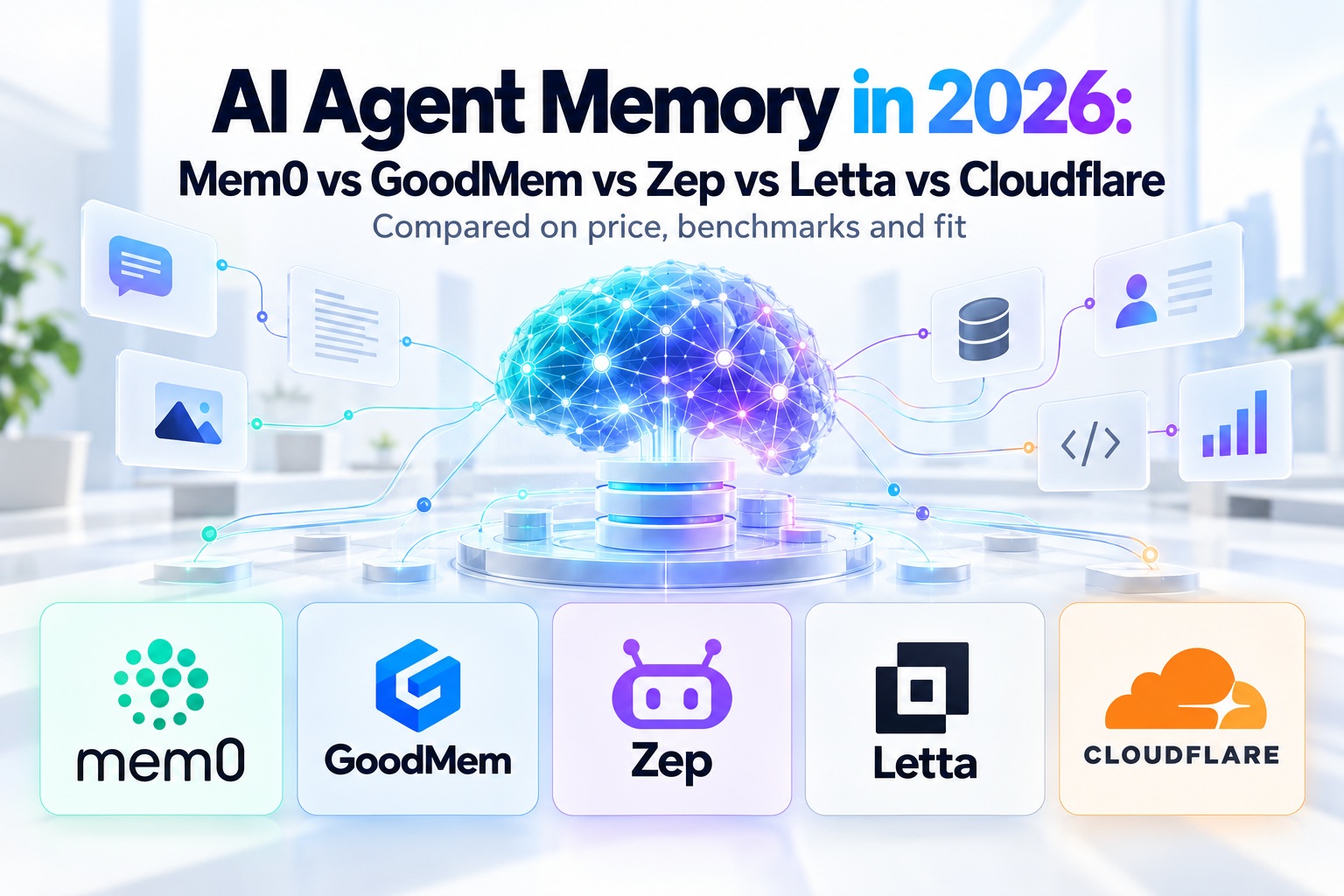
Summary. Agent memory became production infrastructure in 2026, and five products now shape the buying decision: Mem0, GoodMem, Zep, Letta and Cloudflare Agent Memory. They are not the same kind of thing.
- Mem0 is a vector-first memory layer that reports 92.5% on the LoCoMo benchmark and 94.4% on LongMemEval at about 7,000 tokens per query, against 25,000 or more for full-context baselines.
- GoodMem, from PAIR Systems, is a Java and PostgreSQL memory platform built around per-resource access control and a signed software supply chain. Its own benchmark on a production BI agent cut total tokens by 28%.
- Zep stores memory as a temporal knowledge graph through its Graphiti engine, which has passed 32,000 GitHub stars.
- Letta, formerly MemGPT, is a stateful agent runtime with three memory tiers.
- Cloudflare Agent Memory, announced during Cloudflare's Agents Week in April 2026, is a managed edge service that is still in private beta and not yet billed.
On price, Mem0 runs from free to $249 a month, GoodMem is free to self-host and from $15 a month on its cloud, Letta's Pro plan is $20 a month, and Zep's Flex plan is $125 a month. This guide compares architecture, benchmarks, pricing and fit so you can pick one.
An LLM forgets everything between calls. In 2026 the gap between a demo and a production agent is whether it can remember a user across sessions without stuffing the whole history into every prompt. Mem0's co-founder and chief executive, Taranjeet Singh, framed the stakes when the company raised $24 million in October 2025: memory is "becoming one of their key moats now that LLMs are getting commoditized." Five teams are now selling the shovels. Here is how they differ, for AI engineers and CTOs choosing what to build on.
About this update. We first published this comparison on 1 August 2026 with four products. This version adds GoodMem and rechecks every price, status and benchmark against the vendors' own pages as of 20 October 2026. Mem0 has since dropped its $79 Growth tier, and Cloudflare has published documentation for Agent Memory while keeping it in unbilled private beta. Researched with AI assistance and reviewed by our editorial team.
Five answers to the same problem
Every memory product solves one problem: the context window is finite and expensive, so an agent needs somewhere to keep what matters and a way to fetch only the relevant part back. The common design in 2026 is a three-tier model that Letta's predecessor MemGPT popularised: core memory in the context window, recall memory in a searchable store and archival memory in cold storage. The five products differ in how they store and retrieve the recall and archival tiers. This is the same decision that sits under the broader memory versus RAG and vector database question, narrowed to products you would actually buy.
- Mem0 extracts facts from a conversation and stores them in a vector index, with graph memory for entity relationships on its Pro tier.
- GoodMem keeps the source document, its extracted text, chunks, dense and sparse vectors and rendered page images in one PostgreSQL database with pgvector, as its architecture comparison with vector databases sets out. It serves documents and conversation history from the same store, with the embedding, reranking and generation models chosen by the operator, hosted or local.
- Zep builds a temporal knowledge graph in which every fact carries a validity window recording when it became true and when it was superseded.
- Letta runs the agent itself and lets the model page its own memory in and out, like an operating system managing memory and disk.
- Cloudflare Agent Memory turns conversations into four kinds of stored memory, facts, events, instructions and tasks, and recalls them through an API, with newer facts superseding older ones on the same topic.
Same problem, five architectures.
Architecture: how each one stores memory
The storage model drives everything downstream, from what the tool is good at to how you self-host it.
| Product | Memory model | Self-host option |
|---|---|---|
| Mem0 | Vector-first extraction, graph memory on Pro | On-premise on the Enterprise plan |
| GoodMem | Documents, chunks, vectors and page images in one PostgreSQL store; access checked per resource | Free self-hosted build, including commercial use; also VPC and air-gapped |
| Zep | Temporal knowledge graph (Graphiti) with validity windows | Graphiti on Neo4j or FalkorDB; Community Edition retired April 2025 |
| Letta (MemGPT) | Stateful runtime, three tiers, self-editing memory | Free, all features |
| Cloudflare Agent Memory | Managed extraction into facts, events, instructions and tasks | Managed only (private beta) |
| Full-context baseline | Entire history in every prompt | Not applicable |
Mem0 is the most portable: it bolts onto an existing agent stack and does not ask you to adopt a runtime or a graph database.
GoodMem is built like infrastructure rather than an SDK. According to PAIR Systems, every retrieval is authorised against the specific resource before any search runs, and scoped API keys are bounded by a permission ceiling fixed when they are issued. Its installer verifies signed SLSA Build Level 3 provenance by default, and the server runs as a non-root, distroless Java 21 image. REST and gRPC use TLS by default. PAIR Systems says on its Trust Center and in its security brief that it is ISO 27001 certified, with a SOC 2 Type II audit in progress. Core storage needs no separate vector database or message broker, so teams keep their existing PostgreSQL backup and access practices. GoodMem runs in its own cloud, in your VPC or fully air-gapped.
Zep's temporal graph is the distinctive one for changing facts. Because every edge carries a valid-from and valid-to timestamp, the agent can answer questions such as a customer's current plan versus the plan they held last quarter without the model guessing.
Letta's distinctive property is that memory is part of the runtime, so an agent can edit its own memory and improve across sessions.
Cloudflare's is the most managed: the service extracts, classifies and deduplicates memories for you, and namespaces and profiles keep one user's memory apart from another's.
Benchmarks: what the numbers say, and who reported them
Treat every benchmark here as vendor-reported, because the vendors ran them.
Mem0. Mem0's State of AI Agent Memory 2026 report and its research page put the token-efficient algorithm it released in April 2026 at:
- 92.5% on LoCoMo;
- 94.4% on LongMemEval;
- 64.1% and 48.6% on the 1M and 10M BEAM splits.
Each comes at about 6,700 to 7,000 tokens per query, roughly a quarter of the 25,000 or more a full-context approach spends.
GoodMem. PAIR Systems' benchmark on a production enterprise BI agent, across 17 scenarios, reports:
- 28% fewer total tokens, with a 95% interval of 2% to 47%;
- 53% fewer median tokens per query;
- 23% fewer reasoning iterations;
- the same answer-quality pass rate with memory on and off.
The quality comparison has a wide interval, so read it as no detected change rather than proof of none. Its retrieval study reports a 35% median relative gain in mean reciprocal rank across eight public CRUMB retrieval tasks after automated fine-tuning of the embedder.
Zep. Zep reports up to a 90% latency reduction against passing the full conversation history into context, and up to 18.5% higher accuracy on reasoning tasks, from its own temporal-graph evaluation.
LoCoMo, LongMemEval and BEAM are the long-conversation suites the field settled on in 2026. They test whether a system can recall and reason over facts spread across long, multi-session dialogues rather than a single prompt. The useful signal in Mem0's numbers is the token cost more than the headline accuracy: a layer that keeps recall high at a quarter of the tokens directly lowers the model bill, the same logic behind agent unit economics and cost per task.
GoodMem's studies measure cost and ranking quality rather than answer accuracy on LoCoMo or LongMemEval, so they do not line up against Mem0's figures. Independent cross-vendor benchmarking is still thin; third-party comparisons of Mem0 and Zep from Vectorize and Atlan are useful context but rely largely on the same vendor figures. Run your own evaluation on your data before you commit.
Pricing: what you actually pay
The tools price very differently, and one of them does not charge yet.
| Product | Entry price | Higher tiers |
|---|---|---|
| Mem0 Hobby | Free: 10,000 add requests and 1,000 retrievals a month | Starter $19, Pro $249 a month; Enterprise custom |
| GoodMem | Free to self-host, commercial use included, no cap on stored memories | Cloud from $15 a month, usage-based; Enterprise custom |
| Letta | Free to self-host; cloud free plan up to 3 agents | Pro $20 a month, up to 20 stateful agents |
| Zep Flex | $125 a month, 50,000 credits | Then $25 per 10,000 credits |
| Cloudflare Agent Memory | Not billed during private beta | Pricing not announced |
| Full-context baseline | No product fee | 25,000+ tokens per call in model spend |
All prices are as listed on the vendors' pages on 20 October 2026.
Four points matter for budgeting.
Mem0's ladder has a gap. The Growth tier at $79 a month is no longer listed, so Starter at $19 jumps straight to Pro at $249. Pro is where graph memory starts, and on-premise deployment sits in Enterprise.
GoodMem's self-hosted build is free even inside a product you sell, according to GoodMem's pricing page, so the bill is your own PostgreSQL and model spend. Its cloud offers a 14-day trial without a card. Enterprise adds source-code access, OEM and managed-service rights and a 99.99% uptime SLA. Its TCO brief works through storage footprint against token savings and reaches a 9:1 ratio in its worked example, with a calculator to rerun it on your workload. That is the vendor's model, not a measured result for your system.
Zep's figure of $25 is not the plan price. The number that circulates online is the price of 10,000 extra credits; the Flex plan is $125 a month.
Letta and Cloudflare are the cheap ends. Letta is the cheapest route to full control, because self-hosting is free with every feature. Cloudflare says it will give at least 30 days' notice before it starts charging for Agent Memory, so there is no memory-specific price to model yet.
Which to choose
There is no single winner. Match the memory model to what your agent actually does.
| If you need | Pick | Why |
|---|---|---|
| A fast prototype with minimal operations | Mem0 | Free tier, vector-first, drops onto any stack |
| A memory layer that must pass a security review | GoodMem | Per-resource access checks, scoped keys, signed provenance, self-host or air-gap |
| Documents, decks and spreadsheets as memory | GoodMem | Renders PDF, Word, PowerPoint and Excel pages in-process, with no LibreOffice |
| Reasoning over facts that change over time | Zep | Temporal graph with per-fact validity windows |
| Free self-hosting with full control | Letta | Self-host is free with all features |
| Agents that edit their own memory | Letta | MemGPT-style runtime paging |
| Agents already built on Cloudflare | Cloudflare Agent Memory | Managed memory beside Workers (beta) |
| The lowest reported token cost | Mem0 | About 7,000 tokens per query, as reported |
A reasonable default in 2026:
- Start on Mem0 to get an agent remembering quickly and cheaply.
- Shortlist GoodMem when the memory layer must run inside your own infrastructure and pass a security review, or when documents and conversation history need to live in one governed store.
- Move to Zep when temporal reasoning over changing facts becomes the requirement.
- Choose Letta when you want to own the runtime and self-host.
- Keep Cloudflare Agent Memory on the watchlist until it leaves beta and publishes pricing.
For the products other than GoodMem, the memory layer is not a substitute for retrieval over documents. Many teams still pair it with a vector store, which is a separate vector database decision.
How to evaluate a memory layer on your own data
Vendor benchmarks are a starting point, not a decision. Because every vendor here runs its own evaluations, the only number that binds is the one you produce on your traffic.
Build the test set. Take a fixed set of real multi-session conversations from your product, each with a known correct answer to a question that needs an earlier turn.
Measure three things together. Run every candidate over the same set and record:
- recall accuracy: did it retrieve the fact;
- token cost per retrieval call: what it adds to every model request;
- p95 retrieval latency: what the user feels.
A layer that wins on accuracy but triples token cost can be the wrong choice once you multiply by production volume, which is the point behind agent unit economics.
Test what separates the products:
- Changing facts: include cases where a later turn overrides an earlier one, and check whether the system returns the current fact or the stale one. This is where Zep's temporal graph is meant to win.
- Getting started (GoodMem): the Cloud free trial needs only a Google or GitHub sign-in and no card, and provisions an instance in seconds. Configure your models, ingest a small dataset, inspect the retrieved sources and compare retrieval with and without reranking; the getting started guide and RAG tutorial walk through it.
- Access control (GoodMem): mix a policy document with an earlier conversation, and check that an agent whose key is scoped to one space is refused on another before any search runs.
- Retrieval tuning (GoodMem): GoodMem's retrieval optimiser compares embedder and reranker pipelines on your held-out queries and reports how likely each is to be near the best. Fine-tuning a model is a separate step, so record the two as separate configurations. GoodMem's retrieval optimisation guide explains the scoring.
- Learning across sessions: test Letta's self-editing memory on a task that repeats.
- Edge latency: if latency at the edge is the constraint, prototype on Cloudflare once you have beta access.
Test the operational path you will actually run: deleting a user's memory on request, a retention window that evicts old data and, for regulated workloads, the self-host route. These are not benchmark lines, but they decide whether a memory layer is deployable under a real data-protection regime rather than only fast in a demo.
India-specific considerations
Agent memory stores exactly the data the Digital Personal Data Protection Act 2023 governs: names, preferences, conversation history and other personal data about identifiable users. Three consequences follow.
Retention and deletion are required. Purpose limitation applies, so memory needs an eviction and deletion policy, not indefinite accumulation.
Data residency matters. A managed US-hosted memory service may not suit a regulated Indian workload. The practical options are:
- GoodMem's free self-hosted build;
- Mem0's on-premise Enterprise plan;
- Letta's free self-hosting;
- Zep's Graphiti on Neo4j or FalkorDB.
GoodMem can run fully air-gapped with local model endpoints such as vLLM, TEI, llama.cpp or Ollama, and its optional OCR service, so no content has to leave the network. Its security model documentation says partitions inside one instance are not a tenant boundary: deployments that need hard isolation between customers use one database per customer. That is the stronger boundary for DPDP-governed data.
Cost reads differently in rupees. Mem0's Pro plan at $249 a month is about ₹23,600 at the European Central Bank's reference rates for 19 October 2026, before model spend. So the memory bill belongs in the same plan as the production AI agent budget, not as an afterthought.
None of these tools makes a system DPDP compliant on its own: encryption, retention and access control around the memory store are the controls that matter.
How eCorpIT can help
eCorpIT is a Gurugram-based technology organisation, founded in 2021, ISO/IEC 27001:2022 certified, assessed at CMMI Level 5 and MSME certified, with senior-led engineering teams working across AWS, Microsoft and Google platforms. We build production AI agents and pick the memory layer that fits the workload: our teams run head-to-head evaluations on your data, wire the memory store into your agent stack and design DPDP-aligned retention, deletion and encryption around it, as part of our AI evaluation and observability service. Talk to us at /contact-us/.
Last updated: 20 October 2026.