On this page · 12 sections
- The declaration that catches most teams
- The five requirements, and which need code
- User-generated content: report and block are separate
- Age signals now come from the platform
- Restrict Minor Access has a revenue consequence
- Permissions changes that hit social growth loops
- What we build, and how
- India-specific considerations
- Why eCorpIT
- FAQ
- How eCorpIT can help
- References
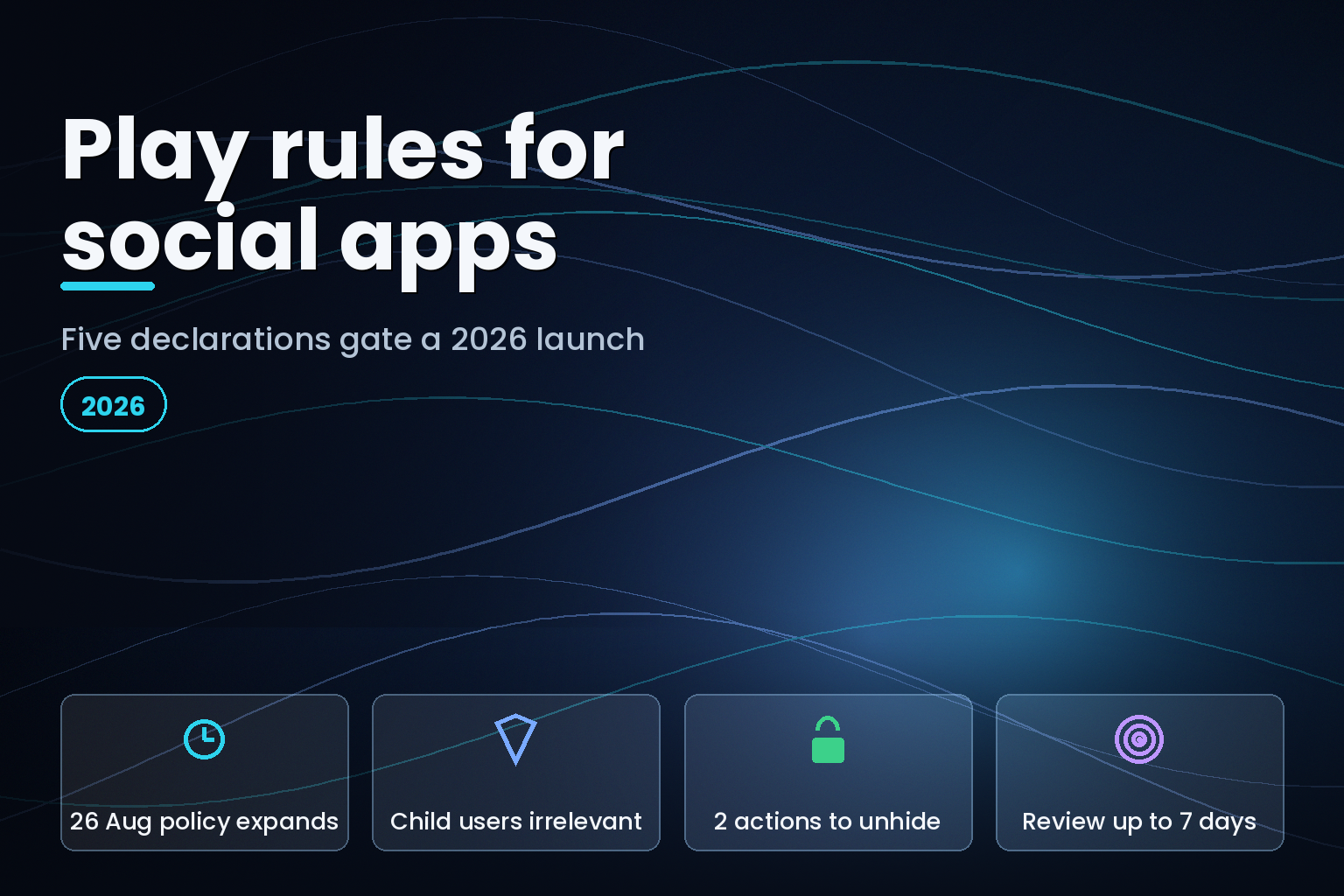
Summary. Google Play's Child Safety Standards policy applies to any app that declares itself as "Social" in Play Console, and Google states plainly that "the presence or absence of child users in your app is irrelevant to this policy." From 26 August 2026 the same policy extends to anonymous and random chat apps, alongside a parallel expansion of the Age-Restricted Content and Functionality policy announced in the July 2026 updates. On 29 July 2026 Google expanded the Play Age Signals API from Brazil to Australia and Canada by mid-August 2026, with global rollout later in the year, returning age bands of 16-17 and similar directly to apps. The 15 April 2026 policy announcement added 2 new policies and changed 2 more, including contacts and location. Five Play Console declarations now gate a social app launch, 4 of them need engineering work rather than paperwork, incidental sexual content must sit behind at least 2 user actions, and Play review can run to 7 days or longer.
The declaration that catches most teams
Most social app teams discover the Child Safety Standards policy after they have built the product. The trigger is not a content audit or a user complaint. It is a dropdown.
Google's guidance defines the scope in one line: "A Social app is an app that declares itself as a 'Social' app in Play Console." An anonymous chat app is one whose core functionality is for users to communicate anonymously where the identity of one or more users is deliberately hidden. A random chat app is one whose core functionality is randomly connecting users to communicate with people they do not know.
Then comes the sentence that removes the usual escape hatch. Asked what happens if an app is adults-only or age-gated, Google's answer is that "the presence or absence of child users in your app is irrelevant to this policy. If your app meets the criteria above, then it is within the scope of this policy and must comply with its requirements."
An 18-plus product with a working age gate is still in scope. That is the single most expensive misreading we see in social app scoping.
The five requirements, and which need code
Child Safety Standards has five requirements. Three are self-certifications in Play Console, which sounds like paperwork until you notice that certifying something you have not built is a false declaration.
| Requirement | What Play asks for | Engineering work |
|---|---|---|
| Published CSAE standards | Globally accessible web page prohibiting child sexual abuse and exploitation | Publish and link; must name the app or developer as listed on Play |
| In-app feedback mechanism | A way to raise concerns without leaving the app | In-product flow, not an external link |
| Address CSAM | Act on actual knowledge, per your published standards | Moderation queue, takedown path, audit trail |
| Comply with child safety laws | Process to report confirmed CSAM to NCMEC or a regional authority | Reporting workflow and record retention |
| Child safety point of contact | Named individual who can speak to your enforcement procedures | Named person, not a shared inbox |
The published standards page has three specific tests. It must load without error, be relevant in scope by mentioning CSAE or child safety, and reference the app or developer name exactly as it appears on the Play store listing. A generic corporate policy page fails the third test.
The in-app mechanism is looser than teams expect. Google accepts "a comprehensive in-app user feedback experience, a support email, or chat channel for reports" provided users can access it without leaving the app. A mailto link that launches an external mail client does not clear that bar.
User-generated content: report and block are separate
Any app hosting user-generated content must implement moderation independently of the child safety rules. Play's UGC policy sets out what that means concretely, and the split matters.
Apps with publicly accessible UGC, which covers social networking apps explicitly, must provide in-app functionality to report users and content, and to block users. Apps with 1:1 interaction such as direct messaging, tagging or mentioning must provide blocking. Google's guidance adds a design note worth following: "a button which doubles as both a report or block functionality can be confusing if it is not clearly labeled as such," with the recommendation to keep separate, clearly labelled functions for each.
Users must accept terms of use before creating or uploading content, and that step cannot be skippable. The terms of use are separate from the privacy policy, and Google recommends keeping them distinct.
Incidental sexual content carries its own numeric test. It must sit behind filters requiring at least two user actions to disable. A single click does not qualify. Google's worked example walks through a settings page, a "Hide Mature Content" tab, then unchecking a box, which is three actions. The content must also be hidden by default, the app must not promote or recommend it, and children must be excluded by a neutral age screen.
A neutral age screen has a precise definition too: it asks users to freely enter month, day and year of birth. Presetting the birth date to the required age, or telling users what age is needed, is an incorrect implementation.
Age signals now come from the platform
Knowing who is a minor used to be your form's problem. In 2026 the signal increasingly arrives from the operating system.
The Play Age Signals API is a privacy-preserving API that lets parents share a child's age range, such as 16-17, directly with apps through Google Family Link, and lets adults share their age when an app prompts. Google announced on 29 July 2026 that it was expanding the API from its existing availability in Brazil to users in Australia and Canada by mid-August 2026, with a full global rollout to all users later in the year. Age ranges are never shared by default and parents can change or revoke the setting at any time.
Paul Feng, VP of Product Management at Google Play, framed the design choice this way: "Rather than enforcing one-size-fits-all rules, we give developers the flexibility to choose how they integrate safety signals."
That flexibility is the point for a product team. The signal tells you an age band; what you do with it, whether that is content filtering, feature gating or a different default feed, remains your architecture decision. Build the plumbing to receive and act on an age band even if your first release treats every user identically, because retrofitting it into a live feed is considerably harder.
Restrict Minor Access has a revenue consequence
Restrict Minor Access is a separate Play Console control, and it is required for some app types. Apps whose core functionality is real-money gambling, or matchmaking and dating, must enable it. From 26 August 2026 that list expands to apps whose core functionality is randomly connecting strangers, and apps built for anonymous communication where a user's identity is deliberately hidden.
Read what enabling it actually does. Users determined to be under 18 cannot search for, download or purchase the app. Existing installs keep working, but those users "will not be able to renew existing subscriptions or make new purchases." For a subscription social product with any under-18 cohort, that is a revenue change, not a store-listing change, and it should be modelled before the switch is flipped.
Enabling it also requires selecting "18 and over" as the app's only target age group. There is one carve-out: apps where matchmaking or dating is an incidental rather than core feature are not required to block minors, provided they implement appropriate age-gating safeguards for those specific features. Google clarified that carve-out in the 15 April 2026 policy announcement.
We have covered the 26 August cutover in detail for teams directly affected, in our guide to Google Play's anonymous and random chat policy, and the store-listing side in our App Store social media declaration and age assurance readiness piece.
Permissions changes that hit social growth loops
Two April 2026 policy changes land directly on the growth mechanics social apps rely on.
Contact import is now governed by a Contacts Permissions policy. Apps that do not need broad access to a user's contacts must use the Android Contact Picker instead, which Google describes as a more secure alternative that minimises data collection. The friend-finder that reads the entire address book on signup is the pattern this targets.
Precise location is narrowing too. Google introduced the location button as the recommended minimum scope for precise location, in line with its user data and sensitive permissions requirements. Geofencing was also removed as an approved foreground services use case; the Geofence API is the replacement. Location-tagged posts and nearby-people features need re-scoping against both changes.
What we build, and how
eCorpIT builds social and community products: feeds, messaging, creator tools, and the moderation and trust-and-safety systems underneath them. We also take over social apps that were built without the compliance layer and now need one.
Our engagement runs in five steps.
- Declaration and scope review. We establish which Play categories the app will declare, which policies that triggers, and which of the five Child Safety Standards requirements are unmet. This produces a written gap list before any code is written.
- Moderation architecture. Report and block flows, the moderation queue, takedown paths and the audit trail that lets you evidence action on actual knowledge.
- Age and identity plumbing. Play Age Signals integration, neutral age screens where required, and the feature-gating layer that consumes an age band.
- Product build. Feed, graph, messaging and media pipeline, with the safety layer treated as a first-class subsystem rather than a pre-launch scramble.
- Submission and iteration. We prepare the Play Console declarations, allowing for review times that Google warns may run to 7 days or longer in exceptional cases.
For adjacent builds, see our ecommerce app development company page, and our age assurance app compliance service for the compliance work as a standalone engagement.
India-specific considerations
Indian social products carry a second compliance track alongside Play's. The Digital Personal Data Protection Act 2023 governs collection, storage and processing of personal data, and social apps collect a great deal of it: contact graphs, location, media, and message content. Consent capture, retention limits and deletion paths shape the schema, so they belong in the first data model rather than a later remediation project. We design applications aligned with DPDP requirements, and the engineering detail is in our DPDP Act engineering playbook.
Moderation staffing is the other India-specific variable. Multilingual moderation across Indian languages is a materially different problem from English-only moderation, and automated classifiers degrade sharply outside the languages they were trained on. Budget for human review capacity in the languages your users actually post in.
Why eCorpIT
eCorp Information Technologies Private Limited was founded in 2021 and works from Gurugram, Haryana. We hold CMMI Level 5, ISO 27001:2022 and MSME certification, and we are partners with AWS, Microsoft, Google, Shopify and Kaspersky. Teams are senior-led and multi-disciplinary.
On engagement model, we scope social builds in two parts: a fixed-scope declaration and moderation gap review with a written deliverable, then the build itself as time-and-materials against an agreed backlog with a monthly ceiling. Retained trust-and-safety engineering runs as a monthly commitment in engineer-days. We publish the model rather than a rate card, because the honest number depends on how much of the safety layer already exists.
FAQ
How eCorpIT can help
We review a social product against the Play declarations it will need to make, produce a written gap list across Child Safety Standards, UGC moderation and age assurance, and then build the missing layer as part of the product rather than bolted on before submission. If you are building a social, community or messaging product, or you already have one and the 26 August 2026 changes affect it, contact us with your intended Play category and we will tell you which of the five declarations you can already make truthfully.
References
- Learning more about our Child Safety Standards policy — Google Play Console Help, accessed 16 August 2026.
- Preview: Child Endangerment (effective 26 August 2026) — Google Play Console Help.
- Child Endangerment policy — Google Play Console Help.
- Preview: Age-Restricted Content and Functionality (effective 26 August 2026) — Google Play Console Help.
- Age-Restricted Content and Functionality policy — Google Play Console Help.
- User Generated Content policy — Google Play Console Help.
- Understanding moderation requirements and incidental sexual content in UGC apps — Google Play Console Help.
- Manage target audience and app content settings — Google Play Console Help.
- Delivering safer, age-appropriate experiences on Google Play — Paul Feng, VP of Product Management, Google Play, 29 July 2026.
- Policy announcement: April 15, 2026 — Google Play Console Help.
Last updated: 16 August 2026.