On this page · 8 sections
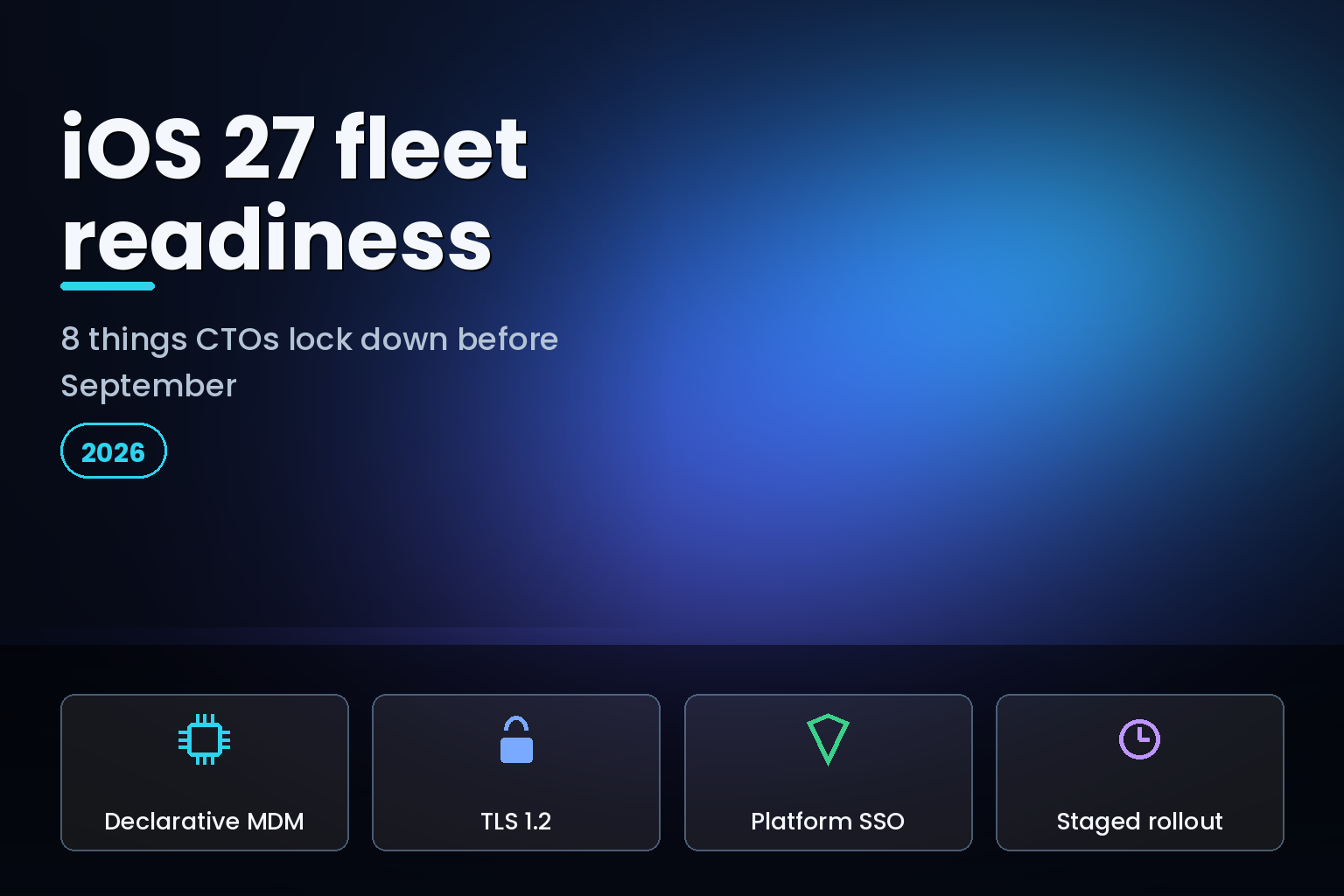
Summary. iOS 27 is the release that ends optional declarative device management. Apple confirmed at WWDC on June 8, 2026, that across the OS 27 generation, declarative device management becomes the standard, legacy software-update MDM support is removed, and TLS 1.2 becomes a hard requirement for all management services. Seven new declarative configurations bring the entire network stack, VPN, IKEv2, IPsec, Always On VPN, DNS proxy, encrypted DNS, and network relays, under declarative control. Apple shipped developer beta 2 on June 22, 2026, the public beta arrives in July, and the public release is expected around September 14, 2026, which leaves CTOs roughly 10 to 12 weeks. The cost of inaction is concrete: any fleet whose MDM still relies on legacy update management loses 100% of its update enforcement the moment a device upgrades. Apple Intelligence adds a second workstream, since the features need an iPhone 15 Pro or newer, which launched at $999, or ₹1,34,900 in India. Here are the 8 things to lock down.
This is a fleet-readiness checklist, not a feature tour. Each item below is a change that can break an existing deployment or expose a gap if you reach September unprepared. The common theme, repeated across Apple's deployment guidance and every major MDM vendor's WWDC analysis, is that legacy workflows fail entirely when devices move to OS 27. Plan the migrations now, validate them against the July public beta, and you reach release day with a fleet that updates cleanly. For the app side of the same cycle, pair this with our iOS 27 app-testing checklist.
Craig Federighi, Apple's senior vice president of Software Engineering, said the company is "delivering the next generation of Apple Intelligence" this year. For managed fleets, that intelligence is also a governance decision, which is item 7 below.
Why iOS 27 is a bigger deal for IT than for users
For consumers, iOS 27 is a design refresh and a smarter Siri. For IT, it is a structural change in how devices are managed. Apple has been signalling the move from server-driven MDM commands to declarative device management for several years, and the OS 27 generation is where the transition stops being a roadmap and becomes the floor. The era of legacy MDM is effectively over, as 9to5Mac put it, and declarative management is the new standard.
That matters because declarative management is not a cosmetic change. It moves logic onto the device, which reports its own state and applies policy autonomously, instead of waiting for a management server to push and poll. The upside is faster, more reliable enforcement. The cost is that workflows built on the old model do not carry over, and some of them are removed outright in OS 27. The eight items below are ordered by how badly they break if ignored.
The 8 fleet-readiness items at a glance
| # | Lock down | Risk if you skip it |
|---|---|---|
| 1 | Declarative device management migration | Core management workflows fail on upgrade |
| 2 | Legacy software-update management | You lose update enforcement entirely |
| 3 | TLS 1.2 on all MDM services | Devices cannot talk to your management server |
| 4 | Network stack as declarative assets | VPN and DNS policies stop applying |
| 5 | Platform SSO migration to DDM | Single sign-on login flow breaks |
| 6 | In-house app SDK and UI testing | Internal apps misrender or fail to launch |
| 7 | Apple Intelligence enablement policy | Ungoverned AI features and data exposure |
| 8 | Staged update and beta-test policy | Uncontrolled, all-at-once fleet upgrades |
1. Migrate to declarative device management
This is the foundation. With iOS 27 and the rest of the OS 27 generation, declarative device management is the standard rather than an option. If your MDM and your configuration profiles still assume the older server-command model, start the migration now. Confirm with your MDM vendor which of your existing profiles have declarative equivalents, convert them, and validate on a test device running the beta. The goal is that every policy you rely on, passcode, restrictions, apps, network, has a declarative path before any production device upgrades.
2. Replace legacy software-update management
This is the single most dangerous gap. Apple is removing legacy software-update MDM support in all OS 27 releases. If your update enforcement still uses the legacy mechanism, you lose the ability to enforce, defer, or schedule updates the moment a device upgrades to iOS 27. For a regulated fleet, losing update control is both an operational and a compliance problem. Move to declarative software-update enforcement, which lets you target a specific OS version and enforcement deadline, and test that a managed device actually honours it before you depend on it in production.
3. Make TLS 1.2 mandatory on every management service
iOS 27 and macOS 27 require TLS 1.2 or higher for all device-management communication. If any part of your management chain, the MDM server, a proxy, a content-caching service, or an internal certificate, still negotiates older TLS, devices on iOS 27 will not complete management transactions. Audit the full path now. Confirm your MDM endpoint, any reverse proxy, and your certificate chain all present TLS 1.2 or higher, and retire anything that cannot. This is a quick check that becomes an outage if missed.
4. Move the network stack to declarative assets
iOS 27 brings seven new declarative configurations that cover the network stack: VPN plugins, IKEv2, IPsec, Always On VPN, DNS proxy, encrypted DNS, and network relays. Credentials now ship as separate declarative assets rather than being baked into a configuration profile. For any fleet that depends on Always On VPN or managed DNS, this is a required migration, not an optional one. Rebuild these policies as declarative configurations, separate the credentials into their own assets, and verify that a test device establishes the VPN and applies DNS policy under the new model.
5. Migrate Platform SSO to declarative management
Platform single sign-on moves to declarative device management in OS 27, with a new login experience that reflects how enterprise identity actually works, including a floating login window that can present a custom web-based authentication flow. If your fleet uses Platform SSO with an identity provider, plan the migration and test the new login flow end to end. Sign-in is the first thing every user touches, so a broken SSO flow on upgrade day is a fleet-wide help-desk event. Validate it on the beta with real identity-provider credentials.
6. Update and test your in-house apps
Internal enterprise apps face the same SDK and design changes as App Store apps. Since April 28, 2026, builds uploaded to Apple have required the iOS 26 SDK, and iOS 27 enforces the modern UIScene lifecycle while removing the opt-out that let apps defer the Liquid Glass design. An internal line-of-business app that has not adopted the scene lifecycle can fail to launch when rebuilt against the new SDK, and one with custom UI can misrender under forced Liquid Glass. Audit every in-house app, rebuild and test it on the beta, and confirm managed app configuration and any Managed Device Attestation still work. Our iOS 27 app-testing checklist covers the app-level tests in detail.
7. Set an Apple Intelligence enablement policy
iOS 27 pushes Apple Intelligence deeper into the system, and on managed devices that is a policy decision, not a default. Decide which fleets get the AI features, which do not, and what data they may process. The features need an iPhone 15 Pro or newer, so device eligibility is uneven across a mixed fleet. For regulated data, treat on-device processing and Private Cloud Compute differently in your data map, and document the basis under which any personal data is processed. Our breakdown of iOS 27 Apple Intelligence features and device requirements lists what is gated to which hardware so you can scope the policy precisely.
8. Define a staged update and beta-test policy
Do not let a fleet upgrade itself the day iOS 27 ships. Use declarative software-update enforcement to stage the rollout: a small pilot ring first, then department by department, with a defined hold on the rest until the pilot is clean. Put the July public beta on a handful of dedicated test devices so you discover breakage on your terms, in your environment, against your apps and identity provider, well before the general release. A staged policy turns release day from a risk into a routine.
A 10-week migration timeline to the September release
The eight items are easier to manage as a schedule than as a list. Working back from an expected September 14 release, here is a defensible sequence for the weeks between the July public beta and launch.
| Window | Focus | Outcome |
|---|---|---|
| July, public beta opens | Stand up test devices; begin DDM migration | Beta fleet running; declarative profiles drafted |
| Late July | TLS 1.2 audit; network stack as declarative assets | Management path verified; VPN and DNS validated |
| Early August | Platform SSO migration; in-house app rebuilds | SSO login tested; internal apps launch cleanly |
| Mid August | Apple Intelligence policy; hardware-attestation adoption | Enablement rules set; asset checks live |
| Late August | Staged-rollout rings defined; release candidate testing | Pilot ring ready; enforcement deadlines configured |
| Around September 14 | Controlled rollout begins | Pilot upgrades first; fleet follows by ring |
The point of the schedule is to front-load the items that break hardest. Declarative migration, legacy update replacement, and TLS sit first because a miss there is an outage, not an inconvenience. Platform SSO and in-house apps come next because they are user-facing on day one. Policy and adoption work fills the back half, when the structural migrations are proven. Run each change against the beta as you go, so by the time the release candidate appears in early September, nothing about your fleet's behaviour on iOS 27 is a surprise.
A short governance note belongs in every ring: record what changed, who approved it, and how you verified it. That record is useful operationally and, for any fleet touching personal data, it is the evidence trail a data-protection review will ask for. The declarative model makes this easier, because device state is explicit and reportable rather than inferred from a sequence of pushed commands.
New capabilities worth adopting, not just defending against
Not every change is a threat. iOS 27 gives IT genuinely useful new tools. MDM consoles can now read the health and genuineness of critical hardware components, including baseband, camera, Face ID, Touch ID, NFC, and Ultra-Wideband, which makes asset verification and return-to-inventory checks far stronger. Declarative app configuration supports hardware-bound keys and Managed Device Attestation, so apps and extensions can authenticate to enterprise services with hardware-backed trust. Apple Business Manager adds bulk purchase and management of app subscriptions through the same workflow as one-time apps, plus new APIs to automate blueprints, configurations, users, groups, apps, and licenses. Plan to adopt these alongside the defensive migrations; they are the upside of the declarative model.
India-specific considerations
For fleets operated from India, the declarative shift lands at the same time as live data-protection obligations. Under the Digital Personal Data Protection Act, 2023, a managed device that processes employee or customer personal data needs a clear basis and an audit trail, and the new hardware-attestation and declarative-configuration tools make that easier to evidence. The Apple Intelligence policy in item 7 is also a DPDP question: if AI features process personal data, document the purpose and the safeguards. On hardware, the Apple Intelligence entry point is the iPhone 15 Pro at ₹1,34,900 at launch, so a mixed Indian fleet will have many devices that run iOS 27 but cannot use the AI features, which is worth reflecting in both policy and budget. TLS 1.2 enforcement applies equally to any India-hosted management infrastructure.
FAQ
How eCorpIT can help
eCorpIT is a Gurugram-based, CMMI Level 5 and MSME-certified technology organisation whose senior engineering teams handle Apple fleet readiness end to end. We run iOS 27 migration audits: declarative device management conversion, TLS and network-stack validation, Platform SSO testing, in-house app rebuilds, and an Apple Intelligence enablement policy mapped to your data obligations. If you manage an Apple fleet and want it ready before the September release, talk to us through our contact page and we will scope the migration around your rollout calendar.
References
- WWDC 2026: Apple's biggest device management updates — ManageEngine.
- Apple @ Work: the era of legacy MDM is over — 9to5Mac, June 20, 2026.
- WWDC26 device management updates — Apple Support.
- What's new in managing Apple devices, WWDC26 — Apple Developer.
- WWDC 2026: what changes for Apple device management — Applivery.
- Apple unveils next generation of Apple Intelligence, Siri AI, and more — Apple Newsroom, June 8, 2026.
- Upcoming requirements: minimum SDK — Apple Developer.
_Last updated: June 30, 2026._