On this page · 10 sections
- What Alibaba actually shipped at WAIC 2026
- The billing models are not comparable line by line
- The decision framework that actually holds up
- A worked comparison on one workload
- Governance and isolation: the part that survives an audit
- India-specific considerations
- What we would do
- FAQ
- How eCorpIT can help
- References
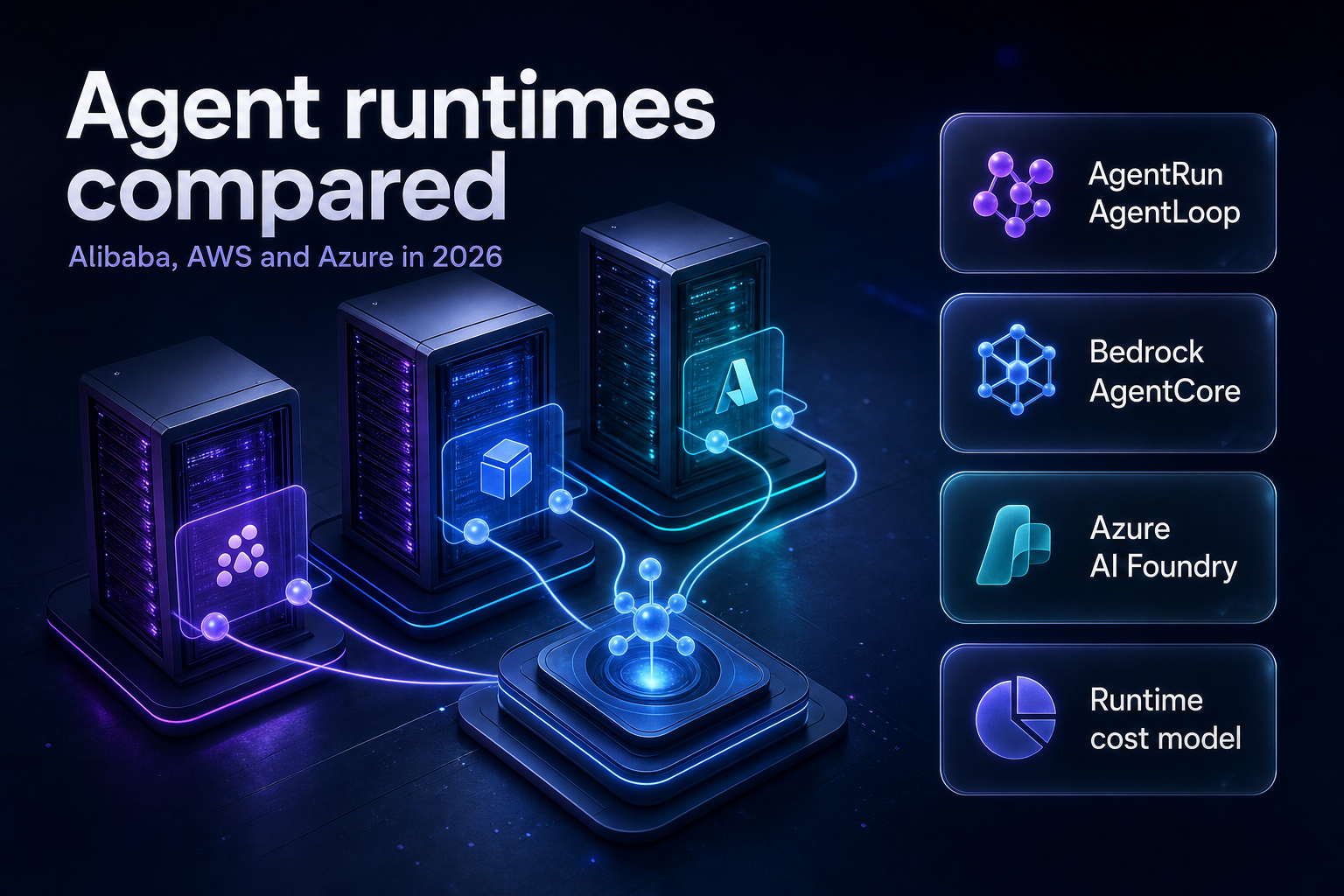
Summary. Alibaba Cloud launched Agent Native Cloud at the World Artificial Intelligence Conference in Shanghai on 18 July 2026, adding two products, AgentLoop and AgentTeams, to its existing AgentRun platform. That completes a three-way field. Amazon Bedrock AgentCore bills its runtime at $0.0895 per vCPU-hour and $0.00945 per GB-hour, with a published pricing page last updated on 18 June 2026. Microsoft's Foundry Agent Service charges nothing extra for Foundry-native agents and bills hosted agents on the underlying container compute per hour. Alibaba published no per-unit rate card with the WAIC announcement at all. Three vendors, three billing models, and the decision turns on how much of your session time is spent waiting rather than computing. Alibaba's own numbers claim 15 coordinated agents now handle 85% of its developer support requests.
The pitch from all three is the same: stop hand-rolling the substrate under your agents. The differences start immediately after that sentence.
What Alibaba actually shipped at WAIC 2026
The platform was unveiled by Qi Zhou, head of Alibaba Cloud's Cloud-Native Application Platform, at WAIC 2026 in Shanghai on 18 July 2026, and first reported by the Shanghai Observer. Alibaba Cloud's own community blog post followed on 20 July.
Agent Native Cloud is a suite, not a single product:
- AgentRun handles lifecycle management: development, deployment and operations. It existed before WAIC; the other two are new.
- AgentLoop does real-time tracing, evaluation and optimisation of agent performance.
- AgentTeams coordinates and governs multiple agents so an organisation can run complex multi-agent workflows.
- Agentic Computer provides secure cloud-based execution.
Underneath sits a redesigned infrastructure layer with native sandbox environments, workload isolation, elastic scaling and enterprise identity integration.
Alibaba also introduced TokenWorks inside its Platform for AI, available through PAI-EAS. TokenWorks folds request routing, inference execution, compute reuse and scheduling into one system for large-model inference. That is a separate concern from agent orchestration, and it matters more than it sounds: on agentic workloads the inference layer, not the orchestration layer, is usually where the money goes.
Two other announcements from the same event frame the strategy. T-Head, Alibaba's chip unit, open-sourced its AI software stack, T-Head SAIL, which spans operating systems, SDKs and interfaces and is tuned for T-Head's Zhenwu AI chips. As of April 2026, cumulative Zhenwu shipments reached 560,000 units supporting over 400 customers across more than 20 industries. And Alibaba unveiled Qwen 3.8-Max-Preview, a 2.4-trillion-parameter model that the company says ranked second only to Fable 5 in initial tests, with open weights promised.
Zhou framed the shift in terms that are worth quoting directly, as reported by Crypto Briefing on 18 July 2026: "the next phase of competition will not be determined by how many AI agents an organization deploys, but by its ability to transform those agents into controllable, reusable, collaborative, and continuously evolving organizational assets."
Alibaba showcased internal results alongside the launch: 15 coordinated AI agents handling 85% of developer support requests, a 90% reduction in operational support time, and software release cycles compressed to one day. Those are vendor-reported figures from a controlled internal deployment, not an audited benchmark, and should be read that way.
Alibaba was not alone at WAIC. Huawei Cloud expanded its AgentArts platform and the open-source openJiuwen ecosystem, and launched an Industry AI Workshop for smart finance with prebuilt workflows, models, datasets and prompts, targeting a cut in AI development timelines from months to weeks and a reduction in development cost of more than 60%.
The billing models are not comparable line by line
This is the part most comparison posts get wrong. The three platforms do not price the same units, so a per-unit table is misleading unless you fix a workload first.
| Dimension | Alibaba Agent Native Cloud | Amazon Bedrock AgentCore | Microsoft Foundry Agent Service |
|---|---|---|---|
| Runtime charge | No public per-unit rate published with the 18 July 2026 announcement | $0.0895 per vCPU-hour and $0.00945 per GB-hour, billed per second | No additional charge for Foundry-native agents; hosted agents billed on underlying container compute per hour |
| Idle / I/O wait | Not specified publicly | Free if no other background process runs; AWS states agents spend 30-70% of session time in I/O wait | Container compute is billed per hour, so wait time inside a hosted container is billed |
| Multi-agent orchestration | AgentTeams (coordination and governance across agents) | Built at the application layer; Gateway and Policy provide the plumbing | Multi-agent experiences designed natively in Foundry |
| Observability | AgentLoop: real-time tracing, evaluation, optimisation | AgentCore Observability, telemetry into Amazon CloudWatch, billed at CloudWatch rates | Observability in Foundry Control Plane |
| Memory pricing | Not published | $0.25 per 1,000 short-term events; $0.75 per 1,000 long-term records stored per month with built-in strategies | Billed separately for short-term, long-term and retrieval |
| Framework portability | Sandbox-based execution with enterprise identity integration | Bring-your-own-framework serverless runtime | Hosted agents run Microsoft Agent Framework or LangGraph on a managed runtime |
The structural difference is this. AWS meters the agent's actual CPU and memory second by second and gives away the wait. Microsoft gives away the orchestration and meters the tokens and tools. Alibaba has said what the platform does and has not said what it costs.
Where AWS puts the meter
AgentCore's pricing page, last updated 18 June 2026, is the most detailed of the three, and the numbers are specific enough to model against:
| Component | Unit | Price |
|---|---|---|
| Runtime, Browser, Code Interpreter | CPU | $0.0895 per vCPU-hour |
| Runtime, Browser, Code Interpreter | Memory | $0.00945 per GB-hour |
| Web Search | Queries | $7.00 per 1,000 queries |
| Gateway | API invocations | $0.005 per 1,000 invocations |
| Gateway | Search API | $0.025 per 1,000 invocations |
| Gateway | Tool indexing | $0.02 per 100 tools per month |
| Identity | Token or API key requests | $0.010 per 1,000 (free via Runtime or Gateway) |
| Memory | Short-term | $0.25 per 1,000 new events |
| Memory | Long-term storage | $0.75 per 1,000 records per month (built-in strategies) |
| Memory | Long-term retrieval | $0.50 per 1,000 retrievals |
| Policy | Authorization request | $0.000025 per request |
| Evaluations | Built-in evaluator input | $0.0024 per 1,000 input tokens |
Billing is calculated per second with a one-second minimum, using actual CPU consumption and peak memory consumed up to that second. A 128 MB minimum memory charge applies. Storage is separate: container deployment bills through Amazon ECR, direct code deployment bills the code artifacts at S3 Standard rates.
AWS publishes a worked example that is genuinely useful for sizing. A customer support agent running 10 million sessions a month, 60 seconds per session with 70% I/O wait, 1 vCPU during active processing, memory rising from 1 GB to a 2.5 GB peak, costs $0.0004475 in CPU and $0.000276 in memory per session. Total: $0.0007235 per session, or $7,235 a month for 10 million sessions. AWS states that a pre-allocated pricing model would need to provision for the 2.5 GB and 1 vCPU peak for the full 60 seconds, producing up to 3.3x higher CPU cost and up to 1.4x higher memory cost.
Other published examples: a browser automation agent at 100,000 sessions of 10 minutes each with 80% I/O wait comes to $1,226.67 a month. A code interpreter running 30,000 executions a month costs $109.40. A Gateway-heavy HR assistant at 50 million interactions with 200 indexed tools costs $2,250.04. Observability for 200,000 agent invocations generating 10 GB of spans and 6 GB of event logs comes to $6.50.
Read those numbers together and a pattern falls out. The runtime is cheap. The tools and evaluations are where the bill lands. In AWS's own e-commerce example, evaluating 15,000 interactions a month with three built-in evaluators costs $1,782, which is more than the entire Gateway bill for 50 million interactions in the other example. Evaluation is a token workload wearing a platform label.
Where Microsoft puts the meter
Foundry Agent Service takes the opposite position at the top of the stack. There is no additional charge for creating or running Foundry-native agents built from prompts and workflows. You pay for model token consumption through Foundry Models, and separately for Foundry Tools and Foundry IQ connections.
Hosted agents are the exception. They let you run agents built with external open-source frameworks, including Microsoft Agent Framework and LangGraph, on a managed Foundry runtime in customer-dedicated containers with built-in scaling, observability, security and governance. Those are billed on the underlying container compute consumed per hour, quoted as a vCPU-hour and a GiB-hour rate. Memory is billed separately across short-term storage, long-term storage and retrieval.
The tool charges are itemised: File Search vector storage per GB per day with 1 GB free, Code Interpreter per session, Web Search per 1,000 transactions, Custom Search per 1,000 transactions. On top of that sit separate charges and licences for Azure Logic Apps connectors, Microsoft Fabric data agent, Microsoft SharePoint, Grounding with Bing Search, Foundry IQ through Azure AI Search, and your own licensed data.
One practical warning. Azure's published rate table renders its figures dynamically per region and currency, so the numbers do not appear in a static fetch of the page. Anyone quoting specific Azure agent-runtime cents per hour from a blog post rather than from the live calculator is quoting something they did not read. Price it in the Azure pricing calculator for your own region before you commit a budget.
Where Alibaba has not put a meter yet
Alibaba's WAIC announcement described capability, not price. No per-unit rate card and no general-availability date for the new AgentLoop and AgentTeams products accompanied the launch. For a platform decision that is a real gap, and it is the single strongest argument for treating Agent Native Cloud as a watch-list item rather than a 2026 commitment outside China.
There is one pricing signal worth noting from the same announcement, though it applies to a different product. The team edition of Meoo, Alibaba's natural-language development tool, offers off-peak pricing that reduces token costs to as low as 20% of standard rates during designated hours. Time-of-day token pricing is unusual among the major vendors, and for batch agent workloads that can be scheduled it is a meaningful lever.
The decision framework that actually holds up
Skip the feature matrices. Four questions decide this.
1. What fraction of your session is I/O wait?
AWS says agentic workloads typically spend 30-70% of session time waiting on LLM responses, tool calls or database queries. If your agents sit at the high end of that band, AgentCore's active-consumption model is a structural discount that a per-hour container model cannot match. If your agents are compute-heavy, running long local inference or heavy data transformation inside the session, the advantage narrows and a flat container rate can win.
Measure this before you choose. Instrument one representative agent with OpenTelemetry spans and compute the ratio of active CPU time to wall-clock session time. Our guide to OpenTelemetry GenAI conventions for LLM and agent tracing covers the span attributes that make this measurable rather than guessed.
2. Where does your data already live?
Foundry's advantage is not the runtime. It is that an agent reaching into SharePoint, Fabric or Microsoft 365 inherits the identity and access plumbing you already run. If the answer to "what should this agent be allowed to read" is already encoded in your Microsoft tenant, rebuilding that on another cloud is the expensive part, not the compute.
3. Are you willing to be framework-portable?
AgentCore accepts any framework, model or protocol wrapped in AWS isolation. Foundry hosts Microsoft Agent Framework and LangGraph agents on a managed runtime. Both let you keep the agent code and swap the substrate. Choosing on runtime price alone is a mistake if the framework choice is the thing that will actually lock you in. If you have not settled that layer yet, start with our comparison of production AI agent frameworks: LangGraph, CrewAI, Microsoft and Pydantic.
4. Can you afford the evaluation bill?
This is the line item teams miss. AgentCore Evaluations charges $0.0024 per 1,000 input tokens and $0.012 per 1,000 output tokens for built-in evaluators, and $1.50 per 1,000 custom evaluations with model usage billed separately. Batch evaluations run at a 25% discount, at $0.0018 and $0.009 per 1,000 tokens. Evaluate 2% of production traffic on a busy agent and the evaluation bill can exceed the runtime bill several times over.
The real cost is usually the evaluation loop, not the runtime.
A worked comparison on one workload
Take a mid-sized support agent: 500,000 sessions a month, 45 seconds per session, 60% I/O wait, 1 vCPU active, 2 GB peak memory, three tool calls per session through a gateway, short-term memory events at one per session.
On AgentCore's published rates:
- CPU: 18 active seconds x 1 vCPU x ($0.0895 / 3600) = $0.0004475 per session
- Memory: 45 seconds x 2 GB x ($0.00945 / 3600) = $0.00023625 per session
- Gateway: 1.5 million InvokeTool calls x $0.005 per 1,000 = $7.50 per month
- Short-term memory: 500,000 events x $0.25 per 1,000 = $125 per month
Runtime and memory: 500,000 x $0.00068375 = $341.88 a month. Add Gateway and memory events and you are at roughly $474 a month, before model tokens. Converted at an assumed ₹87 to the dollar, that is roughly ₹41,000 a month for half a million agent sessions, smaller than one mid-level engineer's monthly cost. Model tokens, tools and evaluations will dwarf it.
That is the finding worth carrying into a budget meeting. Runtime pricing differences between these three platforms are real but second-order. The first-order costs are tokens, tool calls and evaluation. Choose the runtime on isolation, identity and operational fit, then optimise the token bill separately.
Governance and isolation: the part that survives an audit
All three vendors now describe sandbox isolation as a first-class feature rather than a bolt-on, and that shift is the substantive change of 2026.
AgentCore runs sessions in microVMs. Billing spans microVM boot, initialisation, active processing, idle and shutdown, which tells you the isolation boundary is per session rather than per tenant. AgentCore Policy checks each tool call against Cedar policy statements at $0.000025 per authorization request, with natural-language policy authoring priced at $0.13 per 1,000 input tokens. AgentCore Identity manages OAuth tokens and API keys and is included at no extra cost when used through Runtime or Gateway.
Alibaba's Agent Native Cloud describes native sandbox environments, workload isolation and enterprise identity integration as part of the redesigned infrastructure. Foundry hosted agents run in customer-dedicated containers with governance included.
For a regulated workload the question to ask a vendor is narrower than "is it isolated". Ask where the isolation boundary sits, whether a tool call can be denied before execution rather than logged after it, and whether the authorisation decision is auditable per call. AWS's per-request Policy pricing is at least evidence that the check happens per call. We covered the surrounding control set in AI agent security guardrails.
India-specific considerations
For Indian enterprises the calculus has two extra terms.
Region availability and data residency. Azure's Foundry Agent Service pricing page lists Central India, South India and West India among its regions. If your DPDP posture requires processing inside India, confirm that every component of the agent stack, not only the model endpoint, is available in an Indian region. Agent platforms are assemblies of a dozen services and the weakest link decides where the data actually lands. Under the Digital Personal Data Protection Act 2023, the obligation attaches to the data fiduciary regardless of which cloud executes the tool call.
Chinese cloud in the stack. Agent Native Cloud, Qwen 3.8-Max-Preview and T-Head SAIL are a coherent full-stack play from silicon upward, and the open-weight promise on Qwen makes the model layer genuinely portable. The infrastructure layer is a different question for an Indian enterprise with government, defence or listed-company customers. Procurement policy, not benchmark scores, will decide that one. The open-weight route lets you take the model without taking the cloud, and that is the pragmatic answer for most Indian teams: evaluate Qwen weights on infrastructure you already trust. Our analysis of Chinese AI models and US enterprise token share and the enterprise AI export control compliance playbook go deeper on the procurement side.
Cost in rupees. At $0.0895 per vCPU-hour, a continuously busy 1 vCPU agent runtime costs roughly $64 a month before memory, tools and tokens. At the same assumed ₹87 to the dollar that is about ₹5,600. That is not the number that will break a budget. The token bill is.
What we would do
For an AWS-native organisation with agents that wait a lot: AgentCore, and instrument the evaluation sampling rate hard from day one.
For a Microsoft 365 organisation where the agent's value is reaching internal documents: Foundry Agent Service, and price the tool connections before the runtime.
For Agent Native Cloud outside China: wait for a published rate card and a GA date. The architecture argument is sound and AgentTeams addresses a real gap in multi-agent governance, but you cannot budget against a press release. Take the Qwen weights if they land open, and revisit the platform when the pricing page exists.
For anyone still choosing: build the same small agent twice, on two platforms, with real traffic for two weeks. The comparison table that matters is the one your own invoice produces. Our walkthrough of building an AI agent on Amazon Bedrock AgentCore is a reasonable starting point for the first of those two builds.
FAQ
How eCorpIT can help
eCorpIT builds and operates production AI agents for enterprises across India and global markets, and platform selection is the first conversation we have on every engagement. Our senior engineering teams instrument a representative agent, measure the real I/O-wait ratio and evaluation volume, then model the actual monthly cost on each candidate runtime before anyone commits to a vendor. We also handle the parts that decide whether an agent survives an audit: identity, per-call authorisation, tracing and evaluation. If you are choosing between AgentCore, Foundry Agent Service or a self-hosted runtime, talk to us and we will run the comparison against your workload rather than a vendor's example.
References
- Alibaba Cloud Unveils Agent-Native Innovations at WAIC 2026 — Alibaba Cloud Community, 20 July 2026.
- Alibaba Cloud launches Agent Native Cloud to scale enterprise AI agents — Crypto Briefing, 18 July 2026.
- Amazon Bedrock AgentCore Pricing — Amazon Web Services, page updated 18 June 2026.
- Foundry Agent Service pricing — Microsoft Azure.
- Amazon Bedrock AgentCore overview — Amazon Web Services.
- Amazon Bedrock AgentCore FAQs — Amazon Web Services.
- Foundry Agent Service product page — Microsoft Azure.
- What is Microsoft Foundry Agent Service? — Microsoft Learn.
- Foundry Tools pricing — Microsoft Azure.
- Foundry Models pricing — Microsoft Azure.
- Amazon Bedrock pricing — Amazon Web Services.
- Amazon CloudWatch pricing — Amazon Web Services.
- Qwen 3.8-Max-Preview announcement — Alibaba Qwen team.
- Foundry IQ pricing (Azure AI Search) — Microsoft Azure.
Last updated: 22 July 2026.