On this page · 12 sections
- What changed in 2026
- Vapi: managed orchestration, models at cost
- Retell AI: itemised per-minute pricing, low ceremony
- Bland AI: one bundled rate, enterprise-led
- LiveKit: open-source framework plus a usage-priced cloud
- Head-to-head comparison
- Pick X if…
- Worked cost example: 10,000 and 100,000 inbound minutes a month
- India, TRAI, DPDP and data residency
- Implementation checklist
- How eCorpIT can help
- References
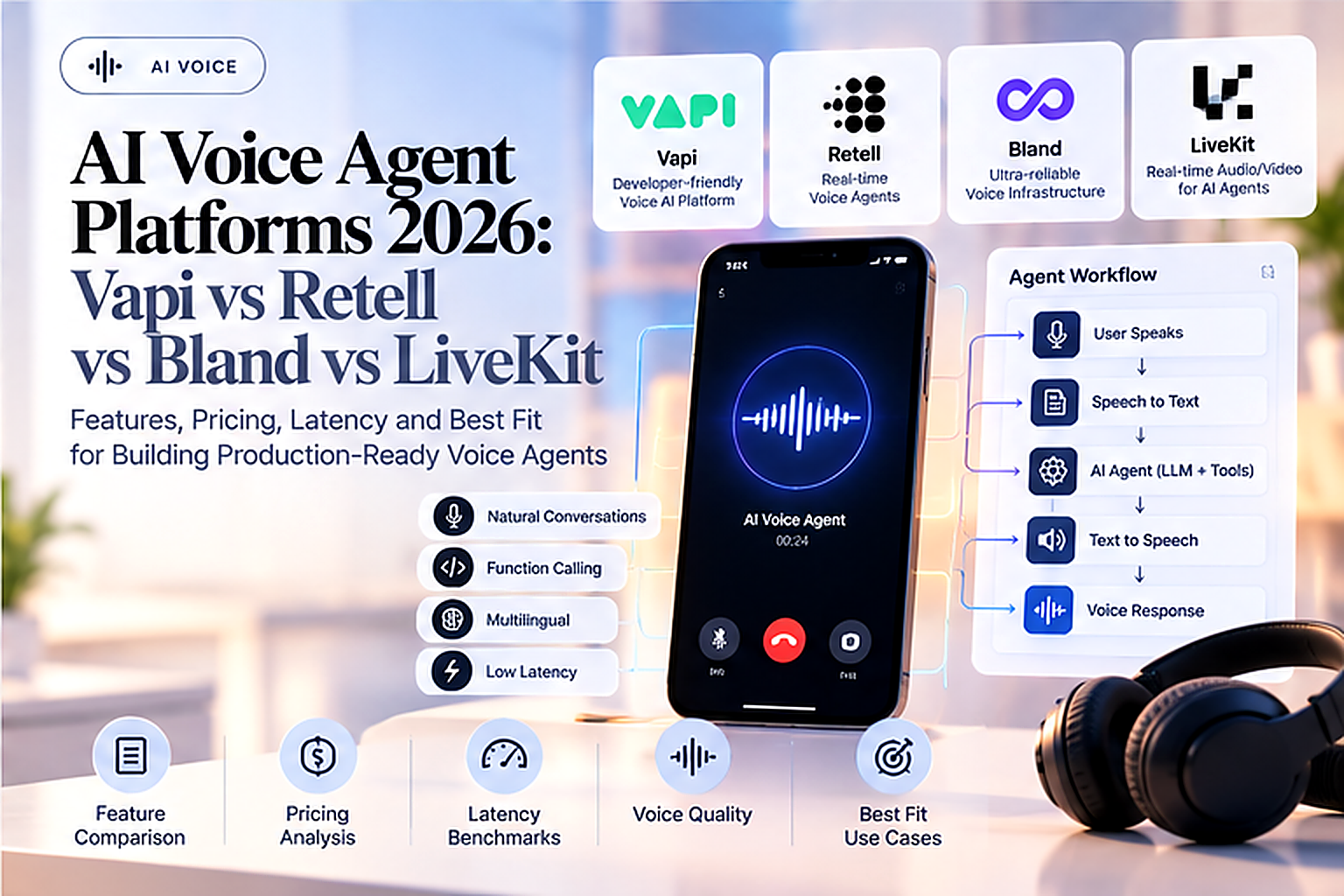
Summary. The choice comes down to how much of the voice stack you want to own. LiveKit is the cheapest per minute at scale and the only one of the four with an open-source core: the Agents framework is Apache-2.0, LiveKit Cloud starts at $0 and charges $0.01 per agent-session minute after plan allowances, and our reference stack works out to roughly $0.05 to $0.06 a minute before engineering time. Vapi charges a $0.05 a minute hosting fee and passes STT, LLM, TTS and telephony through at cost; in September 2026 it moved new customers from Build/Scale tiers to Success Packages (Core $29 a month, Pro at 10% of hosting with a $999 minimum), cut no-package concurrency from 10 calls to 4, and kept HIPAA at $2,000 a month. Retell prices each component per minute ($0.055 voice infrastructure, $0.015 standard TTS, LLMs from $0.008 to $0.384), includes 20 free concurrent calls and a self-signed BAA at no fee, and our reference stack lands near $0.11 a minute. Bland bundles LLM, STT and TTS into one rate: $0.14 a minute on Start or $0.12 on the $299 Build plan, up from a flat $0.09 before 5 December 2025, with on-prem and VPC only on Enterprise. Pick Retell or Bland for speed to a working phone agent, Vapi for API-first control without running servers, and LiveKit when you have engineers and want self-hosting, an India region or the lowest unit cost. Indian teams calling customers must now also pre-declare AI calls to their telecom operator under TRAI's September 2026 rules.
About this article. Prices, plans, concurrency, compliance claims and Indian telecom rules were checked against vendor pages, documentation and TRAI and Gazette notifications on 22 October 2026. Vendors change pricing often, so re-check before you commit. No vendor paid for inclusion or placement. Researched with AI assistance and reviewed by our editorial team.
What changed in 2026
- Vapi repackaged. Between mid-September and early October 2026, Vapi replaced Build/Scale with Success Packages for new customers. Usage stays at $0.05 a minute, new no-package accounts drop from 10 concurrent calls to 4, and zero data retention, formerly a $1,000-a-month add-on, comes with any package; existing accounts keep their 10 included lines. Vapi also retired Workflows on 18 August 2026, recommending Squads as the replacement, and in May announced a $50M Series B led by Peak XV, taking total funding to $72M.
- Bland raised per-minute rates. Bland's billing docs record the move from a flat $0.09 a minute to plan-based rates on 5 December 2025: $0.14 (Start), $0.12 (Build, $299) and $0.11 (Scale, $499). The public pricing page shows only Start, Build and Enterprise, so treat Scale as a question for sales.
- Retell added orchestration. Its 24 August 2026 changelog launched Retell Workflows for pre-call and post-call automation and added GPT-5.6 and GPT Realtime 2.1.
- LiveKit raised and localised. It raised a $100M Series C at a $1B valuation in January 2026, led by Index Ventures, now itemises inference per model and documents a Mumbai agent region with an India SIP endpoint.
- TRAI brought AI calls under its rules. A September 2026 amendment defines calls placed by artificial-voice and automated platforms as application-to-person calls that must be declared to the operator in advance.
Existing Vapi workflows stopped running on 19 August, which is the best argument for keeping prompts, tools and routing in your own repository.
Vapi: managed orchestration, models at cost
What it is. A hosted voice-agent API. You configure assistants (prompt, model, voice, transcriber, tools), group them into Squads, and Vapi runs the real-time pipeline. Proprietary SaaS; Vapi's FAQ says it does not support on-premise deployments.
Pricing. The pricing page lists $0.05 a minute for hosting, prepaid, providers at cost and $5 of free credits. Its calculator shows Deepgram at $0.0095 to $0.0099 a minute, OpenAI models at $0.0077 to $0.0452 and ElevenLabs at $0.0146 to $0.0238, or $82 to $129 per 1,000 minutes before telephony. Vapi numbers and SIP are free; Twilio inbound is $0.008 a minute and outbound $0.014, billed by Twilio.
| Package | Price | Concurrent calls | Retention | Notable |
|---|---|---|---|---|
| No success package | $0 | 4 | 14 days | Email support, no SLA |
| Core | $29/month | 10 | 30 days | ZDR, 2-business-day SLA |
| Pro | 10% of hosting, $999/month minimum | 30 | 180 days | RBAC, Slack, 99% uptime SLA |
| Premier | Custom | Custom | Custom | 99.9% SLA, SSO, dedicated SIP, EU region |
Add-ons on any package: HIPAA at $2,000 a month per organisation (DPA plus BAA), concurrency at $10 per line a month, organisations at $20 a month.
Strengths. Wide provider choice (11 native transcribers, plus custom transcriber and TTS endpoints), bring-your-own keys, and SIP guides for Twilio, Telnyx, Plivo, DIDWW and others.
Limits. The highest published HIPAA price of the four. The EU region is Premier-only, and there is no India region. Vapi's FAQ quotes end-to-end latency of about 800 milliseconds, a vendor figure. Its Trust Center lists SOC 2 Type II, SOC 3, HIPAA, GDPR, CCPA and PCI DSS v4.0.1, and from 14 September 2026 moved some providers to an optional list outside its DPA commitments.
Best for: developer teams that want control over every model choice without running media servers.
Retell AI: itemised per-minute pricing, low ceremony
What it is. A managed voice-agent platform with a no-code builder, phone numbers, batch calling, post-call analysis and an API. Proprietary, with no self-host option.
Pricing. The pricing page advertises $0.07 to $0.31 a minute, billed to the second, with $10 of free credits:
- Voice infrastructure $0.055 a minute. There is no separate STT line, so transcription sits inside this fee.
- TTS $0.015 a minute for Retell, Cartesia, OpenAI and similar voices; ElevenLabs $0.040 to $0.10.
- LLM, flat per minute: GPT 5 mini $0.008, GPT 5.4 mini $0.024, GPT 5.2 $0.056, GPT 5.6 Terra $0.064, up to $0.384. A fast tier doubles the GPT 5 and 6 rates.
- Telephony $0.015 a minute on Retell's US Twilio numbers ($0.15 for India on Twilio); free on custom SIP trunks.
- Add-ons: knowledge base +$0.005 a minute, PII removal +$0.01, guardrails +$0.005.
- 20 concurrent calls free, then $8 per call a month.
Silence and hold time are billed; the AI fee stops after a transfer. Two exceptions matter for budgets: calls under 10 seconds with a dynamic opening are billed as 10 seconds, and prompts over 4,000 tokens stretch the billed duration in proportion.
Strengths. Predictable line items, the most generous free concurrency, and the simplest compliance path. Retell's compliance docs list HIPAA, GDPR and SOC 2 Type 1 and Type 2, with the BAA and DPA self-signed at no extra fee and per-agent retention from 1 day to 2 years. Its language pages list 55+ languages, including Hindi, Tamil, Kannada, Marathi and Urdu.
Limits. Flat LLM rates cost more than token metering on short-prompt agents. Retell's docs say: "we do not currently operate services within the European Union". It claims roughly 600 ms turn-taking latency, vendor-reported.
Best for: operations and product teams that want a production phone agent in days.
Bland AI: one bundled rate, enterprise-led
What it is. An enterprise voice platform that, per its documentation index, owns its telephony, STT, LLM and TTS stack, with Conversational Pathways for flow design. Proprietary; on-prem and VPC on Enterprise.
Pricing. From the pricing page:
| Plan | Platform fee | Talk time | Transfer time | Concurrency | Daily cap |
|---|---|---|---|---|---|
| Start | $0 | $0.14/min | $0.05/min | 10 | 100 calls |
| Build | $299/month | $0.12/min | $0.04/min | 50 | 2,000 calls |
| Enterprise | Custom | Custom | Custom | Custom | Unlimited |
The rate covers LLM, STT and TTS with no token charges. Bland's own sources disagree on telephony: the pricing FAQ says it is billed separately at pass-through cost, the docs index says the rate includes it, and the billing page charges a $0.015 minimum per outbound attempt on Bland numbers. Get it in writing. Customers who bring their own telephony pay no transfer fee.
Strengths. One number to budget, and the only on-prem option among the managed vendors. The pricing FAQ lists SOC 2 Type I and II, HIPAA with a BAA, GDPR with a DPA, PCI DSS (self-attested), ISO 27001 and FedRAMP 20x Class A, with documents under NDA on Enterprise.
Limits. The highest list rate, daily caps on self-serve plans, and less model choice. Bland's docs claim sub-400 ms latency and 40+ languages (vendor figures).
Best for: regulated enterprises that want the vendor to own the build.
LiveKit: open-source framework plus a usage-priced cloud
What it is. The LiveKit Agents framework (Python and Node) is Apache-2.0, and LiveKit's security page says its media server, SIP service, Egress, Ingress and SDKs are Apache 2.0 too. LiveKit Cloud is the paid platform that hosts agents, media, telephony, inference and observability. LiveKit says OpenAI built ChatGPT's Advanced Voice on LiveKit Cloud.
Pricing. From LiveKit's pricing page:
| Plan | Price | Agent minutes | Concurrent sessions | Notable |
|---|---|---|---|---|
| Build | $0 | 1,000 included | 5 | 1 free US number, $2.50 inference credits |
| Ship | From $50/month | 5,000, then $0.01/min | 20 | Team, rollback, $5 credits |
| Scale | From $500/month | 50,000, then $0.01/min | From 50, up to 600 on request | HIPAA BAA, region pinning, $50 credits |
| Enterprise | Custom | Custom | Custom | SSO, support SLA |
US local numbers cost $1 a month and $0.01 a minute inbound beyond the included minutes; third-party SIP is $0.004 a minute (Ship) or $0.003 (Scale) plus your carrier; recordings $0.005 a minute. LiveKit's calculator prices Deepgram Nova-3 at $0.0048 a minute, Cartesia Sonic 3 at about $0.030 and GPT-5.4 mini at about $0.0030, with lower Scale rates; its default phone stack totals $0.0479 a minute, including $0.01 of optional observability. Per-token and per-character unit prices sit on its inference page.
One nuance: LiveKit's turn-detection and adaptive-interruption models are free for Cloud-hosted agents, but self-hosted agents on Ship and Scale pay $0.50 and $1.20 per 1,000 requests after a development allowance.
Strengths. Lowest unit cost, code control, WebRTC plus phone, self-host or cloud, and an India stack. The security page lists SOC 2 Type II, GDPR, CCPA, the EU-US Data Privacy Framework and BAAs on Scale and Enterprise; PCI DSS and ISO 27001 are in progress.
Limits. You write and run agent code; there is no no-code path comparable to Retell or Bland. LiveKit's own Mumbai example quotes about 1.67 s end to end, vendor-reported.
Best for: engineering-led teams, multi-channel products and anyone who needs a self-host exit.
Head-to-head comparison
| Factor | Vapi | Retell AI | Bland AI | LiveKit |
|---|---|---|---|---|
| Headline rate | $0.05/min plus providers | $0.07-$0.31/min | $0.14 or $0.12/min | $0.01/agent min after allowance |
| Free tier | $5 credits | $10 credits | Start plan | 1,000 agent min |
| Included concurrency | 4, 10 (Core), 30 (Pro) | 20 | 10 (Start), 50 (Build) | 5, 20, from 50 |
| Extra concurrency | $10/line/month | $8/call/month | Higher plan | Higher plan |
| Licence | Proprietary | Proprietary | Proprietary | Apache-2.0 core; Cloud proprietary |
| Self-host / on-prem | No | No | Enterprise | Yes |
| Orchestration | Assistants, Squads | No-code builder, Workflows | Conversational Pathways | Code (Python/Node) |
| HIPAA BAA | +$2,000/month | No fee | Enterprise | Scale ($500) and up |
| Published artefacts | SOC 2 Type II, SOC 3, HIPAA, GDPR, PCI DSS v4.0.1 | SOC 2 Type 1/2, HIPAA, GDPR | SOC 2 I/II, HIPAA, GDPR, PCI DSS (self-attested), ISO 27001 | SOC 2 Type II, GDPR, HIPAA, DPF |
| Regions | US; EU on Premier | AWS, no EU | Residency on Enterprise | Region pinning; Mumbai |
| Vendor-reported latency | ~800 ms | ~600 ms | Sub-400 ms | ~1.67 s (Mumbai example) |
The latency row is not comparable: each vendor measures a different span with different models, and none is independently audited.
Pick X if…
| If you… | Pick | Why |
|---|---|---|
| Need an inbound phone agent live in days | Retell | No-code builder, 20 free lines, itemised pricing |
| Need HIPAA on a small budget | Retell or LiveKit Scale | Retell's BAA has no fee; LiveKit includes one at $500 a month |
| Want API-first control and your own model keys | Vapi | Models at cost, wide provider list, Squads |
| Want one rate, a vendor-led build, on-prem | Bland Enterprise | Bundled pricing, forward-deployed engineers |
| Have engineers and run 100k+ minutes a month | LiveKit | About $0.05 a minute on our stack, Apache-2.0 exit |
| Must host the agent in India | LiveKit | Mumbai region, India SIP endpoint |
| Must keep data in the EU | Vapi Premier or LiveKit Scale | EU region; region pinning and DPF |
Worked cost example: 10,000 and 100,000 inbound minutes a month
Scenario. An inbound support line on US local numbers, 4-minute average calls, open 10 hours a day for 22 days. Peak concurrency at three times the average gives about 3 and 23 simultaneous calls. Each platform uses a comparable stack: Deepgram-class STT, a GPT-5.4 mini-class LLM, Cartesia or ElevenLabs-class TTS, US PSTN.
Two assumptions. Vapi and LiveKit pass token prices through, so both use LiveKit's $0.0030 a minute estimate for GPT-5.4 mini; long prompts and tool calls multiply it. Bland's carrier is your own Twilio account at $0.008 a minute, the inbound rate Vapi lists. Vapi figures assume a new customer on Success Packages.
Per-minute stacks
- Vapi: $0.05 + $0.0097 Deepgram + $0.0030 LLM + $0.0146 ElevenLabs + $0.008 Twilio = $0.0853
- Retell: $0.055 voice infra + $0.024 GPT 5.4 mini + $0.015 Cartesia + $0.015 telephony = $0.109
- Bland Build: $0.12 + $0.008 carrier = $0.128, plus $299 a month
- LiveKit: $0.01 agent + $0.0048 Deepgram + $0.0030 LLM + $0.030 Cartesia + $0.01 inbound = $0.0578 at Ship list rates, before allowances
| Platform | 10,000 min/month | 100,000 min/month | $/min at 100k |
|---|---|---|---|
| Vapi | $853 + $29 Core = $882 | $8,530 + $29 + 13 lines × $10 = $8,689 | $0.087 |
| Retell | $1,090 (within 20 free lines) | $10,900 + 3 lines × $8 = $10,924 | $0.109 |
| Bland | $1,200 + $299 + $80 = $1,579 | $12,000 + $299 + $800 = $13,099 | $0.131 |
| LiveKit Cloud | Ship: $597 | Scale: $5,160 | $0.052 |
Bland needs Build even at 10,000 minutes: about 114 calls a day breaks Start's 100-call cap. LiveKit at 10,000 minutes on Ship: $50 plan + $50 agent minutes over the 5,000 allowance + $99 inbound + $48 STT + $30 LLM + $300 TTS + $25 recordings − $5 credits = $597. At 100,000 minutes on Scale, since Ship's 20 sessions sit below the 23-call peak: $500 + $500 agent + $990 inbound + $420 STT + $300 LLM + $2,250 TTS + $250 recordings − $50 credits = $5,160, using Scale's lower STT and TTS rates.
What the table hides.
- Engineering. LiveKit's lower bill assumes engineers who build and run the agent. A $300 to $1,000 monthly gap at 10,000 minutes will not fund that; $3,500 to $8,000 at 100,000 minutes starts to.
- Model choice. Moving Retell to GPT 5 mini ($0.008) cuts its stack to $0.093 a minute. On LiveKit, Cartesia is the biggest line; Inworld Realtime TTS 2.0 Flash at $0.009 a minute would save about $0.021 a minute.
- Compliance. Add HIPAA and Vapi gains $2,000 a month; LiveKit at 10,000 minutes must move to Scale ($837 on the same stack); Retell adds nothing; Bland needs Enterprise.
- SLAs. Vapi Pro at 100,000 minutes costs its $999 minimum, since 10% of $5,000 hosting is only $500, taking Vapi to $9,529.
- Speech-to-speech. Retell lists GPT Realtime 2.1 at $0.38 a minute; LiveKit estimates $0.0676 a minute from tokens. See our MAI-Voice-2 vs OpenAI Realtime cost comparison and GPT Realtime 2.1 build guide.
India, TRAI, DPDP and data residency
Telephony rules. TRAI's February 2025 amendment to its commercial communication regulations bars ordinary 10-digit numbers for telemarketing: promotional calls use the 140 series and service or transactional calls the 1600 series, senders must tell their operator in advance that they use auto-dialers or robo-calls, and consent given for an ongoing transaction lasts 7 days. In July 2026 TRAI clarified that the 1600 series is for service and transaction calls by RBI, SEBI, IRDAI and PFRDA-regulated entities to existing customers and by government, and that 140 calls may be filtered only through the DND registry. In August it opened a 1601 series for service calls by utilities, courier and logistics firms.
The bigger change came on 18 September 2026. TRAI's third amendment defines application-to-person (A2P) calls as calls an application or automated platform initiates without direct human dialling, explicitly including artificial-voice technology. Every sender must pre-declare A2P use and the numbers it will call from to its operator; undeclared A2P calls are treated as unsolicited commercial communication. A termination charge of up to ₹0.05 a minute applies to A2P calls outside the designated 140, 1600 and 1601 series, transaction consent now lasts seven days or until revoked, and the amendment states that it does not exempt senders from DPDP Act obligations. The provisions phase in over 30 to 90 days from publication. The rules govern calls a business places, so in our reading a customer calling your support line is outside them, while the outbound callbacks and renewal calls that follow are inside.
Carriers. We could not verify a published India inbound rate from Vapi, Bland or LiveKit, and Retell lists $0.15 a minute on Twilio for India, so treat Indian carrier pricing as quote-based. LiveKit recommends a local SIP trunk such as Plivo, Twilio or Exotel.
DPDP. The DPDP Rules were notified on 13 November 2025, and most obligations apply from about May 2027. A voice agent records personal data: you need a consent notice that stands on its own at call start, retention limits on recordings and transcripts, and a grievance process that answers within 90 days. Retell's retention controls, Vapi's ZDR and LiveKit's recording-to-your-bucket model help; none designs consent for you.
Hosting and languages. LiveKit is the only one with documented India hosting: Mumbai agents, an India-hosted Deepgram instance that falls back to Frankfurt, and region pinning on Scale. Vapi runs US and EU; Retell runs on AWS outside the EU; Bland offers residency on Enterprise. For languages, Retell lists Hindi, Tamil, Kannada, Marathi and Urdu; LiveKit's Sarvam plugin adds more Indian languages; Vapi accepts custom STT and TTS endpoints. For on-premise Indic models, see our VoicERA on BHASHINI guide, and for Indian CX vendors our Nurix vs Verloop comparison.
EU and US. For GDPR, Vapi's EU region (Premier) and LiveKit's region pinning with DPF certification are the documented options; for HIPAA, see the BAA row above.
Implementation checklist
- Size concurrency from your busiest 15 minutes, not monthly averages. Vapi's no-package default of 4 calls will drop calls on most support lines.
- Choose the telephony path first. BYO SIP keeps numbers portable and is the realistic route for +91 numbers and the 140, 1600 and 1601 series.
- Declare outbound AI calls in India to your operator before the first campaign, and budget the A2P termination charge.
- Test turn-taking yourself with pauses, barge-in, noise, accents and 8 kHz carrier audio; record p50 and p95 latency.
- Keep agent definitions in Git, deployed through the vendor API.
- Trace every call with OpenTelemetry GenAI conventions and gate releases with evals in CI.
- Treat speech as untrusted input: restrict tool permissions and confirm consequential actions, as our prompt injection guide explains.
- Sign BAA and DPA before go-live and check subprocessors, including Vapi's optional provider list.
If you are weighing a contact-centre platform instead, see our guide to Amazon Connect agentic voice.
How eCorpIT can help
eCorpIT is a Gurugram-based technology organisation, founded in 2021, assessed at CMMI Level 5 and MSME certified, with senior-led engineering teams working across AWS, Microsoft and Google platforms. Our AI voice agent development service builds voice agents on managed platforms and open-source stacks, chooses between them using your own call logs and compliance needs, and handles SIP set-up, agent logic as code, tracing, evals, TRAI declarations and DPDP consent design. Talk to us at /contact-us/.
Last updated: 22 October 2026.