On this page · 13 sections
- A correction to an earlier version of this page
- The billing model already settled this argument
- 1. Scope by intent, not by channel
- 2. Ground the agent in your systems
- 3. Design the escalation path first
- 4. Measure resolution and retention, not deflection
- 5. Run human review before you scale
- Unit costs are not going to bail you out
- A disciplined first deployment
- What it means for India
- FAQ
- How eCorpIT can help
- References
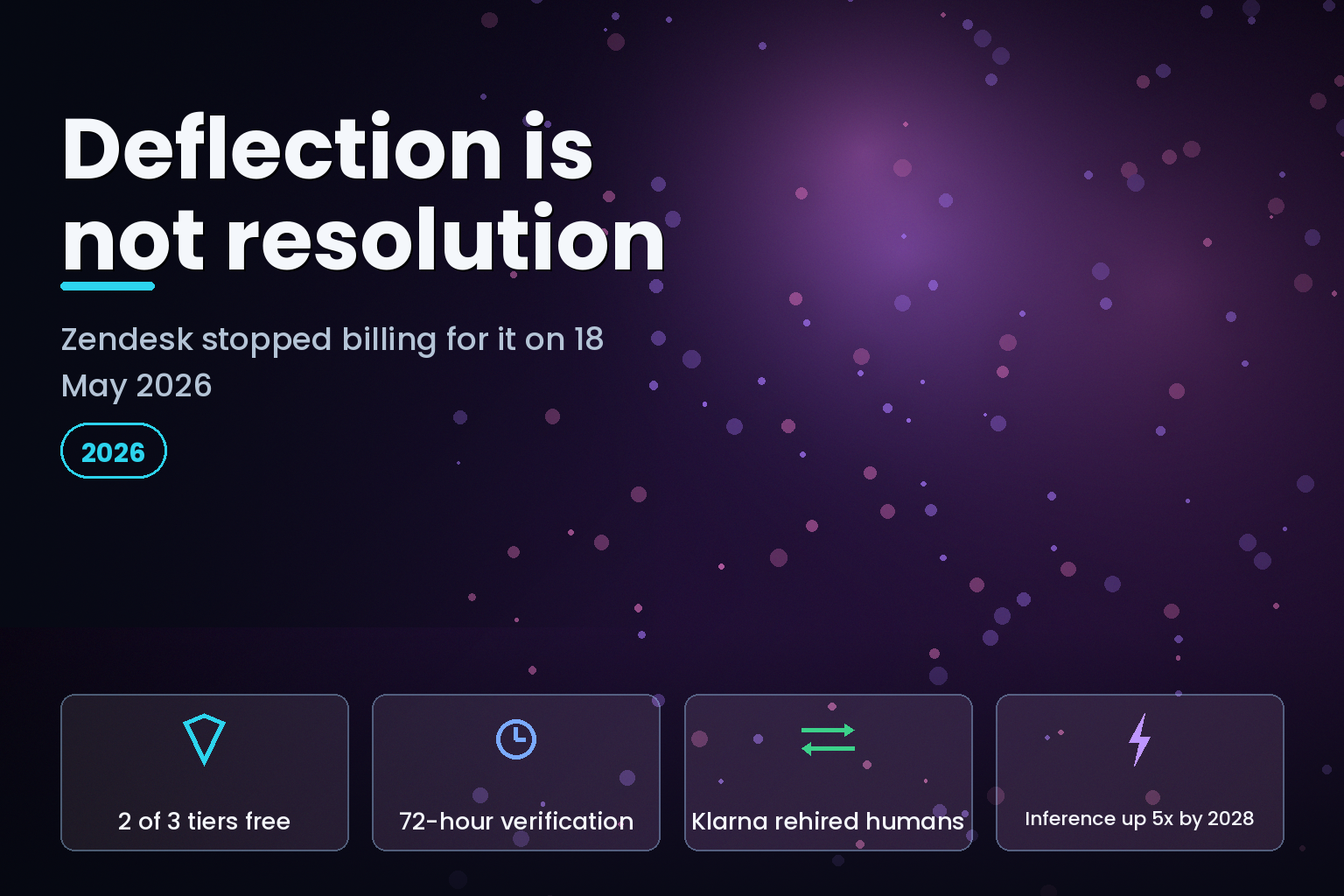
Summary. On 18 May 2026 Zendesk rebuilt its AI billing around three resolution tiers, and two of them are free. Assisted escalation, where the agent helped but a human finished, does not count against your allowance. Contained resolution, where the agent finished and the customer never came back, also does not count, unless a separate evaluation model confirms it within 72 hours. Only verified resolution is billed. A vendor declining to charge for deflection is the strongest evidence available that deflection and resolution are different events. Salesforce Agentforce, by contrast, bills $2.00 per conversation whether or not anything was resolved. Klarna ran 2.3 million chats through an AI assistant in its first month, reported roughly $40 million in annualised savings, then began rehiring human agents in May 2025. Gartner forecast on 17 August 2026 that inference cost per agentic workflow will rise more than fivefold through 2028. Five design patterns separate the deployments that keep the saving from the ones that only appear to.
A correction to an earlier version of this page
An earlier version of this article said an AI resolution costs about $0.62 against $7.40 for a human, with chat near $0.41, citing a McKinsey 2026 sample. It also gave median tier-1 deflection as 41.2% with a top quartile of 58.7%, and quoted satisfaction scores of 4.25, 4.1 and 4.3 credited to "2026 enterprise CX data."
None of those figures survives checking. There is no McKinsey publication by that name, and the dollar figures trace to a single aggregator post with no link. The deflection percentages and satisfaction scores had no named study behind them either. We have removed all of them and rebuilt the evidence from vendor rate cards and named primary sources. The AI agent unit economics analysis covers how that number cluster spread.
The argument the old version made was right. The numbers it used to make it were not.
The billing model already settled this argument
The cleanest proof that deflection is not resolution is that a major vendor stopped charging for it.
Zendesk's automated resolution tiers, introduced 18 May 2026, define three outcomes.
| Tier | What happened | Billed? |
|---|---|---|
| Assisted escalation | Agent collected data, authenticated or routed; a human resolved it | No |
| Contained resolution | Agent finished, customer did not follow up, verification did not confirm | No |
| Verified resolution | Agent resolved it and an evaluation model confirmed within 72 hours | Yes |
| Agentforce conversation | Any 24-hour session, resolved or not | Yes, $2.00 |
| Fin outcome | Conversation resolved without a human | Yes, $0.99 |
The middle row is the interesting one. A contained resolution looks like a success in every dashboard built on deflection: the agent replied, the customer went away, no ticket was created. Zendesk will not bill for it, because after a 72-hour window a large language model reads the conversation text and cannot confirm the request was satisfactorily resolved.
That is the deflection trap, priced. The customer who goes away because the answer was good and the customer who goes away because the answer was useless produce the same deflection number and different businesses.
Not every vendor draws the line there. Salesforce Agentforce bills $2.00 per conversation, defined as a 24-hour session, regardless of outcome, or $0.10 per action under Flex Credits. Freshdesk bills $0.10 per session, so one issue spanning four sessions bills four times. Fin bills $0.99 per outcome and charges nothing when a human finishes the job.
Read your contract for which unit it bills. It tells you what your vendor thinks it is selling.
1. Scope by intent, not by channel
What you point the agent at matters more than which agent you pick.
Automate by intent. Hand the AI tier-1 queries with a definitive answer and a short resolution path: order tracking, billing balance checks, password resets, shipping status, account updates. Keep disputes, fraud, hardship cases and nuanced complaints with people.
Salesforce's own worked example shows why the short path is where the economics live. Its "Where is My Order" scenario resolves in two actions, authenticate the customer and retrieve the order, for 40 Flex Credits or US$0.20. Add steps and the cost climbs linearly until, at 20 actions, it reaches the $2.00 conversation rate. Short, definitive intents are cheap. Long, judgement-heavy ones are not, and they are also the ones the agent resolves worst.
Scoping by channel, which usually means putting a bot on chat, mixes both classes of intent into one queue and drags the whole experience to the level of the hardest case in it.
2. Ground the agent in your systems
An agent that guesses is expensive, because a confident wrong answer produces a second contact, sometimes a refund, occasionally a lost customer.
Grounding means wiring the agent into the systems that hold the truth: the order-management system for order status, the billing system for balances, the knowledge base for policy. A bot bolted on as a chat overlay with no connection to those systems is the configuration most likely to generate a plausible answer that is wrong.
Grounding also changes what escalation means. An agent connected to the order system can say the parcel is in customs and offer a date. An ungrounded one can only say it will look into it, which is a deflection wearing a resolution's clothes, and under Zendesk's tiers it is the row that does not bill.
3. Design the escalation path first
Klarna is the public case study, and the lesson is in the sequence.
Klarna's AI assistant handled 2.3 million chats in its first month and the company reported roughly $40 million in annualised savings. In May 2025 it began rehiring human agents after customers reported generic answers and the system struggled with complicated cases. Chief executive Sebastian Siemiatkowski told Bloomberg: "As cost unfortunately seems to have been a too predominant evaluation factor when organizing this, what you end up having is lower quality."
The fix was structural. Confidence scoring so the system escalates rather than guesses when it is unsure, and generated handoff summaries so the human agent receives the conversation with context instead of asking the customer to start again.
Build that path before launch, not after the first bad quarter. A hard case that reaches a person smoothly still costs less than an all-human queue. A hard case that hits a dead end costs the customer.
4. Measure resolution and retention, not deflection
Teams that measure deflection get deflection, including the unresolved kind.
Salesforce's State of Service: AI Agents Edition, which surveyed 3,075 customer service professionals, found that after deploying AI agents the most improved KPI reported was customer satisfaction, ahead of rep productivity, average handle time, retention and first-response time. Seventy percent of adopting organisations reported measurable value within 60 days. Adoption of agentic AI in service rose from 39% in 2025 to 66% in 2026.
That is a useful correction to the assumption that these systems are bought for cost alone, and it points at the right dashboard. Five numbers belong on it.
Resolution rate, defined the way your contract defines it rather than the way your dashboard defaults to it. Follow-up contact rate for AI-handled interactions, which is the earliest signal that deflection is hiding unresolved demand. Cost per resolution rather than cost per contact, because a cheap contact that resolves nothing is not cheap. Satisfaction split three ways across AI-handled, human-handled and hybrid, because the gap between them is the quality signal. And escalation rate, which is unhealthy near zero, meaning the agent is guessing, and unhealthy near total, meaning it is resolving nothing.
If your vendor bills on verified resolutions, your dashboard should count the same event. Two definitions of resolution in one organisation guarantees an argument at renewal.
5. Run human review before you scale
Before opening the agent to all traffic, have people read a real sample of its answers, catch hallucinations and wrong escalations, and tune against them.
This is unglamorous and it is the step most often skipped under launch pressure. An agent can score its own interactions for quality, but a human sets the bar and judges the edge cases, and Zendesk's own model concedes the point by using a separate evaluation model rather than the agent's own judgement to decide what counts as resolved.
| Pattern | The principle | The failure it avoids |
|---|---|---|
| Scope by intent | Automate definitive tier-1 intents only | Judgement cases forced onto an agent |
| Ground in your systems | Wire into order, billing and knowledge base | Confident wrong answers and repeat contacts |
| Escalation path first | Confidence scoring plus context handoff | Dead-end chats and silent churn |
| Measure resolution | Track follow-ups and cost per resolution | Deflection that hides unresolved demand |
| Human review before scale | Read a real sample, tune, then expand | A hallucination discovered by customers |
Unit costs are not going to bail you out
Most three-year support-automation cases assume per-unit AI cost falls each year. Gartner's 17 August 2026 forecast says the opposite for agentic workloads: inference cost per agentic workflow will increase more than fivefold through 2028. Gartner calls it the Inference Paradox, better unit economics escalating the overall cost of AI without a clear pathway to commensurate and predictable value.
"Product leaders cannot rely on more efficient token economics to rationalize AI costs," said Will Sommer, Sr. Director Analyst at Gartner. "Each successive generation of AI capability will necessitate more, and often more expensive, tokens."
Gartner puts the gap between the two architectures directly: compared to a basic chatbot interaction, routing a task to an agentic reasoning model increases provider inference costs by at least five times, and more as task complexity grows.
The buying side is consolidating at the same time. Salesforce signed a definitive agreement on 15 June 2026 to acquire Fin, formerly Intercom, for approximately $3.6 billion, expected to close in its fiscal 2027 fourth quarter. The per-outcome and per-conversation models most shortlists weigh against each other are becoming one company's portfolio, which makes change-of-control and repricing terms worth more attention than a small difference in unit rate.
Scoping discipline is the durable lever. Rates change and vendors merge.
A disciplined first deployment
Pick three to five tier-1 intents with definitive answers and automate only those. Ground each one in the system that holds its truth. Build the escalation path with a confidence threshold and a context summary before going live. Run human review on a sample of real answers. Instrument resolution, follow-up rate and satisfaction from day one, using your contract's definition of a resolution.
Launch to a slice of traffic, hold it there for two weeks, and expand only when the follow-up rate stays flat.
The failed version puts a bot on every chat, grounds it in nothing, hides the human path and measures deflection. Our conversational AI agent patterns and AI customer experience use cases and ROI go deeper on the architecture, and the AI support agent build versus buy analysis covers the vendor pricing models in detail.
What it means for India
India runs a large share of the world's outsourced customer experience work, and two things change the calculation here.
Channel mix comes first. Support runs across WhatsApp, web chat and voice, often in more than one Indian language. Voice is priced differently wherever it is priced at all: an Agentforce voice action costs 30 Flex Credits against 20 for a standard action. A per-conversation model charges the same for a two-line WhatsApp exchange as for a long voice call, which penalises messaging-heavy volume.
Cost structure comes second. Human support costs less in India, so the absolute saving per ticket is smaller and the case rests on 24x7 coverage, consistency and peak absorption rather than labour arbitrage. A dollar-denominated per-conversation rate is also an FX exposure on a rupee support budget.
Consent is not optional. Under the Digital Personal Data Protection Act, 2023, consent applies to every stored conversation, including transcripts that a vendor's verification model reads. Zendesk's tier model has an evaluation model reading conversation text for up to 72 hours after the fact, so where that processing happens belongs in the data-protection review before signing, not after.
FAQ
How eCorpIT can help
eCorpIT (eCorp Information Technologies Private Limited, founded 2021, Gurugram) designs and builds AI customer-support deployments for B2B and D2C teams in India, the UK and the US. Our senior-led, CMMI Level 5, MSME-certified and ISO 27001:2022 certified teams scope by intent, ground agents in your order and billing systems, build the escalation path before launch, and instrument resolution against the definition your vendor contract actually bills on. We design data handling aligned with DPDP Act requirements. To scope a deployment, or to review an existing one against the five patterns above, contact us.
References
- About automated resolution tiers - Zendesk, tiers introduced 18 May 2026
- Salesforce Agentforce Pricing - Salesforce, page modified 31 July 2026
- Gartner Predicts AI Inference Costs Per Agentic Workflow Will Increase More Than Fivefold Through 2028 - Gartner, 17 August 2026
- Salesforce Signs Definitive Agreement to Acquire Fin - Salesforce, 15 June 2026
- New Research: AI Service Agents Improve Customer Satisfaction - Salesforce, n=3,075
- AI Customer Service Agent Pricing Comparison: The Complete 2026 Guide - Intercom, 8 July 2026 (vendor page positioning Fin)
- Klarna changes its AI tune and again recruits humans for customer service - CX Dive, May 2025
- Klarna Reverses AI Push, Says Customers Prefer Human Support - Forbes, 18 May 2025
- Klarna backtracks AI customer service plans - eMarketer
- Zendesk pricing - Zendesk, seat rates
- Zendesk Relate 2026: preparing for an outcome-based future built on verified resolutions - Diginomica
- Fin AI Agent - Fin, per-outcome pricing
_Last updated: August 22, 2026._