On this page · 9 sections
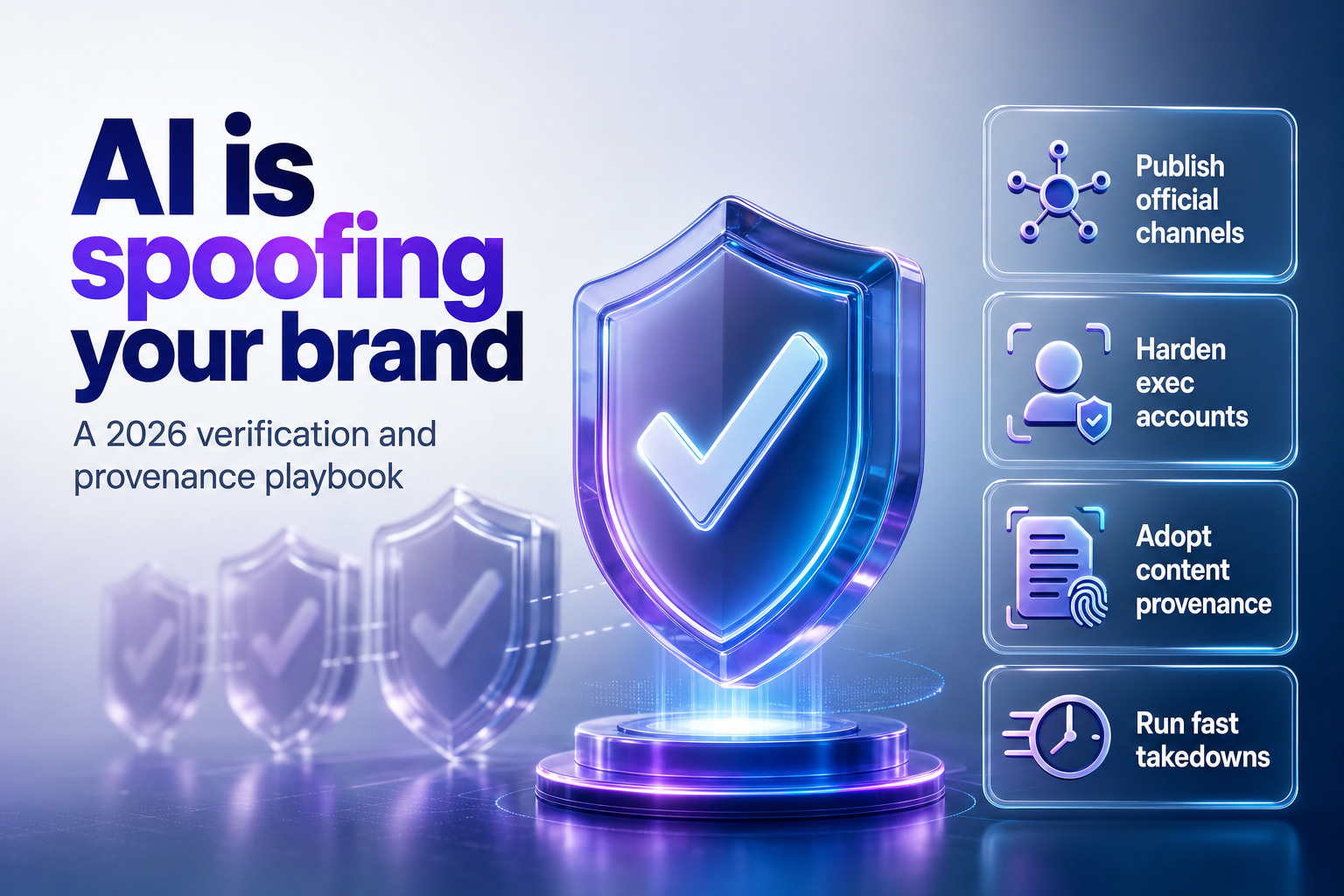
Summary. Generative AI has made brand impersonation cheap, fluent, and fast, and the numbers show it is now a mainstream risk. Deepfakes account for roughly 11% of global fraudulent activity in 2026, up from 0.1% in 2022, and an estimated 8 million deepfakes circulated online in 2025, a sixteenfold rise from around 500,000 in 2023. Deepfake fraud attempts rose about 700% globally year-on-year in Q1 2025. The money follows: US deepfake fraud losses reached $1.1 billion in 2025, and the deepfake-detection firm Pindrop estimates three in ten retail fraud attempts are now AI-generated. For a founder or marketer, the threat is fake ads, cloned landing pages, and executive impersonations that confuse customers and erode trust. The good news is that the defense is mostly proactive brand work you already know how to do: publish clear official channels, harden executive accounts, adopt content provenance like C2PA and SynthID, and prepare fast takedowns. This playbook lays out those steps, and shows how the same moves that stop impersonation also build the brand trust that Google and AI search now reward.
The mindset shift: the old warning signs are gone. Typos and clumsy phrasing used to flag a fake. AI removed them, so verification, not vibe-checking, is the defense.
The threat in numbers
Start with the scale, because it changes how seriously you resource this. The data across 2025 and 2026 is consistent: impersonation is no longer a fringe problem.
| Metric | Figure | Trend |
|---|---|---|
| Deepfakes as a share of fraud attempts | ~11% | 2026, up from 0.1% in 2022 |
| Deepfakes circulating online | ~8 million (2025 estimate) | Up ~16x from ~500,000 in 2023 |
| Deepfake fraud attempt growth | ~700% | Year-on-year, Q1 2025 |
| US deepfake fraud losses | $1.1 billion | In 2025 |
| Retail fraud attempts that are AI-generated | ~3 in 10 | Per Pindrop |
Those figures come from Sumsub's 2026 fraud trends, deepfake statistics compilations, and retail-scam analysis. Criminals now generate ads, landing pages, and fake websites that mimic real brands, often paired with deepfake influencer endorsements, which drives customer confusion, fraudulent orders, chargebacks, and brand erosion. The threat surface is your whole public identity, not one channel.
Step 1: publish and enforce official channels
The single most protective move is also the most basic: make it trivial for a customer to confirm what is genuinely yours. Inventory your official assets, meaning domains, apps, social accounts, support numbers, and approved partner lists, and publish them in one place people can check. Keep branding consistent across all of them. As brand-protection guidance for 2026 stresses, a brand that looks and sounds inconsistent is easier to imitate, because when customers are unsure what is official, fakes become more convincing by default.
This is also where brand protection and search visibility converge. Consistent official channels, verified accounts, and clear ownership are the same trust signals that answer engines weigh, a point we develop in our analysis of Google's 2026 trust-signal shift and the AEO versus GEO versus SEO guide.
Step 2: harden executives and train the teams around them
C-suite names are the highest-value impersonation targets, because a convincing fake founder or CFO can authorize payments or extract data. Two moves matter. First, harden the accounts: require unique passwords and two-factor authentication on every executive social profile, and audit lookalike account names across major platforms quarterly to catch clones before they are weaponized. Second, train the people attackers actually contact. Finance and HR are the usual targets of executive impersonation over direct message or messaging apps, and the rule to drill is simple: verify any payment or access request through a second channel, a call to a known number rather than a reply to the message, no matter how convincing the profile looks.
Step 3: adopt content provenance (C2PA and SynthID)
Provenance is the technical half of the defense: a way to prove a piece of media genuinely came from you, and to check whether something is AI-generated. Two standards lead, and they work best together.
| Standard | What it is | Coverage and note |
|---|---|---|
| C2PA Content Credentials | Cryptographically signed metadata about how a file was made | Emitted by OpenAI, Adobe Firefly, Microsoft Copilot, TikTok, Meta AI; can be stripped |
| SynthID | An imperceptible watermark in AI-generated media | In nearly all Google AI generations; 95% to 99% detectable after re-encoding |
| Layered approach | Combine signed metadata and watermarking | The industry's converged standard |
| Regulatory driver | EU AI Act Article 50 transparency rules | Enforcement begins August 2026 |
| Practical use | Sign your own media, check suspicious media | Prove authenticity, detect fakes |
The ecosystem matured quickly. OpenAI and Google have aligned on C2PA and SynthID, SynthID now covers close to 100% of Google's AI generations, and C2PA adoption is spreading across major platforms, pushed further by EU AI Act transparency rules taking effect in August 2026. For a brand, the practical play is to sign your own visual content with Content Credentials where your tools support it, so your real assets carry proof, and to use provenance checks when vetting suspicious media. Our piece on SynthID watermarks and content authenticity for marketers goes deeper on the marketing angle.
Step 4: prepare fast takedowns before you need them
Detection is only half the job; response speed decides the damage. Build the takedown machinery in advance: standard evidence packages, platform escalation contacts, and legal templates ready to go, with impersonation alerts wired into your ticketing and incident-response workflow under clear service levels, and cases tracked on a dashboard. The difference between a 24-hour takedown and a two-week exposure usually comes down to whether the playbook existed before the attack. Expand monitoring across every channel too, since trademark scams touch domains, paid ads, social profiles, and fake sites at once, and attackers simply route around single-channel coverage.
India-specific considerations
Indian brands face the same AI impersonation wave, amplified by scale and mobile-first audiences. A few local notes. WhatsApp and other messaging apps are common vectors for executive-impersonation payment fraud here, so the second-channel verification rule is worth drilling hard with finance teams. Publish official handles and support numbers prominently, because Indian consumers frequently verify a business through a quick search before transacting, and clear official channels both prevent fraud and feed the trust signals that improve search visibility. And with the DPDP framework tightening data-protection duties, treat an impersonation incident that exposes customer data as a potential breach with reporting obligations, not just a marketing problem.
FAQ
How eCorpIT can help
eCorpIT is a Gurugram-based technology and digital marketing organization, founded in 2021 and assessed at CMMI Level 5. Our senior-led teams help brands build the verification foundations that stop impersonation and improve search trust at once: consistent official-channel systems, hardened accounts, content-provenance workflows, and structured data that makes your real presence easy to confirm. Talk to our team for a brand-trust and AI-search visibility review.
References
_Last updated: 12 July 2026._