On this page · 7 sections
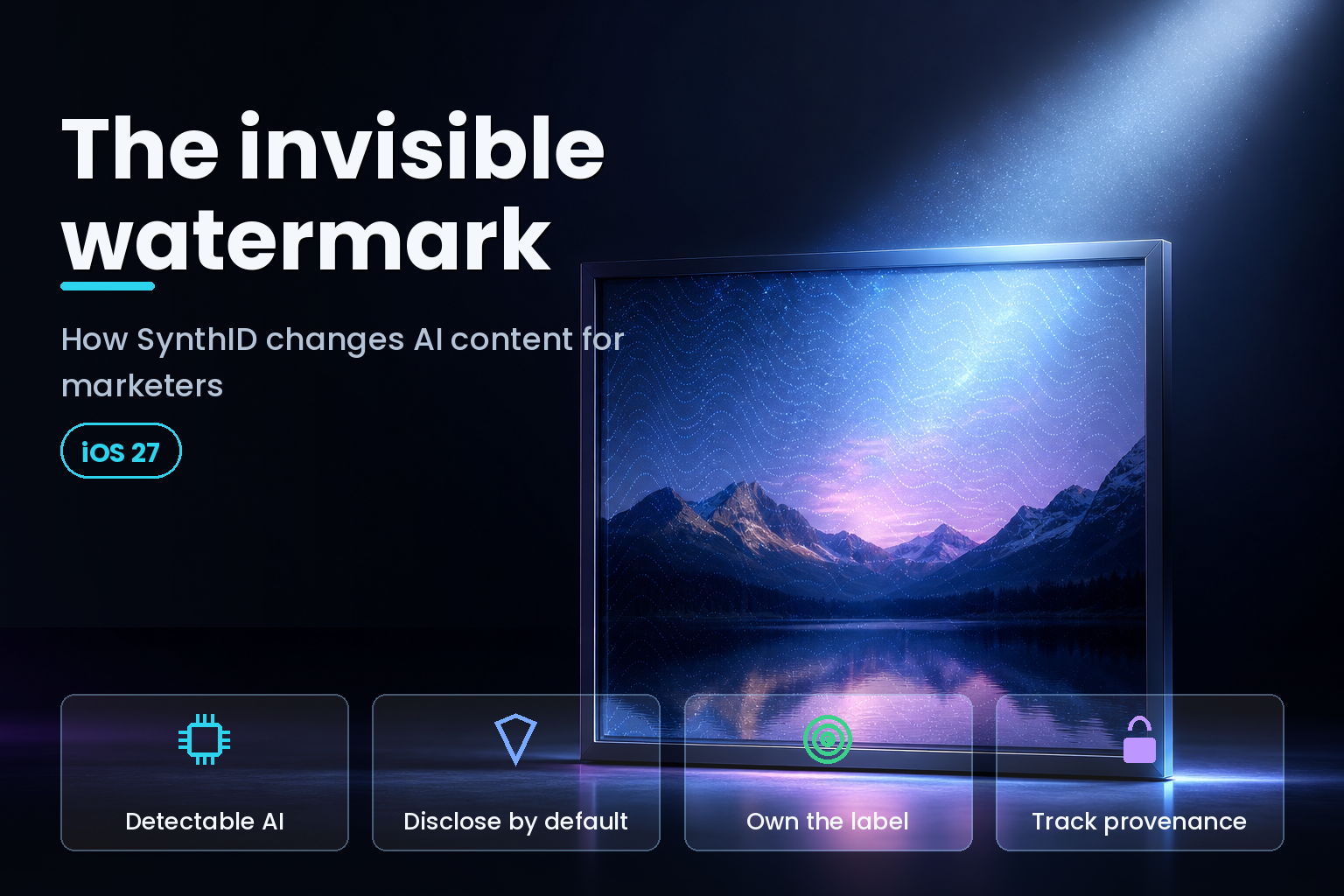
Summary. At WWDC 2026, Apple rebuilt Image Playground to make photorealistic images for the first time, and it added a hidden SynthID watermark to every one so they can be identified as AI-generated. That single change, shipping in iOS 27, drags AI content authenticity from a talking point into a workflow problem for marketers. SynthID is Google DeepMind's invisible watermark, now the default across Google's generative products and adopted by OpenAI across ChatGPT and its API on May 19, 2026. The timing matters because the rules are arriving at once: the EU AI Act's Article 50 transparency duties take effect on August 2, 2026, requiring AI outputs to be machine-readable and labelled, with fines up to €15 million or 3% of global annual turnover. The money in scope is not small either, with roughly $9.1 billion in AI-generated video ad spend globally in 2026, about 12% of US digital video advertising. This article breaks down five ways an invisible watermark on your phone changes how marketing teams make, label, and defend AI content.
What Apple actually shipped
Image Playground has been rebuilt. When it launched in iOS 18.2 two years ago, it made cartoonish, Pixar-style pictures. In iOS 27, iPadOS 27, and macOS 27, a far more capable model can generate images in any style, including photorealistic ones, and can edit existing photos from a natural-language prompt. The heavy generation runs on Apple's Private Cloud Compute rather than fully on-device, which keeps prompts encrypted while giving the model room to work.
Because photorealism invites deepfake misuse, Apple paired the upgrade with provenance. As iDrop News reported, Apple is "keeping folks honest by adding a hidden SynthID watermark that will identify them as AI-generated." It fits the company's trust-first framing of Apple Intelligence, which sits alongside the broader iOS 27 AI overhaul; as Apple's senior vice president of software engineering, Craig Federighi, put it at the keynote, "We believe privacy in AI is non-negotiable."
What SynthID is, in one minute
SynthID embeds an imperceptible signal into the pixels of a generated image, not into the file's metadata. That distinction is the whole point for marketers. Metadata such as a C2PA manifest is easy to strip: take a screenshot and it is gone. A SynthID signal lives in the image content itself, so it can survive common edits, re-compression, and screenshots that destroy metadata. The two systems are designed to work together, and both are spreading fast. SynthID now ships by default across Google's generative products and has marked billions of files since its 2023 launch, and Google signs its Veo and Imagen outputs with it.
| Feature | SynthID | C2PA content credentials |
|---|---|---|
| What it is | Invisible watermark in the pixels | Signed provenance metadata |
| Where it lives | Inside the image content | Attached to the file |
| Survives a screenshot | Often yes | No, the manifest is lost |
| Survives metadata stripping | Yes | No |
| Best role | A durable "this is AI" signal | Detailed origin and edit history |
5 ways this changes AI content authenticity for marketers
1. Your AI images now declare themselves
Any photorealistic image a team member makes in Image Playground on an iPhone carries a SynthID signal, whether or not they mention it. "Is this AI?" stops being a judgement call and becomes a detectable fact. Passing off AI output as an unedited photograph is now a losing bet, because detection tools can read the watermark after the fact.
2. Disclosure moves from optional to enforceable
The EU AI Act's Article 50 obligations apply from August 2, 2026. Providers of generative systems must mark outputs in a machine-readable format so they are detectable as AI, and deployers who publish AI content to EU users must label it clearly. This reaches any business serving EU audiences, not only EU companies, and Article 99 sets penalties up to €15 million or 3% of global turnover. Watermarks are what make non-disclosure visible.
3. Platforms will label your content for you
You may not get to choose whether your AI creative wears a label. Meta says it labels photorealistic images made with its own AI and labels images across Facebook, Instagram, and Threads when it detects industry markers such as C2PA metadata or invisible watermarks. As SynthID spreads, more platforms will auto-detect and badge AI content, which changes how that creative is perceived and can affect its reach. Better to control the disclosure than to have it applied to you.
4. Authenticity becomes a positioning choice
Once AI content is detectable, "made by a human" and "transparently AI-assisted" both become deliberate brand signals rather than defaults. Some D2C brands will lean into provenance, attaching content credentials and owning the fact that a visual is AI-made. Others will reserve human-shot photography as a premium marker. Either way, silence is no longer a neutral option, because the watermark answers the question for you.
5. You need a provenance workflow, not a policy PDF
Most marketing teams using AI have no formal disclosure process, which is the real gap these rules expose. The fix is operational: track which assets are AI-generated, preserve their content credentials, decide your disclosure standard per channel, and brief freelancers and agencies on it. Because SynthID survives the screenshots and re-saves that break metadata, you cannot assume an image is "clean" just because its file details look empty.
| The shift | What changes | What to do |
|---|---|---|
| Self-declaring images | AI is detectable after the fact | Stop treating AI output as untraceable |
| Enforceable disclosure | EU rules bite from Aug 2, 2026 | Label AI content for EU-facing campaigns |
| Platform labelling | Networks badge AI for you | Own the disclosure before they do |
| Authenticity as signal | Human vs AI becomes a choice | Decide your position per brand and channel |
| Provenance workflow | Metadata alone is not enough | Track assets, keep credentials, brief teams |
India-specific considerations
Indian marketers are not outside this. Any D2C brand or agency in Gurugram or elsewhere that runs campaigns reaching EU users falls under the EU AI Act's transparency duties from August 2, 2026, regardless of where the team sits. Domestically, India's advertising self-regulator ASCI already expects clear disclosure when ads are materially altered or misleading, and AI-made visuals fit squarely in that spirit. On the data side, India's Digital Personal Data Protection Act 2023 (DPDP) governs the customer data behind personalised creative, so consent and provenance should be designed together. The practical takeaway is the same everywhere: build a disclosure workflow now, because the watermark that proves an image is AI is already in the tools your team uses.
FAQ
How eCorpIT can help
eCorpIT helps marketing and D2C teams build AI content workflows that are fast and defensible. Our senior-led team sets up provenance tracking with SynthID and C2PA in mind, defines per-channel disclosure standards, and aligns campaigns with the EU AI Act and India's DPDP so a creative process does not become a compliance risk. To build an AI content authenticity workflow for your brand, talk to eCorpIT.
References
Last updated: July 7, 2026.