On this page · 12 sections
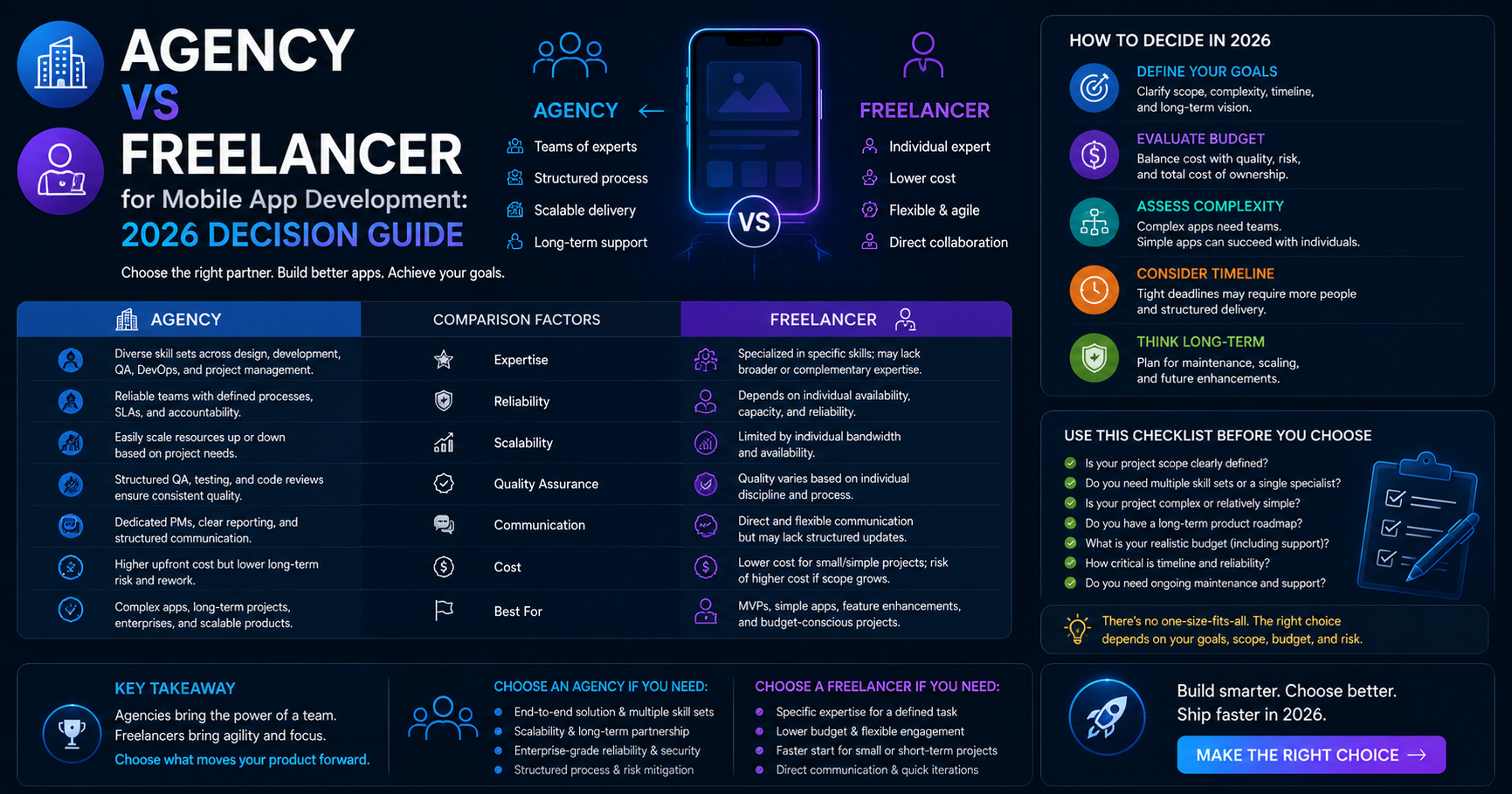
Summary. Hire a freelancer when your scope is narrow, your timeline is short, your budget is small, and you can absorb the risk if the freelancer disappears mid-project. Hire an agency when you need a multi-skill team (designer, PM, QA, DevOps alongside the engineer), IP and MSA discipline, named accountability that survives staff changes, and procurement-grade credentials. This guide gives you the six-criteria framework, the cost math at three scope levels, and the honest cases for each choice.
Talk to eCorpIT about a build · Open the cost calculator
The 2026 framing
Three options for getting a mobile app shipped in 2026 if you do not build in-house.
Freelance individual. One person, found through Upwork, Toptal, Lemon.io, LinkedIn, or a personal network. Direct relationship, lowest overhead, lowest cost per hour. Highest single-point-of-failure risk.
Freelance team or collective. A small group of freelancers operating together. Lower overhead than an agency, higher continuity than a single freelancer. Variable on contractual discipline and procurement-grade credentials.
Mobile app development agency. An organisation with a team of engineers, designers, QA, PMs, and DevOps under one operating model and one MSA. Higher cost per hour. Better continuity, IP protection, procurement-grade credentials, and named accountability.
For most builds above a $15K project budget, the agency model wins on the long-term math even at the higher per-hour rate. For specific narrow-scope builds below $10K or for one-off technical spikes, freelance can be the right call.
The six criteria that decide
Each maps to a question that determines fit.
1. Scope breadth. Does your build need just an engineer, or does it need a designer, PM, QA, and DevOps too? A single freelance engineer cannot competently cover all five roles. An agency packages them.
2. Risk tolerance. What happens if your freelancer disappears, gets sick, or pivots to a different client mid-project? Freelancers have no continuity guarantee. Agencies replace staff on the same MSA without scope reset.
3. IP and MSA discipline. Freelancers sign work-for-hire agreements but the contract enforcement and the IP-transfer mechanics vary. Agencies sign multi-page MSAs with state-jurisdiction clauses, work-for-hire transfer on payment, and source-repository discipline.
4. Procurement requirements. US enterprise, UK NHS-adjacent, Fortune 500 procurement, regulated-firm procurement: these need CMMI, ISO 27001:2022, D-U-N-S, GDPR alignment. Freelancers rarely hold these. Senior agencies do.
5. Named accountability. Mid-market and high-stakes builds benefit from a named delivery lead, a named architect, and a named founder or senior leader who reviews the work. Freelancers are accountable to themselves. Agencies have hierarchical accountability.
6. Cost ceiling. Below $10K total project budget, an agency may be too expensive at minimum-engagement levels. Above $15K, the agency's multi-role coverage typically pays back through faster shipping and lower scope-creep risk.
Cost math at three scope levels
Real comparison, with the honest trade-offs.
Narrow scope ($3K–$10K)
A single technical task: implementing a Stripe integration, building a specific screen, fixing a performance issue, OS-version compatibility update.
| Option | Cost | Timeline | Risk |
|---|---|---|---|
| Freelance senior (Toptal, Lemon.io) | $3K–$8K at $60–$80/hour | 2–4 weeks | Medium — single-point dependency |
| eCorpIT Hourly model | $4K–$10K at $44/hour | 2–4 weeks | Low — backup engineer, founder review |
For narrow scope, freelancers can win on per-hour rate. The agency model carries some overhead at this level.
MVP-scope ($15K–$35K)
A 6-10 week MVP build with multiple features, basic backend, design work, QA, and store submission.
| Option | Cost | Timeline | Risk |
|---|---|---|---|
| Freelance engineer + freelance designer | $12K–$25K total at $60–$80/hour engineering + $50/hour design | 8–12 weeks (more friction) | High — no PM, no QA, no continuity |
| Freelance team or collective | $18K–$30K | 8–12 weeks | Medium — depends on team discipline |
| eCorpIT fixed-price MVP | $8K–$25K, all-in (design + PM + QA + dev + submission) | 6–10 weeks | Low — named accountability, weekly demos |
For MVP scope, agency models typically win on total cost (because the multi-role coverage is bundled) and on timeline (because PM and QA are included from day one).
Full product build ($35K–$150K+)
12-20 week complex multi-role build with custom backend, payments, compliance overlay, integrations, and ongoing iteration.
| Option | Cost | Timeline | Risk |
|---|---|---|---|
| Freelance team or collective | $40K–$120K | 14–24 weeks | High — coordination overhead, IP discipline gaps, procurement disqualification |
| US agency | $80K–$300K | 14–24 weeks | Low — but expensive |
| eCorpIT Quarterly or Project | $35K–$150K | 12–20 weeks | Low — same procurement-grade credentials as US agency at India rate |
For full product builds, agencies clearly win. The risks of freelance coordination at this scope rarely pay back.
When freelancers clearly win
Five buyer situations where a freelancer is the right call.
Narrow single-feature build under $10K. A specific screen, a specific integration, a specific bug fix. Agency minimums often exceed the project budget.
Technical spike or proof-of-concept. A 1–2 week paid evaluation of whether a specific approach is feasible. Freelancers are well-suited; agencies often resist sub-minimum engagements.
Maintenance work with predictable monthly hours. A 20–40 hour monthly engagement for ongoing bug fixes and small features. A trusted freelancer at $60/hour costs less than an agency at $44/hour with 40-hour minimums.
Highly specialised skill the agency cannot match. A specific game engine, a specific cryptographic library, a specific niche framework. Top freelancers in narrow niches can be better than generalist agencies.
Direct founder-to-founder relationship. Some founders prefer working with one named senior engineer directly. The freelance model supports this; agency models intermediate the relationship.
When agencies clearly win
Five buyer situations where an agency is the right call.
Multi-role builds requiring engineering, design, PM, QA, and DevOps. Most MVP-and-above builds. Coordinating four freelancers on these roles is harder than hiring one agency.
Procurement requires CMMI Level, ISO 27001, D-U-N-S, and named references. Freelancers rarely hold these. Agencies must.
Stakeholder review and design-system discipline matters. Brand-led builds, regulated builds, enterprise builds. Agencies have repeatable review processes; freelancers vary.
Continuity over 6+ months matters. Freelancers move on. Agencies replace staff on the same MSA. For multi-year products, agency continuity wins.
Compliance-aware design (HIPAA, PCI-DSS, FCA, SOC 2) is required. The design discipline that makes the regulator's audit straightforward comes from repeat experience, not a single freelancer's last project.
The IP and MSA picture
The most-underestimated difference between freelancers and agencies.
Freelancer IP transfer. Standard work-for-hire contracts assign IP on payment. Enforceable in court. Practical enforcement requires the freelancer's cooperation post-engagement (assigning specific copyrights, transferring repository access, documenting trade secrets). When the freelancer has moved on, getting this cooperation can be slow or impossible.
Agency IP transfer. MSA with explicit work-for-hire clause, repository ownership under your account from day one, signed deliverables register, signed acceptance certificates per milestone. The IP transfer is procedurally enforced, not just contractually.
For builds above $15K, the agency IP discipline pays back the cost premium across the engagement lifecycle.
The procurement-grade credentials gap
Six certifications and registrations US, UK, and enterprise procurement teams ask for, with the typical freelancer-vs-agency reality.
| Credential | Freelancer typical | Senior agency typical |
|---|---|---|
| CMMI Level 5 appraisal | Not applicable to individuals | Held by senior agencies |
| ISO/IEC 27001:2022 | Not applicable to individuals | Held by senior agencies |
| ISO 9001:2015 | Not applicable to individuals | Held by senior agencies |
| D-U-N-S verified | Not typical | Standard for senior agencies |
| GDPR + UK GDPR + DPDP DPA boilerplate | Variable | Standard |
| Named US/UK reference clients | Variable | Standard for senior agencies |
For most enterprise procurement, the credentials gap is the deciding factor. Freelancers are not disqualified by being individual; they are disqualified by not holding the certifications procurement requires.
The hybrid model: agency + key freelancer
A useful pattern for some builds: agency for the multi-role core, freelancer for a specific niche skill.
Example: An agency runs the cross-platform MVP build with senior engineer, designer, PM, QA, and DevOps under one MSA. A specialist freelancer is engaged separately for 40 hours of advanced computer-vision integration that the agency does not have in-house.
The hybrid works when the boundary is explicit: the freelancer's deliverable is scoped, the IP transfer is documented, and the agency takes integration responsibility for the freelancer's output.
eCorpIT supports this pattern. We will tell you on the discovery call whether your specific build benefits from one specialist freelancer alongside the core team.
Frequently asked questions
A short closing note
The agency-vs-freelancer decision in 2026 has a clear answer for most builds. Freelancers win on narrow scope, tight budget, and specialised niches. Agencies win on multi-role coverage, IP discipline, procurement-grade credentials, and named accountability. The six-criteria framework above and the cost math at three scope levels give you the decision-making tools for your specific build.
If you want an honest senior read on which model fits your build, that is what we do.
Further reading
References
Page last reviewed by Manu Shukla, Founder, eCorpIT, on 30 May 2026. Next review: August 2026.