On this page · 14 sections
- What the iframe is, and why WordPress wants it
- What apiVersion 3 actually changes: nothing
- What actually breaks
- Third-party libraries, which is where the real time goes
- The two handbook pages disagree with each other
- The timeline, as documented
- What 7.0 actually changed, and the behaviour nobody mentions
- The opt-out, and why you should not reach for it
- How to test before 19 August
- What else lands in 7.1
- India-specific considerations
- How eCorpIT can help
- FAQ
- References
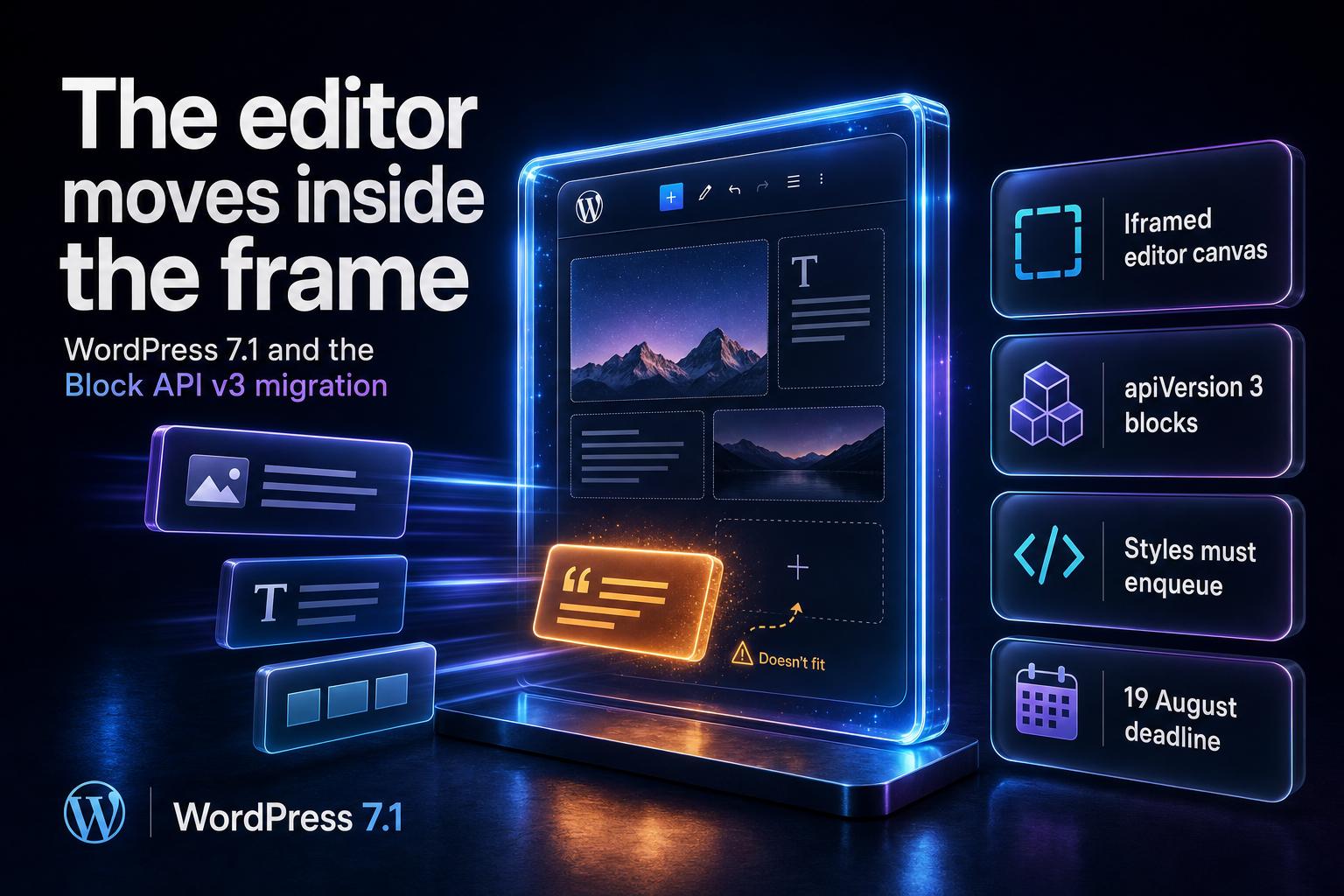
Summary. WordPress 7.1 is scheduled for 19 August 2026, and the release roadmap published on 19 June 2026 lists an "Enforced iframed editor" item: the plan is to enforce iframing for block-based themes in 7.1, then extend it to all themes in a future release. That has produced a round of posts telling plugin authors their blocks will break in August. The WordPress documentation says close to the opposite. The migration guide, last updated on 1 June 2026, states plainly that "Most blocks should work in the iframe editor without modification." Block API version 3, introduced back in WordPress 6.3, changes no API at all: unlike version 2, which made useBlockProps() mandatory in WordPress 5.6, version 3 is a declaration that your block is safe inside an iframe, not a new contract. The real work is narrow. If your block touches the global document or window, it needs a ref. If it does not, changing one field in block.json is the whole job. There is also a caveat worth reading before you plan a sprint: the 24 February 2026 dev note from Ella Van Durpe says in bold that the iframe is not enforced in WordPress 7.0 and "The timeline to enforce it has been revised in favor of a more gradual rollout", and the 7.1 roadmap carries its own warning that what it lists "doesn't necessarily mean each will make it into the final release". Two live handbook pages currently contradict each other on which release does this. Here is what is actually true, and how to test it this week.
What the iframe is, and why WordPress wants it
The block editor's canvas has historically rendered in the same document as the admin screen. That is why theme CSS has to be defensively prefixed, why vw and vh resolve against the browser window rather than the content area, and why media queries in the editor have needed workarounds.
Putting the canvas in an iframe fixes that class of problem at the root. The migration guide lists five gains: style isolation, so admin styles no longer affect editor content and block CSS no longer needs prefixing; viewport-relative units that resolve against the canvas; media queries that work "natively without needing workarounds, which were fragile"; easier development, because front-end styles can be dropped in largely unchanged; and better selection handling, since the editor content gets its own window and can hold a visible selection while a URL input holds a collapsed one.
Most editors already work this way. Per the 7.0 dev note, the site editor, template editor, all block, template and device previews are already iframed unconditionally. The post editor is the last holdout, and it is the one with the compatibility debt.
What apiVersion 3 actually changes: nothing
This is the part the panic posts get wrong, and it is worth being precise about because it determines how much work you have.
The handbook's API Versions page lists the full history. Version 1 was the initial version. Version 2, from WordPress 5.6, was a real breaking change: authors had to use useBlockProps() to render the block wrapper, and had to call useBlockProps.save() explicitly because class names and styles were no longer added automatically to saved markup. Version 3, from WordPress 6.3, adds no such requirement.
| apiVersion | WordPress | What the author must do |
|---|---|---|
| 1 | Initial | Nothing; original block contract |
| 2 | 5.6 | Use useBlockProps() and useBlockProps.save() |
| 3 | 6.3 | Declare the block iframe-safe; no API change |
Declaring version 3 tells the editor your block works inside an iframe. It does not change how your block is written. Nothing in your edit or save function has a new obligation. The docs are explicit that a block "may still be rendered outside the iframe if not all blocks support version 3".
So the migration, for the overwhelming majority of blocks, is this:
            {
  "$schema": "https://schemas.wp.org/trunk/block.json",
  "apiVersion": 3,
  "name": "my-plugin/my-block",
  "title": "My Block"
}
The guide confirms the shortcut: "All core blocks are already using apiVersion 3, so simply changing your apiVersion to 3 should allow your blocks to work in the iframe post editor."
That is the headline. Change the number, test, ship. The rest of this article is about the minority of blocks where that is not enough.
What actually breaks
One thing breaks, and it breaks for one reason. The migration guide states it directly:
"The iframe will have a differentdocumentandwindowthan the admin page, which is now the parent window. Editor scripts are loaded in the admin page, so accessing thedocumentorwindowto do something with the content will no longer work."
Your editor JavaScript runs in the parent admin page. Your block's DOM now lives in a different document. Every global reference silently points at the wrong one. Nothing throws; things just stop finding elements.
| Pattern in your block | Symptom inside the iframe | Fix |
|---|---|---|
document.querySelector() for block DOM |
Returns null or the wrong node | Use element.ownerDocument via a ref |
window.addEventListener('resize') |
Fires on the admin window, not the canvas | Use ownerDocument.defaultView |
document.addEventListener('click') |
Misses clicks inside the canvas | Attach via the element's ownerDocument |
jQuery plugin bound to document |
Silently does nothing | Pass the element reference in |
| Third-party lib using globals internally | Breaks with no error | Patch it or pass an element target |
Measuring with window.innerWidth |
Reads the admin viewport | Read from defaultView |
The fix pattern is a ref that gives you the element, from which you reach the correct document and window. The guide's recommended form uses useRefEffect from @wordpress/compose, because a plain useEffect callback will not re-run if the ref changes:
            import { useBlockProps } from '@wordpress/block-editor';
import { useRefEffect } from '@wordpress/compose';

export default function Edit() {
	const ref = useRefEffect( ( element ) => {
		const { ownerDocument } = element;
		const { defaultView } = ownerDocument;
		defaultView.addEventListener( 'resize', onResize );
		return () => {
			defaultView.removeEventListener( 'resize', onResize );
		};
	}, [] );

	const blockProps = useBlockProps( { ref } );

	return <div { ...blockProps }>Hello world!</div>;
}
The same shape works with useRef plus useEffect if you prefer, reading ownerDocument and defaultView off ref.current. The guide's own framing is worth keeping: "Regardless of the iframe, it is good practice to do this and avoid the use of globals." This is a code-quality fix that the iframe merely forces.
Third-party libraries, which is where the real time goes
Your own code is easy. A masonry layout, a lightbox, or a pan-zoom widget that reaches for document internally is where a two-hour job becomes a two-day job.
If the library accepts an element, pass it the ref and you are done. Scripts like jQuery load in the parent window, which the guide notes "is fine" as long as you hand it the element:
            const ref = useRefEffect( ( element ) => {
	jQuery( element ).masonry( /* … */ );
	return () => {
		jQuery( element ).masonry( 'destroy' );
	};
}, [] );
If the library reaches for globals internally and you cannot change it, the guide gives an escape hatch and immediately warns you off it: WordPress loads all front-end scripts inside the iframe, so you can reach them through defaultView, "but note that ideally you shouldn't use scripts loaded in the iframe at all". Those scripts load asynchronously, so you must guard for them and let the re-render bring you back:
            const ref = useRefEffect( ( element ) => {
	const { defaultView } = element.ownerDocument;

	// Scripts load asynchronously; the block re-renders once dependencies arrive.
	if ( ! defaultView.jQuery ) {
		return;
	}

	defaultView.jQuery( element ).masonry( /* … */ );
	return () => defaultView.jQuery( element ).masonry( 'destroy' );
} );
For a library you must fix yourself, the guide documents a patch-package workflow: edit the library in node_modules to replace global document and window with ownerDocument and defaultView derived from the element, then:
            npm add -D patch-package
npx patch-package @panzoom/panzoom
Add the postinstall hook and commit the generated patch file:
            {
  "scripts": {
    "postinstall": "patch-package"
  }
}
The documented example patches @panzoom/panzoom, swapping currentNode.parentNode === document for a comparison against the node's own ownerDocument, and rebinding its move and up pointer handlers from document to ownerDocument. The guide closes with the right instruction: "Even when patching works, prefer submitting an upstream issue or PR so the library supports iframe environments natively." A patch is a holding position, not a fix, and it is your maintenance burden at every upgrade. Teams that have been through the same exercise on other platforms will recognise the shape of it from the React Native new architecture migration.
The two handbook pages disagree with each other
If you have been confused about the timeline, it is not you. Two WordPress handbook pages currently state different things, and one of them is stale.
The API Versions page, last updated 8 December 2025, says: "In WordPress 7.0, the post editor is planned to always work as an iframe, regardless of the apiVersion of registered blocks."
The migration guide, last updated 1 June 2026, says the same sentence with a different number: "In WordPress 7.1, the post editor is planned to always work as an iframe, regardless of the apiVersion of registered blocks."
The 7.0 dev note settles it, in bold: "Please note that the iframe is NOT enforced in WordPress 7.0! The timeline to enforce it has been revised in favor of a more gradual rollout to allow more time and feedback."
The newer page is right and 7.0 shipped without enforcement. Treat the API Versions page's 7.0 claim as out of date. The wider lesson for anyone planning against a platform roadmap: check the last-updated date on the page before you plan a sprint against it, because handbooks drift. It is the same discipline we argued for reading the Interop 2026 web platform commitments.
The timeline, as documented
| Release | Iframe behaviour | Source |
|---|---|---|
| 6.3 | Post editor iframed if all registered blocks are v3+ | API Versions handbook |
| 6.9 | Console warning for v2 or lower; block.json schema allows only apiVersion: 3 |
Migration guide |
| 7.0 (shipped) | Condition checks blocks in the content, not all registered; not enforced | 7.0 dev note |
| 7.1 (19 Aug 2026) | Planned enforcement for block-based themes | 7.1 roadmap |
| Future | Extension to all themes | 7.1 roadmap |
The 6.9 detail matters and is under-reported: the block.json schema was updated to only allow apiVersion: 3, and registering a block at version 2 or lower logs a browser console warning. If you maintain blocks and have not looked at your console lately, look now.
What 7.0 actually changed, and the behaviour nobody mentions
WordPress 7.0's change was to the condition, not the enforcement. Per the dev note: "Instead of checking the registered blocks across all plugins, only the block API versions of blocks that are actually inserted in the post will now be checked. If all blocks inserted are version 3 or higher, the post editor will be iframed. If not, the iframe will be removed to ensure the lower-versioned blocks are guaranteed to work."
That is a meaningful improvement. Before 7.0, one stale block registered by any plugin on the site denied everyone the iframe. Now only what is actually in the post counts.
The consequence is the most interesting undocumented-in-the-panic-posts detail: the condition is live, not evaluated once at load. A contributor reported during 7.0 beta that creating a new post loads the editor in an iframe, and inserting a version 2 block switches the editor to non-iframed then and there. Aki Hamano confirmed it as expected behaviour in WordPress 7.0.
So today, in 7.0, your editor can change mode mid-session as an author inserts blocks. If you are chasing a bug that reproduces only sometimes, that is a candidate explanation.
Note also the fallback semantics, straight from the dev note's author: if not all blocks are v3, "the editor will not be iframed, so no blocks should be in a broken state". Today, a v2 block does not break. It removes the iframe. That is the whole reason enforcement is the event worth preparing for.
The opt-out, and why you should not reach for it
Buried in the migration guide is a sentence most coverage misses: "In summary, if you haven't been able to fully test your blocks in the iframe editor yet, by maintaining apiVersion 2, you can prevent the post editor from working as an iframe in most cases."
Staying on version 2 is a deliberate, documented brake. It is legitimate as a holding position while you test.
It is a bad plan past August. Holding at version 2 means every author on that site loses the iframe, and therefore loses the correct vw, vh and media-query behaviour that block themes are increasingly written against. You are not protecting your block; you are degrading the editor for everyone else's. And once enforcement lands for block themes, the brake stops working and you find out what you deferred.
There is one asymmetry worth knowing if you test with the Gutenberg plugin active: per the migration guide, with the plugin enabled the editor is always iframed, and per the dev note the plugin extends enforcement to classic themes from Gutenberg 22.6, explicitly to gather feedback before core attempts it. That is a feature for you. The plugin is the closest thing to a preview of enforcement that exists.
How to test before 19 August
Testing this takes an afternoon, not a sprint.
Install and activate the Gutenberg plugin on a staging site. Per the documented behaviour, the editor is then always iframed, which is exactly the state 7.1 is heading toward. Insert every block your plugin registers, on both a block theme and a classic theme.
Watch the browser console for the version 2 registration warning that WordPress 6.9 added. It tells you which of your blocks are not declared yet.
Exercise the interactive paths specifically, because static blocks almost never break. Anything that measures, drags, observes resizes, binds document-level events, or initialises a third-party widget is where the failures live. Static content and standard block supports are fine.
Then flip apiVersion to 3 in each block.json, rebuild, and repeat. If a block misbehaves, the cause is almost always a global reference; search your source for document. and window. and convert those call sites to a ref. If you build blocks with an npm toolchain, remember the supply-chain side of the same build: we wrote about npm v12's install-script approval defaults in our guide to npm v12 install-script approval in CI/CD.
One planning caution. The 7.1 roadmap states, in bold: "As always, what's shared here is being actively pursued, but doesn't necessarily mean each will make it into the final release of WordPress 7.1." Enforcement has already slipped once, from 7.0. Do the migration because it is a day of work and it improves your code. Do not build a client communications plan around 19 August as a hard cutover date, because the WordPress project has not promised one.
What else lands in 7.1
The iframe is one item on a large release. Three others will reach plugin authors.
The Classic block is planned for deprecation, with TinyMCE no longer loaded by default when it is not needed, and the freeform block moving into its own package. If your product assumes TinyMCE is present in the editor, test that assumption.
WordPress is upgrading from React 18 to React 19, landing in the Gutenberg plugin first with an eventual pathway to core. There is a "React 19" experiment on the Gutenberg experiments page, and the project is asking plugin and theme developers to test early.
The Icon API opens to third parties with register_icon() and unregister_icon(), core-icons theme support, SVG sanitisation and namespace validation, and collection support similar to the Font Library. New core blocks are slated too, including Playlist, Table of Contents and Tabs, which is worth checking against your plugin's feature list before you sell the same thing.
India-specific considerations
For agencies in Gurugram, Bengaluru and Pune maintaining WordPress estates for United States and European clients, the practical exposure is not the code. It is the fleet.
An agency carrying 40 client sites is running the same audit 40 times, mostly against third-party plugins it did not write. The efficient order is to inventory which blocks each site actually uses, which the 7.0 in-content condition now makes the relevant question, then chase only the plugins those blocks come from. Sites on classic themes are not in the 7.1 scope as documented, which buys real time.
Where client sites process personal data, the editor change is neutral, but any plugin audit is a reasonable moment to also check what your plugins send where, given the Digital Personal Data Protection Act 2023 makes the site operator the Data Fiduciary rather than the plugin vendor.
How eCorpIT can help
eCorpIT is a CMMI Level 5 certified, MSME-registered engineering organisation in Gurugram, founded in 2021, with senior-led multi-disciplinary teams. We audit and migrate WordPress block plugins and theme estates for agencies and product teams: inventorying which blocks each site actually uses, converting global document and window access to refs, upstreaming or patching third-party libraries that assume a single document, and testing against the Gutenberg plugin so you see enforcement behaviour before it ships. It is usually a smaller job than it looks, and we will tell you if it is. If you maintain a fleet of client sites and want a straight assessment of your exposure ahead of 7.1, talk to our team or read more about our custom web application development work.
FAQ
References
- Roadmap to 7.1. Posted by @annezazu, Make WordPress Core, 19 June 2026.
- Migrating Blocks for iframe Editor Compatibility. Block Editor Handbook, last updated 1 June 2026.
- Iframed Editor Changes in WordPress 7.0. Ella Van Durpe, Make WordPress Core, 24 February 2026.
- API Versions. Block Editor Handbook, last updated 8 December 2025.
- Preparing the Post Editor for Full iframe Integration. Make WordPress Core, November 2025.
- Blocks in an iframed (template) editor. Make WordPress Core, 29 June 2021.
- Gutenberg PR #75187: check inserted blocks for the iframe condition. WordPress/gutenberg.
- Gutenberg PR #75475: iframe enforcement for classic themes. WordPress/gutenberg.
- React 19 upgrade in WordPress. Make WordPress Core, 27 May 2026.
- Classic block deprecation tracking issue. WordPress/gutenberg.
- Icon API iteration issue. WordPress/gutenberg.
- What's new for developers (July 2026). WordPress Developer Blog.
- The Digital Personal Data Protection Act, 2023. Ministry of Electronics and Information Technology, Government of India.
Last updated 17 July 2026.