On this page · 10 sections
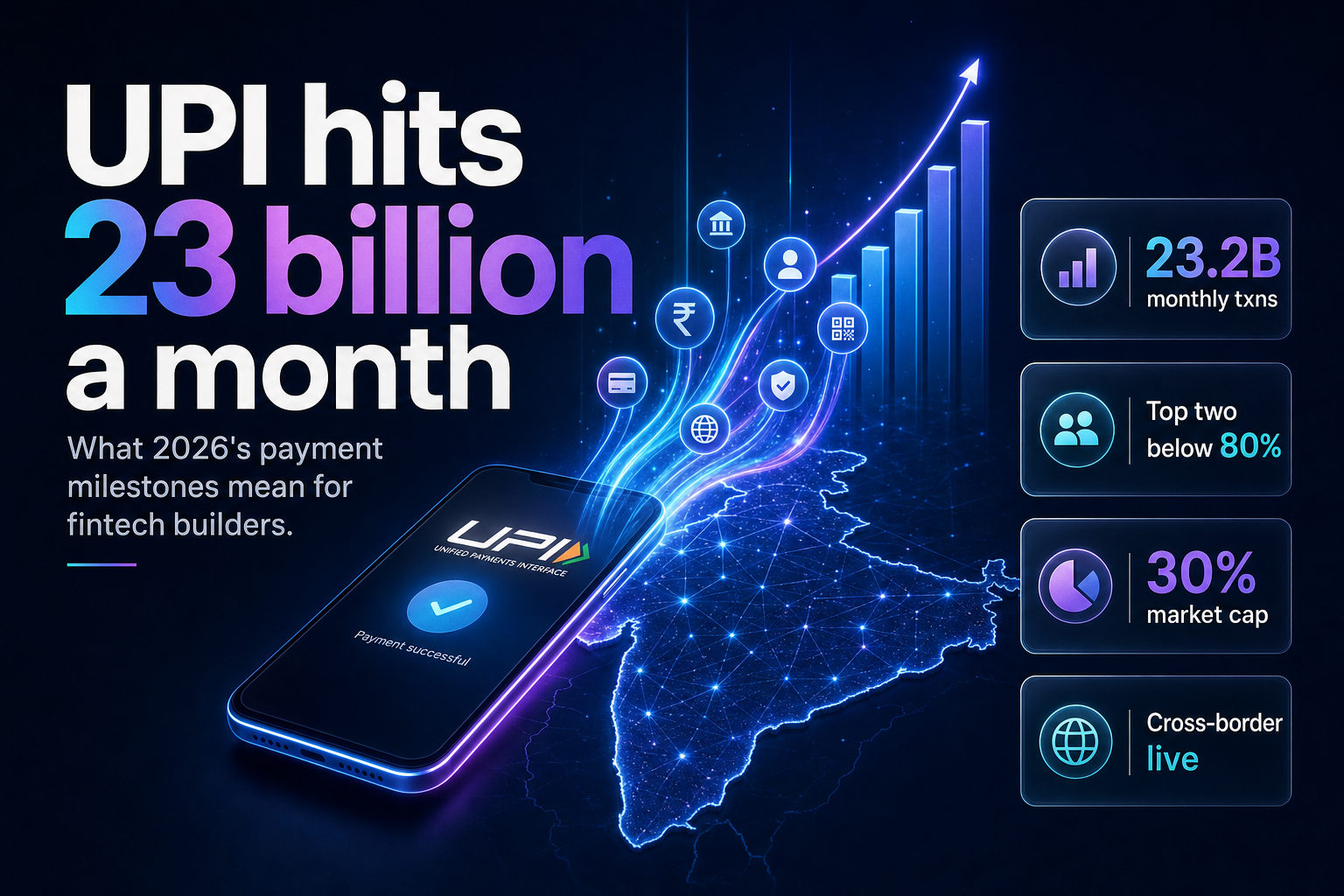
Summary. UPI processed 23.2 billion transactions worth ₹29.9 trillion in May 2026, its highest month on record. In the same month, the combined share of PhonePe and Google Pay slipped below 80 percent, to about 79 percent, for the first time, as smaller apps gained ground. The NPCI cap that limits any single third-party app to 30 percent of UPI volume now takes effect on December 31, 2026, and from 2027 apps must hold volume under 30 percent on a rolling three-month basis. For fintech founders and product teams, three forces are converging at once: record scale, a regulated ceiling on the incumbents, and Credit Line on UPI opening a new product surface. Here is what each one means for what you build.
The scale milestone
The headline number is simple and large. UPI crossed 23.2 billion transactions in a single month, worth ₹29.9 trillion, in May 2026. That volume is the backdrop for every other decision: any product you attach to UPI inherits a rail that already runs at national scale, and the constraint is no longer reach but differentiation. The frontier, as one industry framing put it, is moving from transaction infrastructure to decision infrastructure, meaning the value shifts to what you do around the payment, not the payment itself.
The 30% cap and why it matters
UPI concentration has been a policy concern since 2020. Historically PhonePe and Google Pay together held over 85 percent of the market, with PhonePe near 47.8 percent and Google Pay near 37 percent as of late 2024, both far above the proposed 30 percent ceiling. NPCI has repeatedly extended the deadline, and it now stands at December 31, 2026. From 2027, a third-party app provider must keep its transaction volume under 30 percent of total UPI volume, measured over the previous three months on a rolling basis.
The practical read for builders: the regulator is deliberately making room below the incumbents. A well-built challenger app has a policy tailwind it did not have in 2020, but it also inherits the same fraud, trust and unit-economics problems that make payments hard.
| Metric | 2026 figure | Note |
|---|---|---|
| Monthly transactions (May 2026) | 23.2 billion | Highest ever |
| Monthly value (May 2026) | ₹29.9 trillion | Highest ever |
| Top-two combined share | Below 80 percent (about 79 percent) | First time, May 2026 |
| TPAP market-share cap | 30 percent | Deadline December 31, 2026 |
| Countries where UPI is live | 10 | Includes Nepal, France and Greece |
The market is already diversifying
The May 2026 dip below 80 percent is early evidence the cap conversation is reshaping behaviour before the deadline. Smaller apps, including BHIM, Navi and super.money, have taken share. For a product team, that is distribution opportunity: users are, for the first time in years, willing to try a third or fourth UPI app, which lowers the cost of acquiring them to a differentiated experience rather than a cheaper one.
Credit Line on UPI: the real builder surface
The most important product shift is not the cap, it is credit. Credit Line on UPI lets banks extend short-term credit lines that a user spends through the same UPI app they already use, and by 2026 most major banks are expected to offer it across savings, overdraft and co-lending channels. The RBI is standardising UPI credit rules to align with base-loan norms. For fintechs, NBFCs and PSPs, that opens embedded, contextual credit at the point of a UPI purchase, including compliant buy-now-pay-later without third-party shadow lending. Payments were the platform; credit is the business model. If you build fintech apps, this is where the 2026 roadmap should point. Our list of fintech app development priorities covers the build side.
| Shift | Opportunity for builders | Watch-out |
|---|---|---|
| 30 percent cap on top apps | Room for a differentiated challenger app | Compliance and scale economics |
| Credit Line on UPI | Embedded, contextual credit and BNPL | RBI credit rules; lending partnerships |
| Market diversifying | New distribution for niche apps | Fraud and trust controls |
| Cross-border UPI | Remittance and travel-payment apps | Multi-country rails and forex |
| RBI fraud safeguards | Safer rails raise user trust | Build fraud tooling from day one |
Cross-border and the rails underneath
UPI is now live in ten countries, including Singapore, the UAE, Nepal, France and Greece, with a direct India-Nepal linkage for real-time remittances and acceptance at merchants such as Galeries Lafayette in France. For builders, cross-border acceptance turns UPI from a domestic rail into a remittance and travel-payments surface, though each corridor adds its own compliance and settlement work.
India-specific considerations
The rules around UPI keep tightening in ways builders must design for. Most person-to-person and person-to-merchant payments are capped at ₹1 lakh, with some merchant categories allowed up to ₹5 lakh, and the RBI has been exploring higher limits for select merchant use cases. The RBI has also proposed a customer-activated kill switch that lets users instantly disable all their digital payment channels — UPI, IMPS and NEFT — set out in its April 2026 discussion paper and not yet notified, and it recognised Sahamati as the self-regulatory organisation for the Account Aggregator ecosystem, which matters for any app using consented financial data. Handle that data under the Digital Personal Data Protection Act, 2023 from the first line of code.
What to do this quarter
If you are building on UPI, stop competing on being a cheaper wallet and start competing on a decision or a credit moment the incumbents do not own. Scope a Credit Line on UPI integration with a bank or NBFC partner, design fraud controls in from the start rather than bolting them on, and build consent and data handling to DPDP and Account Aggregator standards. The rail is done; the product is yours to define.
FAQ
How eCorpIT can help
eCorpIT is a Gurugram-based, CMMI Level 5 consultancy that builds fintech and payments apps for the Indian market. Our senior engineers ship UPI integrations, Credit Line on UPI and Account Aggregator flows, and fraud tooling, designed aligned with RBI and DPDP requirements rather than claiming certification. If you are planning a UPI or embedded-credit product for 2026, talk to our team.
References
- NPCI extends 30% UPI market share cap deadline on third-party apps to December 2026 - Business Today.
- NPCI extends UPI market share cap deadline to 2026 - MediaNama.
- India extends UPI market share cap deadline by two years - Electronic Payments International.
- Fintech 2026: why Credit Line on UPI will reshape the entire ecosystem - IBS Intelligence.
- Credit Line on UPI: how it works now - Billcut.
- RBI news updates, July 2026 - Banking Finance.
- The profit era has begun: who wins Indian fintech - India Fintech.
_Last updated: July 10, 2026._