On this page · 14 sections
- What changed in GBP for 2026 — the AI era
- The six ranking signals that actually move the needle in 2026
- The 25-step Google Business Profile optimisation checklist
- The four common mistakes that block 80% of local visibility
- Comparison table — Old vs new GBP ranking landscape
- How to optimise for the AI Overview local pack
- Multi-location considerations
- Comparison table — GBP and local SEO tools landscape (2026)
- The 90-day GBP optimisation sprint
- Comparison table — India-specific citations to build alongside GBP
- How eCorpIT applies this for our own GBP
- FAQ
- How eCorpIT can help
- References
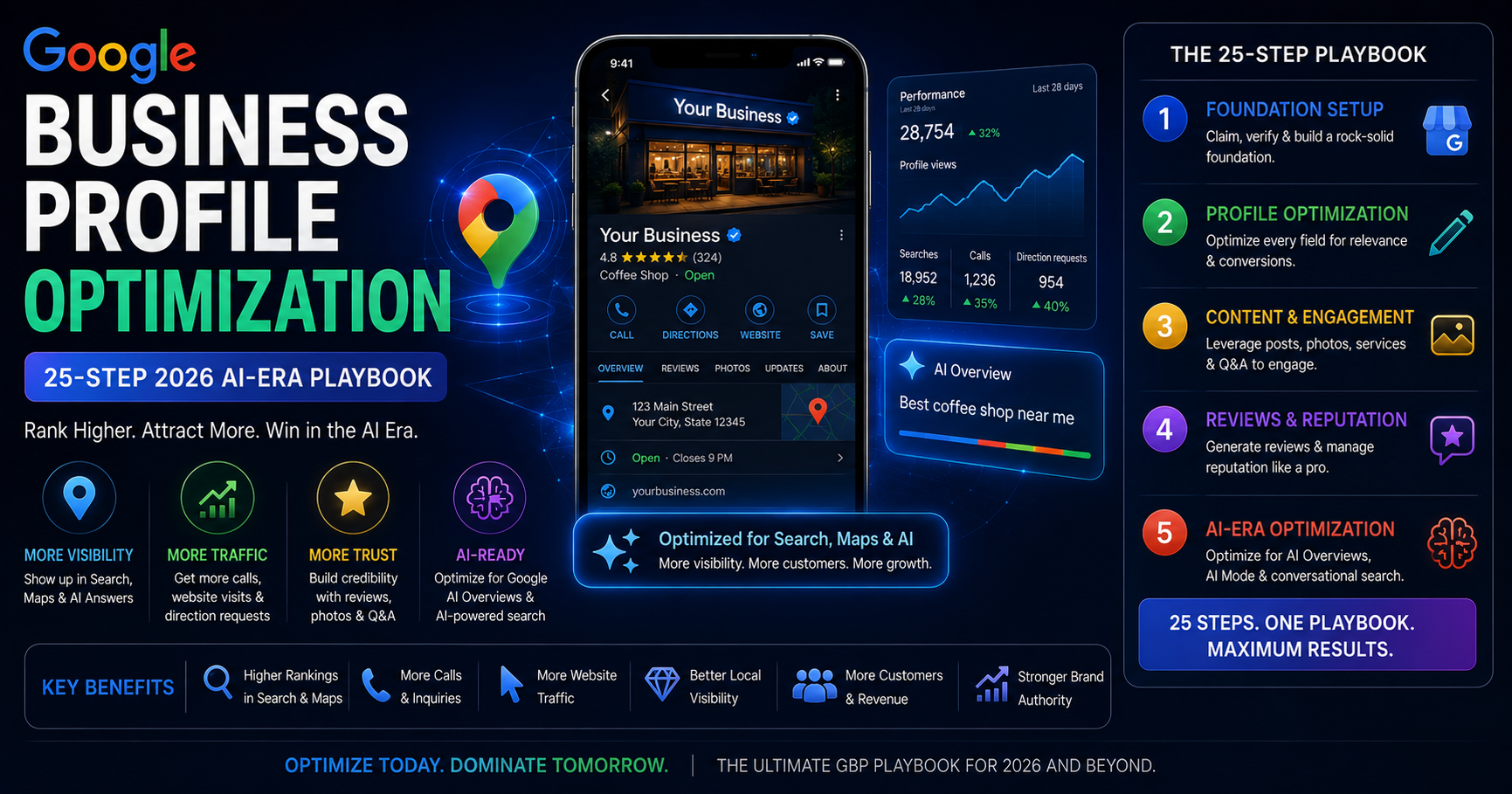
Summary. Google Business Profile (GBP) rules changed materially in 2026. Google's AI Overview local pack now shows on roughly 8% of local queries (rising fast), and AI Overviews appear on approximately 15% of all Google searches — up from about 6% in early 2024. Some local businesses are seeing 50%+ drops in visibility as the traditional three-pack gives way to AI-curated summaries that often surface only one or two businesses. The fix is not a checklist of one-time edits. It is a sustained operational discipline: primary category (the single biggest control lever, accounting for roughly 32% of relevance ranking), review cadence (last-90-day reviews now carry significantly more weight than older ones), photo density (profiles with 100+ photos generate 520% more calls than profiles with fewer than 10), regular GBP posts (a minimum of 2-3 per month — 30+ days of silence triggers visibility loss), and a complete products and services catalogue (Google Maps AI pulls directly from these to answer Ask Maps queries). A well-optimised GBP can generate 5-15 calls per day for active Gurugram businesses at zero ongoing cost. This article is the working 2026 playbook — the 25-step checklist, what changed in the AI era, the four common mistakes that block 80% of local visibility (duplicate listings, NAP inconsistency, primary-category errors, empty service descriptions), the 90-day optimisation sprint, three comparison tables and India-specific citation tactics.
The honest framing for 2026: GBP is no longer a "set it once" surface. It is a content channel that needs weekly attention. Businesses that treat it that way win the local pack and the new AI Overview local results; businesses that treat it as a static listing lose meaningful traffic to competitors who post weekly, refresh photos monthly and maintain a current review cadence.
This guide is built for local-business owners, marketing leads at growth-stage companies, agency teams handling multi-location clients, and operations managers responsible for service-area visibility. eCorpIT operates from 1120, 11th Floor, SVH 83 Metro Street, Sector 83, Gurugram, Haryana 122012 — we work daily with GBP optimisation across Indian, US and UK clients. Research draws on Google Business Profile Help, Local Falcon, BrightLocal, the Search Engine Journal coverage of dynamic GBP, Map Ranks, Local Mighty, Digital Applied and Indian-market reporting from DecodeGrowth and Mayank Digital Labs.
What changed in GBP for 2026 — the AI era
Four shifts that reshape every local optimisation plan.
1. AI Overview local pack. Started appearing in late 2025; expanding rapidly through 2026. The AI summary now replaces the traditional three-pack for many search queries, often featuring only one or two businesses instead of three with phone numbers and call buttons. AI-powered local packs appear on approximately 8% of local keywords and climbing. Businesses outside the AI summary face meaningful visibility loss — early data shows some experiencing 50%+ visibility drops on affected queries.
2. Ask Maps (Gemini-powered conversational search). Rolled out in March 2026. Users ask Google Maps conversational questions ("Find me a quiet coffee shop good for working" or "Where can I get a same-day phone repair in Gurugram") and receive AI-generated recommendations. Ask Maps pulls from your GBP service catalogue, reviews, posts, photos and Q&A — not just the basic profile fields. Incomplete profiles get summarised by AI from inferred sources; complete profiles get cited as the canonical answer.
3. AI auto-generated descriptions, menus and service details. Google now uses AI to fill profile gaps automatically, pulling from your website, reviews and other online sources. The implication for businesses: the AI fills the void if you do not — and the AI's version may include inaccuracies you cannot easily edit. Complete profiles preserve editorial control.
4. Know Before You Go. AI-generated summaries about a business appear in Google Maps before a user visits, drawing from reviews, Q&A, photos and business information to surface wait times, popular items, accessibility details and atmosphere. Optimising the source material (especially reviews and Q&A) directly shapes what Know Before You Go shows.
The composite effect: GBP rewards businesses that feed Google fresh, structured, complete information weekly. Static profiles lose ground regardless of historical rankings.
The six ranking signals that actually move the needle in 2026
Google's stated three pillars remain relevance, distance and prominence. The operational decomposition for 2026 looks like this:
| Signal | Approximate weight | What you control |
|---|---|---|
| Primary category | ~32% of relevance | The single biggest dial — choose the narrowest accurate category |
| NAP consistency (Name, Address, Phone) | Foundation signal | Identical across website, social, citations, GBP |
| Review profile (count + recency + sentiment + keywords) | #1 ranking factor in 2026 | Steady cadence (5-15+ reviews/month), 90-day recency weight |
| Profile activity (posts, photos, engagement) | 1.4x lift on top-3 local pack vs dormant | Weekly posts, monthly photo refresh |
| Service catalogue + products | Powers Ask Maps + AI Overview | Complete service list with detailed descriptions |
| Behavioural signals (clicks, calls, direction requests, conversion) | Growing weight in 2026 | Profile quality drives engagement → engagement drives ranking |
Two operational implications. First, the primary-category decision is more consequential than any other on-profile edit — switching a "Mobile App Development Company" to "Mobile Phone Repair Shop" would change visibility more than any other change. Choose the narrowest accurate category. Second, behavioural signals are now a real ranking factor — a profile with good answers, complete photos, recent reviews and active posts gets more clicks, calls and direction requests, which in turn lifts the ranking. The flywheel is real.
The 25-step Google Business Profile optimisation checklist
A complete sequence to run end-to-end on any business profile.
Foundation (steps 1-6)
- Claim and verify the listing. Use Google Business Profile Manager. Verification can be postcard, phone, email, video or instant Google Workspace — choose whichever Google offers for your category. For multi-location businesses, stagger verification submissions — submitting many at once can trigger spam detection.
- Audit for duplicate listings. Search the business name + variations. Search the phone number. Search the address. If duplicates exist, follow Google's duplicate listing removal process. Duplicates split signal and frequently rank lower than a single canonical profile.
- Lock NAP consistency. Verify identical Name, Address, Phone across the website, Google Business Profile, all social profiles, all local directories, all citations. Even small variations ("Suite" vs "Ste," "11th Floor" vs "11F") fragment trust signal.
- Choose the correct primary category. This is the single most important decision — roughly 32% of relevance ranking. Pick the narrowest category that accurately describes what you do. "Mobile App Development Company" beats "Software Company"; "AI Consulting" beats "Information Technology Service."
- Add 5-10 relevant secondary categories. Google allows up to 10 total categories. Each one expands the surfaces you can appear in without diluting primary-category strength.
- Complete every profile field. Hours, attributes, products, services, descriptions, opening date, payment methods, accessibility features. Empty fields invite AI auto-generated content from inferred sources — content you cannot easily edit.
Content and credibility (steps 7-13)
- Write a 750-character business description. Lead with the most important keyword phrase. Include city, primary service, and one strong differentiator. Avoid keyword stuffing — Google will rewrite obvious stuffing.
- Upload 30+ photos at launch, then 3+ new photos per week. Profiles with 100+ photos generate roughly 520% more calls than profiles with fewer than 10. Photo categories: exterior, interior, team, work in progress, finished projects, products, behind-the-scenes. Geo-tag photos to the business address.
- Add a complete service list with detailed descriptions. Each service gets its own entry with a description of 150-300 characters. Detailed service descriptions power Ask Maps and AI Overview citations.
- Add products where applicable. Product entries directly feed AI Overview answers in 2026. Each product has a name, description, photo and price (or price range).
- Set up booking (where applicable). Connect to a booking partner so users can book directly from the profile.
- Add attributes specific to your category. Wheelchair accessibility, women-led, LGBTQ-friendly, has WiFi, accepts credit cards, etc. Attributes increase profile completeness and surface in AI-generated descriptions.
- Add Q&A entries proactively. Don't wait for users to ask. Ask and answer 10-15 common questions from your own perspective using a Google account so they show as business-answered. The Q&A section feeds Know Before You Go and Ask Maps.
Reviews (steps 14-17)
- Implement a review request system. Email, SMS, QR code on receipts, or post-service follow-up. Aim for 5-15 new reviews per month as a baseline — review velocity over 90 days now beats sudden bursts followed by silence.
- Respond to every review within 24-48 hours. Both positive and negative. Response rate is a public trust signal and Google reads response sentiment as a ranking input.
- Encourage keyword-rich reviews. Without prompting customers verbatim, design your request flow to surface specific outcomes ("What did we help you achieve?"). Reviews that mention your service category and city are stronger ranking signals than generic "great service" reviews.
- Address negative reviews professionally. Acknowledge the issue, state what you've done to resolve, invite the customer to continue offline. Negative reviews handled well rank you higher than complaint-free profiles where Google suspects review manipulation.
Activity and freshness (steps 18-21)
- Post weekly to GBP. Use the four post types: What's New, Offer, Event, Product. Minimum cadence is 2-3 posts per month — 30+ days of silence triggers significant AI Overview visibility drops.
- Use UTM-tagged links in posts. Track which posts drive clicks and calls so you optimise the content that converts.
- Refresh photos monthly. Even simple updates (new project, team event, seasonal change) signal active operation to Google's algorithm.
- Maintain hours accurately, including holidays. Special hours for festivals, public holidays, end-of-year. Incorrect hours create poor user experiences and a public Google Maps badge that says "may be incorrect."
Measurement and iteration (steps 22-25)
- Use the GBP Insights dashboard weekly. Track searches, views, calls, direction requests, photo views. Identify trends.
- Run a Local Falcon or BrightLocal grid scan monthly. See how you rank for your top 10 keywords across a geographic grid around your location. Identify where you rank well and where you don't.
- Monitor AI Overview citations. Use tools like Otterly or Ahrefs Brand Radar to see when your business is cited in AI Overview local results. This is the new visibility surface.
- Audit competitors quarterly. Identify the 3-5 highest-ranking competitors in your category. Compare their primary category, review velocity, photo count, post frequency, attribute coverage. Close the gaps systematically.
The four common mistakes that block 80% of local visibility
Across audits of mid-market GBP listings in 2024-26, these four issues account for roughly 80% of underperformance.
Mistake 1 — Duplicate listings. Multiple GBP entries for the same business location (often created accidentally by employees, by Google's automated business discovery, or by acquisition history). Duplicates fragment review count, split signal, and frequently rank lower than the canonical listing would. Fix by claiming all duplicates and using Google's merge/delete workflow.
Mistake 2 — NAP inconsistency. Subtle variations in name, address or phone across the web. Examples: "eCorpIT" vs "eCorp IT" vs "eCorp Information Technologies Private Limited"; address with "Floor 11" vs "11th Floor" vs "F11"; phone with country code formats varying ("+91 9810940524" vs "+91-9810-940-524" vs "9810940524"). Lock one canonical version of each across all surfaces.
Mistake 3 — Wrong primary category. Choosing too broad a category or one that does not match search intent. A Gurugram software company that picks "Information Technology Company" instead of the more specific "Mobile App Development Company" or "Software Development Company" loses meaningful visibility in the queries that actually matter. Audit primary category against the keywords customers actually use.
Mistake 4 — Empty service descriptions. Service entries listed without descriptions, or with one-sentence descriptions that say nothing useful. Empty fields invite AI auto-fill from inferred sources. Detailed service descriptions (150-300 characters each, including specific outcomes and city references) power Ask Maps citations and AI Overview answers.
Comparison table — Old vs new GBP ranking landscape
| Factor | 2022-2024 importance | 2026 importance | What changed |
|---|---|---|---|
| Primary category | High | High (~32%) | Unchanged in weight; AI now uses it more aggressively |
| NAP consistency | Foundation | Foundation | Same |
| Review count | High | Moderate | Shifted toward review velocity + recency |
| Review recency (last 90 days) | Moderate | Very high | Now weighted significantly more |
| Photo count | Moderate | High (520% calls lift for 100+) | Photo density matters more |
| Posts cadence | Low | High | 30+ days silence = visibility drops |
| Service catalogue completeness | Moderate | Very high | Powers Ask Maps + AI Overview |
| Products catalogue | Low | High | AI Overview pulls products directly |
| Q&A entries | Low | Moderate | Feeds Know Before You Go |
| Behavioural signals (clicks, calls) | Moderate | High | Now major ranking factor |
| Static profile information | High | Moderate | Dynamic profiles outrank static |
The shift from 2024 to 2026: dynamic content (posts, photos, fresh reviews, updated services) matters meaningfully more; static information (initial setup quality) still matters but no longer wins alone.
How to optimise for the AI Overview local pack
Five disciplines specific to the new AI surface.
1. Complete the service catalogue exhaustively. Ask Maps and AI Overview pull from service entries. A business with 5 generic service entries loses to a competitor with 20 specific service entries that match natural-language queries.
2. Use natural-language phrasing in service descriptions. Write the way customers ask. "Same-day iPhone screen replacement in Gurugram" beats "Mobile device repair services." Match query patterns.
3. Keep posts current and topical. AI Overview considers post freshness when deciding which businesses to surface. Two posts per month minimum.
4. Cultivate recent reviews that mention your services. AI Overview citation logic favours businesses with current, service-specific reviews. Review responses that include service keywords also help.
5. Maintain a complete photo library across all categories. AI surfaces photos in Know Before You Go and in Maps Discover. Photos of work, team, environment, products all contribute.
For deeper coverage of the AI Overview content strategy that applies beyond GBP, see eCorpIT's AI Overview Content Strategy 2026.
Multi-location considerations
For businesses with multiple locations (chain stores, franchises, regional offices), four operational disciplines:
Separate verification per location. Each location requires its own verification process. Stagger submissions — submitting many at once can trigger Google's spam detection.
Location-specific landing pages on your website. Each GBP location should link to its own landing page on your site with location-specific NAP, services, and ideally local content (team bios, local case studies, area-specific information).
Avoid keyword-stuffed business names. Adding "Best [city] [service]" to the business name violates Google's guidelines and triggers suspensions. The business name should be the brand name only.
Use the bulk management tools. Google Business Profile Manager supports CSV upload for multi-location updates. For 10+ locations, this is the operational mechanism rather than per-location edits.
Comparison table — GBP and local SEO tools landscape (2026)
| Tool | Type | Pricing (approx) | Best for |
|---|---|---|---|
| Local Falcon | Grid rank tracking | $24+/month | Visualising rank across geographic grids |
| BrightLocal | Multi-feature local SEO suite | $29-79/month | Citation building + audit + rank tracking |
| Whitespark | Citation building specialist | $20-100/month | Bulk citation submissions |
| Moz Local | Citation distribution | $14-30/month/location | Pushing NAP to citation network |
| Yext | Enterprise citation control | Custom (enterprise) | Multi-location chains, listings sync |
| GMB Everywhere | GBP audit + analysis | $9-30/month | Quick audits, category research |
| Pleper | Local SEO tool suite | $39-79/month | Posts automation, rank tracking |
| GBP Insights (free) | Native Google reporting | Free | Baseline analytics — start here |
| Otterly / Profound | AI citation tracking | $29+/month | Monitoring AI Overview local pack citations |
| Google Search Console | Search performance | Free | Organic search visibility for local landing pages |
The working stack for most Indian SMBs in 2026: GBP Insights (free) + Local Falcon (rank tracking) + a citation-building tool like Whitespark or BrightLocal. Total monthly cost: ₹4,000-8,000.
The 90-day GBP optimisation sprint
For businesses ready to systematically improve their GBP from baseline to fully optimised, a 90-day sprint that consistently produces measurable lift.
Days 1-14 — Foundation audit and cleanup. Claim and verify the listing. Audit for duplicates and merge or delete. Lock NAP consistency across web, social, citations. Choose the correct primary category. Add 5-10 secondary categories. Complete every profile field including attributes. Write the 750-character description. Set up booking if applicable.
Days 15-30 — Content and credibility build. Upload 30+ photos across all categories. Write detailed service descriptions (150-300 chars each). Add products with names, descriptions and prices. Set up Q&A with 10-15 pre-emptive entries. Audit competitor profiles in the same category.
Days 31-60 — Review cadence and activity rhythm. Implement a review request workflow (email, SMS, QR code, post-service follow-up). Target 5-15 new reviews in the period. Respond to every review within 24-48 hours. Post weekly to GBP using all four post types. Refresh photos monthly. Run a Local Falcon scan to baseline rankings.
Days 61-90 — Measurement and iteration. Review GBP Insights weekly. Identify post types that drive the most engagement. Run a second Local Falcon scan and compare. Identify gaps versus top-ranking competitors and close them. Document the operational workflow for sustained execution beyond the 90-day window.
The output of a successful 90-day sprint: a complete, dynamic GBP that ranks higher, generates measurably more calls and direction requests, and continues to compound through the year as the activity rhythm continues. Indian businesses in service industries (medical, legal, IT services, healthcare, education, retail) routinely move from ~2-3 calls per day to 5-15 calls per day during a properly executed sprint.
Comparison table — India-specific citations to build alongside GBP
For Indian businesses, GBP works best alongside India-focused citation platforms.
| Citation platform | Audience | Authority for India search | Submission cost |
|---|---|---|---|
| Justdial | Pan-India consumer | Very high — top India search result for "X near me" queries | Free + paid options |
| Sulekha | Pan-India service businesses | High — strong for home services, education, IT services | Free + paid options |
| IndiaMART | B2B trade | Very high for B2B and manufacturing | Free + paid leads |
| TradeIndia | B2B trade | High for export-focused businesses | Free + paid options |
| Yelp India | Restaurants, retail, services | Moderate; growing | Free |
| Yellow Pages India | All categories | Moderate; established | Free |
| Bing Places | Bing/Microsoft users | Moderate; small share but growing | Free |
| Apple Business Connect | iPhone Maps users | Growing in India | Free |
| Foursquare | Discovery apps | Moderate; powers many third-party apps | Free |
| Facebook Business Page | Social + search hybrid | Moderate; declining as search source | Free |
For a Gurugram-based business, the priority citation list is: Justdial (highest single non-GBP referrer), IndiaMART (for B2B), Sulekha (for services), Bing Places, Apple Business Connect, plus 5-10 category-relevant citations.
How eCorpIT applies this for our own GBP
We apply this exact discipline to our own Google Business Profile at 1120, 11th Floor, SVH 83 Metro Street, Sector 83, Gurugram, Haryana 122012. Our primary category is set narrowly to match the services we sell, NAP is locked across web/social/citations, we publish GBP posts weekly, refresh photos monthly, and respond to every review within 24 hours. The eCorpIT approach is the same one we recommend for clients.
For deeper Gurugram local SEO context, see eCorpIT's Best Digital Marketing Company in Gurugram & Delhi NCR (2026) and Local SEO Gurugram Google Maps Rankings 2026.
FAQ
How eCorpIT can help
eCorpIT runs Google Business Profile optimisation programs for clients across India, the US and the UK — multi-location GBP management, citation building, review velocity systems, AI Overview optimisation, local rank tracking with Local Falcon and BrightLocal, and the 90-day optimisation sprint described above.
If your local visibility is below where it should be — or if you have multiple locations to manage at scale — our team can help. Reach us at ecorpit.com/contact-us/ or contact@ecorpit.com.
References
- Google Business Profile Help — "Tips to improve your local ranking on Google": support.google.com
- Google Business Profile Help — Duplicate listings: support.google.com
- Map Ranks — "Google Business Profile SEO & Ranking Signals Explained 2026": mapranks.com
- Local Mighty — "Google Business Profile Ranking Factors 2026": localmighty.com
- Local Mighty — "Google Business Profile Optimization Checklist for 2026": localmighty.com
- Digital Applied — "Google Business Profile 2026 Complete Feature Guide": digitalapplied.com
- Search Engine Journal — "The Death Of The Static GBP: Why Dynamic Profiles Are The New Local Ranking Factor": searchenginejournal.com
- OnPurpose Media — "New Google AI Overview Local Packs Impacting Local SEO": onpurposemedia.com
- DigiSphere Marketing — "4 AI Features Transforming Google Business Profiles in 2026": digispheremarketing.com
- AgencyJet — "Google Business Profile: The updated Guide to the 2026 AI Evolution": agencyjet.com
- DecodeGrowth — "Google My Business for Indian Service Businesses 2026 Local SEO Guide": decodegrowth.in
- Rajesh R Nair — "Google Business Profile Optimization for Indian Businesses 2026": rajeshrnair.com
- Mayank Digital Labs — "Top 5 Reasons Your Gurugram Business Needs SEO in 2026": mayankdigitallabs.in
- PagePros — "Multi-Location Google Business Profile Management 2026": pagepros.io
- eCorpIT — "AI Overview Content Strategy 2026": ecorpit.com
- eCorpIT — "Ultimate Guide to SEO in 2026": ecorpit.com
- eCorpIT — "Best Digital Marketing Company in Gurugram & Delhi NCR (2026)": ecorpit.com
- eCorpIT — "Local SEO Gurugram Google Maps Rankings 2026": ecorpit.com
Last updated 13 June 2026 by the eCorpIT Editorial team. We refresh this guide every quarter as Google releases GBP feature updates and AI surface changes. Pricing and feature details for third-party tools are approximate at time of writing; verify current rates before subscribing.