On this page · 10 sections
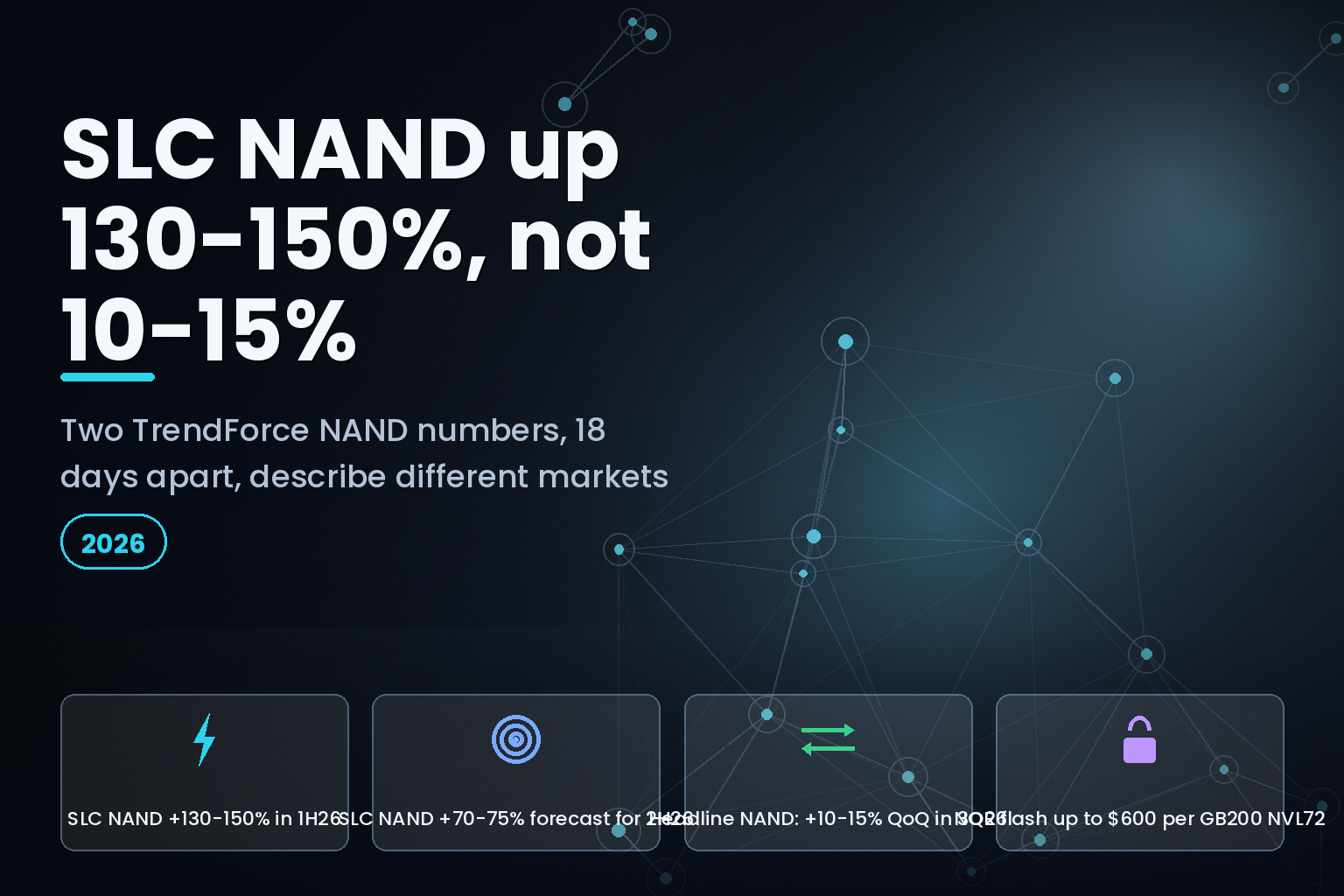
Summary. On 16 June 2026 TrendForce reported that average SLC NAND contract prices rose an estimated 130-150% during the first half of 2026, and that NOR Flash rose 100-120% over the same period. Eighteen days later, on 3 July 2026, the same firm forecast that NAND Flash contract prices would rise 10-15% QoQ in the third quarter and headlined the release "gains moderate". Both numbers are correct. They describe different markets that share a word. A team pricing an industrial gateway, an automotive ECU or a networking switch off the 10-15% figure is understating its 2026 memory line by roughly five times, and the June note put the 2H26 increases at 70-75% for SLC NAND and 60-65% or more for high-density NOR on top of the first-half rise. Two suppliers also disagree by more than 4x on how many NOR devices sit in an NVIDIA GB200 rack, a firmware-flash line put at up to $600 per NVL72 system. Nobody has reconciled that either.
Two numbers, one label
The gap is not a revision. The 3 July release covers the volume NAND market: client SSDs, enterprise SSDs, eMMC and UFS for handsets, and open-market wafers. That market is dominated by advanced-layer 3D NAND, it is where consumer price resistance bites, and TrendForce says price tolerance among consumer customers "has reached its limit". Hence 10-15%.
The 16 June release covers mature-node code storage: NOR Flash and SLC NAND, the parts that hold boot code, firmware and write-intensive buffers. Suppliers keep moving that capacity to HBM and high-layer 3D NAND, so the supply base shrinks while demand from edge AI, robotics and networking grows. TrendForce says cumulative contract price increases for both categories exceeded 100% in the first half of 2026.
Here is what each number covers.
| TrendForce release | Product scope | Move reported | Period |
|---|---|---|---|
| 3 July 2026 | NAND Flash contract, volume market | +10-15% QoQ | 3Q26 forecast |
| 3 July 2026 | Conventional DRAM contract | +13-18% QoQ | 3Q26 forecast |
| 16 June 2026 | SLC NAND average contract | +130-150% | 1H26 actual |
| 16 June 2026 | SLC NAND average contract | +70-75% | 2H26 forecast |
| 16 June 2026 | NOR Flash average contract | +100-120% | 1H26 actual |
| 16 June 2026 | High-density NOR Flash | +60-65% or more | 2H26 forecast |
The compounding matters. A part that rose 140% in the first half and rises another 72% in the second half ends 2026 at roughly 4.1 times its January price. The headline NAND number gets you nowhere near that.
Why the mature-node corner is the one that broke
The cause is capacity allocation, not demand froth. TrendForce's 16 June note says major suppliers "continue to prioritize capacity allocation toward higher-value products such as HBM and advanced-layer 3D NAND", which squeezes the mature-node capacity NOR Flash and SLC NAND depend on. Several international vendors have been exiting low-capacity and mature-node segments outright: TrendForce's 28 April 2026 report on Macronix cites analysts putting Kioxia and Micron as gradually leaving the SLC NAND segment.
That exit is what the remaining suppliers are living off. Macronix president Lu Chih-yuan told an investors' conference on 27 January 2026: "Samsung announced its plans to stop producing and supplying eMMC [NAND flash memory chips]. The impact is huge. That has led to severe shortages in the market." He added that Macronix is the only company capable of producing MLCs used in eMMC outside Samsung, Hynix, Micron and Kioxia.
The replacement capacity is small and late. Macronix committed NT$22 billion (US$699.1 million) of capex for 2026, about eleven times the NT$1.8 billion it spent in 2025, to add roughly 10,000 wafers to a 12-inch fab running 20,000 wafers a month. Its total capacity is still effectively capped near 25,000 wafers a month, and Lu said Macronix would delay its 3D NOR development by about two years to fund the expansion. TrendForce's April report notes most new tools arrive only in the first half of 2027 because of industry-wide equipment shortages. Winbond approved record 2026 capex of NT$42.1 billion (US$1.33 billion) against NT$5.5 billion in 2025, targeting NOR and NAND shipment growth of 30-40% year-on-year.
None of that lands in time for a 2026 build. Winbond president James Chen said at the company's 10 February 2026 earnings conference: "Our capacities have been fully booked this year and next year, including DRAM, NOR and NAND. The industry's upcycle should last for quite a long time."
The GB200 rack count nobody has reconciled
Two Taiwanese sources published NOR content figures for the same NVIDIA rack two days apart in February 2026, and they disagree by more than 4x.
Chen, at the 10 February earnings conference, said an AI server rack based on NVIDIA's GB200 chips requires more than 120 NOR flash chips, equal to the consumption of 120 PCs. On 12 February, Blocks & Files reported Taiwan's Commercial Times as saying there can now be up to 30 NOR devices in a GPU server rack, costing up to $600 per NVIDIA GB200 NVL72 system, and forecast to reach $900 within a couple of years.
The two figures may be counting different things. A GB200 NVL72 holds 18 compute trays plus switch trays, so "30 devices" plausibly counts discrete boot flash sockets while "more than 120" counts every NOR die including BMC, NIC, PSU and switch firmware. Neither source states its counting rule. If you are modelling firmware-flash exposure in a rack you are buying, treat $600 as a floor and the 120-device count as the ceiling, and ask your ODM for a per-tray bill of materials rather than picking one published number. The real cost is usually the part nobody itemised.
Who this actually hits
The exposure is not evenly spread. Use this to work out whether you are in the 10-15% market or the 70-75% one.
| Product class | Memory type at risk | 2H26 exposure | Practical signal |
|---|---|---|---|
| Industrial gateway, PLC, robotics controller | SLC NAND, high-density NOR | +70-75% and up | Your BOM lists a 1-8Gb SLC part |
| Automotive ECU, ADAS, cockpit | AEC-Q100 NOR, automotive-grade SLC | Highest, TrendForce flags "even stronger price momentum" | Part number carries an automotive temperature grade |
| Networking switch, satellite, medical imaging | SLC NAND boot and buffer | +70-75% | Long-lifecycle part with no drop-in replacement |
| Handset, tablet, consumer device | eMMC, UFS | Modest, supply "relatively more abundant" in 3Q26 | Volume UFS 4.0 or eMMC sourcing |
| Server and storage fleet | Enterprise and client SSD | Upward but negotiable | 30TB TLC enterprise SSD now $22,600 |
| Edge AI appliance | 256Mb-and-above NOR | +60-65% or more | Firmware grew past tens of megabytes |
TrendForce is explicit that long-lifecycle automotive and industrial applications face "an elevated risk of prolonged shortages" through the second half, and that industrial-grade and automotive-grade SLC NAND may run above the 70-75% average. Automotive parts carry AEC-Q100 qualification and fixed temperature grades, so a substitution is a requalification, not a purchase order change.
The storage side of the same shortage is easier to see because the prices are public. VDURA's Flash Volatility Index put a 30TB TLC enterprise SSD at $22,600 in August 2026 against $3,460 in the third quarter of 2025, with 30TB QLC at $18,080 against $2,768, while a 30TB HDD went from $495 to $1,216. Erik Salo, SVP of Product and Operations at VDURA, said: "Flash pricing has stopped swinging wildly, but it has settled at a level that breaks the assumptions most all-flash architectures were sold on." The same capacity reallocation drives both. We covered the DRAM side of it in our note on the server DRAM price rise for 3Q26, and the downstream device effect in 2026 price hikes and enterprise fleet budgets.
What to do before the next build
Four things, with dates attached.
Re-price the BOM against the right series. If any line is SLC NAND, NOR Flash or automotive-grade managed NAND, model 2H26 at the 70-75% and 60-65% bands from the 16 June note, not the 10-15% headline. Do it before you commit a 2027 build cost.
Get on a long-term agreement or accept allocation. TrendForce says suppliers are managing through LTAs and selective order acceptance "rather than relying solely on aggressive price increases". Macronix has moved NOR and SLC NAND to monthly price negotiation. A quarterly purchase cadence is now the expensive option.
Cut firmware footprint where it is cheap to do so. Edge AI firmware has grown from tens of megabytes to multiples of that, which is what pushed demand into 256Mb-and-above NOR. Compression, dead-code removal and moving model weights off the boot device to a cheaper managed part are engineering work that pays at these prices.
Requalify a second source now, not when the first one allocates. Winbond and Macronix both offer AEC-Q100-qualified NOR families. Requalification takes months; the capacity is booked through 2027.
The upstream picture does not soften either. TrendForce's 30 June 2026 research puts average 8-inch utilisation across the top ten foundries at 88% in 2026, rising to 90% in the second half, with foundry prices already up 5-15% between the first and second quarters and a further 5-10% for capacity-constrained nodes into the third. It expects mature-node price increases to extend through 2027.
India-specific considerations
Indian electronics manufacturers and product companies sit downstream of every one of these decisions and buy in dollars against a rupee BOM. A component that ends 2026 at four times its January price is a margin event, not a procurement irritation, particularly for the industrial and automotive tiers that India's manufacturing push targets. Two practical notes. First, an LTA signed in dollars removes price risk but not currency risk, so hedge the two separately. Second, if your product ships firmware over the air, a smaller firmware image also cuts data-transfer cost and update failure rates on Indian mobile networks, which makes the footprint work pay twice. Teams building connected plant systems should read this alongside our piece on smart manufacturing with IoT and AI in Indian factories. Where firmware carries personal data, the Digital Personal Data Protection Act 2023 obligations attach to what the device stores, not to what it costs.
What is still unknown
TrendForce has not published a 4Q26 SLC NAND or NOR forecast as of 25 August 2026, so the 70-75% band is a half-year estimate rather than a settled quarterly path. The 3 July release does not say whether its 10-15% NAND figure excludes SLC, which is why the two numbers can be read as contradicting each other. Neither Winbond nor Commercial Times has published the counting rule behind the GB200 NOR device figures. And Macronix's automotive eMMC controller samples are targeted for late in the first quarter of 2027, so the substitution route for automotive managed NAND does not exist yet.
What is not in doubt is the direction of supplier capital. The top five NAND vendors turned over $68.87 billion in the second quarter of 2026, a 77% quarterly jump driven by average selling prices rather than volume, and TrendForce notes they are prioritising capital expenditure on DRAM and HBM rather than new NAND capacity. That is the same allocation choice that emptied the mature-node corner in the first place. The cloud and AI capital expenditure question and your firmware flash line are the same story seen from two ends.
FAQ
How eCorpIT can help
Our embedded and platform engineering teams work on the two levers that are still in your control at these prices: shrinking firmware footprint so a smaller NOR or SLC part clears the requirement, and restructuring device software so a second-source component does not force a full requalification. We are CMMI Level 5 and ISO 27001:2022 certified, and we design connected-device systems aligned with DPDP Act 2023 requirements. Ask our embedded engineering team to review your firmware footprint against your 2027 BOM.
References
- Apple's Across-the-Board Price Increases Add Uncertainty to Consumer Demand, TrendForce, 1 July 2026
Last updated: 25 August 2026.