On this page · 13 sections
- What the deadline actually covers
- Check whether you are affected in two minutes
- What replaces what
- The order of operations that avoids double-counting
- Writing the custom pixel
- The subdomain gotcha that breaks the Order status page
- Twenty days, sequenced
- What breaks if you do nothing
- App pixel, custom pixel or app block
- India-specific considerations
- FAQ
- How eCorpIT can help
- References
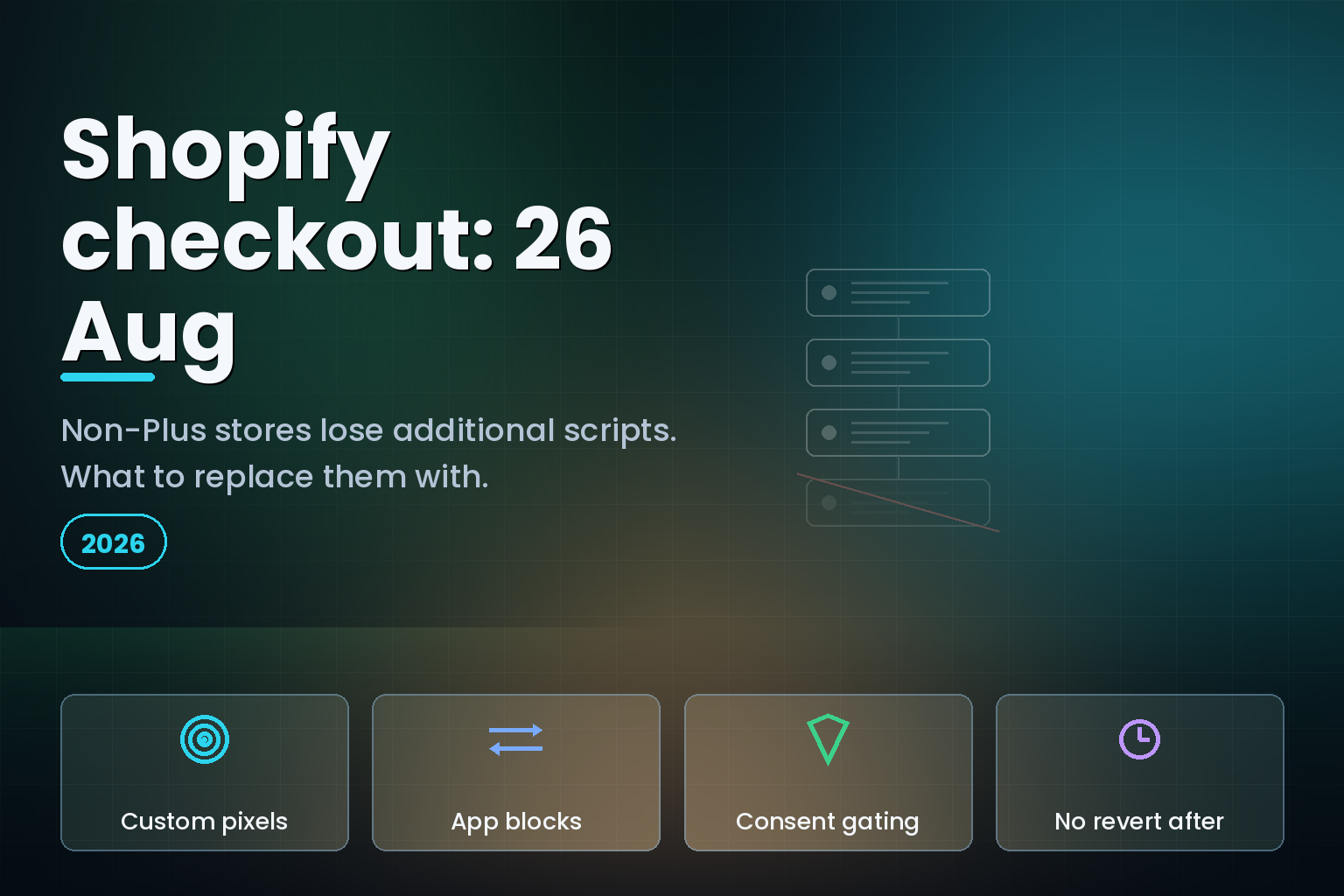
Summary. Shopify's Help Center states it plainly: "August 26, 2026 is the deadline for stores on a non-Plus Shopify subscription plan to upgrade their existing Thank you and Order status pages to the new version of those pages." That is 20 days from 6 August 2026. Shopify Plus stores passed this milestone on 28 August 2025, and since that same date the Additional scripts section in Checkout settings has been view-only for everyone, so you cannot edit your way out of the problem. If you do not upgrade before 26 August 2026, Shopify auto-upgrades the pages and your existing customisations go with them. For a Basic-plan store in India at ₹1,499 per month before 18% GST, the cost of getting this wrong is not the subscription, it is the Google Ads and Meta conversion data that stops arriving on the day. Three replacements exist: app pixels for tracking, custom pixels where no app fits, and app blocks for page content. This guide covers the exact steps, the working pixel code from Shopify's own documentation, and two gotchas that will not show up in a staging test.
What the deadline actually covers
Shopify is retiring three ways of customising the Thank you and Order status pages: checkout.liquid, Additional scripts, and apps that use script tags. The replacement is the checkout and accounts editor, where design and functionality are recreated with blocks and tracking is recreated with web pixels.
The dates that matter:
| Date | What happened or happens | Who it applies to |
|---|---|---|
| 28 August 2025 | Deadline to upgrade Thank you and Order status pages | Shopify Plus stores |
| 28 August 2025 | Additional scripts section became view-only, no manual edits | All plans |
| 6 January 2025 | Cut-off for store creation date that governs revert eligibility | Stores wanting to revert |
| 26 August 2026 | Deadline to upgrade; auto-upgrade after this date | Non-Plus plans |
| 26 August 2026 | Last date a manual upgrade can be reverted | Eligible stores only |
Stores on the Pause and Build plan are upgraded automatically, and Shopify's guidance is explicit that this cannot be reverted even after unpausing. If you have parked a seasonal store, it has already moved.
Check whether you are affected in two minutes
Go to Settings, then Checkout, and look at the Configurations section. If a notice to upgrade your Thank you and Order status pages is displayed, you are still on the deprecated versions. In the Configurations section the notice reads "Upgrade Thank you and Order status pages by August 26, 2026"; expand it and click Review customizations to open your personalised upgrade guide.
That guide is generated for your store and lists what you actually have, sorted into Apps, Incompatible apps and Additional scripts. If the guide is empty you can skip straight to publishing the upgrade. Most stores with any history of paid media will not find it empty.
What replaces what
| Legacy customisation | Replacement | Notes |
|---|---|---|
| Additional scripts for tracking and analytics | App pixels, or a custom pixel where no app fits | Shopify says all recommended tracking apps in the upgrade guide use web pixels |
| Additional scripts for page content | App blocks in the checkout and accounts editor | Recommended apps in the Page customizations section offer blocks |
| Apps using script tags | An updated version of the same app, or an alternative | Apps not updated by their developer appear under Incompatible apps |
checkout.liquid |
Checkout and accounts editor | Plus-only surface historically |
| Google tags in any of the above | The Google & YouTube app | Google Tag Manager containers are not supported by the app |
Shopify's stated preference is app pixels over custom pixels, described as offering improved stability, security and performance. The caution on the custom pixel documentation is worth reading before you commit to hand-written JavaScript: "Custom pixels is an advanced feature that requires JavaScript knowledge. Compliance with applicable laws, consents, code security, troubleshooting, and updates are your responsibility." Shopify also states directly that adding and using custom pixels is unsupported by Shopify.
That is not a reason to avoid custom pixels. It is a reason to write them once, properly, and to keep them in version control rather than in a text box.
The order of operations that avoids double-counting
Shopify's own note describes the trade-off. Connecting an app pixel before deactivating an additional script means no gap in tracking but a short period of duplicate events. Deactivating the script first means no duplicates but a gap. Pick deliberately.
For a store spending real money on Google Ads or Meta, duplicates distort bidding for the duration, and a gap distorts it for the duration too. The lower-damage path for most merchants is: connect and test the app pixel, verify events arriving in the destination platform, then deactivate the script the same day. Do it on a low-traffic day, not on a sale weekend.
The deactivation itself is done from the upgrade guide. Under Additional scripts, either click Disable script on a direct app match, or click View script and then Disable script. Confirm in the dialog, then re-check the third-party platform to make sure events are still arriving. A Disabled label appears against the script afterwards.
One detail that catches teams out: you can reactivate a script only while your Thank you and Order status pages have not completed their upgrade. Once the pages are upgraded, reactivation is gone.
Writing the custom pixel
When no app covers the tracking you need, a custom pixel is the supported escape hatch. The rules are narrow and Shopify's documentation states them clearly.
The pixel sandbox accepts JavaScript only. Any HTML in the vendor's snippet has to go, including <script> tags and <noscript> fallbacks. A pixel that loads via script src= has to be rewritten. Shopify's own example for Google:
            const script = document.createElement('script');
script.setAttribute('src', 'https://www.googletagmanager.com/gtag/js?id=YOUR_PIXEL_ID');
script.setAttribute('async', '');
document.head.appendChild(script);

window.dataLayer = window.dataLayer || [];
function gtag(){dataLayer.push(arguments);}
gtag('js', new Date());
gtag('config', 'YOUR_PIXEL_ID');
Loading the SDK is not enough. Shopify notes that neither Meta's nor Google's SDK automatically transmits data from a Shopify custom pixel, so you subscribe to events explicitly using analytics.subscribe. The purchase event, which is the one the Thank you page was carrying:
            analytics.subscribe("checkout_completed", (event) => {
  fbq('track', 'Purchase', {
    currency: event.data?.checkout?.currencyCode,
    value: event.data?.checkout?.totalPrice?.amount,
  });
});
The full pattern from Shopify's documented Meta example covers page_viewed, product_viewed, search_submitted, product_added_to_cart, payment_info_submitted, checkout_started and checkout_completed. Note the optional chaining throughout, which is in Shopify's own sample and is not decoration: event payloads vary and a hard property access will throw inside the sandbox.
Custom events published from your theme work the same way. A theme file publishes:
<script>Shopify.analytics.publish("special_email_signup", { email_campaign_id: 123});</script>
and the pixel subscribes to the same name, reading event.customData.
Consent is not optional and it changes your numbers
New custom pixels require Marketing and Analytics permissions by default, configurable under Customer privacy and then Permission in the pixel's details. New custom pixels also qualify as data sale by default, configurable under Customer privacy and then Data sale. In markets configured to require consent, which Shopify names as including the European Economic Area and the United Kingdom, web pixels run only when the visitor has granted the permissions the pixel requires.
Shopify maps its Marketing and Analytics purposes to Google's Consent Mode like this:
            gtag('consent', 'update', {
  'ad_storage': 'granted',
  'analytics_storage': 'granted',
  'ad_user_data': 'granted',
  'ad_personalization': 'granted',
});
Now the part most migration posts leave out. Shopify's own guidance warns that after replacing additional scripts with pixels you might see a decrease in events received by the third-party platform, because app pixels and custom pixels track only with consent, whereas consent was often not set up properly in additional scripts or checkout.liquid code.
Read that twice before your next performance review. Some of the conversion volume you are about to lose was never consented in the first place. Brief your paid media team and your CFO before the drop lands, not after, and do not spend a week hunting a bug that is actually a compliance correction.
The subdomain gotcha that breaks the Order status page
This one is buried in a note and will cost you a week if you miss it.
If your online store uses a custom domain, Shopify states that you must also change your customer account domain to a subdomain of your online store domain, such as account.example.com. Otherwise pixels and cookie consent will not work on the Order status page, because the domain must be the same as the one where consent was obtained.
Check this before you write a single line of pixel code. A store on shop.example.in with customer accounts still on a shopify.com domain will pass every test on the Thank you page and fail silently on Order status, which is exactly the page most merchants forget to test.
Twenty days, sequenced
Days 1 to 2. Open the upgrade guide from Settings, Checkout, Configurations, Review customizations. Screenshot every script before you touch anything, because view-only becomes no-access after the upgrade. Confirm your customer account domain is a subdomain of your store domain.
Days 3 to 6. Work the Apps section. For each app in Tracking and analytics, click Manage and set up app pixel tracking. For each in Page customizations, click Add blocks and rebuild the block in the checkout and accounts editor.
Days 6 to 9. Work Incompatible apps. Contact the developer of anything listed under apps that require an update, and start evaluating alternatives in parallel rather than waiting for a reply you may not get before 26 August.
Days 9 to 14. Work Additional scripts. Take the direct app matches first, then decide app-versus-custom-pixel for the rest. Write the custom pixels, set permissions and data sale flags deliberately rather than accepting defaults.
Days 14 to 17. Test. Use the third-party platform's own pixel helper where one exists. Test on the Order status page, not only the Thank you page. Place real test orders rather than relying on preview.
Days 17 to 19. Deactivate scripts one at a time, verifying the destination platform after each.
Day 19 to 20. Publish the upgrade from the upgrade guide. Remember the revert window closes on 26 August 2026, and only for stores created before 6 January 2025 that upgraded manually less than 30 days ago and had pre-existing customisations.
What breaks if you do nothing
Nothing breaks quietly. Shopify auto-upgrades the pages and the customisations go. In practice that means Google Ads conversion tracking, Meta pixel purchase events, affiliate postbacks, order-status upsell widgets, custom thank-you content and any bespoke JavaScript stop working on the same day, without a deploy on your side to blame.
Writing in Search Engine Land on 23 April 2025, Paid Media Editor Anu Adegbola set out the practical warning for Google advertisers: "Google Tag Manager isn't supported in the app, so move tags out of GTM containers for full compatibility." She also noted a change many merchants never registered: tags not updated before 2 February were converted by Shopify into custom pixels, which can cause inaccurate data.
If your Google measurement runs through GTM today, migrating to the Google & YouTube app is not a lift-and-shift. Budget for rebuilding tags rather than moving a container.
App pixel, custom pixel or app block
| You need | Use | Why |
|---|---|---|
| Standard vendor tracking with an official app | App pixel | Shopify recommends it for stability, security and performance; the upgrade guide surfaces direct matches |
| Vendor tracking with no compatible app | Custom pixel | Supported escape hatch, but unsupported by Shopify support and your compliance responsibility |
| Content on the Thank you or Order status page | App block | Rebuilt in the checkout and accounts editor from an installed app |
| Google Ads, Analytics, Merchant Center | Google & YouTube app | Built by Google for Shopify; GTM containers are not supported |
The rule of thumb: prefer an app for anything a vendor supports, and reserve custom pixels for the two or three genuinely bespoke events your business depends on.
India-specific considerations
Indian merchants are hitting this deadline with a different cost base and a different compliance overlay.
On cost, published 2026 Indian pricing puts Shopify Basic at ₹1,499 per month on annual billing, Grow at ₹5,599, Advanced at ₹22,680 and Plus from roughly ₹1,75,000 per month, with 18% GST on top and monthly billing running around 25% more than annual. A Basic store therefore pays about ₹1,769 a month including GST. Against that, the engineering cost of rebuilding pixels once is small; the cost of losing a month of conversion data during Diwali quarter planning is not.
On compliance, the consent behaviour Shopify describes for the EEA and UK is worth adopting in India regardless of what is strictly required today. The Digital Personal Data Protection Act 2023 governs the personal data flowing through these pixels, including email and phone captured on checkout events. Configuring the Marketing, Analytics and data sale flags deliberately, rather than accepting defaults, is the cheapest compliance work you will do this year. We design applications aligned with DPDP Act requirements rather than claiming certification against them.
If you are running a headless storefront, the calculus differs again and the checkout surface is only part of the decision; see our take on rebuilding on Shopify Hydrogen for headless D2C.
This deadline also lands in the same three-week window as Google's Content API for Shopping shutdown on 18 August 2026. Both changes touch the same commerce and measurement stack, and both need the same engineers. Sequence them: Merchant API first because its date is earlier, checkout second. Teams running both in parallel with one developer generally finish neither.
For the broader platform picture, see the Interop 2026 web platform developer guide, and for how these platform shifts fit into Indian retail operations, our read on retail digital transformation across D2C and quick commerce.
FAQ
How eCorpIT can help
eCorpIT is a Gurugram-based technology organisation founded in 2021, and a Shopify partner with senior-led engineering teams building and maintaining commerce stacks for Indian D2C and retail brands. For this deadline we audit your upgrade guide, map every additional script to an app pixel, custom pixel or app block, write and version-control the pixel code, and verify events on both the Thank you and Order status pages before anything is deactivated. We are CMMI Level 5 assessed, MSME certified and ISO 27001:2022 certified. If 26 August is close and your checkout still carries legacy scripts, send us your store setup at /contact-us/ or see our ecommerce app development service.
References
- Non-Plus: Upgrading and replacing your Thank you and Order status pages, Shopify Help Center.
- Reviewing and replacing additional scripts on your Thank you and Order status pages, Shopify Help Center.
- Upgrading and replacing your Thank you and Order status pages, Shopify Help Center.
- Plus: Upgrading and replacing your Thank you and Order status pages, Shopify Help Center.
- Create custom pixel code, Shopify Help Center.
- Manage your custom pixels, Shopify Help Center.
- Testing custom pixels, Shopify Help Center.
- Pixels overview, Shopify Help Center.
- App pixels, Shopify Help Center.
- Customizing your checkout and accounts with apps, Shopify Help Center.
- Customer privacy settings, Shopify Help Center.
- About web pixels, Shopify.dev.
- Customer events reference, Shopify.dev.
- Pixel privacy, Shopify.dev.
- Shopify's checkout overhaul means it's time to migrate your Google Tags, Anu Adegbola, Search Engine Land, 23 April 2025.
- Shopify pricing in India: a complete 2026 breakdown, PayGlocal, 2026.
- Shopify plan comparison India 2026, BYB Traction, 2026.
- About Thank you and Order status page customization, Shopify.dev.
Last updated: 6 August 2026.