On this page · 11 sections
- Why the e-rupee is a different instrument, not a faster UPI
- The 2026 pilot reality: read the numbers honestly
- Programmability primitives you can actually build on
- How a non-bank actually gets access
- Cross-border is where the roadmap gets ambitious
- Architecture: what your team has to build
- India-specific considerations
- What not to over-invest in yet
- FAQ
- How eCorpIT can help
- References
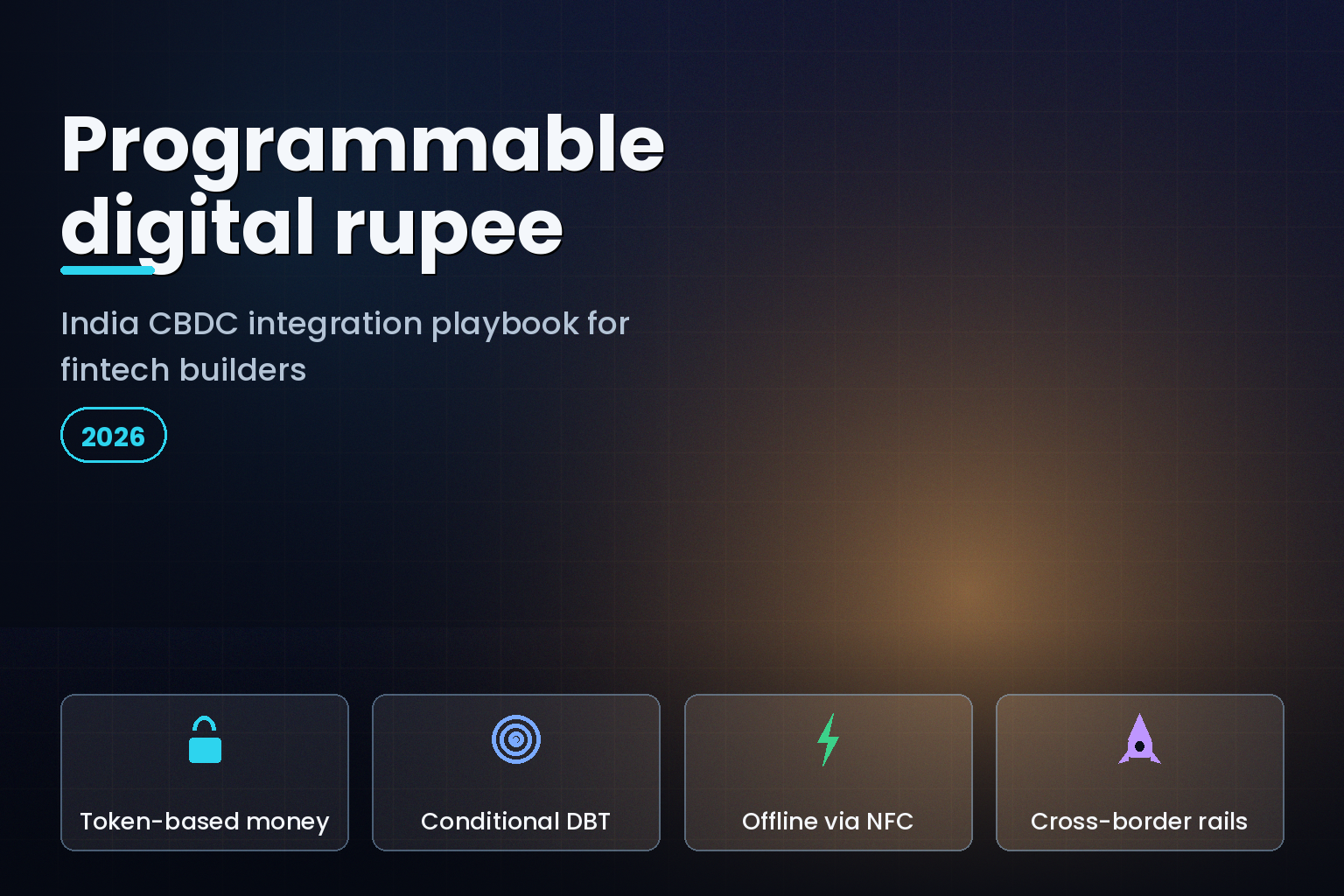
Summary. India's retail digital rupee (e₹) circulation reached ₹1,016 crore by March 2025 across 17 banks and more than 6 million users, then fell back to about ₹771 crore in the Reserve Bank of India's 2025-26 annual data. Those are small numbers next to UPI, which clears billions of transactions a month. The point of the e-rupee in 2026 is no longer volume. On 30 August 2024 the RBI expanded programmability, and through 2025-26 it ran conditional welfare transfers in Gujarat, Puducherry and Chandigarh. In April 2024 it opened access to non-bank payment firms, and Cred became the first fintech to offer an e-rupee wallet, with YES Bank issuing the tokens. If you build payments in India, the e-rupee is now a programmable, token-based instrument you can design for, not a release-date headline.
The Reserve Bank of India has been unusually candid that adoption is not the goal yet. "We are in no hurry for a full rollout of CBDC," said T. Rabi Sankar, Deputy Governor of the RBI, telling reporters the central bank would not launch full scale while global use cases stay limited. For builders, that candour is useful. It means the rules of the road are still being written, and the teams that understand the token model now will ship faster when programmable money reaches production scale.
This guide is written for fintech developers, product leads and architects. It covers what "programmable" actually changes at the protocol level, how the e-rupee differs from UPI and e-RUPI, how a non-bank gets access, what you have to build, and where the cross-border rails are heading. Every figure below is dated and sourced.
Why the e-rupee is a different instrument, not a faster UPI
The mistake most teams make is treating the digital rupee as another payment method to bolt onto an existing UPI stack. It is not. UPI moves an instruction between two bank accounts; the money stays in the banking system and settles later through clearing cycles. The e-rupee is a bearer token issued directly by the RBI. When it moves, the token itself is the money, and settlement is instant because there is no interbank message to reconcile afterwards.
That single design choice changes your architecture. With UPI you integrate against a bank or a payment service provider and reconcile against a switch. With the e-rupee you hold and transfer central-bank liabilities, so token custody, double-spend prevention and offline synchronisation become your problem, not a bank switch's. If your team already understands UPI's API rate limits and OC-215 architecture, treat the e-rupee as a separate track with its own failure modes.
There is a second instrument people confuse with the e-rupee: e-RUPI. e-RUPI is a prepaid, purpose-bound voucher delivered over UPI rails; it is not central-bank money. The e-rupee is legal tender. Programmability on the e-rupee is therefore money-level programmability, which is why the welfare use cases matter.
e-rupee, UPI and e-RUPI compared
| Property | Digital rupee (e₹) | UPI | e-RUPI |
|---|---|---|---|
| What moves | A central-bank token (the token is the money) | An instruction to move bank deposits | A prepaid voucher redeemed over UPI |
| Issuer | Reserve Bank of India | Payer's bank via NPCI switch | Sponsor bank, backed by prefunded value |
| Settlement | Instant, final, on transfer | Deferred through bank clearing | On voucher redemption |
| Works offline | Yes, via NFC (RBI offline mode, 2025) | No, needs connectivity | No, needs connectivity |
| Programmable at money level | Yes, conditional and purpose-bound tokens | No | Purpose-bound, but voucher-level only |
| Needs a bank account per user | No | Yes | No |
Sources for this table: the RBI's digital rupee FAQs, plus explainer comparisons from Razorpay, Paytm and Axis Bank, all cited in the references.
The 2026 pilot reality: read the numbers honestly
Any builder pitching an e-rupee feature to a payments committee needs the real adoption picture, because leadership will ask. Retail e-rupee circulation climbed from ₹234 crore in 2024 to ₹1,016 crore by March 2025, when the pilot spanned 17 banks and more than 6 million users. In the RBI's 2025-26 annual data, retail circulation then declined to roughly ₹771 crore. CBDC users were reported at around 70 lakh (7 million) through 2025. Against UPI's scale, this is a rounding error.
The RBI's response to slow retail uptake was to stop chasing volume and pivot to functions that UPI cannot do. That is the opening for builders. The digital rupee will not win a transactions-per-second contest with UPI in 2026, and you should not position it that way internally. It wins where conditionality, offline capability and direct central-bank issuance solve a problem UPI was never designed for. State-Bank-of-India, HDFC Bank and ICICI Bank anchor the bank side of the pilot, so most non-bank integrations route through one of them.
The honest read: build e-rupee capability now as an option value play, not because volume has arrived. The migration cost of adding it after programmable subsidies go national will be higher than the cost of designing for it today.
Programmability primitives you can actually build on
Programmability is the reason to care. On 30 August 2024 the RBI widened the programmable pilot to cover categories including fuel, groceries, education, dining, healthcare and travel. Deputy Governor Sankar has framed programmability as the feature that separates CBDC from every other payment instrument, pointing to purpose-driven direct benefit transfers, subsidies and targeted lending.
In practice, three primitives matter for design:
Purpose binding. A token can be restricted so it is only accepted at approved merchant categories or specific merchant IDs. In the welfare pilots in Gujarat, Puducherry and Chandigarh, food-subsidy tokens could be spent only on designated items and could not be diverted to cash or unrelated household spending.
Conditional release. Value can be held and released when a condition is met, which is what makes targeted lending and milestone-based disbursement possible without a human approver in the loop.
Validity windows. A token can carry an expiry or a usage window, so a subsidy that must be consumed within a season cannot be hoarded.
You do not write these rules against a public RBI API today; they are set at issuance by the issuing bank inside the pilot. But your product logic has to model them. An illustrative policy object for a purpose-bound welfare token looks like this:
            {
  "token_class": "e-rupee-retail",
  "purpose": "food-subsidy-2026",
  "allowed_mcc": ["5411", "5422"],
  "allowed_merchant_ids": ["GUJ-PDS-00042"],
  "not_valid_after": "2026-12-31",
  "convertible_to_cash": false,
  "offline_transfer": true
}
Treat that as a data model to reason about, not a published endpoint. The concrete engineering lesson: your wallet, ledger and merchant-acceptance code must all respect a token that can legally refuse to be spent. That refusal path is new. UPI never had it.
How a non-bank actually gets access
For most of the pilot's life, only banks could offer the digital rupee. That changed in April 2024, when the RBI decided to let non-bank payment system operators offer CBDC wallets, widening distribution beyond the initial bank apps. The first proof point arrived when Cred, backed by Tiger Global and Peak XV, became the first fintech platform to offer e-rupee access, with YES Bank facilitating token issuance.
That template, a fintech front end plus a sponsor bank that issues and redeems tokens, is the realistic path in 2026. You are unlikely to hold central-bank tokens directly as a startup. You partner with a pilot bank, integrate its e-rupee issuance and redemption, and own the wallet experience, the offline flow and the reconciliation. If you have already shipped a payments product, this is closer to adding a new instrument to a fintech payments stack than to building a bank.
Integration paths for a fintech in 2026
| Path | Who holds tokens | What you build | Best for |
|---|---|---|---|
| Sponsor-bank wallet | Partner pilot bank (SBI, HDFC, ICICI, YES) | Wallet UX, offline NFC flow, conditional-token handling, reconciliation | Consumer apps adding e-rupee alongside UPI |
| Merchant acceptance | Bank on the merchant side | Acceptance in your POS or checkout SDK, refund and expiry handling | PSPs and D2C checkout builders |
| Government DBT rails | Issuing bank under a state programme | Beneficiary onboarding, purpose-bound redemption, audit trails | Govtech and welfare-disbursement platforms |
The reconciliation column is where teams underestimate the work. Instant, final settlement removes one headache and adds another: there is no clearing window in which to catch and reverse an error, so your validation has to happen before the token moves, not after.
Cross-border is where the roadmap gets ambitious
The e-rupee's second act is cross-border, and this is the part senior stakeholders should track. The RBI's 2025-26 annual report set out plans to widen domestic CBDC pilots and to explore bilateral and multilateral cross-border CBDC pilots in 2026-27. Two initiatives sit underneath that.
Project Nexus is a Bank for International Settlements Innovation Hub effort to interlink national fast-payment systems for instant retail cross-border payments. The RBI joined alongside Bank Negara Malaysia, Bangko Sentral ng Pilipinas, the Monetary Authority of Singapore and the Bank of Thailand, with the founding agreement signed on 30 June 2024 in Basel and the platform targeted to go live around 2026. Nexus links UPI-style systems rather than moving CBDC directly, but it is the rail India is betting on for retail corridors.
Project mBridge is the multi-CBDC wholesale platform involving China, Hong Kong, Thailand and the UAE that reached minimum-viable-product stage in mid-2024. India has engaged with the wholesale CBDC direction, and in 2026 reporting emerged that the RBI proposed placing BRICS CBDC interlinking on the agenda of the India-hosted summit. Separately, the RBI signed a digital assets pact with the Monetary Authority of Singapore and is exploring CBDC corridor pilots with Singapore and the UAE, with trials expected across 2026-27.
Cross-border CBDC rails at a glance
| Initiative | Type | Partners named in reporting | Status in 2026 |
|---|---|---|---|
| Project Nexus | Retail, interlinks fast-payment systems | India, Malaysia, Philippines, Singapore, Thailand | Agreement June 2024; targeted live around 2026 |
| Project mBridge | Wholesale multi-CBDC | China, Hong Kong, Thailand, UAE | MVP mid-2024; India engaged |
| Singapore, UAE corridors | Bilateral CBDC pilots | India with Singapore and UAE | Trials expected 2026-27 |
For builders, the near-term takeaway is narrow: cross-border e-rupee is trials, not production, through 2026. Do not design a remittance product around it yet. Do design your data model so a token can carry a corridor and a counterparty jurisdiction, because that is where compliance will land first.
Architecture: what your team has to build
Strip away the policy and a production e-rupee wallet needs five components UPI did not force you to own.
A token store. You custody bearer tokens on the device and in a server-side ledger, with strict double-spend prevention. Losing a device cannot mean minting money, so key management and recovery are first-order security work, not an afterthought.
An offline path. The RBI's offline mode uses NFC so two devices can transact without connectivity, which matters for Tier 3 and low-network areas. Offline means you accept value you cannot immediately confirm against a server, so you need a queue, a sync-on-reconnect flow, and a conflict policy for the rare double-spend attempt.
A conditional-logic engine. Your acceptance and spend code must evaluate purpose, merchant category, validity window and cash-convertibility on every transaction and be able to decline cleanly. Build the decline path first; it is the one QA teams forget.
A reconciliation and audit layer. Instant finality changes reconciliation from "match and settle later" to "validate before transfer." For DBT programmes you also need an audit trail a government auditor can read.
A compliance surface. KYC, tiered limits, and data handling that aligns with the Digital Personal Data Protection Act, 2023. Our DPDP engineering playbook for Indian startups covers the consent and data-minimisation patterns that apply directly here.
The real cost is usually the offline sync and the reconciliation rewrite, not the wallet UI. Teams that budget for the UI and show the ledger get surprised in testing.
India-specific considerations
Three things shape an Indian build. First, DPDP. A wallet that touches beneficiary identity and spend data is squarely in scope, so design for consent, purpose limitation and data minimisation from the first commit. Second, KYC and limits. The e-rupee lets a user transact without a bank account per transaction, but onboarding still runs through a sponsor bank's KYC, and tiered wallet limits apply. Third, interoperability with UPI. The RBI has pushed for e-rupee and UPI interoperability at the merchant QR level, so a merchant should not need two acceptance stacks. Plan for a single acceptance surface even while the instruments settle differently underneath.
For teams already deep in the UPI ecosystem, it is worth watching how NPCI's unified agent protocol prepares UPI for agentic payments and how new credit primitives such as credit line on UPI for D2C merchants evolve, because programmable central-bank money and programmable credit will eventually meet in the same app.
What not to over-invest in yet
A short list, because runway is finite. Do not build a consumer e-rupee wallet expecting UPI-scale usage in 2026; the circulation numbers say it is not there. Do not architect a cross-border remittance product on e-rupee rails while they are still in trials. Do not assume a public, self-serve RBI programmability API exists; issuance rules are set inside the pilot through sponsor banks. Do build the token model, the offline path and the conditional-logic engine into your domain design now, because those are the parts that are expensive to retrofit once programmable subsidies scale.
FAQ
How eCorpIT can help
eCorpIT is a Gurugram-based technology company, founded in 2021 and assessed at CMMI Level 5, that builds payments and fintech products for the Indian market. Our senior engineering teams design token-based wallet architecture, offline NFC flows, conditional-logic engines and reconciliation layers, and we design applications aligned with DPDP and RBI pilot requirements rather than claiming certification we do not hold. If you are scoping an e-rupee capability alongside your existing UPI stack, talk to our fintech app development team or contact us to plan an integration path.
References
_Last updated: 19 July 2026._