On this page · 9 sections
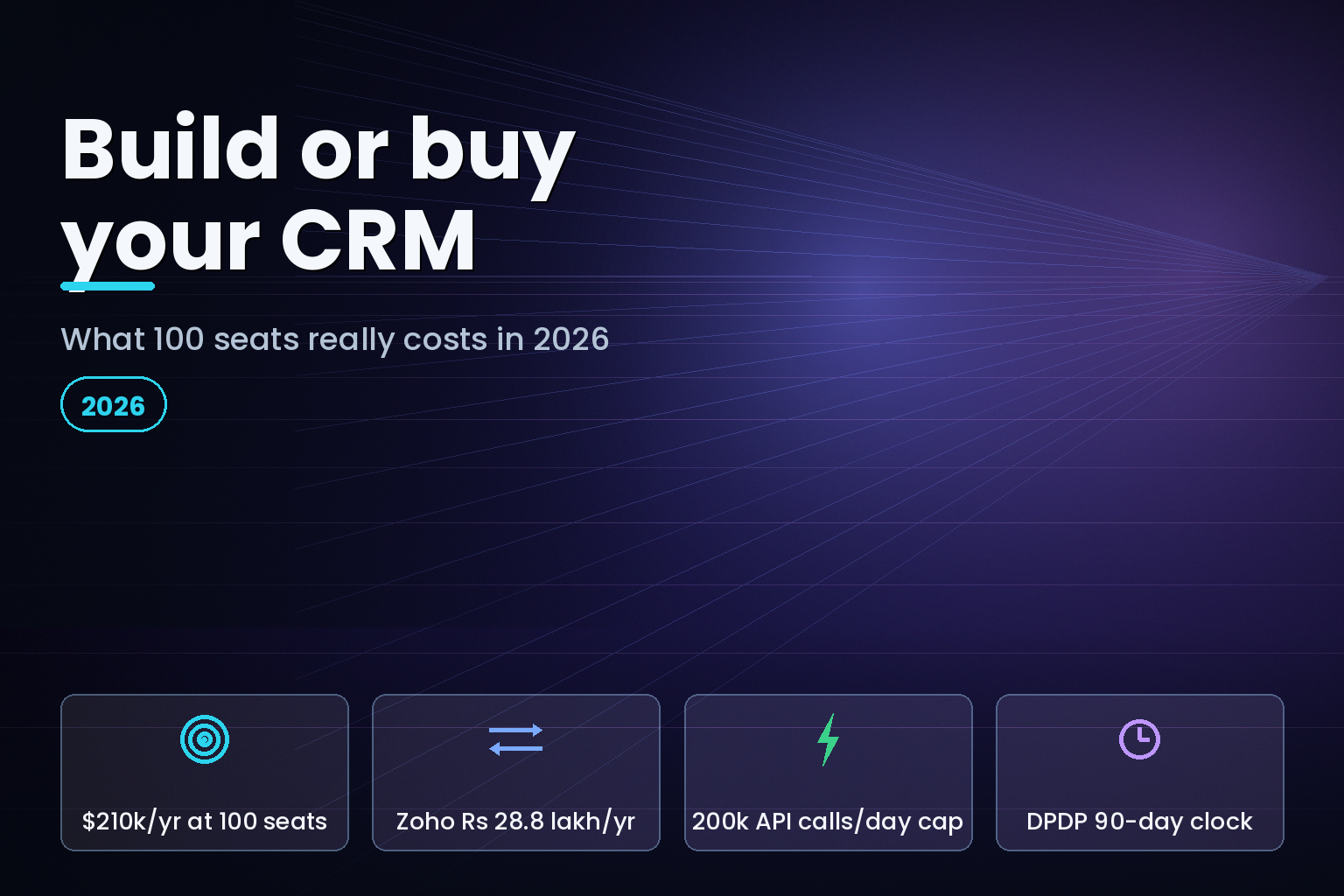
Summary. A hundred-seat sales team on Salesforce Enterprise pays $175 per user per month, or $210,000 a year at the list price published in August 2026. The same team on Zoho CRM Enterprise pays Rs 2,400 per user per month billed annually, about Rs 28.8 lakh a year. Microsoft Dynamics 365 Sales Enterprise lists at Rs 8,735 per user per month paid yearly, so roughly Rs 1.05 crore. HubSpot Sales Hub Professional starts at $100 per seat per month plus a one-time $1,500 onboarding fee that is not optional. That is a spread of more than 7x for software that does broadly the same job, and the gap is the whole build-versus-buy argument. A custom CRM almost never wins on features. It wins, when it wins, on the four or five workflows a packaged product cannot model and on a seat cost that stops growing with headcount.
What the five main options actually cost
Prices below are the vendors' own published list rates, read from their pricing pages in August 2026. Note the currency mix: Salesforce publishes no rupee price on its India page at all, and HubSpot's India-facing pricing page renders nothing without JavaScript, so both are quoted in dollars. Zoho and Microsoft publish rupee rates directly.
| Vendor and edition | Published list price | 100 seats, one year | Billing note |
|---|---|---|---|
| Salesforce Sales Cloud Enterprise | $175 per user per month | $210,000 | Billed annually; Pro Suite charges $25 per user per month extra for the web services API |
| Microsoft Dynamics 365 Sales Enterprise | Rs 8,735 per user per month | about Rs 1.05 crore | Paid yearly, GST extra as applicable |
| HubSpot Sales Hub Professional | from $100 per seat per month | $120,000 plus $1,500 | Onboarding required for a one-time fee of $1,500 |
| Zoho CRM Enterprise | Rs 2,400 per user per month annually, Rs 3,000 monthly | about Rs 28.8 lakh | Local taxes charged in addition |
| Freshsales Enterprise | $59 per user per month | $70,800 | Billed annually |
Two details that change the arithmetic more than the headline rate. HubSpot's onboarding fee rises to $3,500 on Sales Hub Enterprise and is described as required, not recommended. And Salesforce puts the web services API behind a paid add-on on Pro Suite, which matters because API access is the thing you need if you plan to integrate the CRM with anything else you own.
Nobody pays list. Discounts at the hundred-seat mark are real. But list price is the right number for a build-versus-buy model, because it is the number that scales linearly with a growing sales team, and growth is the scenario in which building starts to look sensible.
The failure statistic you should stop quoting
Almost every custom CRM pitch opens with a version of "70% of CRM implementations fail". We went looking for the study behind it and could not find one.
The figure circulates only on vendor blogs, consultancies and agency pages, each attributing it to Gartner or Forrester without a document identifier, a date or a methodology. The numbers quoted are mutually inconsistent, running from 30% through 47% and 55% to 70%, which is the usual signature of a claim with no underlying research. The Gartner artefact most often named, a survey reported as finding that 42% of CRM software goes unused, now redirects to Gartner's homepage rather than to a document. The closest thing to a peer-reviewed source is a 2008 paper in the Journal of Database Marketing and Customer Strategy Management, and its abstract supports no such headline.
This matters commercially, not just intellectually. If your business case for a custom build rests on an unsourceable number, it will not survive a finance review. Build the case on your own data instead: seat count and its trajectory, the number of hours your team spends in spreadsheets that sit beside the CRM, and the specific processes your reps work around rather than through.
Build versus buy, on the vectors that decide it
| Decision vector | Buy a SaaS CRM | Build a custom CRM |
|---|---|---|
| Time to first productive use | Days to weeks; HubSpot's own onboarding windows are 60 days on Professional and 90 days on Enterprise | Months; a usable first release is realistic in one to two quarters if scope is held |
| Upfront cost | Low; subscription plus onboarding fee | High; the whole build lands before any value does |
| Cost trajectory | Linear in seats, forever | Front-loaded, then flat in seats and variable in change requests |
| Maintenance overhead | Vendor's problem, except for your customisations and integrations | Yours, permanently; budget for it from day one or the system rots |
| Data control and residency | Governed by the vendor's terms and regions | You choose the region, the retention policy and the export format |
| Process fit | Good for standard pipelines; workarounds accumulate where your process is unusual | Exact, and exactly as good as your understanding of your own process |
| Integration ceiling | Bounded by the edition's API allowance | Bounded by your own infrastructure |
The honest reading of that table is that buying wins for most companies most of the time. Custom development earns its place in three situations: when the sales process itself is the differentiator and no packaged pipeline models it, when the CRM has to sit inside an operational system you already own rather than beside it, or when seat economics have turned the subscription into a tax on hiring.
The API ceiling is the constraint people miss
The moment a CRM has to exchange data with billing, support, an ERP or a warehouse, the edition's API allowance becomes a design constraint rather than a footnote.
Salesforce publishes the formula openly. Enterprise and Professional editions with API access get 100,000 calls per 24-hour period plus 1,000 calls per Salesforce licence, plus any purchased add-ons. Salesforce's own worked example is an Enterprise org with 15 licences at 115,000 requests. Run that at 100 seats and the ceiling is 200,000 calls a day. Unlimited and Performance editions get 5,000 calls per licence instead of 1,000. Limits are enforced per org rather than per user, so a badly written nightly sync competes with everything else you run. Concurrent long-running requests, meaning anything over 20 seconds, are capped at 25 in production, and exceeding that returns a REQUEST_LIMIT_EXCEEDED error rather than a queue.
Zoho meters in credits rather than raw calls, on a rolling 24-hour window. Enterprise gets 50,000 credits plus 1,000 per user, so 150,000 credits a day at 100 seats, against a maximum of 5,000,000. The deduction is not one credit per call: converting a lead costs 5 credits, sending mail costs 20, merging records costs 50, and inserts or updates cost 1 credit per 10 records. A bulk import is cheap; a per-record workflow that sends email is not.
HubSpot publishes 650,000 calls a day on Professional and 1,000,000 on Enterprise, with a rate limit of 190 requests per 10 seconds on both.
Price the integration against those ceilings before you choose an edition. A team that discovers at month four that its sync design needs an edition upgrade has effectively been charged for the upgrade by its own architecture.
India-specific considerations
A CRM is a database of identified individuals, which places it squarely inside the Digital Personal Data Protection Act, 2023.
Section 5(1) requires that every consent request be accompanied or preceded by a notice describing the personal data, the purpose, how the data principal may exercise rights, and how to complain to the Board. Section 6(1) sets the standard for consent as free, specific, informed, unconditional and unambiguous, given by a clear affirmative action, and section 6(4) requires withdrawal to be as easy as giving consent was. Section 11 gives the data principal a right to a summary of their data and, importantly for a CRM, the identities of every other data fiduciary and processor the data has been shared with. Section 12 covers correction and erasure, and section 8(7) requires erasure once consent is withdrawn or the purpose is served, whichever is earlier. Section 8(6) requires intimation of a personal data breach to both the Board and each affected data principal.
The Rules were notified on 14 November 2025 with an eighteen-month phased compliance period, and the government's own explainer sets a hard operational number: requests relating to access, correction, updating or erasure must be addressed within a maximum of ninety days. Penalties run to Rs 250 crore for failure to maintain reasonable security safeguards and Rs 200 crore for failing to notify a breach.
Read that list as a feature specification. A CRM needs a per-record consent state and its provenance, a lawful-basis field on every contact, an export that satisfies the section 11 access right including downstream recipients, a genuine delete rather than a soft-delete flag, a ninety-day clock on rights requests, and a breach register. Packaged CRMs increasingly ship parts of this. Whether they ship enough for your data map is a question to answer during evaluation, not after signature. A custom build has to implement all of it, and that work is a real and frequently under-costed part of the estimate.
How we scope a CRM build
- Map the process before the schema. The workflows that packaged CRMs cannot model are the entire justification for building, so they get written down and agreed first.
- Draw the integration map and count the calls. This decides whether you are building a CRM or building an integration layer with a CRM attached, and the two have very different costs.
- Design the DPDP surface into the data model. Consent state, lawful basis, retention clock, erasure and the access export are schema decisions, not a compliance sprint at the end.
- Ship a thin vertical slice to real reps inside a quarter. A CRM nobody uses is the only guaranteed failure mode, and it shows up in week three of real use, not in user acceptance testing.
- Plan the migration and the parallel run. Contact deduplication and history import routinely take longer than the application build.
Our engagement model follows that order. A fixed-scope discovery produces the process map, the integration count against the relevant API ceiling, and the DPDP data map, and those three artefacts are enough to say honestly whether you should be building at all. Several of these engagements end with a recommendation to buy and to spend the budget on integration and data quality instead. The build itself then runs on milestones tied to the slice plan, with a retained senior team afterwards, because a CRM that stops changing stops matching the sales process.
For related reading, our custom software development company guide covers how we scope and price bespoke builds generally, SaaS development company covers multi-tenancy and billing if you intend to sell the product rather than run it internally, and software development company in Gurgaon covers engineering partner selection.
FAQ
How eCorpIT can help
eCorpIT is a Gurugram-based engineering organisation, founded in 2021, that builds custom CRM and revenue systems and integrates packaged ones. We start with a fixed-scope discovery that produces the process map, an integration count measured against the relevant vendor's API ceiling, and a DPDP data map, so the build-versus-buy decision is made on your numbers rather than on a vendor's. We design systems aligned with Digital Personal Data Protection Act, 2023 requirements and deliver with senior-led, multi-disciplinary teams under CMMI Level 5 assessed processes. Talk to our team if you want that decision made properly before anything gets built.
References
Last updated: 16 August 2026.