On this page · 11 sections
- The 2026 lineup: four things called "agent" tooling
- What is shutting down, and when
- Responses API vs Chat Completions: the primitive choice
- Agents SDK vs Agent Builder: code vs canvas
- What each option costs
- The decision, by use case
- India-specific considerations
- Bottom line
- FAQ
- How eCorpIT can help
- References
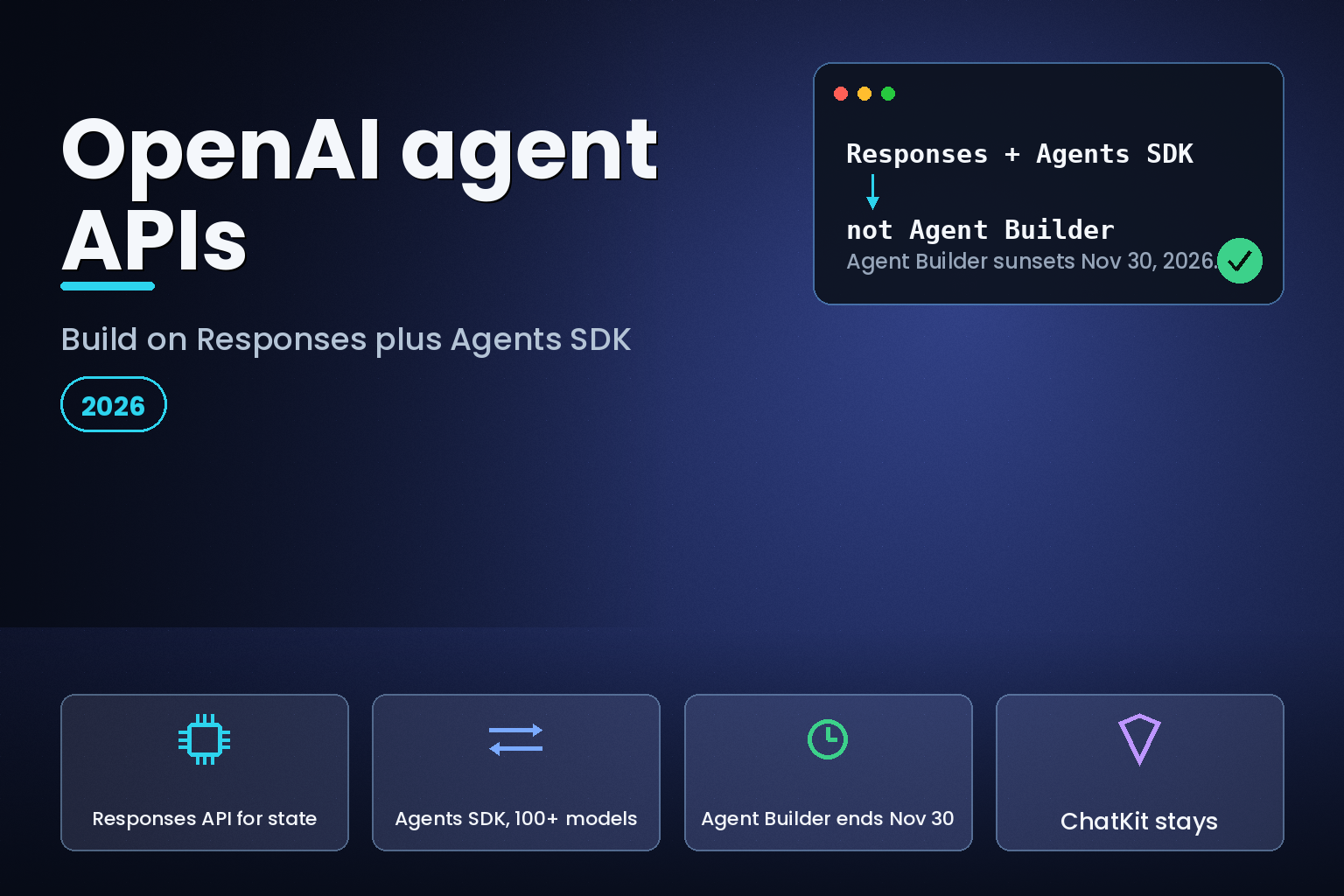
Summary. OpenAI now gives you four ways to build agents, and one of them is closing. On June 3, 2026, OpenAI posted deprecation notices for Agent Builder, the visual canvas inside AgentKit, and the Evals platform: the Evals dashboard goes read-only on October 31, 2026, and both products, along with reusable prompt objects, leave the platform on November 30, 2026. Separately, the older Assistants API sunsets on August 26, 2026, after which calls to /v1/assistants and /v1/threads return an error with no grace period. What survives and gets the investment is the Responses API, the new primitive OpenAI recommends for all new projects, and the Agents SDK, a code-first framework that is provider-agnostic across 100-plus models. ChatKit, the embeddable chat UI, also stays. The practical answer for 2026: build durable agent logic on the Responses API plus the Agents SDK, keep Chat Completions for simple stateless calls, use Agent Builder only for throwaway prototypes, and start nothing new on the Assistants API.
AgentKit landed at DevDay on October 6, 2025, and Sam Altman, CEO of OpenAI, pitched it as the fast path from prototype to production: "It is everything you need to build, deploy, and optimize agent workflows with way less friction." Nine months later, the visual half of that pitch is being retired while the code half is promoted. If you are choosing where to build now, the cost of guessing wrong is real. Built-in tools already carry their own meters on top of tokens: OpenAI's web search tool bills $10 per 1,000 calls, file search adds $2.50 per 1,000 calls plus $0.10 per GB of vector storage a day, and the code interpreter is $0.03 per container. Picking the wrong primitive means rebuilding the plumbing that touches all of it.
This guide separates the four options, shows what is closing and when, and gives a decision matrix by use case.
The 2026 lineup: four things called "agent" tooling
The confusion starts with names, so here is the plain version.
Chat Completions is the original API, at /v1/chat/completions. It is stateless: you resend the conversation each call and manage history yourself. It is broadly compatible and is not going away, but new agentic features are not being added to it.
The Responses API is the newer primitive OpenAI shipped in March 2025 as the evolution of Chat Completions. It keeps the simple request shape but adds server-side state through previous_response_id and the Conversations API, plus built-in tools (web search, file search, code interpreter), remote MCP support, and background execution. OpenAI's own guidance is that new capabilities land in the Responses API first, and often only there.
The Agents SDK is a lightweight, open-source framework for orchestrating one or many agents in code. It is provider-agnostic: it runs on the Responses API and Chat Completions, and on 100-plus other models through a common interface. This is the layer OpenAI now points to for logic that has to live in your codebase.
AgentKit is the suite announced at DevDay 2025, not a single API. It bundles Agent Builder (a drag-and-drop visual canvas for multi-agent workflows), ChatKit (an embeddable chat UI), a Connector Registry, and evaluation tooling. The important distinction for this decision: Agent Builder is the piece being retired, while ChatKit stays.
Two older paths sit alongside these. The Assistants API, OpenAI's first stateful agent API, is deprecated with a hard sunset. And for people who do not want to write code at all, OpenAI now steers non-technical workflows toward Workspace Agents inside ChatGPT rather than Agent Builder.
What is shutting down, and when
Three separate clocks are running in the second half of 2026. Missing any of them means a broken production path, because none of these shutdowns has a degraded mode.
| Product | Status and date | What to do |
|---|---|---|
| Assistants API | Sunsets August 26, 2026; endpoints then error | Migrate to the Responses API plus the Conversations API |
| Agent Builder (visual canvas) | Leaves the platform November 30, 2026 | Rebuild the workflow logic in the Agents SDK |
| Evals platform | Read-only October 31, 2026; gone November 30, 2026 | Move to code-based evaluations you own |
| Reusable prompt objects | Removed November 30, 2026 | Inline prompts and version them in your repository |
| Chat Completions | Supported; no new agentic features | Keep for simple, stateless calls |
| ChatKit | Remains available | Keep for embeddable chat interfaces |
The Assistants API deadline is the sharpest. OpenAI announced it on August 26, 2025 with exactly one year of runway, and has said it will not ship a tool to migrate existing Threads to Conversations, so that port is manual work. If you still run anything on /v1/threads, treat August 26, 2026 as a hard wall and read our Assistants API shutdown and Responses migration walkthrough before you start.
Responses API vs Chat Completions: the primitive choice
Every agent you build sits on one of these two request primitives, so choose here first. Chat Completions is simpler and universal; the Responses API is where OpenAI is putting agent features and state.
| Dimension | Chat Completions | Responses API |
|---|---|---|
| Conversation state | Manual: you resend history each call | Server-side via previous_response_id / Conversations API |
| Built-in tools (web, file, code) | Not available | Available |
| Remote MCP tools | Not supported | Supported |
| New agentic features | Frozen | Land here first, often only here |
| Best for | Simple, stateless one-shot calls | New agent apps that need tools and state |
For a stateless classifier or a single completion, Chat Completions is still the right, cheap default. For anything that keeps context, calls tools, or connects to an MCP server, start on the Responses API. That choice also sets up the model-selection work in our note on choosing between OpenAI's realtime and platform APIs.
Agents SDK vs Agent Builder: code vs canvas
This is where the wind-down forces a decision. Agent Builder and the Agents SDK solve the same problem, multi-step and multi-agent orchestration, but only one of them will exist in December 2026.
| Dimension | Agent Builder (visual) | Agents SDK (code) |
|---|---|---|
| Interface | Drag-and-drop canvas | Python or TypeScript in your repo |
| Versioning | On the OpenAI platform | Your version control |
| Portability | OpenAI platform only | Provider-agnostic, 100-plus models |
| Longevity | Sunsets November 30, 2026 | Supported and recommended |
| Best for | Fast throwaway prototypes | Durable production logic |
Agent Builder is genuinely useful for sketching a workflow with non-engineers in the room. The mistake is shipping that canvas as your production system, because the platform is now telling you it will be gone by year end. The Agents SDK gives you the same orchestration with three properties Agent Builder cannot match: your logic lives in your repository, it is portable across model providers, and it is the path OpenAI is committing to. If you want a broader view of orchestration frameworks, our comparison of production AI agent frameworks puts the Agents SDK next to LangGraph, CrewAI and the Microsoft and Pydantic options.
What each option costs
The base API primitives bill the same way: you pay your chosen model's per-token rates, and Chat Completions, the Responses API and the Agents SDK do not add a framework fee on top. The cost differences come from the built-in tools, which the Responses API unlocks and Chat Completions does not.
As of 2026, OpenAI's built-in tools are metered separately from tokens. The web search tool costs $10 per 1,000 calls, and each search also bills roughly 8,000 input tokens at your model's rate. File search is $2.50 per 1,000 tool calls plus $0.10 per GB of vector storage per day, with the first GB free. The code interpreter is $0.03 per container, billed by the minute with a five-minute minimum per session. Tokens consumed by any tool are charged on top at the model rate.
The planning point: your primitive choice sets your tool bill. If your agent leans on hosted web search and file search, those meters, not the base tokens, often dominate the cost, and only the Responses API path exposes them. The Agents SDK, because it is provider-agnostic, is also the cleanest place to route some traffic to cheaper models and keep the expensive built-in tools for the calls that truly need them, which is the kind of hybrid routing we cover for teams watching AI customer support agent build-vs-buy costs.
The decision, by use case
Match your situation to the row. The pattern is consistent: code-first primitives for anything durable, visual and no-code tools only for prototypes and UIs.
| If you are | Build on | Avoid |
|---|---|---|
| Starting a new production agent | Responses API plus Agents SDK | Agent Builder for core logic |
| Adding an embeddable chat UI | ChatKit | Rebuilding your own from scratch |
| Wanting a no-code business workflow | Workspace Agents in ChatGPT | Agent Builder |
| Running on the Assistants API | Responses API plus Conversations before August 26 | Staying past the sunset |
| Prototyping fast and disposably | Agent Builder until November 30 | Shipping that canvas to production |
India-specific considerations
For Indian product teams and global capability centres standardising an agent stack in 2026, two factors weigh heavier than they do elsewhere. The first is provider portability. Teams under pressure to control token spend want the freedom to route cheaper or open-weight models for high-volume, low-stakes calls, and the Agents SDK's provider-agnostic design makes that a configuration change rather than a rewrite, whereas Agent Builder locks logic to the OpenAI platform. The second is data governance under the Digital Personal Data Protection Act. The Responses API can store conversation state server-side through the Conversations API, so teams handling personal data need to decide deliberately what is persisted with OpenAI versus kept in their own systems, and document that data flow. Building on the SDK in your own code makes that boundary explicit, which matters when a data-protection review asks where user data lives. Governance patterns like these are the focus of our enterprise AI agent governance layers guide.
Bottom line
The four-way choice collapses into a simple rule for 2026. Build new agents on the Responses API for the primitive and the Agents SDK for the orchestration, because that is where OpenAI is investing and it keeps your logic portable and in your repository. Keep Chat Completions for simple stateless calls and ChatKit for embeddable UIs. Treat Agent Builder as a whiteboard, not a runtime, since it leaves the platform on November 30, 2026. And if you are still on the Assistants API, the August 26, 2026 sunset is the deadline that cannot slip.
FAQ
How eCorpIT can help
eCorpIT is a CMMI Level 5 and ISO 27001:2022 certified engineering organisation in Gurugram, and our senior-led teams ship production agents on the Responses API and the Agents SDK. We can migrate an Assistants API or Agent Builder workflow to code before the 2026 deadlines, wire in built-in tools without runaway cost, and set up code-based evals your team owns. If you want a migration and build plan for your OpenAI agents, talk to our engineering team.
References
_Last updated: July 28, 2026._