On this page · 11 sections
- What changed with DeepSeek V4 in July 2026
- The API side: what DeepSeek V4 actually costs to call
- The self-hosting side: what it takes to serve V4 yourself
- The number that decides it: GPU utilization
- Break-even: a worked comparison by monthly volume
- When self-hosting DeepSeek V4 still wins
- India-specific considerations
- A short decision checklist
- FAQ
- How eCorpIT can help
- References
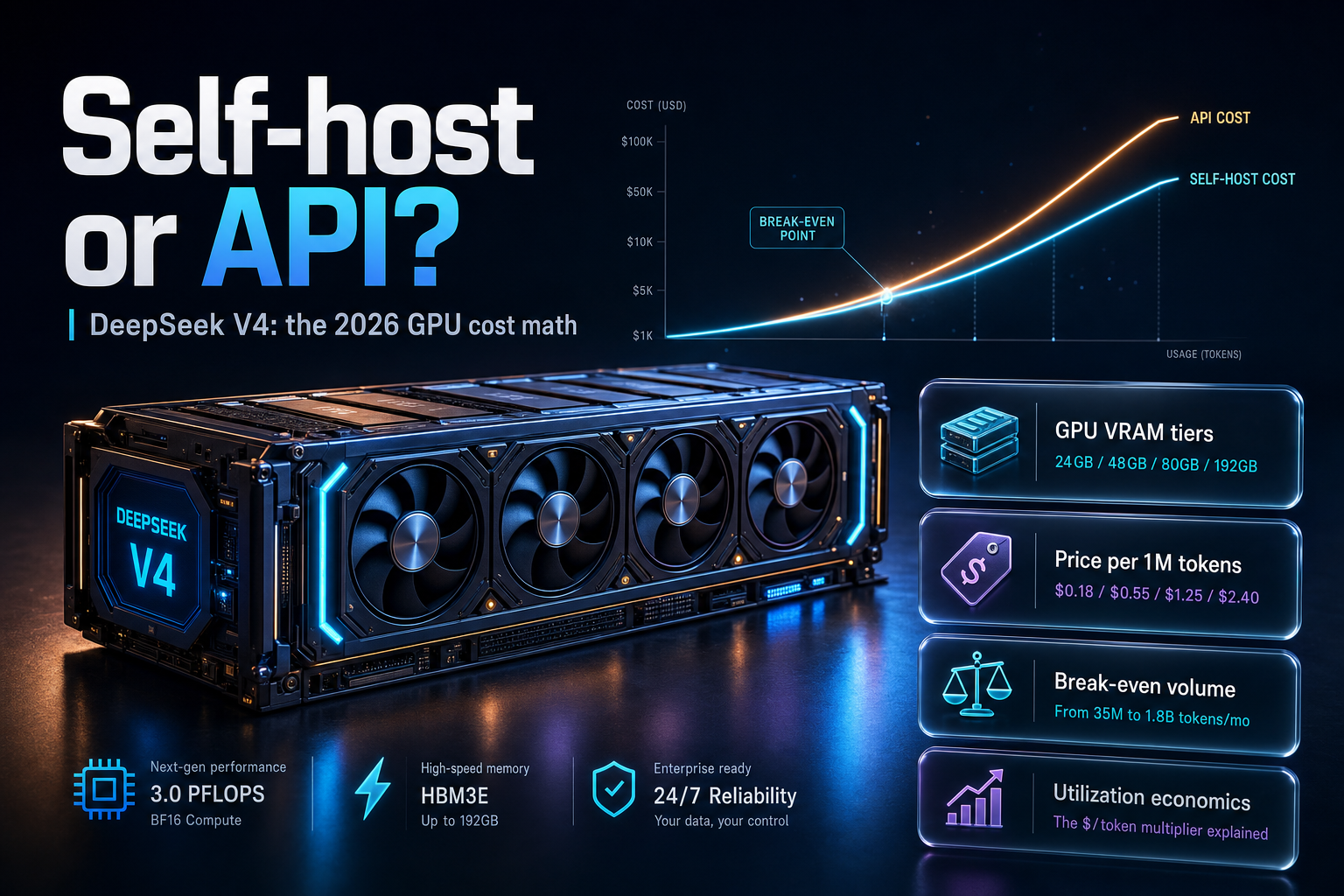
Summary. DeepSeek V4 is an awkward model to reason about, because it ships as both a cheap hosted API and an open-weight model under an MIT license. That means the usual "self-host to escape an expensive API" logic, the logic that works against GPT-5-class or Claude models, does not automatically apply. DeepSeek's own pricing page lists V4-Flash at $0.14 per 1M input tokens (cache miss) and $0.28 per 1M output tokens, with V4-Pro at $0.435 and $0.87; a cache hit drops input to $0.0028. Against rates that low, a rented H100 at a 2026 median near $3.15 per GPU-hour only beats the API when you keep the card busy. A June 2026 arXiv study measured one H100 swinging from $0.21 to $15.25 per 1M output tokens as utilization moved. This guide works those numbers for CTOs, ML platform engineers, and FinOps leads, and shows where self-hosting DeepSeek V4 actually pays and where it just adds an operations bill.
What changed with DeepSeek V4 in July 2026
DeepSeek shipped V4 as a preview on 24 April 2026 and moved it to a stable release around 20 July 2026. On 24 July 2026 at 15:59 UTC the older model names deepseek-chat and deepseek-reasoner were retired; DeepSeek's documentation notes those names now map to the non-thinking and thinking modes of deepseek-v4-flash. If you built against the old identifiers, that cutover is a hard dependency, and we cover it separately in our note on the DeepSeek V4 legacy API cutoff.
Two facts make V4 different from the frontier API you may be comparing it against. First, the weights are open under an MIT license, so you can legally run them on your own hardware. Second, the API is already priced near the floor of what inference costs, so the model gives you a genuine build-versus-buy choice rather than an obvious one. Ahead of the July release, TechNode reported that DeepSeek would add peak and off-peak API pricing; the live pricing page currently lists flat rates, so confirm the rate in your billing region before you model anything.
DeepSeek publishes V4 in two sizes. The specifications below come from DeepSeek's pricing page for the price, context, and concurrency figures, and from published model write-ups for the parameter and weight estimates, which vary by a few percent between trackers.
| Attribute | DeepSeek V4-Flash | DeepSeek V4-Pro |
|---|---|---|
| Total parameters | ~284 billion (MoE) | ~1.6 trillion (MoE) |
| Active parameters per token | ~13 billion | ~49 billion |
| Approx. open-weight size | ~570 GB (FP8/FP4) | ~3.2 TB (FP8/FP4) |
| Context length | 1M tokens | 1M tokens |
| Max output | 384K tokens | 384K tokens |
| Input, cache miss (per 1M) | $0.14 | $0.435 |
| Output (per 1M) | $0.28 | $0.87 |
| API concurrency limit | 2,500 | 500 |
The split matters for this decision. V4-Flash is small enough to serve on a single dense GPU node, and its API is cheap enough that self-hosting rarely wins on token cost. V4-Pro is a 1.6-trillion-parameter mixture-of-experts model whose weights alone run to roughly 3.2 TB, so serving it yourself is a multi-GPU project before you have answered a single request.
The API side: what DeepSeek V4 actually costs to call
Start with the buy option, because it sets the bar the build option has to beat. On DeepSeek's first-party API, V4-Flash charges $0.14 per 1M input tokens on a cache miss and $0.28 per 1M output tokens. Reused prompt prefixes hit the context cache and fall to $0.0028 per 1M input tokens, a hundredfold reduction on the input side that rewards workloads with long, stable system prompts. V4-Pro costs roughly three times as much on input and output, at $0.435 and $0.87 per 1M tokens.
Put that in workload terms. A support-assistant workload that reads 2,000 tokens and writes 500 tokens per turn costs, on V4-Flash, about $0.00028 input plus $0.00014 output, so roughly $0.00042 per turn before caching. A million such turns a month is about $420. Even at ten million turns a month you are near $4,200 on V4-Flash. That is the number self-hosting has to undercut, and it is already low.
The catch on the API side is control rather than price. DeepSeek's first-party API runs on infrastructure in China, so regulated data may not be routable to it without a legal review, and rate limits, model updates, and any peak-pricing windows are the vendor's to change. DeepSeek's V4 models have also appeared on third-party and hyperscaler catalogues, which can give a residency option without self-hosting, but that shifts you to that host's pricing rather than the first-party rates above.
The self-hosting side: what it takes to serve V4 yourself
Now the build option. Self-hosting an open-weight model means renting or owning GPUs, standing up a serving stack such as vLLM or SGLang, and then keeping the whole thing fed, patched, and monitored. The hardware bill starts with memory: you need enough GPU VRAM to hold the weights plus the key-value cache for every in-flight request.
| Requirement | DeepSeek V4-Flash | DeepSeek V4-Pro |
|---|---|---|
| Weights on disk | ~570 GB | ~3.2 TB |
| Practical serving precision | FP8, FP4 for routed experts | FP8, FP4 for routed experts |
| Rough VRAM floor | ~1 node of 8x 80-96 GB GPUs | Multi-node, 3.2 TB-class GPU memory |
| Example GPU class | H100/H200 SXM node | Multiple H200/B200 nodes |
| Serving stack | vLLM or SGLang | vLLM or SGLang with expert parallelism |
| Realistic operator | Platform team with GPU ops | Dedicated inference team |
For rented compute, a 2026 GPU price index put the H100 cohort median near $3.15 per GPU-hour, with quoted rates spanning $1.49 to $6.98 across more than fifteen providers, per IntuitionLabs. H200 rates ran higher, from about $2.30 at the cheapest provider to $13.78 on a hyperscaler, with a cohort median near $4.11 per GPU-hour, per the aimultiple GPU price index. Those ranges move, and hyperscalers sit at the top of them: DataCenterDynamics reported that AWS raised H200 EC2 prices by about 15% in 2026.
Take an eight-GPU H100 node at the $3.15 median. That is about $25.20 per GPU-hour times eight, so roughly $25 per hour, near $18,000 per month if you run it around the clock. You pay that whether the node serves a million requests or sits idle, which is the single most important fact in this whole comparison.
The number that decides it: GPU utilization
A rented GPU costs the same idle as it does at full load. So the real per-token cost of a self-hosted deployment is set less by the sticker price of the card and more by how busy you keep it. A card at 10% utilization costs roughly ten times per token what the same card costs at full load.
The June 2026 arXiv paper Beyond Per-Token Pricing put hard numbers on this. On identical H100 hardware, the authors measured effective cost spanning $0.21 to $15.25 per 1M output tokens purely as a function of the request rate the GPU was serving. At one request per second, a Mixtral 8x7B FP16 deployment cost $15.25 per 1M tokens; at 25 requests per second on the same card, it cost $0.87. They found an underutilization penalty of 2.5x to 24x across the light-to-moderate enterprise loads of one to ten requests per second, rising to 36.3x near idle, and argued that cost calculators assuming fixed utilization understate the real figure by a factor of one over utilization.
Read that against DeepSeek's $0.28 per 1M output tokens for V4-Flash. A self-hosted card only reaches that price band when it is genuinely busy, and it blows straight past it the moment traffic dips. This is why self-hosting a cheap open-weight model to save money is the trap: you are betting you can keep expensive hardware near full load every hour, and most real traffic is spiky. Our guide to running a local LLM in production with vLLM walks through the serving-stack side of keeping utilization high.
Break-even: a worked comparison by monthly volume
Put the two sides on one table. Assume V4-Flash, an eight-GPU H100 node at roughly $18,000 per month rented, and a workload weighted toward output tokens. The API column uses DeepSeek's $0.28 per 1M output rate; the self-host column divides the fixed node cost by the tokens actually served, which is why the effective self-host rate only falls as volume rises.
| Monthly output tokens | DeepSeek V4-Flash API cost | Self-host node cost | Effective self-host rate | Cheaper option |
|---|---|---|---|---|
| 50 million | ~$14 | ~$18,000 | ~$360 per 1M | API, by a mile |
| 1 billion | ~$280 | ~$18,000 | ~$18 per 1M | API |
| 10 billion | ~$2,800 | ~$18,000 | ~$1.80 per 1M | API |
| 40 billion | ~$11,200 | ~$18,000 | ~$0.45 per 1M | API |
| 65 billion | ~$18,200 | ~$18,000 | ~$0.28 per 1M | Roughly even |
| 120 billion | ~$33,600 | ~$18,000 | ~$0.15 per 1M | Self-host |
The crossover against V4-Flash lands near 65 billion output tokens a month, and only if your node holds high utilization the whole time. That is a large, steady workload, on the order of a card kept near full load continuously. Below it, the first-party API is cheaper and carries none of the operations cost. This matches the field heuristic several 2026 analyses reached independently: stay on the API until you are spending well above $15,000 to $20,000 a month, then evaluate self-hosting, per Spheron's cost analysis. Against a frontier API priced at $5 to $15 per 1M tokens the break-even arrives far sooner; against DeepSeek's own cheap rates it arrives late.
The real cost of self-hosting is usually the operations, not the GPUs. Capacity planning, cold-start latency, a serving stack to tune, and a model that drifts as DeepSeek ships updates all land on a platform team, and none of it shows up in a per-token spreadsheet.
When self-hosting DeepSeek V4 still wins
Cost is not the only axis, and for some buyers it is not the deciding one. Self-hosting V4 makes sense when at least one of these holds, regardless of the token math.
Data residency and sovereignty. If regulated data cannot leave your jurisdiction or cannot transit a China-based endpoint, the first-party API is off the table and self-hosting or a residency-compliant host is the only path. This is common in Indian BFSI under sectoral rules, in EU deployments under GDPR, and in healthcare.
Latency control. Sub-100-millisecond first-token latency for a product in a single region is easier to guarantee on your own co-located hardware than across a public API you do not control.
Predictable spend and peak-price insulation. A fixed monthly node cost is easier to budget than metered per-token billing, and it removes exposure to any peak-pricing windows the vendor introduces.
Throughput you can actually fill. If you run steady batch workloads, document processing, offline evaluation, bulk generation, where a card can sit near full load, the utilization problem disappears and self-hosting reaches its best-case per-token cost.
If none of these apply, the API is the cheaper and simpler choice, and a hybrid routing setup to control API spend will get you most of the cost control without the GPU operations. For the hardware trade-offs behind a self-host build, our comparison of B200 vs H100 inference cost per token covers the card-level economics.
India-specific considerations
For Indian teams the arithmetic shifts on both sides. GPU rental is cheaper here than the global hyperscaler top end. JarvisLabs lists H100 SXM at ₹255 per hour and H200 SXM at ₹378 per hour, well below the hyperscaler rates that sit at the top of the dollar ranges above. Subsidized GPU access under the IndiaAI Mission has been reported lower still for eligible users. Rates like these can move the self-host break-even meaningfully below the dollar math, which is why we track India GPU cloud rental pricing separately.
Against that, the data-governance case for self-hosting is often stronger in India. The Digital Personal Data Protection Act 2023 raises the bar for where personal data is processed, and RBI-regulated entities face sectoral localization expectations that a China-based API cannot satisfy. For many Indian buyers, self-hosting V4 is a compliance decision first and a cost decision second, and the cheaper local GPU rates then make that decision easier to fund. Teams working the broader bill should read our playbook on how Indian teams cut cloud spend without breaking delivery.
A short decision checklist
Before you spin up a GPU node for DeepSeek V4, answer these in order. Is your monthly output-token volume above the roughly 65-billion crossover for V4-Flash, or the far higher figure for V4-Pro, at high utilization? Can you actually keep the node busy, or is your traffic spiky enough that utilization will sit in single or low double digits? Do you have a residency, latency, or predictable-spend requirement that the API cannot meet? Do you have a platform team that can operate vLLM or SGLang, plan capacity, and absorb model updates? If you answered no to the volume and utilization questions and no to the residency question, the DeepSeek API is almost certainly your cheaper, simpler option. If you answered yes to residency or to steady high-volume throughput, self-hosting starts to earn its keep.
FAQ
How eCorpIT can help
eCorpIT is a Gurugram-based, senior-led engineering organisation (founded 2021; CMMI Level 5, MSME, ISO 27001:2022 certified) that helps teams decide between hosted LLM APIs and self-hosted open-weight models, then build whichever path the numbers support. We model your token volumes, utilization, and residency constraints against current API and GPU rates, and we design deployments aligned with DPDP Act and RBI localization requirements where regulated data is in scope. Whether you need a vLLM or SGLang serving stack, a hybrid routing layer, or an honest build-versus-buy analysis before you commit hardware, talk to our team.
References
- Models & Pricing, DeepSeek API Docs — official V4-Flash and V4-Pro prices, context, concurrency, and legacy model deprecation.
- DeepSeek to launch V4 in mid-July with new peak-time API pricing, TechNode — release timing and peak-pricing plan.
- Beyond Per-Token Pricing: A Concurrency-Aware Methodology for LLM Infrastructure Cost Estimation, arXiv 2606.11690 — H100 cost span of $0.21 to $15.25 per 1M output tokens by utilization.
- H100 rental prices compared across cloud providers, IntuitionLabs — H100 rental range of $1.49 to $6.98 per GPU-hour.
- Cloud GPU price index, aimultiple — H100 and H200 cohort medians and ranges.
- AWS quietly increases prices for H200 EC2 instances by 15%, DataCenterDynamics — hyperscaler H200 price move.
- AI inference cost economics in 2026, Spheron — self-host versus API break-even heuristics.
- GPU Cloud India pricing, JarvisLabs — India H100 and H200 hourly rental rates in rupees.
- DeepSeek V4 preview release notes, DeepSeek API Docs — V4-Flash and V4-Pro preview launch.
- DeepSeek V4 specifications and benchmarks, NxCode — parameter counts and weight-size estimates for V4-Flash and V4-Pro.
- DeepSeek V4 architecture and pricing overview, Morph — mixture-of-experts detail and output pricing.
_Last updated: 28 July 2026._