On this page · 9 sections
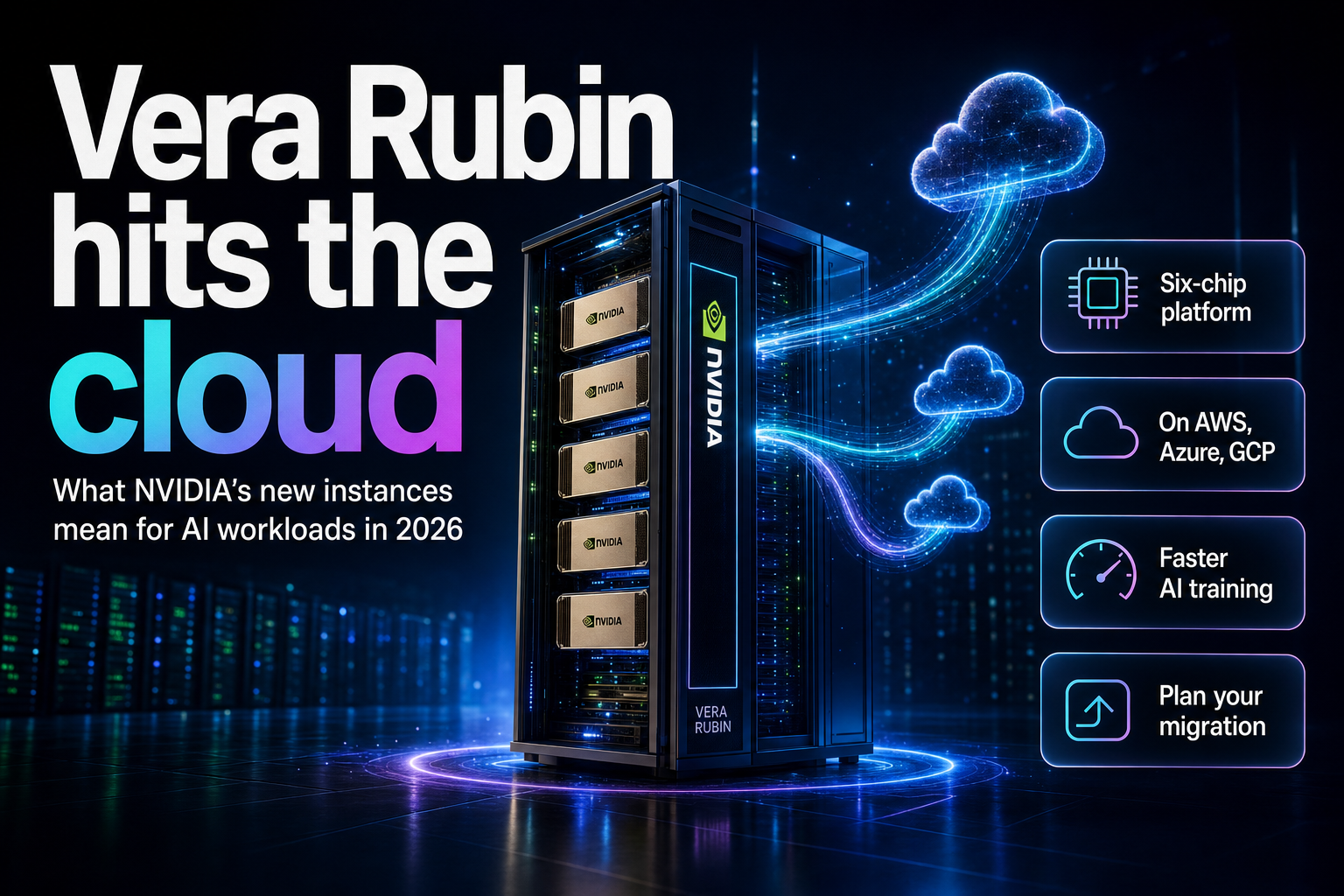
Summary. NVIDIA's Vera Rubin platform entered full production on June 1, 2026 at the GTC Taipei keynote, and production shipments reach eight cloud partners this fall: AWS, Google Cloud, Microsoft Azure, Oracle Cloud, CoreWeave, Lambda, Nebius and Nscale. The jump is large. A Rubin GPU delivers 50 petaflops of FP4 inference, 5 times Blackwell, and 35 petaflops for training, 3.5 times Blackwell, with HBM4 memory bandwidth of 22 terabytes per second, 2.8 times higher. NVIDIA says the platform cuts cost per token up to 10x versus Blackwell for large mixture-of-experts inference, the economics that sit under model prices like $1 to $6 per million tokens. For infrastructure and ML platform teams, the question is not whether Rubin is faster but which workloads justify moving and when capacity will actually be reachable.
What NVIDIA shipped
Vera Rubin is a platform of six chips, not a single GPU: the Vera CPU, the Rubin GPU, the NVLink 6 Switch, the ConnectX-9 SuperNIC, the BlueField-4 DPU and the Spectrum-6 switch. It reached full production on June 1, 2026, and CoreWeave completed the first Vera Rubin NVL72 system bring-up the same day. The rack-scale unit, the NVL72, combines 72 Rubin GPUs and 36 Vera CPUs into one system, delivering 3.6 exaflops of inference compute and 2.5 exaflops for training.
Where and when you can get it
The eight confirmed cloud partners cover the hyperscalers most teams already use, AWS, Google Cloud, Azure and Oracle Cloud, plus the specialist NVIDIA Cloud Partners CoreWeave, Lambda, Nebius and Nscale. Shipments begin this fall, in the second half of 2026. As with every NVIDIA generation, the constraint will be capacity, not catalogue availability, so early reservation matters more than which provider lists it first.
| Metric | Rubin | Improvement vs Blackwell |
|---|---|---|
| FP4 inference per GPU | 50 petaflops | 5x |
| FP4 training per GPU | 35 petaflops | 3.5x |
| Memory bandwidth (HBM4) | 22 TB/s | 2.8x |
| NVLink per GPU | 3.6 TB/s | 2x |
| NVL72 rack inference | 3.6 exaflops | About 5x at rack scale |
| Cost per token (MoE inference) | Up to 10x lower | 10x |
Why it matters for your workloads
The gains are not uniform, so the migration decision should not be either. Rubin's advantage is largest where memory bandwidth and interconnect dominate: large mixture-of-experts inference, advanced reasoning, and agentic workloads that fan out many model calls. The 22 TB/s of HBM4 bandwidth and doubled NVLink are what deliver the up-to-10x cost-per-token improvement, and that is the number that changes a FinOps case. For steady, small-batch inference that already runs cheaply, the benefit is marginal, and the sensible move is to wait. Our guide to GPU spend as a FinOps concern frames the tradeoff.
| Workload | Rubin advantage | What to do |
|---|---|---|
| Large MoE and reasoning inference | Up to 10x lower cost per token | Prioritise for migration |
| Frontier model training | 3.5x training throughput | Reserve capacity early |
| Memory-bound models | 22 TB/s HBM4 bandwidth | Strong fit, plan a move |
| Standard small-batch inference | Marginal at current cost | Stay put for now |
| Small or steady workloads | Limited benefit | No urgency to migrate |
Planning the move
Treat Rubin as a capacity-reservation exercise, not an upgrade you click. Identify the workloads whose cost per token or training time actually gates the business, model the saving against reserved-instance pricing when providers publish it, and get in the reservation queue early because demand will outrun supply. For everything else, Blackwell and cost-optimised options remain the right call, a point we make in our FinOps guide for cloud teams.
India-specific considerations
For Indian teams, Rubin capacity will arrive first through the global hyperscalers and specialist clouds rather than local infrastructure, so latency and data-residency questions matter for any workload touching personal data under the Digital Personal Data Protection Act, 2023. Weigh the cost-per-token saving against egress and residency, and reserve early, because Indian demand competes in the same global capacity pool. The broader planning frame is in our enterprise AI strategy guide.
What to do this quarter
Shortlist the two or three workloads where cost per token or training time is a real constraint, and size the Rubin saving against your current Blackwell spend. Open reservation conversations with your cloud provider now rather than after the fall launch, since capacity, not availability, is the bottleneck. Leave everything that runs cheaply today where it is, and revisit once reserved pricing is public.
FAQ
How eCorpIT can help
eCorpIT is a Gurugram-based, CMMI Level 5 consultancy and an AWS, Microsoft and Google partner. Our senior infrastructure engineers help teams decide which workloads justify Rubin, model the cost-per-token saving against current spend, and plan capacity reservations and migration without over-committing. To plan your AI infrastructure for 2026, talk to our team.
References
- NVIDIA kicks off the next generation of AI with Rubin: six new chips, one AI supercomputer - NVIDIA Newsroom.
- Inside the NVIDIA Rubin platform: six new chips, one AI supercomputer - NVIDIA Technical Blog.
- NVIDIA kicks off the next generation of AI with Rubin - NVIDIA Investor Relations.
- NVIDIA Vera Rubin ships this fall: 8 cloud partners, 10x lower token cost, HBM4 triples bandwidth - Tech Times.
- NVIDIA launches next-generation Rubin AI compute platform - ServeTheHome.
_Last updated: July 10, 2026._