On this page · 9 sections
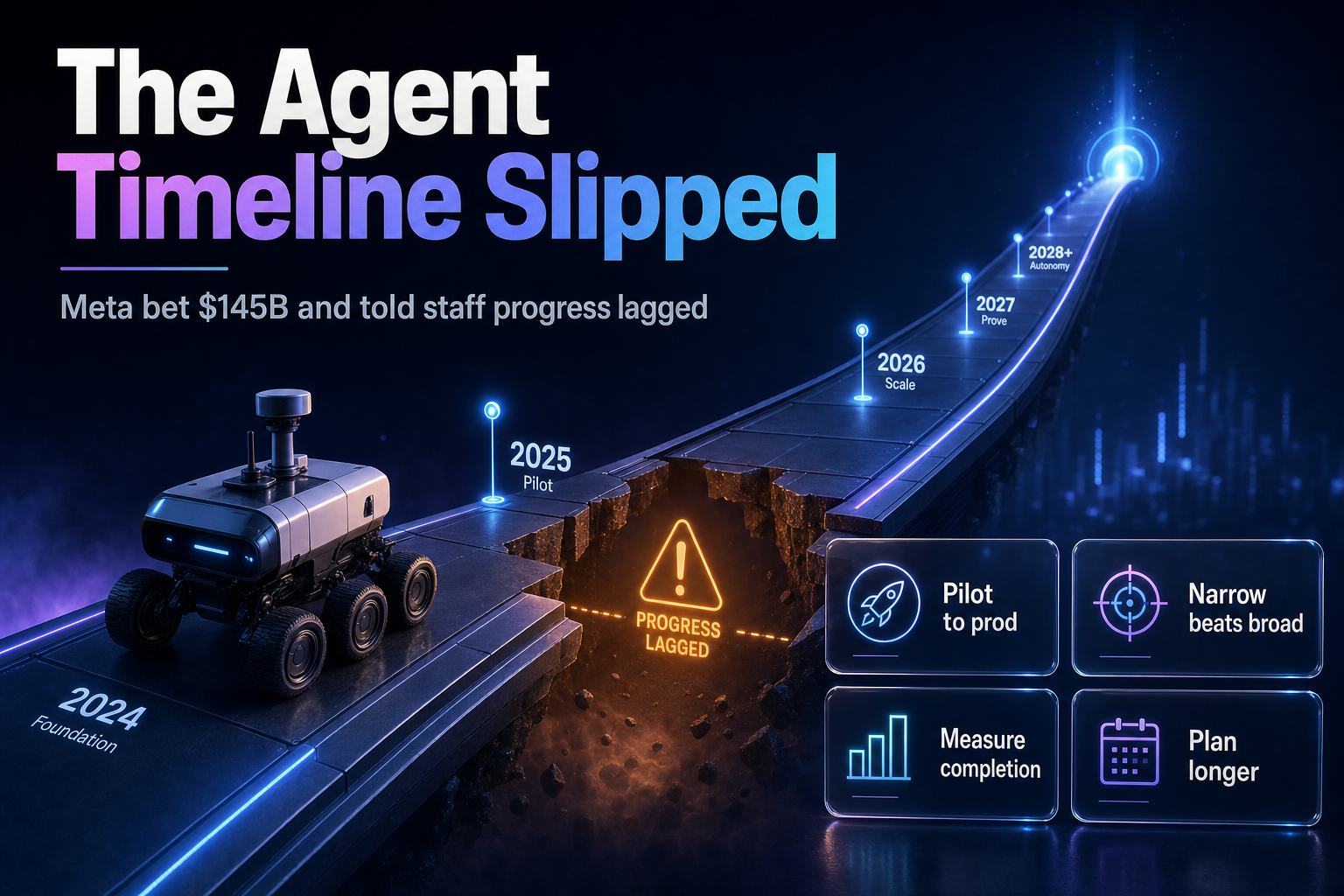
Summary. At an internal town hall on July 2, 2026, Mark Zuckerberg told Meta staff that the pace of AI agent development had not "accelerated in the way" executives previously expected. The admission carries weight because of what Meta staked on the opposite view: projected 2026 capital expenditure of $125 billion to $145 billion, more than twice its 2025 outlay; roughly 8,000 employees laid off, about 10% of the corporate workforce; and about 7,000 more reassigned into new AI groups including Applied AI Engineering and Agent Transformation Accelerator XFN. The restructuring touched roughly 20% of the organisation. Zuckerberg said executives had been "super optimistic" about tools like Anthropic's Claude Code when planning began in January and February, and still expects meaningful benefits within three to six months. The wider data says he is not an outlier: Gartner reports 89% of AI agent pilots never reach production. If the company spending $145 billion is behind schedule, a plan that assumed agents would carry your 2026 roadmap needs re-dating.
What Meta said, and what Meta did
The gap between the two is the story.
| What Meta did | Scale | When |
|---|---|---|
| Cut staff | About 8,000, roughly 10% of the corporate workforce | First wave, 2026 |
| Reassigned staff into AI teams | Upward of 7,000, per Chief People Officer Janelle Gale | 2026 |
| Named new AI groups | Applied AI Engineering, Agent Transformation Accelerator XFN, Central Analytics | 2026 |
| Committed capital expenditure | $125–$145 billion projected for 2026, more than twice 2025 | 2026 |
| Told staff agents lagged | "Progress... hasn't accelerated in the way" expected | July 2, 2026 |
Zuckerberg was candid about the cuts themselves. He said they were not as "clean" as they should have been, and explained that they happened because top officials at the company "were worried that we weren't going to move fast enough to adapt" to a changing industry. He has since ruled out further company-wide layoffs this year.
Read that sequence in order. Meta restructured around a capability, then discovered the capability was behind schedule. The restructuring was not wrong because agents are useless. It was mistimed because the plan assumed a delivery date the technology did not hit.
That is the failure mode worth learning from, and it is available to any company at any scale.
The evidence was there before July
Zuckerberg's town hall is the loudest data point, not the first one. The pilot-to-production numbers have been consistent for a year.
| Finding | Figure | Source |
|---|---|---|
| AI agent pilots that never reach production | 89% | Gartner |
| Generative AI pilots with no measurable P&L return | About 95% | MIT Project NANDA |
| AI pilots that never reach production | 88% | Iris.ai 2026 enterprise analysis |
| AI projects that fail overall | More than 80%, roughly twice the rate of conventional IT projects | RAND Corporation |
| Projects likely abandoned by 2027 without governance and ROI discipline | More than 40% | Gartner |
| ROI delivered by the pilots that do survive | 171% | Reported alongside the Gartner adoption data |
Hold the first and last rows together, because that pairing is the whole strategic picture. Nine in ten agent pilots die. The survivors return 171%. This is not a technology that does not work. It is a technology with a brutal selection function, where most of the loss happens between demo and production rather than in the model.
The recurring causes are not model quality. They are unclear definitions of success, weak data foundations, poor integration into real workflows, chasing technology rather than business outcomes, and fading executive sponsorship. Every item on that list is an organisational choice. AI failure in 2026 is mostly organisational, and the fix is governance and scope discipline rather than more model spend.
The coding-agent numbers are more honest than the marketing
Coding agents are the best-measured agent category, which makes them the right proxy for the rest. The measurements are mixed in a specific and useful way.
| Measurement | Result | Source |
|---|---|---|
| Time on routine coding tasks | Reduced 46%, across 4,500 developers at 150 enterprises | McKinsey |
| Measured overall productivity gain | 10–30% | Aggregated 2026 reporting |
| Time to pull request | Reduced up to 58% | 2026 benchmark reporting |
| AI-generated pull request review time | 4.6x longer in review | 2026 benchmark reporting |
| Security vulnerabilities in AI-generated code | 15–18% more | 2026 benchmark reporting |
| Experienced open-source developers, early 2025 | 19% slower with AI tools | METR |
| Same developers, early 2026 follow-up | 18% faster | METR |
The METR pair is the most instructive line in this article. The same developers went from 19% slower to 18% faster in a year. The tools improved, and so did the developers' skill at using them. That is a learning curve, not a step change, and learning curves take calendar time you have to budget for.
The pull-request rows explain why organisations report faster coding and flat delivery. If time-to-PR drops 58% but those PRs sit 4.6x longer in review and carry 15% to 18% more security vulnerabilities, you have moved the bottleneck rather than removed it. Controlled experiments show large task-level speedups while organisational results stay inconsistent. Senior engineers capture nearly 5x the gains that junior engineers do, which means the same tool widens the gap inside your team instead of levelling it.
The bottleneck moves; it rarely disappears.
Six lessons for CTOs
1. Date your assumptions, then re-date them quarterly
Meta's planning assumption was set in January and February, when executives were, in Zuckerberg's words, "super optimistic" about tools like Claude Code. By July the assumption was wrong. The error was not optimism; it was leaving an optimistic estimate in the plan for five months without a checkpoint. Put a date and an owner on every capability assumption, and review them on a quarterly cycle.
2. Do not restructure ahead of a capability
Meta cut 8,000 people and moved 7,000 into agent teams before agents delivered. Zuckerberg himself said the cuts were not as "clean" as they should have been. Organisational change is the least reversible bet you can make on a technology forecast. Sequence it after evidence, not before.
3. Pick narrow, measurable agent work
The 89% that die share a profile: broad scope, vague success criteria, no owner in the business. The 11% that return 171% look different. They automate a specific task with a countable output, inside a workflow somebody already owns. Choose the task where you can state the current cost per unit and the target.
4. Measure completion, not activity
Ask what fraction of tasks an agent finishes without a human closing the loop. Connection counts, tokens consumed and demo videos are activity. Completion rate is the number that predicts production. If nobody can quote it, the pilot is not ready to scale.
5. Instrument the new bottleneck before you scale the old fix
If your coding agents cut time-to-PR 58% while review queues grow 4.6x, throughput did not improve. Before scaling any agent, identify the downstream step that will absorb the extra volume, and staff it. This is the most common way a successful pilot produces no business result.
6. Budget the learning curve as calendar time
METR's developers needed a year to go from 19% slower to 18% faster. Senior engineers get about 5x the benefit juniors do. Both facts point the same way: agent value arrives through people getting better at using the tools, which cannot be bought forward with more licences. Plan enablement time, and expect your seniors to see returns first.
India-specific considerations
For Indian technology teams and the global capability centres in Gurugram, Bengaluru and Hyderabad, three points change the calculation.
The offshore-cost argument gets weaker, not stronger. If agents cut routine coding time 46% but overall productivity gains land at 10% to 30%, agents do not replace a delivery team. They change what the team spends its day on. Teams that budgeted headcount reduction against agent adoption in 2026 are working from the 46% number instead of the 10% to 30% one.
The seniority mix decides your return. Senior engineers capture nearly 5x the gains of juniors. Indian delivery organisations with pyramid-shaped teams weighted toward junior engineers will see less benefit per licence than a flatter, senior-heavy team. That is an argument for concentrating agent tooling on your senior tier first rather than spreading it evenly.
Data governance is not optional groundwork. Weak data foundations are a named cause of pilot failure, and under the Digital Personal Data Protection Act 2023, agent access to personal data needs a lawful basis and a record. Teams that treat DPDP work as a blocker to agent pilots have the order backwards: the data foundation is the pilot's prerequisite. Our guides on enterprise AI agent governance layers and AI agent security and prompt-injection guardrails cover the controls, and our production AI agent use cases piece covers what has actually shipped.
What to watch
Zuckerberg said he expects Meta to see more significant benefits from its AI investments within the next three to six months. That puts a checkable date on the claim: October 2026 to January 2027. Either the Agent Transformation Accelerator produces results by then or the timeline slips again, and both outcomes are informative for your own planning.
Watch the review-queue metrics rather than the adoption metrics. Adoption is easy to grow and easy to misread. The organisations that get value will show it as delivery throughput, not as licence count.
And treat the 89% as a design constraint rather than a warning. It is the base rate. A plan that does not explain why your pilot is in the other 11% is a plan that assumes it is above average for no stated reason.
FAQ
How eCorpIT can help
eCorpIT is a CMMI Level 5 certified technology organisation in Gurugram, and our senior engineering teams build and run AI agents in production for clients across India and abroad. We scope agent work to tasks with countable outputs, instrument completion rates rather than activity, and design the governance and data foundations that DPDP obligations require before a pilot starts. If your agent roadmap was dated earlier this year and needs an honest re-plan, contact us and we will review the scope with you.
References
- Meta's AI agent progress slower than expected, Zuckerberg tells employees after major restructuring — Storyboard18
- Meta lays off 8,000 employees in AI overhaul as Zuckerberg rules out more broad cuts — Gulf Business
- 89% of AI Agent Pilots Never Scale: Gartner's 2026 Data — The Daily Brief
- Why 88% of Enterprise AI Pilots Never Reach Production — Institute of Project Management
- AI Project Failure Rate 2026: 80% Fail — Pertama Partners
- 80% AI Failure Rate 2026: How RAND and Gartner Expose the AI Productivity Gap — My Business Future
- State of AI Coding Efficiency (2026) — Ingo Eichhorst
_Last updated: July 15, 2026._