On this page · 9 sections
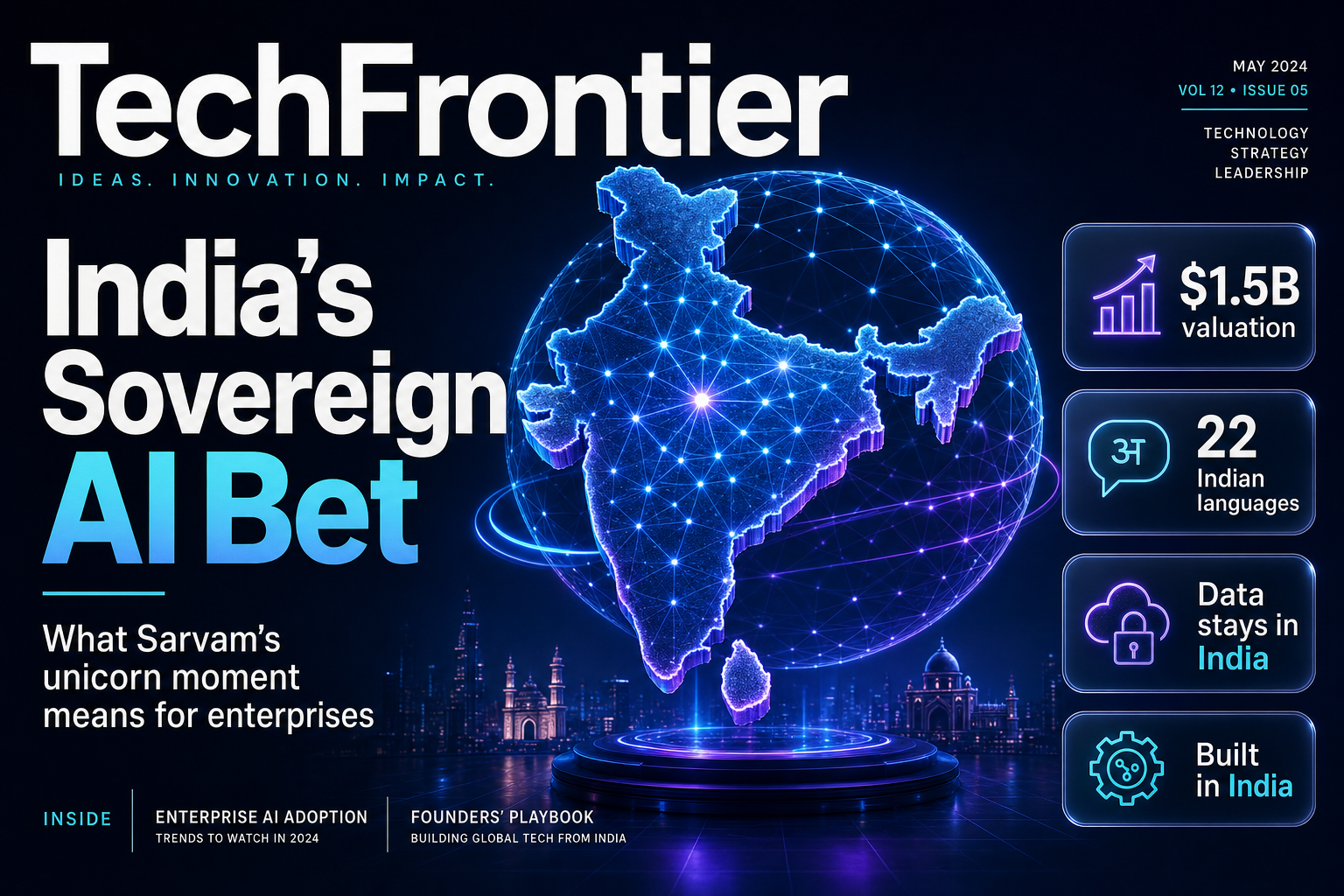
Summary. Sarvam AI became India's newest AI unicorn on June 15, 2026, announcing a $234 million Series B first close at a $1.5 billion valuation, led by a $150 million strategic investment from HCLTech for a 10.46% stake. The round also drew Bessemer Venture Partners alongside returning backers Khosla Ventures and Peak XV Partners, with Sarvam targeting $300 million in total and $66 million still to close. What makes this more than another funding headline is the lead investor: HCLTech, a $14.7 billion-revenue Indian IT services firm, not a Silicon Valley fund. For enterprise CTOs, the story is not a valuation. It is that sovereign AI, models built and hosted in India for Indian languages and regulated data, now has serious capital, a distribution pipeline, and a policy tailwind behind it. This piece explains what Sarvam builds, why data-residency rules make it relevant, and what the honest tradeoffs are.
What actually happened
Sarvam AI, founded in August 2023 by Pratyush Kumar and Vivek Raghavan, both formerly of the AI4Bharat lab at IIT Madras, closed the first tranche of a Series B on June 15, 2026. The headline numbers: $234 million raised so far, a $1.5 billion post-money valuation, and HCLTech taking a 10.46% equity stake for roughly $150 million, as reported by TechCrunch and Business Standard.
The composition matters as much as the size. Sarvam is the first major Indian generative-AI company whose lead investor is an Indian conglomerate rather than a US venture fund. HCLTech gets preferred access to Sarvam's models for its enterprise AI business; Sarvam gets an equity-linked pipeline into a services firm with $14.7 billion in annual revenue and clients across North America, Europe, and Asia. That pairing turns a research lab into a company with an enterprise go-to-market on day one.
HCLTech chief executive C Vijayakumar framed the logic in strategic terms, saying sovereign models for large nations will be a strategic asset and that his conversations with Raghavan gave him "a lot of comfort that this will become a truly influential company out of India in AI for India, and potentially for the world." Raghavan, for his part, has argued that "India's AI journey must go beyond consumption to building foundational capabilities across models, compute, and applications," and that sovereign innovation will be critical for countries with global ambitions.
What Sarvam actually builds
The valuation rests on a real product stack, not a slide. In February 2026 Sarvam unveiled Sarvam 30B and Sarvam 105B, which it describes as India's first large language models trained from scratch in India, covering 22 Indian languages. Alongside the models sits an enterprise conversational platform that Sarvam says had processed more than 140 million conversations, and Pravah, a token-serving layer the company calls a token factory, built to lower inference costs for industrial-scale usage.
Sarvam is one node in a wider sovereign stack. At the IndiaAI Impact Summit 2026, four indigenous models for Indian languages were showcased, developed by Sarvam, BharatGen, Gnani, and Socket, under the IndiaAI Mission that launched in March 2024 with a $1.25 billion government commitment.
| India sovereign AI effort | Backing | Focus |
|---|---|---|
| Sarvam 30B / 105B | HCLTech, Bessemer, Khosla, Peak XV | 22-language LLMs, enterprise conversational platform |
| BharatGen | Government, IBM collaboration | Multimodal Indic LLMs for public services |
| Gnani | IndiaAI Mission | Voice-first Indic AI |
| Socket | IndiaAI Mission | Indic language modelling |
| IndiaAI Mission | $1.25 billion state funding | Compute, datasets, model ecosystem |
Why sovereign AI matters to enterprises now
For most Indian enterprises, the pull toward sovereign AI is not nationalism. It is compliance and control. AI inference on regulated data, banking customer records, insurance claims, healthcare files, increasingly cannot be routed to externally hosted LLM APIs without a data protection officer's approval and a documented compliance basis. Analysts writing on data residency note that as of May 2026 no cross-border transfer blacklist had been gazetted under the Digital Personal Data Protection Act, 2023, which most privacy counsel reads as a reason to keep sensitive data in India until the rules settle.
Three overlapping regimes push the same way: the DPDP Act, 2023 on personal data, RBI guidance on data residency in banking, and MeitY frameworks for government workloads. A model trained and hosted in India, answering in the customer's own language, is easier to fit inside those constraints than a US-default API call.
| Factor | Global LLM API | India-hosted sovereign model |
|---|---|---|
| Data residency | Often cross-border by default | Data stays in India |
| DPDP / RBI fit | Needs contracts, DPO sign-off | Simpler compliance basis |
| Language coverage | Strong English, weaker Indic | Built for 22 Indian languages |
| Cost per unit | Cheapest at scale | 30% to 60% higher in some setups |
| Ecosystem maturity | Deep tooling, large community | Younger, growing fast |
Demand is concentrated where control is non-negotiable: finance, defence, and healthcare, sectors that need audit trails and authority over their own data planes. Our explainer on India's sovereign AI push and the IndiaAI Mission covers the policy backdrop in more detail.
The honest tradeoffs
Sovereign AI is not free, and pretending otherwise sets buyers up for disappointment. Independent write-ups on India-region voice AI put a fully-India configuration at 30% to 60% more per minute than the cheapest US-default setup, because you are paying for India-region compute, storage, and speech services rather than the lowest global rate. For a bank running several lakh calls a month, that delta is material, though usually defensible against the regulatory and reputational cost of a cross-border data question.
The second tradeoff is maturity. Global providers have years of tooling, integrations, and community behind them. India's sovereign stack is younger, and while it is moving quickly, an enterprise standardising on it should plan for gaps in connectors, evaluation tools, and third-party support. The pragmatic pattern most teams land on is a split: sovereign models for regulated, Indic-language, or data-resident workloads, and global APIs where the data is non-sensitive and cost or capability wins. Raghavan himself called an earlier export-control episode affecting a foreign model "a wake-up call," a reminder that supply for critical AI can be interrupted by policy outside your control.
What CTOs should do now
You do not need to pick a single vendor this quarter, but you do need a decision framework. The table below is a starting point for triage.
| Workload | Data sensitivity | Recommended path |
|---|---|---|
| Customer support in Indic languages | Medium to high | Sovereign model, India-hosted |
| Banking / KYC / claims processing | High, regulated | Sovereign or India-region, DPO review |
| Internal coding assistants | Low | Global API, cost-optimised |
| Public-facing marketing content | Low | Global API or hybrid |
| Healthcare records and clinical text | High, regulated | India-hosted, DPDP-aligned design |
Start by classifying workloads by data sensitivity and language need, then map each to a model tier. Keep a compliance basis documented for anything touching personal or regulated data, and design for portability so you are not locked to one provider if policy or pricing shifts. Our guides on DPDP consent and readiness and controlling AI cloud cost in India cover the compliance and FinOps sides of that plan.
India-specific considerations
The Sarvam round is also a policy test case. Business Standard framed it as a bet on whether India can build an independent AI base rather than renting one. For enterprises, the near-term reading is practical: budget for India-region inference where regulated data is involved, treat 22-language coverage as a genuine capability rather than a checkbox, and watch how the DPDP cross-border rules land, since a gazetted transfer list would sharpen the residency question overnight. Healthcare and financial services teams, in particular, should align model choices with DPDP, 2023 and sector guidance from the start, not after a pilot. Our note on healthcare AI deployment under CDSCO and DPDP walks through that sequencing.
How eCorpIT can help
eCorpIT is a Gurugram technology consultancy, founded in 2021, that helps enterprises choose and deploy AI responsibly. Our senior-led teams classify workloads by data sensitivity, evaluate sovereign and global models against real accuracy and cost benchmarks, and design deployments aligned with Digital Personal Data Protection Act, 2023 and RBI residency requirements. We build the portability and governance layers so you can mix Indic sovereign models and global APIs without lock-in. To scope an India-ready AI architecture, contact us.
FAQ
References
- Sovereign models for large nations to be a strategic asset: HCLTech CEO — Business Standard
- Anthropic episode is a wake-up call: Sarvam cofounder Vivek Raghavan — Business Standard
- Why Sarvam's unicorn round is a test case for India's sovereign AI policy — Business Standard
- Voice AI data residency in India 2026: DPDP and RBI — Caller Digital
_Last updated: July 14, 2026._