On this page · 11 sections
- If you are reading this in the final weeks, reorder everything
- The timeline: what has already changed, and what is coming
- What you lose on 30 September 2026
- Your migration options, side by side
- Microsoft's native path: Planner, Planner Premium, and the Project Manager agent
- The third-party route, and when it wins
- The part that actually hurts: reporting and timesheet history
- A realistic migration timeline
- India-specific considerations
- FAQ
- References
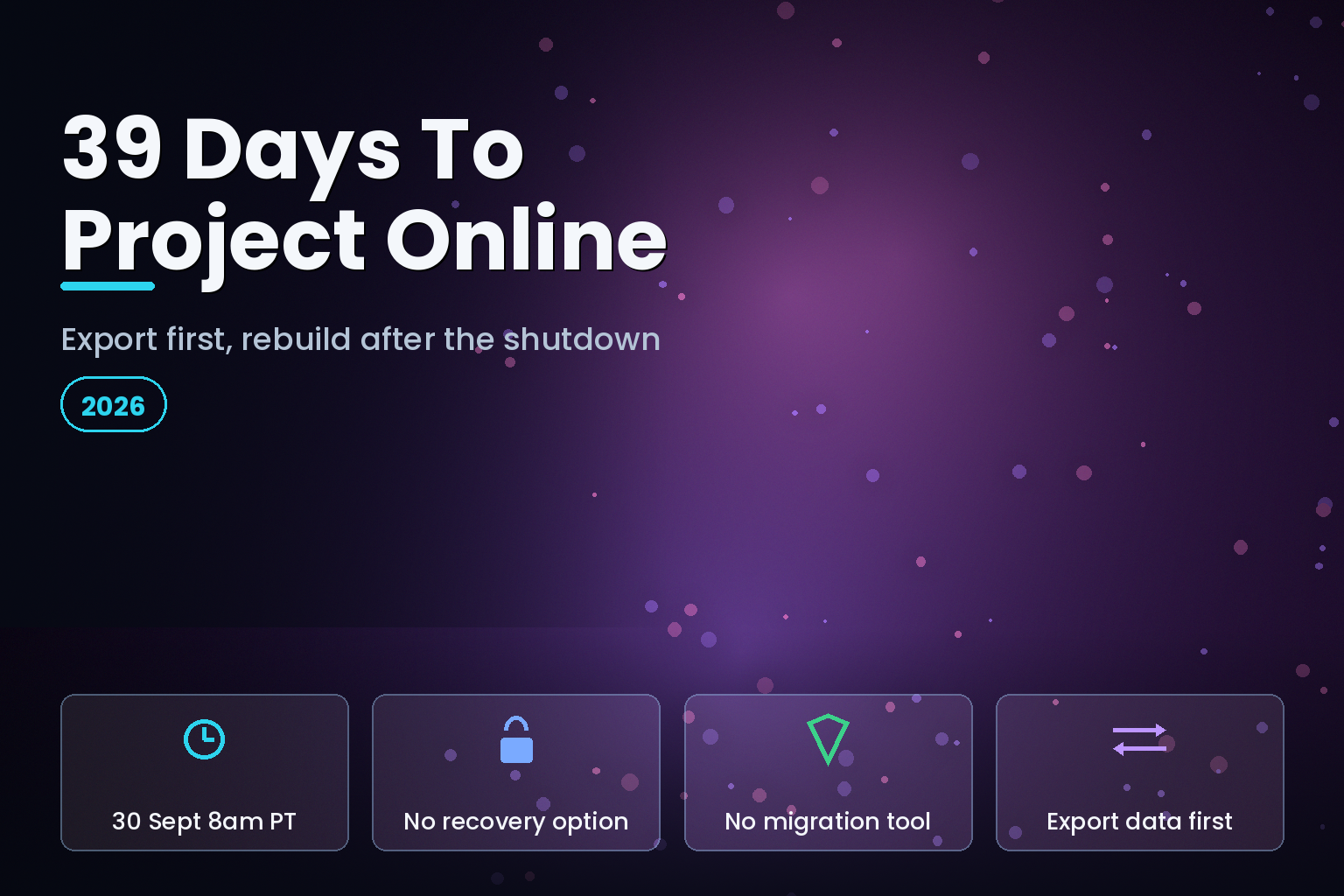
Summary. Microsoft Project Online retires at 8:00 AM Pacific on 30 September 2026 — the exact timestamp is published on the Microsoft Lifecycle page, which lists Project Online under the Modern Lifecycle Policy with a listing start date of 1 March 2013 and a retirement date of 30 September 2026. As of 22 August 2026 that is 39 days away, and it changes the advice on this page. The 12-to-16-week migration timeline below is the right plan, and it no longer fits in the window. If you are still on Project Online today, you are not running a migration any more; you are running a data-rescue operation with a rebuild scheduled after it. Export first — projects, custom fields, OData-fed reports and, above all, timesheet history — because after that date the Project Web App interface, the OData feeds and the project data behind them are gone with no recovery option and no read-only grace period. Then choose your target at leisure: Microsoft Planner with Planner Premium (bundled in Project Plan 3 at $30 per user per month and Plan 5 at $55), Project Server Subscription Edition on-premises, or a third-party PPM such as Celoxis, Smartsheet or Triskell. Nothing about the target decision expires on 30 September. Your data does.
If you run a PMO on Project Online, the deadline is real and the clock has nearly run out. This playbook covers the exact dates, what breaks, the target options with their gaps and costs, and — for teams reading this in the final weeks — the reordering that keeps your data alive even when the full migration cannot finish in time.
If you are reading this in the final weeks, reorder everything
This page was first published on 3 August 2026, when a 12-to-16-week migration still fitted inside the window. It does not any more, and pretending otherwise would be useless to anyone still on the platform. So take the plan below and invert it.
The migration has two halves, and only one of them has a deadline. Rebuilding schedules, standing up Planner Premium or a third-party PPM, recreating custom fields, retraining the PMO — none of that expires on 30 September 2026. You can do it in October, in November, at whatever pace the organisation can absorb. What expires is access to the data, and it expires completely, at a published timestamp, with no read-only period afterwards.
So the only work that genuinely must happen before 30 September is extraction:
Every project schedule, in a format you can read without Project Online — .mpp exports at minimum, plus a structured dump of tasks, assignments, baselines and dependencies. Every enterprise custom field and its values, because these carry the meaning your reports depend on and they are the first thing people forget. A full pull of anything the OData endpoint feeds, exported as data rather than as a live connection. Timesheet history, in full, to a durable archive. * PWA configuration, security groups and workflow definitions, captured as documentation if not as data.
Everything else on this page is still correct and still worth doing. It is simply no longer the thing standing between you and an irreversible loss. If your team has capacity for exactly one workstream in the next five weeks, make it the export, and let the target-platform decision wait until you have the data safe.
The timeline: what has already changed, and what is coming
Microsoft announced the retirement on its Planner blog, framing it plainly: "After more than a decade of supporting project managers and teams around the world, Project Online will officially retire on September 30, 2026." The milestones are staged, and two of them have already passed.
Date | Milestone | What it means ---|---|--- August 2025 | Project for the web redirects to Planner | The modern web planning app folded into Planner in Microsoft 365 1 October 2025 | End of sale | No new Project Online-only subscriptions for new customers 1 April 2026 | New PWA site creation blocked | You can no longer create Project Web App site collections; unused or empty sites may lose access 2 April 2026 | SharePoint 2013 workflows stop | Approval and governance workflows built on the legacy engine break 30 September 2026 | Retirement | Project Online, PWA, OData feeds and all stored project data become permanently inaccessible
Microsoft's Lifecycle page pins the date more precisely than the blog does. It lists Project Online under the Modern Lifecycle Policy, with support dates given in Pacific Time, a listing start date of 1 March 2013 and a retirement date of 30 September 2026 at 8:00 AM PT. For teams outside the Americas that timestamp matters: 8:00 AM Pacific on 30 September is 8:30 PM India Standard Time the same day, and 4:00 PM in the UK. If you have scheduled a final export for "the 30th", check which side of that line your job actually runs on.
The framing matters for planning. This is a hard shutdown, not a deprecation with a read-only grace period. Microsoft has confirmed there is no extension and no built-in tool to lift Project Online data into a successor. Everything you want to keep has to be exported before the tenant goes dark.
What you lose on 30 September 2026
Three losses drive the whole migration, and each needs an owner.
The first is the schedule and portfolio data itself: projects, tasks, dependencies, assignments, baselines, and enterprise custom fields held in PWA. The second is reporting. Project Online exposes an OData reporting endpoint that Power BI datasets, Excel refreshes, and custom scripts read from. Every one of those breaks the day the service stops responding. The third is timesheets. Project Online timesheet history, the record of who booked what against which project, has no home in the default successor, and it is the piece teams most often forget until an audit or a client dispute needs it.
Around those three sit the integrations: PWA configurations, resource engagement approvals, custom workflows, and anything wired into SharePoint. None of that carries over automatically. Project Online was built on SharePoint site collections, so the document libraries, permissions and list-based customisations attached to each PWA instance are their own migration with their own owner — the kind of work a sharepoint development company is usually brought in to untangle, because the dependencies are rarely documented anywhere.
Your migration options, side by side
There is no single right answer. The correct target depends on whether you are a schedule-driven PMO with formal governance, or a team that mostly needs task tracking and shared plans. Here is the honest comparison.
Option | Best for | Key gaps vs Project Online | Indicative cost (2026) ---|---|---|--- Microsoft Planner + Planner Premium | Microsoft 365-centric teams wanting the native path | No enterprise timesheets, weaker enterprise resource pool and engagements | $30/user/mo (Project Plan 3), $55 (Plan 5) Project Server Subscription Edition | Organisations needing full enterprise PPM on their own servers | On-premises infrastructure to run and patch; migration still manual | Server plus CAL licensing, plus hosting Celoxis / Triskell / Wrike | Mature PMOs with portfolio governance and cross-project resourcing | Rebuild of Microsoft 365 integrations and identity | Per-user SaaS, varies by vendor Smartsheet | Teams moving from Excel-style, grid-based tracking | Lighter formal scheduling and critical-path depth | Per-user SaaS monday.com / Asana | Task-driven teams and early-stage PMOs | Not built for critical-path or portfolio governance | Per-user SaaS
Two rules of thumb hold across every migration I have seen. If your value is in Microsoft 365 identity, SharePoint documents, and Power BI, the native Planner path removes the least. If your value is in schedule integrity and portfolio governance, a purpose-built PPM tool such as Celoxis or Triskell usually fits a real PMO better than base Planner.
Microsoft's native path: Planner, Planner Premium, and the Project Manager agent
Microsoft's recommended destination is Planner. The app now combines the former Project for the web, the basic Planner in Microsoft 365, and To Do into one surface. The scheduling muscle sits in Planner Premium, which is included with Planner and Project Plan 3 ($30 per user per month) and Plan 5 ($55 per user per month) as of February 2026.
Planner Premium restores much of what schedule-driven planners expect: portfolios, baselines, task dependencies with lead and lag, Gantt views, and workflow automation through Power Apps and Power Automate. Microsoft has also added a Project Manager agent for Microsoft 365 Copilot users, an assistant that drafts task breakdowns and status updates. With a premium license plus a Copilot license, teams get Goals, Sprints, Task History, and Baselines, along with the agent, inside Planner.
Plan | Price (USD/user/month, 2026) | What it adds ---|---|--- Project Plan 1 | $10 | Grid, board and timeline views, basic Planner Planner and Project Plan 3 | $30 | Planner Premium: portfolios, baselines, dependencies, Gantt Planner and Project Plan 5 | $55 | Plan 3 plus demand management and enterprise portfolio features
The gap to name honestly: base Planner is not a fit for a schedule-driven PMO, and even Planner Premium does not replicate Project Online's enterprise timesheets or its full resource-engagement model. If timesheets and formal resource capacity planning are core to how you run delivery, validate those workflows in a pilot before you commit the whole PMO.
The third-party route, and when it wins
For PMOs with formal governance, portfolio reporting, and cross-project resource management, a dedicated PPM platform often maps more cleanly than Planner. Celoxis, Triskell, and Wrike target exactly this buyer, and Smartsheet suits teams coming from spreadsheet-based tracking.
The practical advantage is import fidelity. Celoxis, Wrike, Triskell, and Smartsheet all support direct import of Microsoft Project .mpp files, and Celoxis specifically maps task hierarchies, dependencies, resource assignments, and baselines into its own data model. That reduces the manual rebuild for the schedules themselves.
The cost sits elsewhere. If your organisation depends on SharePoint document integration, Power BI reporting off the OData feed, and Microsoft 365 identity and permissions, moving to a third-party tool means rebuilding that connected ecosystem, not just importing project files. Budget for the re-integration work, because that is where third-party migrations overrun. This is the same discipline as any enterprise application modernization effort: the data moves faster than the integrations around it.
The part that actually hurts: reporting and timesheet history
Two workstreams decide whether your migration is smooth or painful, and neither is the project schedule.
Power BI reports and Excel refreshes that read the Project Online OData feed will stop returning data the moment the tenant goes dark. Do not wait for the shutdown to find out which dashboards matter. Inventory every report that touches the OData endpoint, then rebuild it against your target platform's API or dataset early, while Project Online is still live and you can reconcile the numbers. A dashboard that silently returns stale data after 30 September 2026 is worse than one that is obviously broken.
Historical timesheet data is the second trap. Project Online timesheets do not migrate cleanly into Planner, and once the service retires the record is gone. Decide now what you must keep, for how long, and in what format. Many teams export timesheet history to a data warehouse or a structured archive rather than trying to force it into the new tool, because the successor platforms are not built to hold years of legacy booking data. Treat this as a records-retention decision with your finance and compliance teams, not a technical afterthought. A structured IT governance and audit view helps here, because timesheet records often carry contractual and audit weight.
A realistic migration timeline
The honest range for a mid-size PMO, meaning 50 to 300 active projects with a shared resource pool and custom enterprise fields, is 12 to 16 weeks end to end. Smaller, task-focused teams can move faster; large portfolios with heavy customisation take longer.
Read that number against the calendar before you plan around it. A 12-week programme started on 22 August 2026 finishes in mid-November, six weeks after the service is gone. This sequence is the right one for anyone who started in the spring, and it is a historical document for anyone who did not. If you are in the second group, run weeks 3 to 6 — export and archive — first and on their own, then pick the sequence back up from week 1 once the data is safe.
A workable sequence:
* Weeks 1 to 3: application portfolio analysis. Inventory projects, custom fields, workflows, OData reports, and integrations. Decide your target platform against the comparison above.
* Weeks 3 to 6: export and archive. Pull project data and timesheet history out of Project Online into a durable format while the service is live.
* Weeks 5 to 10: build the target. Stand up Planner Premium, Project Server, or the third-party PPM; recreate custom fields, views, and permissions; rebuild reporting against the new API.
* Weeks 9 to 14: pilot with two or three real projects, validate timesheets, resourcing, and dashboards, then reconcile against Project Online.
* Weeks 13 to 16: cut over, train users, and decommission Project Online integrations before 30 September 2026.
Project Online's own retirement is one line in a much larger Microsoft end-of-life wave landing across 2026, so if you are also tracking the October 2026 Microsoft end-of-life deadlines, sequence the PMO migration alongside them rather than in isolation.
India-specific considerations
For Indian IT services firms, GCCs, and offshore delivery centres, Project Online often sits at the heart of client-facing delivery governance and billing. Two points deserve attention. First, timesheet history frequently underpins time-and-materials invoicing and client audits, so the retention decision has a direct revenue and contractual dimension, not just a technical one. Export and archive it against your Digital Personal Data Protection Act 2023 (DPDP) retention posture rather than dropping it. Second, licensing arithmetic changes at scale. At $30 to $55 per user per month for the premium Microsoft plans, a 500-seat delivery centre is looking at a materially different annual cost than a third-party per-user PPM, so run the five-year total for each option before committing. Currency and payment terms in India can also shift the comparison once billed in rupees.
FAQ
References
1. Microsoft Community Hub, Microsoft Project Online is retiring: What you need to know
1. Microsoft Community Hub, Changes to Project Web App site creation and unused sites effective April 1, 2026
1. Microsoft Community Hub, Transitioning to Microsoft Planner and retiring Microsoft Project for the web
1. Microsoft 365, Microsoft Planner and Project Plan 3
1. Wellingtone, Microsoft Planner Premium Licensing Plans and Pricing 2026
1. Epicflow, Microsoft Project Online Retirement 2026: Migration Guide and Alternatives
1. Windows Forum, Microsoft Project Online Retires September 30, 2026: Migration Guide
1. Celoxis, Microsoft is Retiring Project Online: Best Alternatives?
1. Onplana, Project Online Retirement: A 90-Day Migration Plan for PMOs
1. Costbench, Microsoft Project Pricing 2026: $10 to $55/user/month Compared
1. Advaiya, Project Online migration: September 2026 shutdown guide
1. Microsoft Learn, Project Online - Microsoft Lifecycle — records the retirement date as 30 September 2026, 8:00 AM Pacific Time, under the Modern Lifecycle Policy
_Last updated: 22 August 2026._