On this page · 9 sections
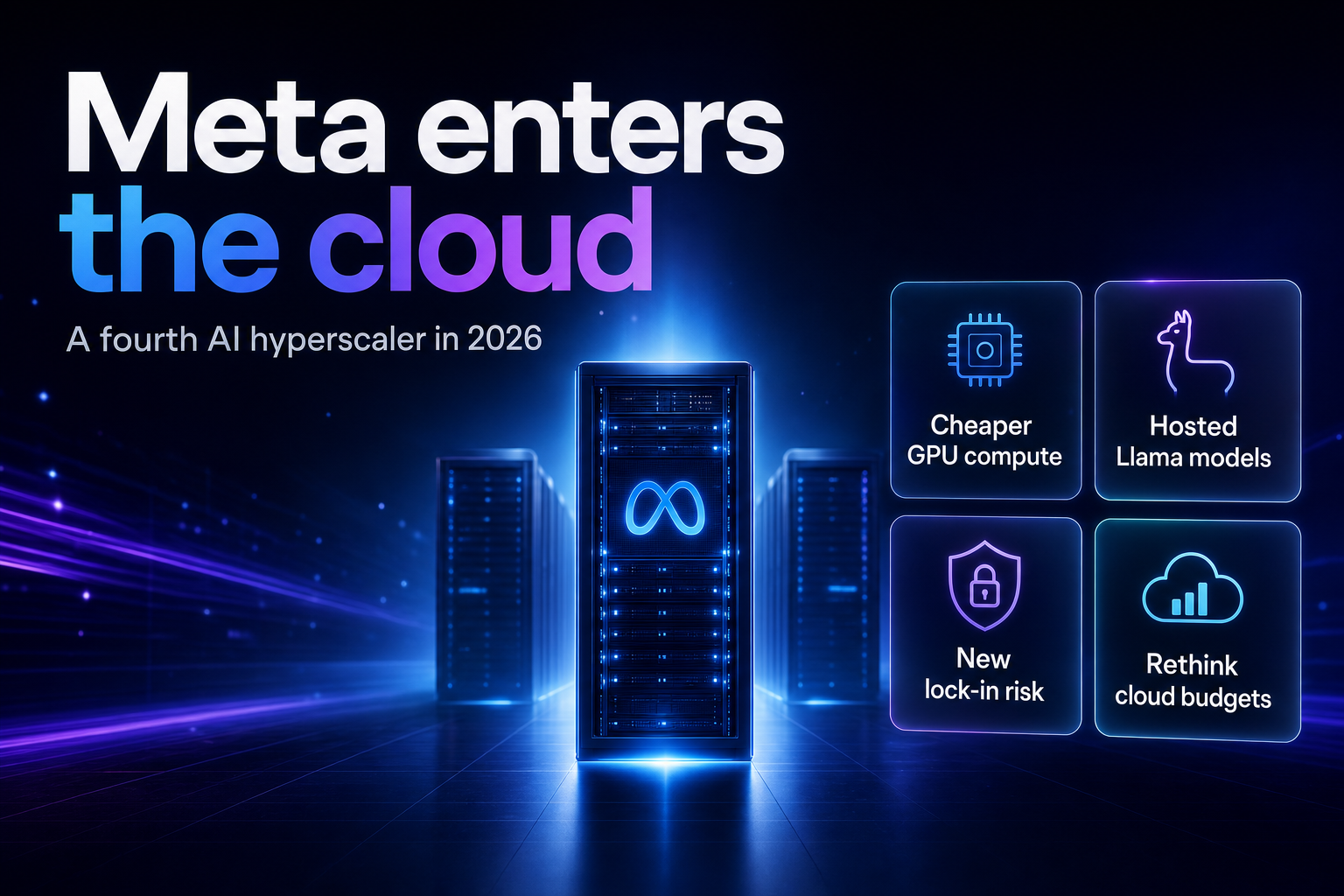
Summary. On July 1, 2026, Bloomberg reported that Meta is building a cloud business to sell its spare AI computing capacity, and Meta shares rose about 9% the same day, per CNBC. The plan would let outside developers rent raw GPU capacity and run Meta's Llama models on Meta's own data centers, much like Amazon Bedrock. That makes Meta a fourth serious option next to AWS (28% of the cloud market in Q1 2026), Microsoft Azure (21%), and Google Cloud (14%), according to Alignment Research. For enterprise buyers, the story is not the brand. It is the price pressure, the negotiating use, and the lock-in questions a new entrant creates.
Meta has spent two years buying Nvidia GPUs and building data centers for its own AI work. Selling the excess is the same move SpaceX made with satellite capacity, as TechCrunch noted: turn an expensive fixed asset into revenue. The Big Five infrastructure players (Amazon, Alphabet, Microsoft, Meta, and Oracle) are on track to spend an estimated $600 billion to $700 billion on capital projects in 2026, up roughly 36% on 2025, with about three-quarters of that aimed at AI infrastructure. When a company builds at that scale, idle capacity is a balance-sheet problem. Renting it out is the fix.
This article lays out what has actually been confirmed, what is still reported or rumored, and how a CTO or FinOps lead in Gurugram or San Francisco should think about it before rewriting a 2027 cloud plan.
What Meta actually confirmed, and what is still reported
Start with the reporting, because the details matter and several loud claims are not yet official.
Bloomberg broke the story on July 1, 2026, writing that Meta is building a cloud business to sell excess AI capacity. CNBC reported the same day that the company is debating whether to sell access to hosted AI models, sell raw computing power, or both, and that a hosted-model service would resemble Amazon Web Services' Bedrock. Meta shares, down nearly 15% for the year to that point, jumped on the news and eased pressure on the stock.
The strategic signal is older than the July headline. Mark Zuckerberg, Meta's chief executive, first raised the idea on the company's Q3 2025 earnings call and returned to it at the May 2026 shareholder meeting. Asked about overspending on AI, he told investors that if Meta reaches a point where it has overbuilt AI infrastructure, "then that is an option that we have," per CNBC's reporting. That is as close to a stated intention as a public company gives before a launch.
What is not confirmed is the packaging. Trade coverage, including Windows News, describes a service tentatively called "Meta Compute" with three tiers: raw GPU rental through an API or dedicated instances, fully hosted Llama models with fine-tuning and deployment tools, and a platform for building agents. Treat the name and the tiers as reported, not official. The pricing figures circulating are estimates too: reports suggest Meta could undercut current rates by 20% to 30%, with some coverage claiming 30% to 40%.
The pricing question, with real numbers
Price is where a new hyperscaler either matters or does not. Here the reported numbers are worth examining, with the caveat that they are estimates until Meta publishes a rate card.
On-demand H100-class GPU instances from the major clouds have typically listed in the range of $2.50 to $3.00 per GPU-hour without a long-term commitment. Because Meta buys Nvidia silicon at enormous scale and builds its own facilities, analysts quoted in trade coverage argue it could offer comparable capacity nearer $1.50 per GPU-hour and still hold a healthy margin. Whether that shows up as the list price or as a negotiating floor is the open question.
| Offering | Reported price per GPU-hour (2026) | Status |
|---|---|---|
| On-demand H100-class, major clouds | $2.50 to $3.00 | Published rates |
| Reserved / committed, major clouds | Below on-demand, 1 to 3 year terms | Published rates |
| Meta reported target | Around $1.50 or lower | Estimate, per trade reports |
| Spot / preemptible, major clouds | Variable, deep discounts | Published rates |
The second-order effect is more useful than the headline discount. A credible fourth vendor gives every enterprise a new anchor in a renewal negotiation. Even buyers who never sign with Meta can use a Meta quote to press AWS, Azure, or Google Cloud for better committed-use pricing. That use is real the day Meta publishes prices, whether or not anyone migrates. We cover the mechanics of that in our guide to how Indian teams cut cloud spend and in our FinOps playbook for AWS, Azure, and GCP.
Where Meta fits against the incumbents
A fourth entrant is not automatically a peer. AWS, Azure, and Google Cloud sell far more than GPUs: databases, networking, identity, compliance attestations, support tiers, and thousands of managed services. Meta is starting from compute and hosted Llama models. For an AI-heavy workload that mostly needs GPUs and an inference endpoint, that narrow scope can be a feature, not a gap.
| Dimension | AWS, Azure, Google Cloud | Meta's reported cloud |
|---|---|---|
| Maturity | 10 to 19 years in market | New, reported launch 2026 |
| Raw GPU rental | Yes, broad instance menus | Yes, reported core offer |
| Hosted models | Bedrock, Azure AI Foundry, Vertex | Llama models, reported |
| Managed services breadth | Very broad | Narrow at launch |
| Enterprise support and SLAs | Established tiers | Unproven |
| Compliance attestations | Extensive | To be demonstrated |
The maturity gap is the honest risk. A first-year cloud has no track record on support, incident response, or the compliance attestations regulated buyers need. For a healthcare or fintech workload in India, that matters as much as price, because a data-processing arrangement has to align with the Digital Personal Data Protection Act, 2023 (DPDP). A cheaper GPU-hour does not help if the provider cannot yet sign the data-protection terms your legal team requires.
The lock-in trap hiding inside a discount
Hosted Llama is the part to watch. Renting raw GPUs is portable: a container that runs on Meta's hardware runs on anyone's. But if you build on Meta's hosted-model APIs, fine-tuning pipeline, and agent tooling, you inherit switching costs, exactly as teams did with Bedrock and Vertex. A 25% inference discount that quietly wires your product to one vendor's proprietary endpoints can cost more over three years than it saves in the first.
The discipline here is old and boring, and it works. Keep an abstraction layer between your application and any single model provider. Prefer open weights you can move. Treat any hosted endpoint, Meta's included, as a swappable component behind your own interface. That is the same argument we make for keeping model choice open in our enterprise AI strategy guide and for watching real token economics in our enterprise inference cost analysis.
There is also a margin signal for buyers to read. CNBC reported that Wall Street welcomed the cloud push even though selling compute carries lower margins than Meta's advertising business. Low-margin infrastructure priced to win share is good for customers in the short run. It can also be repriced once a base of workloads is locked in. Plan for the second act, not just the launch offer.
India-specific considerations
For Indian enterprises, the calculus has two extra variables: data residency and rupee cost. A hosted-model service that processes personal data has to fit DPDP obligations, and a first-year provider may not yet offer India data-region guarantees or the contractual terms a bank or hospital needs. Until it does, Meta's cloud is most useful in India for non-regulated, GPU-heavy work: model training, batch inference, media processing, and internal tooling where data sensitivity is low.
The rupee math still helps. If a new entrant pushes GPU-hour pricing down across the market, an Indian startup running inference at scale sees the benefit even without switching, because incumbents defend share on price. A team spending, say, ₹40,00,000 a year on GPU inference does not need to migrate to gain; it needs a credible competing quote at renewal. That is the practical value of a fourth hyperscaler for a cost-conscious Indian buyer in 2026.
What to actually do before 2027 planning
Do not rewrite your cloud strategy on a Bloomberg report. Do three things. First, add Meta to your vendor watch list and ask for pricing the moment it is public, so you can use it in your next renewal. Second, audit where you are already locked to a single model provider and put an abstraction layer where you are not. Third, keep any near-term Meta usage to portable, non-regulated workloads until the provider proves support and compliance. The opportunity here is use, available now. The migration, if it ever makes sense, comes later, and only after the track record exists.
FAQ
How eCorpIT can help
eCorpIT (eCorp Information Technologies Private Limited, founded 2021, Gurugram) helps CTOs and founders turn cloud news into a plan. Our senior-led, CMMI Level 5 teams run vendor-neutral FinOps reviews, build model-abstraction layers so you are never locked to one provider, and design AI workloads that align with DPDP requirements. As partners of AWS, Microsoft, and Google, we assess new options like Meta's cloud on the evidence, not the hype. To pressure-test your 2027 cloud budget, contact us.
References
_Last updated: July 13, 2026._