On this page · 11 sections
- Why iOS 27 is a bigger enterprise event than usual
- Stage 1: validate on the July public beta
- Stage 2: migrate to declarative management
- Stage 3: stage the fleet at the September launch
- What actually changed in MDM
- The declarative migration you cannot skip
- A readiness checklist before you commit dates
- India-specific considerations
- FAQ
- How eCorpIT can help
- References
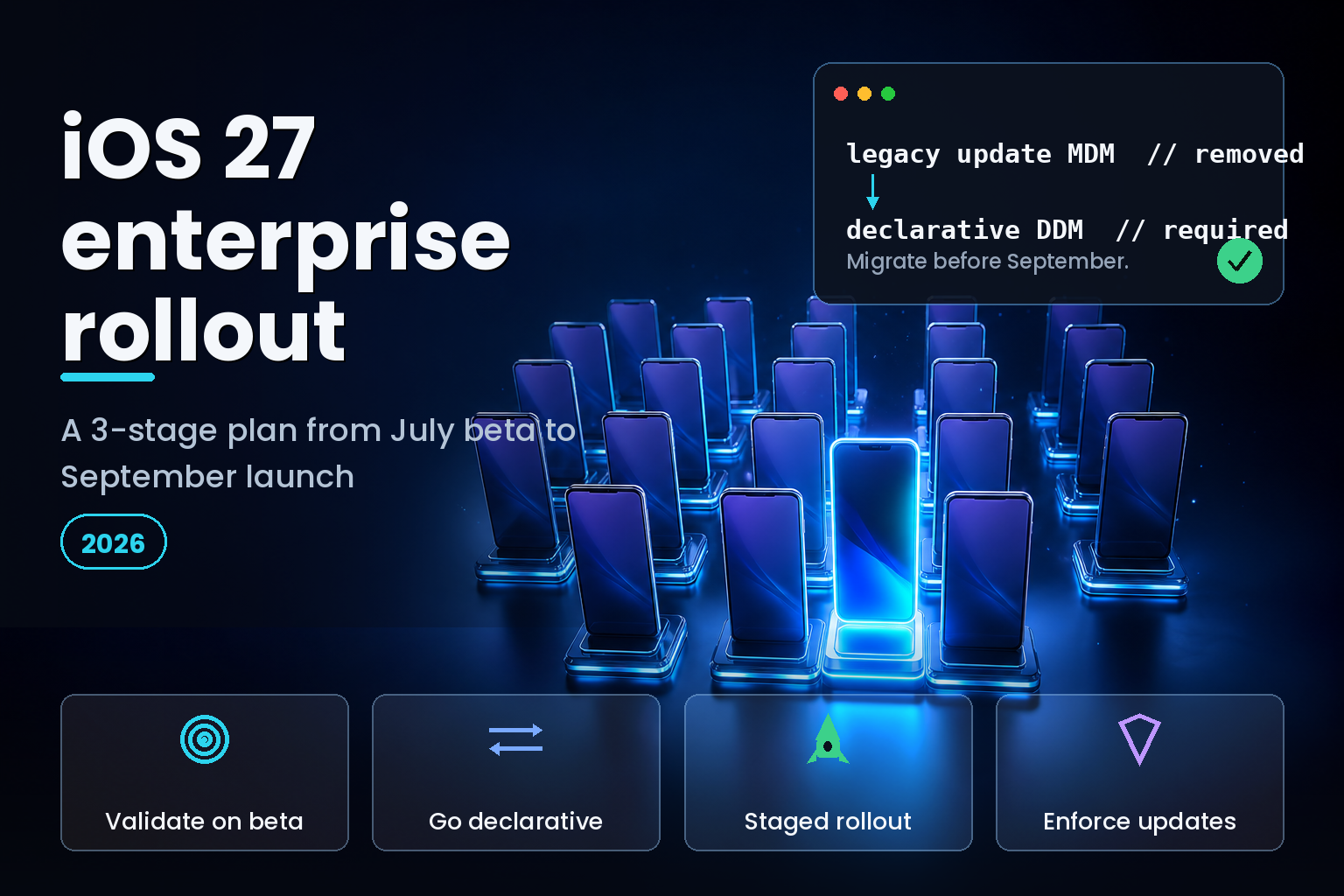
Summary. iOS 27 is the release where declarative device management (DDM) stops being optional for enterprise fleets. On every 27.0 operating system, Apple has removed legacy software update MDM commands, so an MDM that still relies on them loses update enforcement the moment a device upgrades. The public beta is expected around July 14, 2026, and the general release lands in September 2026, which gives IT roughly two months to migrate. This is not a cosmetic change: 76% of large businesses now use more Apple devices, MDM typically costs $3.25 to $9 per device each month, and a broken update policy across thousands of managed iPhones is a security exposure, not an inconvenience. This 3-stage plan moves a fleet from validation on the July beta, through a declarative migration in August, to a staged rollout at the September launch, without a day-one outage.
For a CTO, the headline is one sentence: if your MDM update enforcement is still legacy, it stops working on iOS 27, so the migration is mandatory and the clock is the September release. Everything else in this plan hangs off that fact.
Why iOS 27 is a bigger enterprise event than usual
Most iOS releases are a compatibility check. This one changes the management model. Apple's WWDC26 device management updates confirm that across iOS 27, iPadOS 27, macOS 27, and the rest of the 27.0 generation, the legacy software update commands, queries, deferrals, and recommended-cadence settings no longer function. As 9to5Mac put it, the era of legacy MDM is over and declarative management is the new standard.
The concrete risk is update enforcement. As Der Flounder documented, if your MDM still relies on legacy software update management, you lose the ability to enforce or defer updates the moment a device moves to OS 27. For a regulated enterprise that must hold devices on a validated build or push a critical patch, that is a compliance gap that appears silently as devices upgrade. Apple eased the path by letting DDM deploy legacy profiles as declarative assets, but the software update piece is a hard cutover.
Apple also moved management of the on-device intelligence features, the Siri AI and Apple Intelligence controls, from legacy restriction payloads to declarative configurations, so if you restrict those features for compliance, that policy needs rebuilding in DDM too.
Stage 1: validate on the July public beta
The public beta, expected around July 14, is your validation window, not your rollout. Enrol a small, representative set of test devices, one per hardware tier and per major user persona, and keep them in MDM but out of production. The device-management guidance is consistent: the two months between public beta and general release is the practical window to validate your MDM profiles, test Siri AI restrictions, and confirm managed apps behave on the new OS.
Do four things in stage 1. Confirm your MDM vendor supports the OS 27 declarative commands, because your migration depends on it. Inventory every policy that touches software updates, so you know exactly what breaks. List the compliance restrictions you enforce on AI features, since those move to DDM. And run your critical managed apps on a beta device to catch failures while you still have weeks to fix them. Treat this stage as discovery: you are building the migration list, not pushing anything to users.
Stage 2: migrate to declarative management
Stage 2 is the real work, and it runs through August on later betas. Rebuild your software update policy in declarative software update management, which enforces updates with more user transparency and tighter control than the legacy commands offered. This is the one migration you cannot defer, because it is the piece Apple removed outright.
While you are in the declarative model, adopt the new capabilities that make it worthwhile. Apple added remote log collection through two MDM commands, TriggerEnhancedLogCollection and CancelEnhancedLogCollection, on supervised devices, which shortens support cycles. New status items report enrollment type, Lockdown Mode status, and hardware health across baseband, camera, Face ID or Touch ID, NFC, and Ultra Wideband. And seven new DDM configurations bring the network stack, including IKEv2, IPsec, Always On VPN, encrypted DNS, and network relays, under declarative management, with credentials shipped as separate declarative assets so certificates renew automatically without re-pushing whole profiles, per the Fleet rundown. Pilot all of this with one friendly department before the general release.
Stage 3: stage the fleet at the September launch
The general release arrives in September 2026. Do not push it fleet-wide on day one. By now your declarative update policy is live, your managed apps are validated, and your pilot department is running iOS 27, so the rollout is a controlled expansion rather than a leap.
Move in waves. Start with the pilot group, then a broader early-adopter cohort, then the general population, holding each wave long enough to catch issues your test devices missed. Use your declarative update policy to control the pace, so users upgrade when you allow rather than whenever they tap Settings. Keep a documented rollback and support plan, and watch the new hardware-health and status signals to spot problems early. A staged rollout turns a risky launch-day event into a routine, observable process.
| Stage | Timing (2026) | Goal | Key action |
|---|---|---|---|
| Stage 1: validate | July public beta | Find what breaks | Test MDM profiles on beta devices |
| Stage 2: migrate | August, later betas | Move to declarative | Rebuild update policy in DDM |
| Stage 3: roll out | September launch | Deploy safely | Phased, policy-controlled waves |
What actually changed in MDM
The shift is from imperative commands to declarative configurations. Under the old model, the MDM server sent commands and the device obeyed; under DDM, the device holds a declared desired state and reports its own status. The practical differences for an enterprise are concrete.
| Area | Legacy MDM (pre-27) | Declarative on iOS 27 |
|---|---|---|
| Software updates | MDM update commands and deferrals | Declarative software update management only |
| AI feature controls | Legacy restriction payloads | Declarative configurations |
| Network stack | Profile-based, certs baked in | Seven DDM configs, separate credential assets |
| Diagnostics | Limited remote logging | Trigger and cancel enhanced log collection |
| Device status | Basic queries | Enrollment type, Lockdown Mode, hardware health |
The declarative migration you cannot skip
If you take one thing from this plan, make it the software update migration. Apple did not deprecate the legacy update commands with a grace period; it removed their function on 27.0. An enterprise that upgrades devices before rebuilding update policy in DDM will find those devices outside its update control, which breaks patch SLAs and compliance holds at the same time.
The migration itself is well-supported. Declarative software update management lets you target a specific OS version and an install deadline, and the device enforces it with clearer user messaging than the old flow. Because DDM can also deliver legacy profiles as declarative assets, you can move most of your existing configuration across without rewriting everything, and concentrate your effort on the update policy that genuinely changed. Confirm your MDM vendor has shipped OS 27 support before you commit dates, because the whole plan depends on it.
A readiness checklist before you commit dates
Turn the plan into a checklist your team can run against. Each item maps to a real iOS 27 change, and none of it should wait until September.
Confirm MDM vendor support first. Your entire rollout depends on your MDM having shipped OS 27 declarative commands, so get that confirmation in writing before you set dates. Then inventory your software update policy: list every deferral, deadline, and recommended-cadence setting that uses the legacy commands, because each one stops working and needs rebuilding in declarative software update management.
Next, catalogue your AI-feature restrictions. If you block Siri AI or Apple Intelligence for any compliance reason, those controls move from legacy restriction payloads to declarative configurations, so write down every restriction you enforce and plan to recreate it. Rebuild your network configurations too, taking advantage of the seven new declarative options and separate credential assets so certificate renewal stops forcing full profile pushes.
Then prove it on hardware. Enrol at least one device per tier and per persona in the public beta, run your critical managed apps, and confirm enrolment, update enforcement, and restrictions all behave. Refresh any Intel Macs in your build or admin fleet, since the broader 27 generation assumes Apple silicon tooling. Finally, write the rollout waves and a rollback plan, and name an owner for each stage so the migration has clear accountability rather than diffusing across the IT team.
Work this list during the beta and stage 3 becomes a controlled expansion. Skip it and September becomes a scramble to restore update enforcement you did not realise you had lost.
India-specific considerations
For enterprises and CTOs in India, three factors shape the rollout. First, Apple Business, launched in March 2026 as an all-in-one platform now available in more than 200 countries with Managed Apple Accounts and integration with Google Workspace and Microsoft Entra ID, is a route to cleaner identity and enrolment for growing Indian teams, per Apple's newsroom. Second, the Digital Personal Data Protection Act, 2023 (DPDP) governs employee and customer data on managed devices, and the new declarative model, which keeps company data managed while employee data stays private, aligns with that separation. Third, budget realism: at $3.25 to $9 per device each month for MDM, a large Indian fleet is a real cost line, so use the beta window to confirm your existing vendor handles iOS 27 before you renew or switch. For broader planning, see our note on enterprise AI strategy.
FAQ
How eCorpIT can help
eCorpIT is a Gurugram-based technology organisation with senior-led engineering teams that plan and execute enterprise device rollouts. We can audit your MDM for iOS 27 readiness, migrate software update enforcement to declarative device management, rebuild AI-feature restrictions, and design a staged, policy-controlled rollout aligned with your DPDP obligations. If you want a rollout plan ready before the September release, contact us. You can also browse the eCorpIT blog or read about our team.
References
_Last updated: July 5, 2026._