On this page · 11 sections
- What iCloud+ actually changes for Apple Intelligence
- iCloud+ tiers and pricing in 2026
- What stays free, and what a paid plan raises
- Which iPhone even qualifies
- Why Apple put a meter on server AI
- The new Siri, and the Gemini engine underneath
- Which tier should you actually pick
- India-specific considerations
- FAQ
- How eCorpIT can help
- References
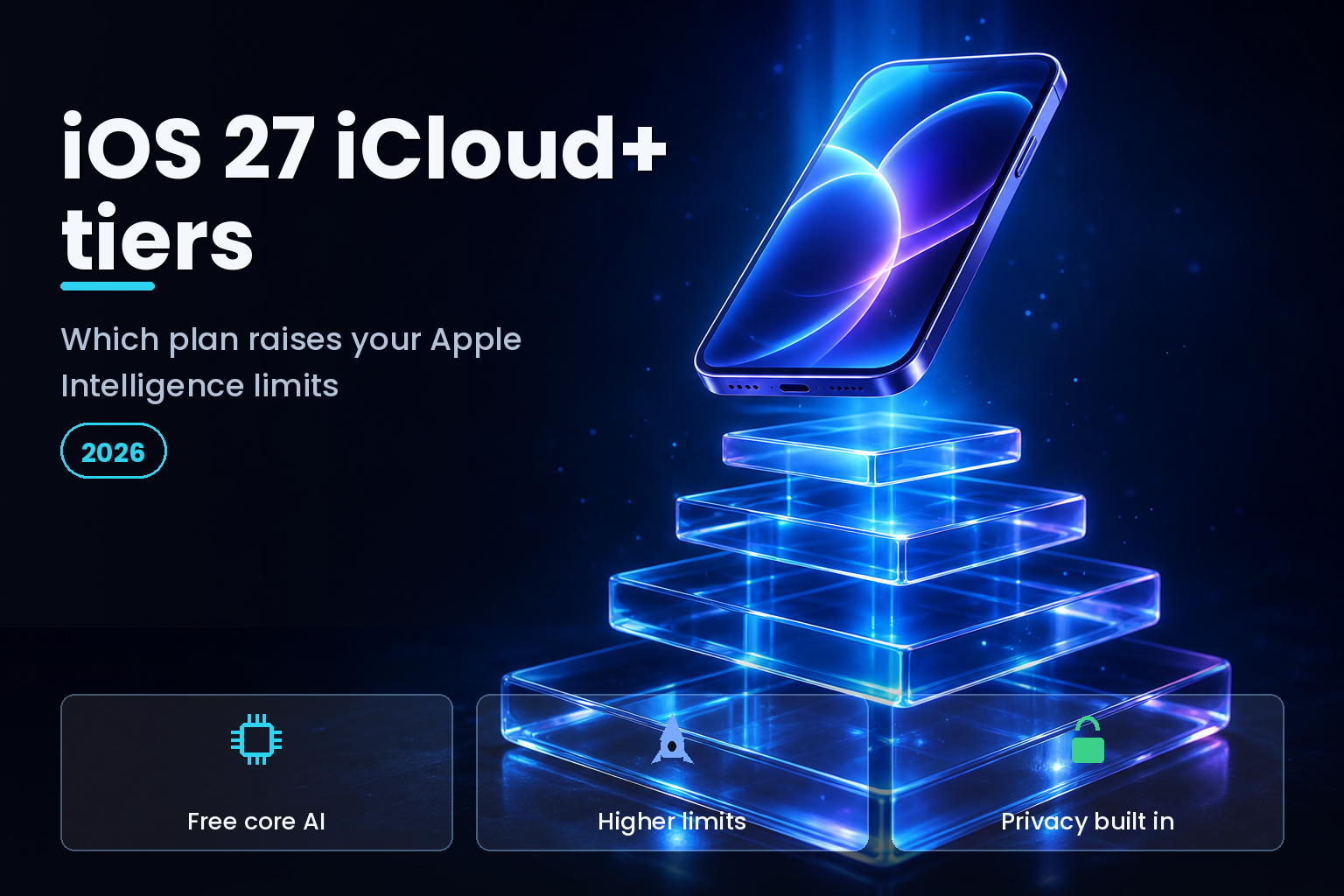
Summary. iCloud+ does not buy Apple Intelligence — a supported iPhone does. In iOS 27, unveiled at WWDC on June 9, 2026 and due for public release around September 14, 2026, the core AI tools stay free: Writing Tools, notification summaries, Clean Up in Photos, Genmoji and basic Siri AI all run without a paid plan. What changed is that a few server-heavy features, image generation first among them, now carry daily usage limits, and Apple lifts those limits for "most iCloud+ subscription plans." iCloud+ starts at $0.99 a month ($75 equivalent is Rs 75 in India) for 50GB and runs to $59.99 (Rs 5,900) for 12TB. The wrinkle: Apple's word "most" reads as excluding the entry $0.99 tier, so the plan that actually raises your AI ceiling probably starts at the 200GB step, $2.99 or Rs 219 a month.
That one word, "most," is the whole decision. If you only care about image generation quotas, the cheapest plan may not qualify, and the useful floor moves up one rung. If you care about storage and privacy features, the calculation is different again. This guide separates what Apple Intelligence gives you for free from what a paid plan adds, prices every tier in dollars and rupees as of Apple's April 6, 2026 rate card, and gives IT buyers a straight answer on which tier to standardise on.
What iCloud+ actually changes for Apple Intelligence
Start with the claim Apple itself made. In the press release accompanying its June 9 announcements, the company wrote: "Some Apple Intelligence features, including image generation, have daily usage limits because they rely on powerful server models. Increased access is available with most iCloud+ subscription plans, which also include Apple Intelligence support for compatible Home cameras." That is the entire mechanism, quoted verbatim.
Two things follow. First, Apple Intelligence is not a paid product; it ships free with iOS 27 on eligible hardware. Second, the paid lever is not access but volume. Free users can still generate images and use the heavier Siri requests that route to Apple's servers, but they hit a daily cap sooner. Paid users on qualifying plans get a higher cap.
The phrase "most iCloud+ plans" is doing real work. As MacRumors noted on June 9, that wording suggests the 50GB tier at $0.99 a month may not clear the bar, and that subscribers on any higher tier, or on an Apple One bundle, are the ones in line for the expanded limits. Apple has not published the exact numeric caps for each tier, so treat any specific per-day figure you see elsewhere with caution. What is confirmed is the direction: pay for a mid or high tier, get more server-AI headroom.
iCloud+ tiers and pricing in 2026
Every Apple Account includes 5GB of iCloud storage free. Above that, iCloud+ adds storage plus a fixed set of privacy features, and Apple bills it monthly only — there is no annual option. The table below uses Apple's own published US and India prices as of April 6, 2026, alongside the feature that changes at each step.
| iCloud+ tier | US price / month | India price / month | HomeKit Secure Video cameras |
|---|---|---|---|
| 5GB (free) | $0 | Rs 0 | None |
| 50GB | $0.99 | Rs 75 | 1 camera |
| 200GB | $2.99 | Rs 219 | Up to 5 cameras |
| 2TB | $9.99 | Rs 749 | Unlimited |
| 6TB | $29.99 | Rs 2,999 | Unlimited |
| 12TB | $59.99 | Rs 5,900 | Unlimited |
Three privacy features are identical across every paid tier: iCloud Private Relay, Hide My Email, and Custom Email Domain. You do not need the 2TB plan to get Private Relay; the 50GB plan carries it too. The differences that scale with price are storage capacity and the number of HomeKit Secure Video cameras, which moves from one on the 50GB plan, to five on 200GB, to unlimited from 2TB up. Family Sharing of the plan across up to five people is available on every paid tier.
What stays free, and what a paid plan raises
The cleaner way to think about iOS 27 is a two-column split: features that are free on any supported iPhone, and features where a qualifying iCloud+ plan raises a daily ceiling. The Mac Observer published a breakdown on July 4, 2026 that maps to Apple's own wording.
| Apple Intelligence feature | Free on supported iPhone | With a qualifying iCloud+ plan |
|---|---|---|
| Writing Tools | Yes | Yes |
| Notification summaries, Smart Reply | Yes | Yes |
| Clean Up and natural-language search in Photos | Yes | Yes |
| Genmoji | Yes | Yes |
| Basic Siri AI | Yes | Yes |
| Image Playground and image generation | Yes, with daily limits | Yes, with higher limits |
| Private Cloud Compute for heavy requests | Yes, when needed | More headroom on some features |
| Apple Intelligence for Home cameras | Limited or unavailable | Included on most iCloud+ plans |
Read the table before you upgrade. If your Apple Intelligence use is writing, summaries, Photos cleanup and the occasional Genmoji, a paid plan buys you nothing on the AI side — those tools are already free and uncapped in normal use. The upgrade pays off in exactly two cases: you generate a lot of images through Image Playground, or you run compatible Home cameras and want their AI features. Everything else is a storage-and-privacy decision, not an AI decision.
Which iPhone even qualifies
None of this matters if the device cannot run Apple Intelligence. iOS 27 installs on a wide range of iPhones — Apple kept the floor at the A13 Bionic chip with 3GB of RAM, so every iPhone from the iPhone 11 onward gets the update. Apple Intelligence is stricter. It needs an A17 Pro chip or newer with at least 8GB of RAM, which in practice means the iPhone 15 Pro, iPhone 15 Pro Max, and the entire iPhone 16 line and later. A handful of advanced features, such as custom Siri voices, ask for 12GB of RAM, found on the iPhone Air and the iPhone 17 Pro and 17 Pro Max.
For an IT buyer refreshing a fleet, that line is the real gate. Buying iCloud+ for a floor of iPhone 14 or older devices does nothing for Apple Intelligence, because the chips cannot run the features at all. The storage upgrade still helps backups and Photos; the AI headroom does not apply.
Why Apple put a meter on server AI
The limits are a cost-control move, and Apple is fairly open about the reason. Apple Intelligence runs in two places. Most requests execute on the device itself, using the local model, at no marginal cost to Apple. Requests that exceed what the on-device model can handle route to Private Cloud Compute, Apple's server tier built on its own silicon.
Private Cloud Compute is engineered so that data sent to it is not stored and is not accessible to Apple or anyone else; Apple describes the nodes as stateless and cryptographically verifiable, and lets independent researchers inspect them through its Security Bounty program. That privacy design is genuine, but running large models on servers still costs money per request. Image generation is the expensive case. Rather than fold that cost into every free device, Apple meters the heavy requests and sells more headroom through iCloud+. In 2026 Apple also began extending Private Cloud Compute beyond its own data centers, running some workloads on Google Cloud and NVIDIA hardware under the same privacy commitments.
The real cost here is server inference, not storage. iCloud+ is simply the billing wrapper Apple already had in place, so it became the meter.
The new Siri, and the Gemini engine underneath
The headline change in iOS 27 is Siri. Apple rebuilt it as an operating-system-level assistant with a standalone app that can read on-screen content and pull personal context across Messages, Mail and Photos, and the Siri app privately syncs its conversation history through iCloud. Under the hood, the new Siri runs on a custom Google Gemini model. Apple confirmed the partnership on January 12, 2026, telling CNBC that Google's technology "provides the most capable foundation" for a more personal Siri.
The deal reset the economics of Apple's AI. Bloomberg's Mark Gurman put Apple's payment at roughly $1 billion a year for the Gemini license. Gene Munster, managing partner at Deepwater Asset Management, called it the "deal of the year," arguing Apple got a capable Siri far cheaper than building the model itself. For iCloud+ buyers, the practical link is simple: the heavier the Siri request, the more likely it routes to a server model, and server requests are exactly what the daily limits govern.
Which tier should you actually pick
For a single user who mainly wants storage and privacy, the 200GB plan at $2.99 or Rs 219 a month is the common sweet spot: enough room for photo libraries and backups, all three privacy features, five Home cameras, and — critically — it sits above the "most plans" line, so it should carry the higher Apple Intelligence limits. The 50GB plan at $0.99 or Rs 75 is fine for a light backup, but it is the tier Apple's wording most plausibly excludes from the raised AI caps.
For families and power users, 2TB at $9.99 or Rs 749 adds unlimited Home cameras and is the entry point for an Apple One bundle. For teams standardising devices, the decision is less about the AI caps and more about backup discipline: pick the smallest tier that reliably holds a full device backup plus Photos for each user, then confirm it clears the qualifying line for AI limits. Storage you can measure; the exact AI caps Apple has not published, so do not overpay for headroom you cannot yet quantify.
India-specific considerations
India is one of the cheaper markets for iCloud+. Apple's April 6, 2026 rate card lists 50GB at Rs 75, 200GB at Rs 219, 2TB at Rs 749, 6TB at Rs 2,999 and 12TB at Rs 5,900 a month, with taxes already included in the listed price. That makes the 200GB plan — the practical floor for the raised AI limits — a Rs 219 monthly decision, well under the cost of most streaming subscriptions.
Two India caveats matter. First, iCloud Private Relay has historically been unavailable in a small set of regions for regulatory reasons, so confirm it is active on your account rather than assuming it. Second, for any business rolling out iPhones in India, personal data handled by AI features falls under the Digital Personal Data Protection Act, 2023; Apple's Private Cloud Compute design helps, but the accountability for how employee and customer data is processed still sits with the deploying organisation. Design your device policy around that, not around marketing claims.
FAQ
How eCorpIT can help
eCorpIT helps teams turn announcements like this into a device and data policy that holds up. We map which of your iPhones actually qualify for Apple Intelligence, model the iCloud+ tier that fits your backup and AI needs in dollars or rupees, and design deployment aligned with DPDP Act 2023 requirements. If you are planning a 2026 fleet refresh or an AI rollout, talk to our team for a plan built on your numbers, not marketing copy.
References
- Apple, "Apple unveils next generation of Apple Intelligence, Siri AI, and more" — apple.com
- Apple Support, "iCloud+ plans and pricing" (published April 6, 2026) — support.apple.com
- MacRumors, "iCloud+ Subscribers Get Higher Apple Intelligence Usage Limits in iOS 27" (June 9, 2026) — macrumors.com
- The Mac Observer, "Apple Intelligence in iOS 27: What's Free vs What Needs iCloud+" (July 4, 2026) — macobserver.com
- Apple Support, "How to get Apple Intelligence" — support.apple.com
- 9to5Mac, "iOS 27: Here are all the compatible iPhone models" (June 8, 2026) — 9to5mac.com
- Apple Security Research, "Private Cloud Compute: A new frontier for AI privacy in the cloud" — security.apple.com
- Neowin, "Apple is expanding Private Cloud Compute beyond its own data centers" — neowin.net
- CNBC, "Apple picks Google's Gemini to run AI-powered Siri coming this year" (January 12, 2026) — cnbc.com
- Benzinga, "Gene Munster Says Apple Scored 'Deal Of The Year' With Google Gemini Partnership" — benzinga.com
- TechCrunch, "WWDC 2026: Everything announced on Siri AI, iOS 27, Apple Intelligence, and more" (June 9, 2026) — techcrunch.com
- Macworld, "iOS 27 Guide: features, release date, beta, compatibility" — macworld.com
_Last updated: July 5, 2026._