On this page · 9 sections
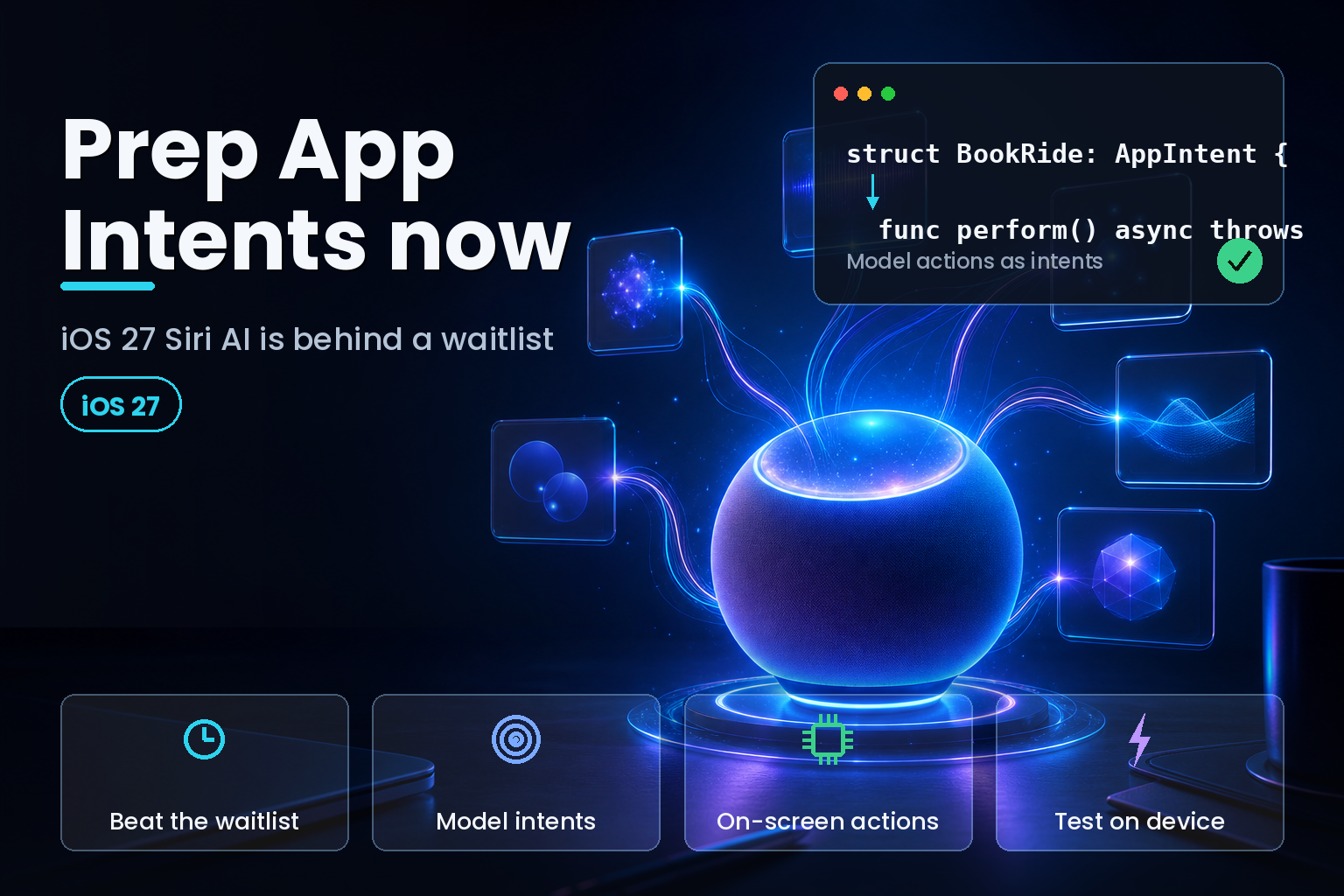
Summary. Apple's new Siri AI shipped in the iOS 27 developer beta on June 8, 2026, and it is gated behind a waitlist: a developer opts in under Settings, then waits, with early reports putting the queue at 4 to 48 hours. The public beta lands in July 2026 and the general release in September, so the window to get an app ready is now. The bigger change sits under the hood. Siri AI runs on Google Gemini, and Apple has made App Intents the way an app exposes its actions to it. In Apple's own words, updates to App Intents let developers connect apps to Siri AI's "personal context understanding, app actions, and onscreen awareness." Reporting from TechTimes and MacRumors says SiriKit, the older path, is now on a deprecation clock. Apple also opened its next-generation Foundation Models to smaller teams: those in the App Store Small Business Program with fewer than 2 million lifetime downloads can call them on Private Cloud Compute at $0 in cloud API fees. iOS 27 runs on every iPhone from the iPhone 11 up. Here is what changed and how to prepare before the public beta.
What Apple shipped, and the waitlist
Apple used WWDC 2026, which opened June 8, to relaunch Siri as Siri AI, and paired it with performance work across iOS 27: TechCrunch reported photos now appear about 70% faster and AirDrop transfers about 80% faster. The Siri AI overhaul is the headline for users, but for developers the mechanics of access matter first.
In the developer beta, Siri AI is not on by default. As 9to5Mac and MacRumors documented, Apple runs a waitlist to manage server load during the launch. A developer updates to iOS 27, opens Settings, goes to Apple Intelligence, and opts in; access has been arriving in roughly 4 to 48 hours. Apple used the same pattern when it first shipped Apple Intelligence with iOS 18 in 2024, and the queue usually shrinks or disappears by the time the public beta arrives. Running the developer beta needs an iPhone 15 Pro, any iPhone 16, or any iPhone 17.
The point for a product team is simple. If your app depends on Siri behaving well, you need waitlist access now, on real hardware, to test against the actual model before the public beta widens the audience in July.
Why App Intents is suddenly non-optional
The old way an app talked to Siri was SiriKit, a set of fixed domains such as messaging or payments. Siri AI changes the contract. Apple's developer press release states that updates to the App Intents framework let developers connect their apps to Siri AI capabilities like personal context understanding, app actions, and onscreen awareness. In plain terms, App Intents is how the new Siri discovers what your app can do and then does it, including acting on what is on screen. TechTimes reported that App Intents now supersedes SiriKit, which is on a multi-year deprecation path.
If your app does not expose App Intents and App Entities, the system has no structured way to surface its actions inside Siri, Spotlight, or visual intelligence. That is the core reason this is not a cosmetic update: the entry point to your app is shifting from a tap on your icon to a request made to Siri.
| Aspect | SiriKit (the old path) | App Intents (the new path) |
|---|---|---|
| Status | On a deprecation clock, per TechTimes | The framework Apple points developers to |
| How Siri reaches your app | Fixed intent domains | Your own defined intents and entities |
| On-screen awareness | Not supported | Siri can act on on-screen content |
| Personal context | Limited | Personal context understanding, per Apple |
| Best move now | Plan migration | Model your core actions as intents |
The iOS 27 timeline developers are racing
Apple's dates are public, and they are close together. The developer beta is out, the public beta is a July event, and the stable release ships in September 2026. One regional caveat matters: Apple said Siri AI is delayed in the EU for iOS 27 and iPadOS 27 because of the Digital Markets Act.
| Stage | When | What it means for you |
|---|---|---|
| Developer beta + Siri AI waitlist | From June 8, 2026 | Test intents on real hardware; opt in to the waitlist |
| Public beta | July 2026 | A much larger audience meets your Siri behaviour |
| General release | September 2026 | Millions update; your intents ship to everyone |
| EU Siri AI | Delayed (DMA) | Plan for Siri AI to be absent in the EU at launch |
| Device floor | iPhone 11 and up | iOS 27 itself installs; Siri AI needs newer hardware |
How to prep your App Intents before the public beta
The work is scoped and doable inside the beta window. Start by listing the three to five actions users most want from your app, then model each as an App Intent with clear App Entities, so Siri can name and call them. Write natural, unambiguous titles and parameters, because the model matches user phrasing against them. Test each intent through Siri, Spotlight, and Shortcuts on a waitlisted device, not just in the simulator. Then handle the unhappy paths: missing parameters, authentication, and empty states, so a spoken request degrades gracefully.
| Step | Do this | Why it matters |
|---|---|---|
| Inventory actions | Pick your top 3 to 5 user tasks | These become the intents Siri can trigger |
| Model intents and entities | Define App Intents and App Entities for each | Gives Siri a structured, callable map of your app |
| Name things clearly | Use plain, distinct titles and parameters | The model matches spoken phrasing to your intent |
| Test on real hardware | Verify via Siri, Spotlight, Shortcuts | The simulator will not reflect the live model |
| Handle failure | Cover missing input and auth states | A spoken request must fail safely, not crash |
For the full framework detail, our iOS 27 App Intents developer guide walks through the code patterns step by step.
What else developers get in iOS 27 and Xcode 27
The App Intents shift arrives with a wider toolkit. Apple's Foundation Models framework is now a single native Swift API that supports stronger on-device models with image input, server models, and custom skills, built with the next generation of Apple Foundation Models that Apple developed with Google and its Gemini models. Developers can also call models of their choice, including Claude and Gemini, through a new language model protocol, and a brand-new framework called Core AI runs full-scale models on device using Apple silicon's Neural Engine.
The cost detail is the one to flag for smaller teams. Apple said developers in the App Store Small Business Program with fewer than 2 million lifetime first-time downloads can use the new Apple Foundation Models on Private Cloud Compute at $0 in cloud API fees. Xcode 27 adds agentic coding with models from Anthropic, Google, and OpenAI, is Apple silicon only, and ships about 30% smaller, while Xcode Cloud is up to 2x faster. Susan Prescott, Apple's vice president of Worldwide Developer Relations, framed the release around giving developers "the best possible tools and technologies to build the future."
Privacy is the question every team using an assistant should ask, given Gemini is involved. Craig Federighi, Apple's senior vice president of software engineering, addressed it on stage: "We believe privacy in AI is non-negotiable." Apple says requests run on-device or through Private Cloud Compute, but teams handling regulated data should still validate what leaves the device before wiring an intent to sensitive actions.
India-specific considerations
For Indian teams, iOS 27 itself reaches a wide install base, since the update supports every iPhone from the iPhone 11 up, and India skews toward those and newer models. Siri AI's language and regional support will roll out over time, so an Indian product team should build App Intents now for English-first flows and plan for later language coverage rather than wait. The EU delay is a useful reminder that Siri AI availability is regional and regulation-sensitive; India's Digital Personal Data Protection Act 2023 (DPDP) governs personal data, so any intent that touches user data should be designed to that standard before it ships. The prep work costs engineering time, not licence fees, since eligible small developers get the new Foundation Models at $0 in cloud API fees.
FAQ
How eCorpIT can help
eCorpIT builds native iOS apps and can get yours ready for Siri AI before the public beta. Our senior engineering teams model your core tasks as App Intents and App Entities, test them through Siri, Spotlight, and Shortcuts on real hardware, and design data handling that fits DPDP and privacy expectations. To prepare your app for iOS 27 and Siri AI, talk to eCorpIT.
References
Last updated: July 7, 2026.